Review: Section 2 at The Bunker Theatre

Despite great strides in awareness over recent years, there’s still a huge amount we’ve yet to learn about mental illness. But if there’s one thing we do know, it’s that it can strike anyone, at any time – even those who seem to have it all together.

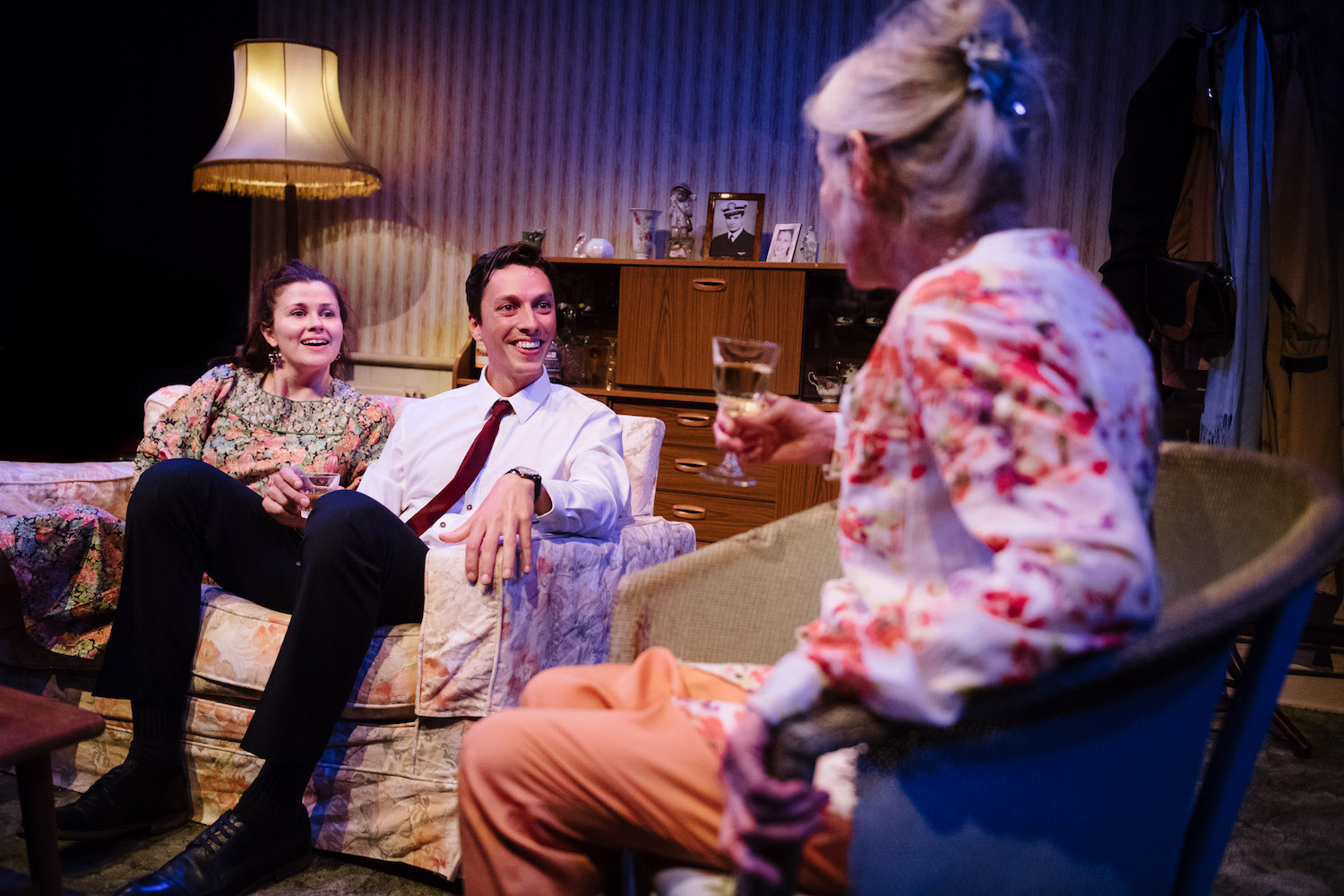
Cam, the central character in Paper Creatures’ new play Section 2, is one of those people. At school he was the golden boy, the star of the rugby team; now he’s in the army, and has been in a steady relationship with his girlfriend for five years. Nothing particular seems to have happened, although there are unproven suspicions, but despite all this somehow he’s ended up being sectioned. That was 28 days ago, and today is the day that Cam – along with his girlfriend Kay, key worker Rachel, and friend Pete – will find out if he can go home. The play takes place on the ward in real time, and as the minutes tick away on Cam’s 28th day, we get an informative and moving glimpse into the workings of a system that’s rarely discussed, on stage or indeed anywhere.

Photo credit: Tim Hall Photography

Section 2 was written by Peter Imms in response to a personal experience he had when a school friend was sectioned, and then developed collaboratively with Paper Creatures in association with Mind, the mental health charity. As such, Nathan Coenen’s portrayal of Cam’s fragile mental state feels both sensitive and authentic: one moment he seems fine, the next he’s forgotten how to breathe; his meds make him forgetful, he seems frequently on the verge of tears, and when he hugs someone, he clings on to them like he’s drowning. The frustrating fact that we don’t know what caused his breakdown only enhances this realism, reminding us that where mental health is concerned, sometimes there simply aren’t neat, easy answers.

The play also examines Kay, Rachel and Pete’s different responses to what’s happened; in fact the balance of the script is such that this is just as much their story as it is Cam’s. Imms moves the characters around very naturally between two rooms, which allows us to witness one-on-one interactions between each pair, and get to know all the characters a little better. Alexandra Da Silva adopts an air of weary resignation as Kay arrives for yet another visit, but we soon realise that behind her tough exterior she’s struggling to keep a lid on her own fear and distress in order to protect the man she loves. She clashes frequently with Esmé Patey-Ford’s Rachel, mistaking her calm professionalism for a lack of empathy, and irritated that Rachel seems more able than she is to establish a meaningful connection with Cam.

This atmosphere of simmering tension is brought to a head by the intervention of Pete, a first time visitor who hasn’t seen Cam for five years. Played by Jon Tozzi, Pete is perhaps the most relatable of the characters: way out of his depth but with an obvious desire to understand, he still maintains a fragile hope that he can somehow find the magic button that will make everything better.

Photo credit: Tim Hall Photography

Section 2 is an important and timely piece of theatre, raising awareness of the far-reaching impact of mental illness, and sectioning in particular. More than that though, it’s a play about friendship and human relationships; though it’s undoubtedly difficult to watch at times, there’s something very uplifting about seeing so many loved ones lining up to support Cam on his road to recovery, each in their own individual way. Sensitively written and performed, this powerful play is well worth a visit.

Can’t see the map on iPhone? Try turning your phone to landscape and that should sort it. I don’t know why but I’m working on it…
Review: Cockamamy at The Hope Theatre

A little over a year ago, I sat at The Hope Theatre and sobbed my way through Off The Middle’s In Other Words, a devastatingly sad story about a husband and wife coming to terms with his diagnosis of dementia. This week, I was back at The Hope to see Think and Hit’s debut production Cockamamy, another play about dementia – and surprise surprise, I ended up in floods again.

I don’t know why theatre on this topic tends to hit me so hard, but I suspect it’s because so often it’s inspired by real experiences and people, and you can tell it comes from a place of deep love and affection mingled with pain and often loss. If that’s the case then Cockamamy is a double whammy, as both writer and actor Louise Coulthard and director Rebecca Loudon know what it’s like to care for a grandparent with dementia, and have put that experience to powerful use to create a funny and deeply poignant play.

Photo credit: Alex Brenner

Let’s back up a bit, though, because Cockamamy isn’t just a play about dementia. It’s really the story of Alice and Rosie, who are far more than just grandmother and granddaughter; they’re best friends. Alice raised Rosie following the death of her mother when she was a little girl, and the strong bond between them is clear from the outset. But there are clouds on the horizon: Alice is getting increasingly confused and forgetful, and she’s convinced she’s being visited by her late husband Arthur. When Rosie meets a new boyfriend, both she and Alice are forced to make some tough decisions about their futures.

It was always going to be a tough story to watch, but what makes Cockamamy so heartbreaking is how instantly likeable the characters are. Alice is a particular delight: a feisty, quirky old lady with a mischievous sense of humour and a surprising habit of quoting Beyonce. We love her from the start, so it’s painful to watch her become more and more fragile and bewildered as the play goes on – particularly as there are moments when the old Alice reappears.

Mary Rutherford’s superb performance is matched by that of Louise Coulthard as Rosie, as she struggles with the conflict between wanting to protect her gran and wanting to get on with her own life. She’s just met the perfect man – Cavan, an Irish junior doctor played by Rowan Polonski – but although he’s patient and supportive of Alice’s situation, their relationship is put under ever greater strain as Rosie repeatedly finds herself forced to choose between them. Unsurprisingly, this building tension ultimately comes to a head in a final scene that’s ugly and brutal in both its honesty and its emotional impact.

Photo credit: Alex Brenner

If I have one quibble, it’s that the long scene changes interrupt the pace of the production and leave us looking at Alice’s empty living room for rather longer than feels necessary. But this minor irritation doesn’t detract from a play that perfectly balances entertainment with an honest, powerful portrayal of the impact dementia can have on families and relationships. Highly recommended, but prepare to be put through the emotional wringer.


Can’t see the map on iPhone? Try turning your phone to landscape and that should sort it. I don’t know why but I’m working on it… 😉
Review: The End of History at St Giles-in-the-Fields Church

St Giles-in-the-Fields Church is a beautiful and historic building in the heart of central London. In any other location it would no doubt be much admired, but amidst the shops, bars, restaurants, theatres and seemingly endless redevelopment work of Soho, it proves surprisingly easy to overlook.

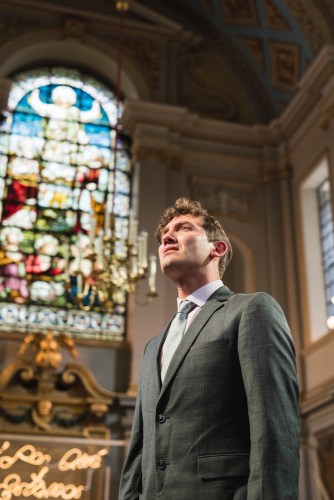
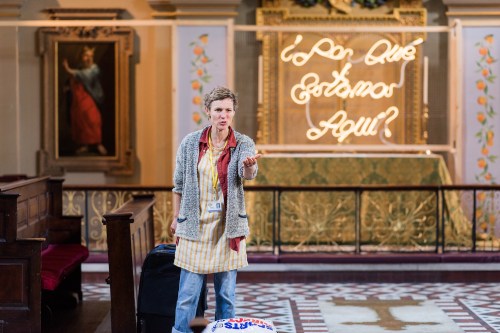
The End of History was written by Marcelo Dos Santos specifically for and about the church, and explores the building’s relationship with its local community in the face of the area’s rapid and relentless gentrification. It does so through the chance encounter of two very different Londoners, who are both drawn to the church on the same day as they face life-changing personal crises. One – Wendy, an art therapist working with the homeless, is all too aware of the church and the sanctuary it offers to those in need. The other – Paul, a real estate marketer who works hard and plays harder – has never really given it a lot of thought, except as a redevelopment opportunity.

Photo credit: Mike Massaro

On paper, there’s no competition – the characters even observe themselves that “she’s a good guy… he’s a bad guy” – but Dos Santos’ play is more subtle than it first appears. In Wendy’s eyes, Paul and people like him are responsible for all the negative changes that have taken place over the years in her beloved city, and she blames him by extension for the perilous housing situation in which she currently finds herself. In fact she’s so blinded by her rage that she misses all the signs that Paul’s going through a pretty major crisis of his own. Her lack of empathy as he gradually crumbles only serves to give ours a boost, and by the time the play ends the line between good guy and bad is considerably less clear.

The result of this is that we ultimately end up with two convincing, complex human beings, nicely played by Sarah Malin and Chris Polick, who finally look up from the chaos of their own lives and share a touching moment of human contact. After an hour’s build-up, the encounter itself is brief and not particularly dramatic or life-changing, but it doesn’t need to be; it’s just two lonely people making a connection when they need it most, and expect it least.

Photo credit: Mike Massaro

Directed by Gemma Kerr, the site-specific production takes full advantage of the unconventional setting, with the actors roaming all over the church (and occasionally climbing over audience members). This leads to a few awkward sight lines and occasional acoustic issues, particularly during Edward Lewis’ quietly charming musical numbers. But that’s a small price to pay to see the play performed in such a unique and visually stunning venue that really means something to the piece as a whole.


Can’t see the map on iPhone? Try turning your phone to landscape and that should sort it. I don’t know why but I’m working on it… 😉
Review: The Yellow Wallpaper at the Omnibus Theatre

Adapted by Ruby Lawrence from a short story written in 1892 by Charlotte Perkins Gilman, The Yellow Wallpaper is an unsettling portrayal of a woman suffering from depression after the birth of her daughter. Separated from her baby and spirited away to the country by her husband John, Alice (Gemma Yates-Round) finds herself increasingly disturbed by one room in particular, believing she can see a woman moving behind the sickly yellow wallpaper.

Photo credit: Lidia Crisafulli

Gilman, who was advised in 1887 to manage her own depression by having “but two hours’ intellectual life a day” and giving up writing altogether, wrote the story to explore the damaging effects of the treatment imposed on women by men. (She even sent a copy to her doctor, and claimed he later confided to friends that he had changed his methods after reading it.) Lawrence’s adaptation goes a step further, hinting at a more sinister purpose behind Alice’s incarceration. The well-meaning but misguided doctor husband of Gilman’s story becomes two separate characters – albeit both played by the same actor (Charles Warner) – and with the addition of housekeeper Nancy, who’s recruited by the doctor, we begin to feel a creeping sense of conspiracy.

This is reinforced by our own bond with Alice, which is established early on as she directly addresses us, confiding her hopes and fears for her future relationship with her daughter Violet, and later makes us complicit in her efforts to rebel against her treatment. We also see everything she sees; the yellow walls of the deceptively simple set designed by Mayou Trikerioti really do change significantly in appearance under Clancy Flynn’s lighting, and stretch in undeniably sinister fashion to allow glimpses of a figure pressing through from the other side. The fact that we share this vision suggests it isn’t only Alice’s paranoia, and perhaps there really are other forces at work.

Gemma Yates-Round gives an excellent performance as Alice; over the course of 70 minutes, we can see her gradually unravelling before our eyes from the poised, intelligent young woman who first meets the doctor to discuss her five-month pregnancy to the dishevelled figure obsessively clawing at the yellow walls. Meanwhile Charles Warner plays every other character – or rather he plays “Not-Alice”, leaving the true identity and even existence of Alice’s husband, doctor and housekeeper open to interpretation. This ambiguity calls for a subtlety in the performance which Warner successfully captures, simultaneously keeping the characters individual enough that we can differentiate between them, but similar enough that they could feasibly all merge into one.

Photo credit: Lidia Crisafulli

Despite the strong performances, however, and an atmosphere of growing suspense effectively created by director Dave Spencer, the layers of ambiguity added to Gilman’s story for this adaptation mean the play at times feels overcomplicated, and leaves us with a frustrating multitude of possible interpretations of what’s really going on. Things are further confused by the addition of a fairy tale composed by Alice for her daughter, an act of rebellion in defiance of the others’ attempts to keep her from writing. This takes the plot away from the original text, and then ends abruptly as the play reaches its climax, with Alice so intent on passing on her story that the woman behind the wallpaper is left feeling like an afterthought. While all this certainly makes for a meaty post-show debate, for those who like their stories to have a beginning, middle and end the play may prove frustratingly open-ended.


Can’t see the map on iPhone? Try turning your phone to landscape and that should sort it. I don’t know why but I’m working on it… 😉

Review: The 25th Annual Putnam County Spelling Bee at the Drayton Arms Theatre

Fun fact: yesterday was the final of the US National Spelling Bee in Maryland. The 14-year-old winner, Karthik Nemmani, triumphed by correctly spelling “koinonia” – which means Christian fellowship or communion – after his opponent, aged 12, stumbled on her own word, “Bewusstseinslage” (a state of consciousness or a feeling devoid of sensory components). Afterwards, reports the Guardian, the generous champion took no pleasure in beating his rival, saying, “We weren’t against each other. We were against the dictionary.”

There’s little sign of such magnanimity at the start of MKEC Productions’ The 25th Annual Putnam County Spelling Bee. We arrive to find the contestants and organisers milling about the theatre, chatting to the audience and bickering amongst themselves, before the show begins and battle commences. Somehow I’d never seen William Finn and Rachel Sheinkin’s Tony award-winning musical before – which is ironic considering I seem to be the only person in the world who thinks a show about spelling actually does sound like fun – but I’m now officially a convert. What starts as a hilariously silly comedy about six misfits who love to spell unexpectedly turns into an emotional rollercoaster, as we get to know the contestants and understand the backstories that have brought them to the bee. Unlike most rollercoasters, however, this is one I’d happily get back on and do it all over again. And then again after that.

Photo credit: Alex Harvey-Brown at Savannah Photographic

This is partly because bits of the show have an improvised feel – specifically those involving members of the audience (nothing too scary and all voluntary, although I’m still glad it wasn’t me up there) and a few pointed one-liners referencing current events – and it would be fascinating to see what goes differently on a second viewing. But it’s mostly because the story, characters and music are all genuinely delightful, despite also being “the slightest bit bizarre” in their own special ways.

There’s last year’s winner Chip Tolentino (Aaron Jenson), who’s doing fine until he spots a pretty girl in the front row and all the blood rushes from his brain to – well, somewhere else. Logainne Schwartzandgrubenniere (Lottie Johnson) is desperate to make her two dads proud, while Marcy Park (Jeannie May) knows that whatever she achieves it’ll never be enough for her parents. William Barfee – excuse me, Barfée (TJ Lloyd) – has a magic foot that helps him spell (yes, really), and Leaf Coneybear (Danny Whelan) is beginning to realise that he might actually be quite smart after all, despite what his family keep telling him. And finally there’s Olive Ostrovsky (Thea Jo Wolfe), who before the show even started, slipped a piece of paper on to the empty seat beside me and whispered, “It’s for my dad.” The obvious and tragic fact that the seat was guaranteed to remain empty made Olive my immediate and enduring favourite.

Trying to keep some kind of order amidst all this pandemonium are former champion Rona Lisa Peretti (Elizabeth Chadwick), vice principal Douglas Panch (Michael Watson-Gray), and bizarrely, Mitch Mahoney (Inti Conde), who’s doing his community service consoling defeated spellers. As you do.

Photo credit: Alex Harvey-Brown at Savannah Photographic

Because there can be only one winner at the spelling bee. As we get to know more about the contestants and what drives them, it becomes obvious this is much more than just a game to our six young spellers, and the final round is surprisingly tense as we wait to see who’ll crack first under the pressure. But although each elimination is a sad moment, the show ends on an upbeat note with the realisation that winning isn’t necessarily everything. Sure it’s a cliché, but when you’re having this much fun, who cares?

A seemingly casual joke about the show’s brief rehearsal time highlights what a polished production this is in spite of that. A brilliant cast excel both individually and as an ensemble, hitting all the right comic notes but also giving emotional depth to characters who at first glance appear to be no more than stereotypes. Director and choreographer Adam Haigh makes full and effective use of the intimate space, setting the tone of the production with the pre-show activities to ensure the audience – who are cast early on as proud parents watching the bee – always feel involved and connected to what’s going on.

The 25th Annual Putnam County Spelling Bee is brilliantly bonkers, and proves what I knew all along – that spelling really is fun. But the show also champions those who dare to be different, and reminds us that sometimes it really is the taking part that counts. This little gem of a production is a feel-good treat and guaranteed to put a smile on your face; don’t miss it.


Can’t see the map on iPhone? Try turning your phone to landscape and that should sort it. I don’t know why but I’m working on it… 😉