Review: Into The Woods at the Cockpit Theatre

Once upon a time… Stephen Sondheim and James Lapine got together to write a musical based on classic fairy tales, including Cinderella, Rapunzel, Jack and the Beanstalk and Little Red Riding Hood. But there’s a twist to this tale: the happy ending comes halfway through, and on reflection in Act 2 turns out to be not quite so happy after all – mostly because none of the characters is satisfied even after they get their wish. A lot of the show’s appeal lies in that simple fact: after listening to their stories all our lives, it’s oddly comforting to discover our favourite fairy tale characters are just as flawed as the rest of us.

In this revival of his 2014 adaptation, Tim McArthur takes that idea one step further, bringing the characters out of their fairy tales altogether and into a world inspired by 21st century reality TV. TOWIE, Jeremy Kyle and Made in Chelsea are all recognisable influences – although interestingly, the Baker and his Wife seem to hail more from Greggs than from Bake Off.

Photo credit: David Ovenden

It’s a clever concept, and works reasonably well in terms of entertainment value as the various characters are introduced, although it doesn’t really go anywhere after that. The story – and some of the characters – remain very much rooted in a world of myth and magic, where it jars slightly that even these very modern characters can’t just whip out their phones and Google how to get what they want.

For lovers of fairy tales, the musical itself is an enchanting blend of familiar and original. The story centres around a childless Baker (Tim McArthur) and his Wife (Jo Wickham), who have to collect four obscure items to break the curse put on them by the Witch (Michele Moran) so they can have a baby. Into the woods they go, where they stumble into the paths of Jack (Jamie O’Donnell), Cinderella (Abigail Carter-Simpson), Rapunzel (Louise Olley) and Red Riding Hood (Florence Odumosu) – who just happen to have all the things they need. All seems well, until in a considerably darker Act 2, a giant starts terrorising their village and the characters are forced back into the woods to fight for survival.

This production is staged in the round, which both works and at the same time, really doesn’t. On the plus side, it does mean that the audience feels surrounded by the action; you never quite know where an actor is going to pop out of next. On the other, even from my relatively high vantage point, I couldn’t see or hear much of what was happening on the other side of Joana Dias’ impressive but complicated set of many ladders, and consequently felt like I was missing out on half the action. This wasn’t helped by the score, which frequently has actors speaking or singing over each other, and to make matters worse, there were also a few technical problems with the sound system at this particular performance.

Photo credit: David Ovenden

In spite of these issues, the cast are generally very good, with standout vocal performances from Michele Moran and Abigail Carter-Simpson as the Witch and Cinderella respectively. Meanwhile Ashley Daniels and Michael Duke bring the house down with their hilariously posh rendition of Agony (yah), and Jamie O’Donnell and Madeleine MacMahon are good fun as Glaswegian Jack and his chain-smoking, beer-swigging Mother – although their accents are at times so thick, particularly in the musical numbers, that it can become tricky to make out what they’re saying.

Though not without some problems, Into The Woods is nonetheless an ambitious and entertaining show, which puts an interesting new spin on a classic whilst retaining the wit and charm of the original. Worth a visit for fairy tale family fun.
Review: The Night Alive at the Brockley Jack Studio Theatre

Despite its ominous title, and playwright Conor McPherson’s reputation for producing work populated by ghosts and devils, his 2013 play The Night Alive seems – at least at first – to be firmly rooted in reality. 50-something Tommy (David Cox) rescues Aimee (Bethan Boxall) from a violent attack by her ex-boyfriend, and brings her home to the room he rents from his widowed Uncle Maurice (Dan Armour). With nowhere else to go, Aimee agrees to stay for a few days, but while her presence proves a comfort to the lonely Tommy, it also brings trouble – not least for Doc (Eoin Lynch), Tommy’s friend and business partner (of sorts) – when her ex Kenneth (Howie Ripley) tracks her down.

Photo credit: Robert Piwko

I say it seems rooted in reality because there are definitely a couple of moments that are open to interpretation in First Knight Theatre’s new production, bringing both Acts 1 and 2 to an ambiguous close and leaving it to the audience to decide for ourselves what exactly we’ve just seen. In fact, both script and direction are clever enough that it’s possible to go back over the whole play afterwards, remembering little details and wondering if they meant more than they appeared to on first sight.

One element that is very real, however, is the isolation and desperate need for human connection displayed by the characters, each of whom is damaged in their own way. Tommy’s estranged from his family and getting by doing odd jobs with Doc, who has a mild learning disability and keeps getting kicked out by his sister and her boyfriend. The unconventional but clearly genuine friendship between the two men lies at the very heart of the play, and is movingly portrayed by David Cox and Eoin Lynch, with a generous and welcome sprinkling of humour to lighten the mood.

Bethan Boxall’s Aimee adapts quickly to her new surroundings, and offers a different kind of companionship, allowing Tommy a brief escape from the monotony of his unsatisfying daily life – and it seems he’s willing to pay almost any price to keep hold of that opportunity. Finally, there’s Uncle Maurice, played by director Dan Armour, whose gruff exterior and authoritarian manner can’t quite hide the fact that he’s still mourning and blaming himself for the death of his wife, or that he desperately wants Tommy to stop wasting his life and appreciate what he’s got while he still can.

Into all this quiet drama steps Howie Ripley’s Kenneth, in the first of two brief but memorable appearances, and instantly the play takes on a different energy as he prowls restlessly around Tommy’s room, taking in every detail and rambling about the darkness outside. We know something bad’s going to happen, but when it does it’s still unexpected enough to leave the audience sitting in shocked – and, if I’m honest, slightly perplexed – silence as we head into the interval. Both this moment of drama and the one that follows in Act 2 are well acted and directed, but don’t seem to fit within the rest of the play, particularly as neither event is really discussed again by the characters once the immediate aftermath is over. This is so odd, in fact, that it feels like it must be deliberate – so perhaps this is one of those details that will take on new meaning after a few days’ reflection.

Photo credit: Robert Piwko

Putting it all together, The Night Alive is a poignant, humorous and intriguing portrayal of five unhappy people whose lives are changed in one fateful moment. Whether that change ends up being for better or worse is left as something of an open question, along with much else that happens during the play. If you’re in the mood for a high quality production that doesn’t give you all the answers, The Night Alive is well worth a visit.


Can’t see the map on iPhone? Try turning your phone to landscape and that should sort it. I don’t know why but I’m working on it… 😉

Review: Adam and Eve at The Hope Theatre

Traditionally, we’ve been led by books, movies and the like to believe that “happily ever after” starts when you get married and settle down. This is particularly interesting when you consider that one of the oldest stories ever told is all about a couple who proved that theory wrong in spectacular fashion.

In Tim Cook’s reimagined Genesis story, newlyweds Adam (Lee Knight) and Eve (Jeannie Dickinson) are moving to the country and buying their first house. It’s not quite Paradise, but they need to get on the ladder and it’s all they can afford, especially now they’ve got a baby on the way. Their “masterplan” is all going swimmingly – until English teacher Adam is suspended from work after being accused of improper behaviour by Nikki (Melissa Parker), one of his students. At first, Eve is more than willing to stand by her man, convinced the accusations are a fabrication and will soon blow over. When they don’t, the first doubts creep in and she begins to wonder just how well she really knows her husband.

She’s not the only one. Over the course of 65 minutes, the story takes multiple twists and turns, and the balance of power shifts back and forth several times, keeping the audience in a permanent state of uncertainty with no idea who we can trust to tell the truth. It’s difficult to talk too much about the performances from Jeannie Dickinson, Melissa Parker and Lee Knight without risking spoilers but I can say that all three are excellent, taking on board the subtleties in the script and giving us just enough to keep us guessing throughout.

All the characters have significant flaws, and both Adam and Nikki give us plenty of reasons to simultaneously doubt and believe their version of events; even when the truth is revealed, there’s still a lingering suspicion that the other party may not be entirely guilt-free. The play’s conclusion is cleverly seeded by Cook – looking back to the start of the play, we can see the clues we missed earlier – but left me wanting more: to understand more fully the guilty party’s motivation, which is clearly complex but only briefly explained, and to witness the fallout from the big reveal.

That should be taken as a compliment, however, because what’s already there is an hour of tense, gripping drama during which it feels like anything could happen. With just a couple of chairs making up the set, director Jennifer Davis makes effective use of the empty space, maintaining a physical distance between the characters so that every scene – even early on – has the potential to escalate quickly into a conflict. Add to this the way the characters continue to eyeball each other suspiciously during scene changes, and the result is an atmosphere of simmering tension that keeps us on our guard from start to finish.

In Adam and Eve, Tim Cook takes the themes of temptation, trust and accusation and proves that while we may now be living in a very different world – a world dominated by money worries, fake news and the relentless pressure to be perfect in the eyes of others – in reality, humanity has changed very little since the original Adam and Eve got kicked out of the Garden of Eden. If there’s a small consolation to this depressing fact, it’s probably that at least we have an excuse; if they couldn’t make it work in Paradise, what chance is there for the rest of us?

Review: In the Shadow of the Mountain at the Old Red Lion Theatre

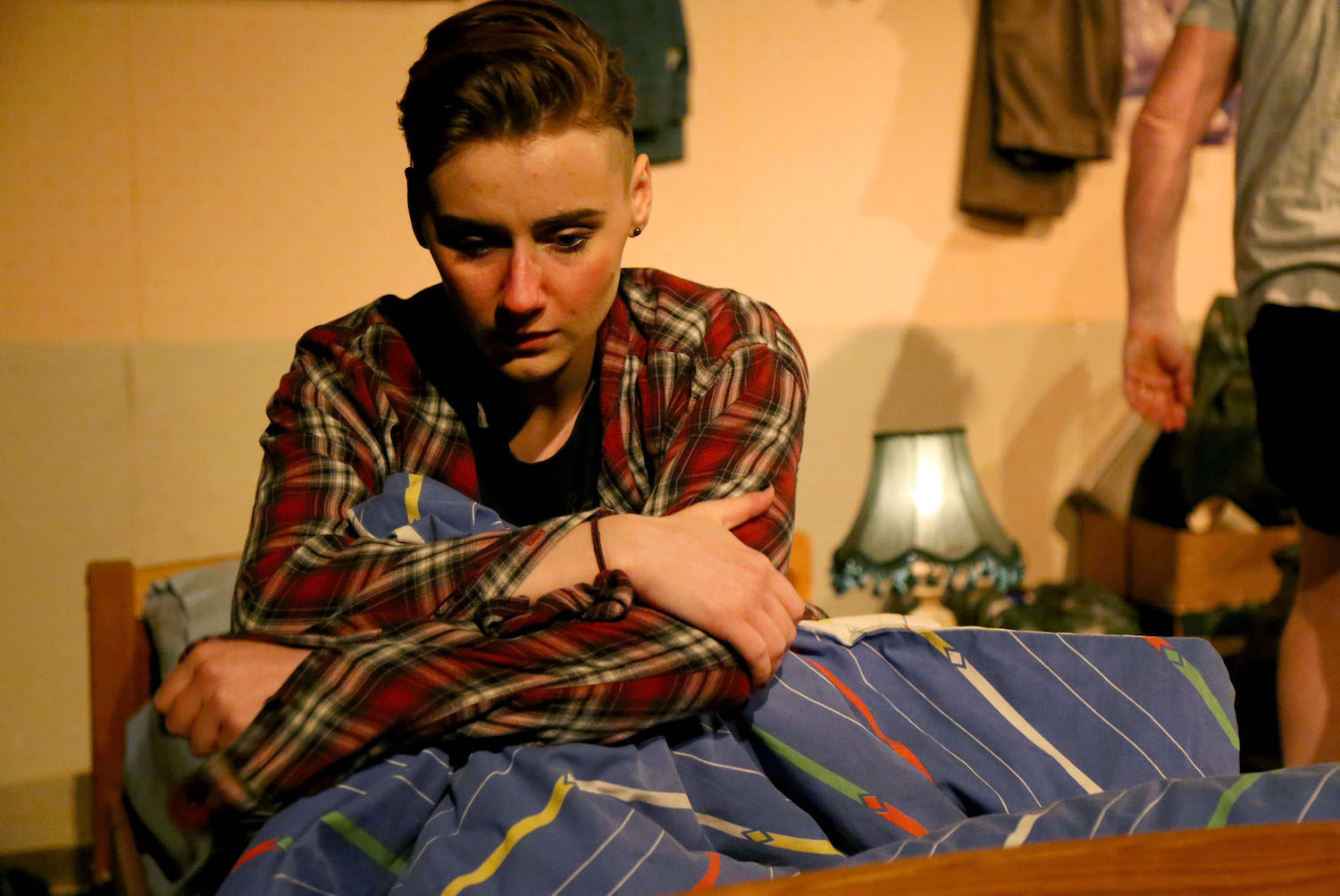
There is no one size fits all when it comes to mental illness, and in Felicity Huxley-Miners’ In the Shadow of the Mountain we see two very different manifestations in the story of one extremely dysfunctional relationship. First, we meet Rob, who’s just found out his girlfriend slept with his best mate and is so devastated he’s thinking about throwing himself under a train – until Ellie explodes into his life and makes it her mission to save him. One thing leads to another, and Rob ends up back at her place… but Ellie has problems of her own, and as her behaviour becomes more and more erratic Rob starts to wonder what he’s got himself into.

Photo credit: Harry Richards

On an otherwise fairly minimal set from Emily Megson, low-hanging “clouds” made out of crumpled paper covered in scrawled handwriting are an early clue that all is not well – and it rapidly becomes clear that Rob and Ellie’s relationship isn’t a healthy one, although it’s not initially obvious exactly why. The play is clever in the way it tackles our assumptions, and it’s only as it comes to an end that we begin to appreciate why Ellie behaves the way she does, and that her mood swings and manipulative behaviour aren’t something she can control. The seemingly unrealistic intensity of the relationship – eight days in the two are already talking love and marriage – also makes more sense with the benefit of hindsight, although it’s still never quite explained why Rob stays as long as he does, when he’s clearly uncomfortable with the speed at which things are moving and his increasing isolation from friends and family.

It’s interesting to note that although the play does make it clear Ellie isn’t well, the only way we know the exact cause – Borderline Personality Disorder – is through the notes in the programme; her diagnosis is never given in the play itself. This is obviously a deliberate decision, since Rob asks outright and Ellie declines to answer, and in some ways it feels right to avoid sticking a label on her. That said, the play’s final scene feels underdeveloped, and perhaps misses an opportunity to raise awareness of a condition that can so easily be misinterpreted.

Photo credit: Harry Richards

There’s also an issue with balance in the story, which becomes increasingly focused on Ellie, leaving Rob and his problems rather out in the cold. Both Felicity Huxley-Miners and David Shears give good performances, and it’s refreshing to see a play about a toxic relationship where the male character doesn’t have the upper hand. But with Ellie stealing pretty much every scene as everyone waits to see what she’ll do next, we get to know little about Rob as a character – which is perhaps why it’s so difficult to put a finger on why he sticks around as long as he does.

In the Shadow of the Mountain takes important steps towards raising awareness of the broad spectrum of mental illness, and Borderline Personality Disorder in particular, and Richard Elson’s production does a good job of capturing, at different moments, the emotional turmoil experienced by both Rob and Ellie. There are areas of the play that could benefit from some more development, but the potential is clearly already there for a powerful and challenging piece of theatre.

Can’t see the map on iPhone? Try turning your phone to landscape and that should sort it. I don’t know why but I’m working on it… 😉

Review: Before 30 at Theatre N16

Yesterday, someone I know helpfully pointed out that in a few weeks I’ll be closer to 40 than 30. And just like that, I went from looking forward to my 36th birthday to panicking about how quickly the years are flying past, when there are so many things I haven’t done yet. It’s not the first time this has bothered me, and it undoubtedly won’t be the last – which is why it’s reassuring to go and see a show like Before 30, and realise that I’m not the only one who’s freaking out.

Written and performed by Tom Hartwell and directed by Phil Croft, Before 30 is a one-man show about a Londoner called Chris. Chris has just turned 29. He’s single, living in a tent in someone’s garage, and the closest he’s got to his dream of being a chef is working for Deliveroo, which would be so much easier (and cheaper) if people didn’t keep nicking his Boris bike. Meanwhile it seems like everyone around him is getting married, getting jobs, having babies and buying houses, and his proudest achievement is – well, he’s not quite sure, to be honest.

Photo credit: Headshot Toby

As Chris veers wildly (and in some cases literally) from one hilarious mishap to another on the road to his 30th birthday, his panic begins to give way to a much more profound feeling of despair. And it’s here that the play really hits home as it examines the damaging expectations imposed on us by society, family, friends – but most of all by ourselves. At the same time, it also makes the very valid point that success is a relative term; someone who appears to have it all according to my world view might be struggling to live up to their own very different ideal, and it’s not for me to judge how happy and fulfilled that person should be.

As in previous plays Flood, Contactless and You Tweet My Face Space, Tom Hartwell demonstrates his exceptional ability to take the 21st century millennial experience and portray it on stage in a way that’s both relatable and very funny. (There’s even a Friends reference; this is a writer who really knows his audience.) As a performer, too, he wastes no time building a rapport with his audience; he has us on side pretty much from the moment he climbs out of his tent wearing a pink Hello Kitty bicycle helmet and tries to sing Happy Birthday to himself. From here, the laughs come thick and fast as we get to know Chris and the array of colourful characters that make up his story – and consequently when events take a more serious turn, we’re sufficiently invested in both story and character to really listen to what he has to say.

Anyone who’s ever had one of those “why God why?!” moments – which I’m willing to bet is most, if not all of us at some point – will find something that speaks to them in Before 30, even if it’s just the comforting knowledge that it’s totally okay to not always feel completely in control of where your life is going. With that knowledge, too, comes the understanding – appropriately timed for Mental Health Awareness Week – that those around us might be dealing with their own issues, even if their Instagram suggests they’ve got it all worked out. 

Yet again, Tom Hartwell has produced a play that delivers on several levels – it’s thoroughly entertaining, frighteningly relatable, and has already inspired a lengthy workplace discussion about the horrors of getting older. Let’s hope the show gets a longer run in the future; it certainly deserves it.

This run of Before 30 is now over 😦 but keep an eye on tomhartwellactor.com or follow @TomHartwell88 for details of future work.