Review: Devil With The Blue Dress at The Bunker Theatre

In Kevin Armento’s Devil With The Blue Dress, Hillary Clinton refers to her husband’s affair with Monica Lewinsky as the second worst thing ever to happen to her. It’s a great line, which unsurprisingly earns a big laugh, but it’s also a very telling comment. Hillary Rodham Clinton – lawyer, author, politician, mother, grandmother, the first woman to be nominated for president by a major political party in U.S. history – is still known above all by people across the world, and within her own nation, for two main events: that time her husband cheated on her with a 22-year-old intern, and that time she was beaten in the presidential election by a man with zero political experience, qualifications or intelligence.
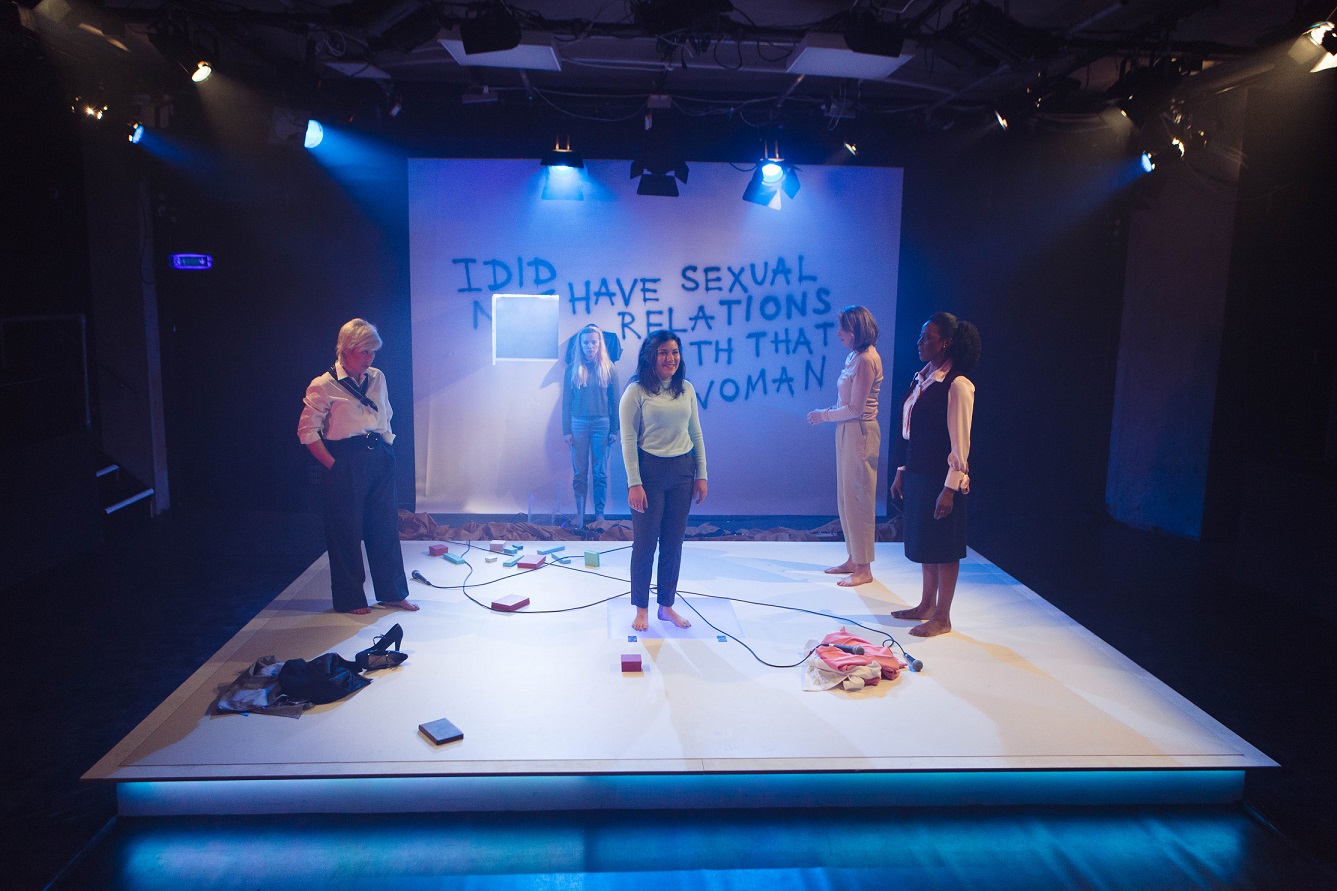
Photo credit: Helen Murray

Devil With The Blue Dress examines the circumstances of the former, while reflecting on the impact it may or may not have had on the latter. Most of us above a certain age will remember, however vaguely, what’s become known as “the Monica Lewinsky scandal”; Armento’s script fills in the political and personal details, from the perspective of both Hillary (Flora Montgomery) and Monica (Daniella Isaacs), as well as the Clintons’ daughter Chelsea (Kristy Philipps), Bill’s devoted secretary Betty (Dawn Hope) and Monica’s friend and confidante, Linda (Emma Handy).

Joshua McTaggart’s production begins in an orderly fashion, with Flora Montgomery’s meticulously controlled Hillary presenting each of the characters in “her play” as they emerge from behind a curtain at the back of the stage. Then Monica, played by Daniella Isaacs, crashes the party, at which point the narrative takes a very different direction. She wants to tell her side of the story, and does so with colour and emotion; in fact she’s the total opposite of Hillary, and if we met her out of context, we’d probably quite like her. It’s a sympathetic view of a woman who’s rarely seen in such a positive light: young and in love, she’s manipulated by those around her and pays for it by becoming the face and name of a global scandal.

By Act 2, the curtain’s down, the truth is out and the gloves – or rather heels – are well and truly off, as little by little the five women turn on each other. And if there’s one key player noticeably missing from the all-female line-up, Bill Clinton still makes his voice heard, both through the sterling work of saxophonist Tashomi Balfour and through the women themselves, with the “supporting cast” of Chelsea, Linda and Betty each taking turns to speak his words. Meanwhile Hillary and Monica face off in a battle over who’s been most wronged by the other, neither apparently giving a moment’s thought to the idea that the President might bear some responsibility for their misery. And it’s that very point that makes this play about a 20-year-old scandal so relevant right now in 2018, with the #metoo movement continuing to gain momentum, even as Donald Trump – a man who literally believes he can do anything he wants to women because he’s famous – sits smugly in the White House.

Photo credit: Helen Murray

Though a little knowledge of U.S. political history might help, particularly at the start of the play, Armento’s writing is clear enough that anyone with the sketchiest knowledge of what happened in 1998 – and 2016 – can easily keep up with the chain of events. The conflict between the women makes for compelling viewing, but what really sets the stage for an interesting debate is the underlying question of why that conflict is even happening, and what damage it’s inflicting on both the individuals involved and the perceptions of those watching. I’ve never questioned why it’s known as the Monica Lewinsky scandal and not the Bill Clinton scandal – but I am now, and I don’t think I’m the only one.

Can’t see the map on iPhone? Try turning your phone to landscape and that should sort it. I don’t know why but I’m working on it… 😉

Review: Julius Caesar at the Bridge Theatre

I intended to start writing my review of The Bridge Theatre’s thrilling, immersive production of Julius Caesar on the train home last night. Instead, I ended up texting pretty much everyone I know to tell them they should go and see it immediately. Having slept on that opinion, I stand by it 100%.

Photo credit: Manuel Harlan

Nicholas Hytner’s production brings ancient Rome screaming into the 21st century with a politically relevant and heart-poundingly gripping take on Shakespeare’s play. While the adaptation steers clear of overt references to any specific regime, there are shades of a certain red baseball cap wearing president in David Calder’s portrayal of Caesar (with one particular gesture that simultaneously clarifies who he’s modelled on and seals our dislike towards him, just moments before his assassination). Perhaps in light of this it’s not surprising that two of the main conspirators against him are strong female figures – Michelle Fairley as Cassius and Adjoa Andoh as Casca – who convince Ben Whishaw’s nervous, endearingly geeky Brutus to join them, only for him to take over the entire plan, overrule all their ideas and mess everything up.

Julius Caesar is a story that works particularly well in an immersive format, because so much of the play focuses on the power of political rhetoric to sway the masses. Standing in the midst of the crowd, clutching a Caesar poster someone had just thrust into my hand while Brutus flyers rained down all around, it was easy to get caught up in the tidal wave of popular opinion as first Brutus and then Mark Antony – played with conviction and down to earth charisma by David Morrissey – took to the stage at Caesar’s funeral.

That said, it only works if the immersive aspects of the show are convincing, and on that front this production delivers to such an extent I actually felt a bit traumatised by the end. From the celebratory gig that’s already underway as we arrive, to the screams of discreetly positioned cast members at Caesar’s assassination, to the debris that falls from above as the theatre’s rocked by explosions and gunfire – the attention to detail is mind-blowing. True, it’s not the most comfortable two hours you’ll ever spend; prepare to be herded fairly roughly from one position to another, to be stepped on by fellow audience members, and possibly even to have an actor scream “Move!” in your face. But I’d still recommend getting a standing ticket if you can physically manage it (the play is two hours with no interval) if an authentic experience is what you’re after.

Photo credit: Manuel Harlan

On the other hand, if you want a good view of Bunny Christie’s incredible set (and prefer to keep your toes untrampled), a seated ticket is probably the way to go; inevitably anyone watching from the ground won’t be able to see everything, whereas from above you’ll be better able to appreciate the versatility of both the space and the set. Consisting of multiple platforms that rise and fall to create a new stage area for each new scene, it’s like spending the evening in several different theatres all at once.

In a city that was already full of theatres, The Bridge – which only opened in October – has already more than proved its worth. This gripping production will thrill those who already know and love Shakespeare, but more importantly, it may just change the minds of those who don’t.

Can’t see the map on iPhone? Try turning your phone to landscape and that should sort it. I don’t know why but I’m working on it… 😉

Review: Fear and Misery of the Third Reich at Jack Studio Theatre

Bertolt Brecht’s Fear and Misery of the Third Reich does pretty much what it says on the tin, but in Aequitas’ new revival, there’s a twist. Selecting from Brecht’s collection of short scenes set in Nazi Germany, the production sticks to the source material, but also takes the opportunity to draw parallels with the depressing post-2016 world in which Trump and Brexit continue to loom ever larger.

The link is obvious to anyone who’s willing to see it – both Trump and Brexit were the result of a democratic process, as was Hitler, and there are clear similarities to be found in the powerful rhetoric of fear used in all three cases. Though the characters remain Germans living under the Nazi regime, the actors are all in modern dress, and sporting accessories including a MAGA cap and a save our NHS badge (“I should put on my Iron Cross,” says one of the men at one point, as he hastily dons his “Brexit means Brexit” badge). To make sure we get the point, we’re also treated to scene change soundbites from and about Trump and co.

Director Rachael Bellis doesn’t try to claim we’ve reached the levels of (justified) paranoia experienced by Brecht’s characters, but she does suspect it’s where we’re headed if action isn’t taken: a world where parents fear being turned in by their children, where a throwaway comment can cost lives, and where a Jewish wife is forced to leave her husband and flee the country in order to save them both. It’s easy to shake our heads and claim such things could never happen here – but then two years ago, how many of us honestly thought Trump would be in the White House, or that anyone in the UK who speaks out against Brexit would be dubbed a traitor in the press?

The cast of six interact well with each other (and, on occasion, the audience) as a variety of characters of different ages and backgrounds. In the first of two scenes that feel closest to our current reality, Clark Alexander and Hugo Trebels face off in an intense debate between an SA thug and his cook’s brother; while the latter clearly has the upper hand in terms of logic and reason, it’s worth nothing when all his adversary need do is draw a chalk cross on his back to ensure he’ll be arrested. In the other, Rhiannon Sommers stands out with a heartbreaking performance as a Jewish woman trying to explain to her husband why she must leave the country, and by extension their marriage.

It’s not all doom and gloom; the play ends abruptly with a shout of “NO!” from a group of protesters getting organised to fight back. Even so, the play’s title is an apt description; we may not be in the Third Reich, but the fear and misery are all too real.

Can’t see the map on iPhone? Try turning your phone to landscape and that should sort it. I don’t know why but I’m working on it… 😉

Review: A Nazi Comparison at Waterloo East Theatre

Based on Schlageter by Hanns Johst – Hitler’s favourite playwright – Craft Theatre’s A Nazi Comparison makes some solid points and clearly has good intentions. I really wanted to like it, but an unnecessary excess of drama makes it difficult to see past the tears and shouting to get to the message behind.

Clare is a PR student at UCL preparing for a big presentation, but after one of her lecturers lends her a copy of Schlageter and she falls for a guy at a Grenfell protest, she starts looking into the unnerving similarities between Nazi propaganda and the rhetoric of today’s press. It doesn’t take long for her to realise that if you replaced “Jews” with “Muslims” in the speeches, it sounds very much like something Donald Trump would say. In the end, unable to stomach the idea of joining a PR machine that knowingly misleads the public, she withdraws from her degree course in sensational fashion.

So far, so good. After we’re treated to a short video presentation about the unfair representation of Jeremy Corbyn by the British media, Louise Goodfield delivers Clare’s fateful presentation with genuine passion – and even if it does start to feel a bit like we’ve wandered into a political rally rather than a play, you can’t help but admire her for having the courage of her convictions and standing up for what she believes is right. Unfortunately, her mum (Helen Foster) doesn’t even attempt to feel the same way, and it’s not long before the two are embroiled in a screaming row – not their first or last of the evening – about all the ways she’s endangered her future. Nor is her mum the only one who can’t understand her decision, and soon Clare finds herself living in a squat with Craig (Craig Edgely), the guy from the Grenfell protest. This goes well for a while – the exact timeframe of the play is unclear – until Craig decides group leader Lucas (Lucas John Mahoney) and his strategy of peaceful protest aren’t working for him any more. Cue more shouting and a dramatic off-stage twist, followed by an even more dramatic on-stage finale.

All this drama starts to get in the way more and more as the play enters its second hour. Nobody seems capable of having a rational discussion; every conversation quickly turns into an argument, with people shouting over each other, sobbing, wailing and generally being far more melodramatic than seems necessary. By the end, it’s all unfortunately a bit of a mess, and not at all clear any more what point is being made, who we’re supposed to be supporting or why.

All that said, there are some very touching scenes between Clare and her dad (Thomas Thoroe), who unlike his ex-wife at least tries to understand where his daughter’s coming from. The physical ensemble work is very slick, particularly in the montage sequence (a bizarrely timed comic interlude) and after each scene, when the cast somersault across the stage like ninjas to get in position for the next. And there’s no faulting the conviction of the company; I would just have liked a bit less raw emotion and a bit more rational debate to help me understand what, beyond the obvious Nazi comparison, I was meant to be taking away.


Can’t see the map on iPhone? Try turning your phone to landscape and that should sort it. I don’t know why but I’m working on it… 😉

Review: The State of Things at Jack Studio Theatre

My theatregoing habit began, more years ago than I like to admit, with a love of musicals – and even now if you put a gun to my head and made me choose a favourite type of theatre, they’d probably still come out on top. So it’s no great surprise that the words “a new musical” always give me a little bit of a thrill – especially when said new musical is coming from The AC Group, whose previous productions have earned widespread acclaim.

So, did The State of Things live up to expectations? Absolutely. It’s got everything – catchy songs, talented actor-musicians, and a story that’s easily relatable for anyone who’s ever felt frustrated by politics (or indeed ever been a teenager).

Photo credit: Headshot Toby

Written by Thomas Attwood and Elliot Clay, The State of Things is about seven friends who discover the A Level Music class they were all planning to take next year is being axed because of lack of funds. Unable to convince their headteacher (“Maggie”) to reinstate the course, they decide to take matters into their own hands and raise the issue with their local MP. But unfortunately they’re teenagers, so not only is their political experience and knowledge a bit sketchy, but other things keep getting in the way, like exam revision, raging hormones and, in one case, a serious family situation.

Ultimately, though, it all circles back to politics, and that’s the core of the story: the frustration of young people who have the necessary understanding but zero power to influence decisions about the future they’ll have to live with. While some of the friends know little about politics (“I looked it up, the Tories are the ones in power”), others are surprisingly knowledgable and passionate about issues affecting not just their school but the local area as a whole. If anything at times they’re a bit too eloquent to be believable – but the show has a point to make, and in the absence of any grownups on stage, it has to fall to the teenagers, however unlikely this might feel.

As if to balance this out, the exceptional cast of actor-musicians bring their teenage characters to well-rounded life, with all the confusion and embarrassment that’s a painful but inevitable part of growing up. There’s a lot of humour, particularly in their various romantic fumblings – Jaz (Rosa Lukacs) gets jealous when boyfriend Beefy (Toby Lee) talks to his French teacher; Adam (Elliot Clay) can barely bring himself to say a word to his crush Ruth (Hana Stewart), and then when he does he says all the wrong things. Class clown Will (James William-Pattison) is secretly totally confused about whether he’s gay or not, while laid back Aussie Sam (Peter Cerlienco) barely notices gender at all. And then there’s Kat (Nell Hardy), the only member of the group who remains single-mindedly focused on their cause – largely because she has nowhere else to go to pursue her passion.

Photo credit: Headshot Toby

The score features a nice mix of upbeat toe-tappers and stirring ballads, all apparently written by the young musicians. Perhaps because of this, they all fit very naturally within the flow of the production (directed by writer Thomas Attwood), and fulfil the dual purpose of driving the story forward and showcasing the talent that could be squandered as a result of cancelling the music course.

If you love a good musical and want to be entertained for an evening, I recommend The State of Things. If you’re interested in the uncertain future of arts education, I recommend The State of Things. If you’re a young person frustrated by the decisions made for you by older generations… well, you get the idea. Basically, this is a thoroughly enjoyable new musical from a talented team – but with an important point to make as well. What’s not to love?


Can’t see the map on iPhone? Try turning your phone to landscape and that should sort it. I don’t know why but I’m working on it… 😉