Review: Window at the Bread and Roses Theatre

In a world of reality TV and social media, it’s all too easy to fall into the habit of obsessively observing other people’s lives, and then comparing them to our own. In Ron Elisha’s Window, this voyeurism reaches new heights when married couple Grace and Jimmy spot their neighbours having sex, seemingly at all hours of the day and night.

It all begins as a bit of slightly naughty fun, even helping to rekindle the dormant sex life of the exhausted new parents. But when Grace falls pregnant with their second child, her interest in the young, beautiful couple across the way – in her mind, an earlier version of herself and Jimmy – starts to develop into an unhealthy obsession that affects her work, health and family life.
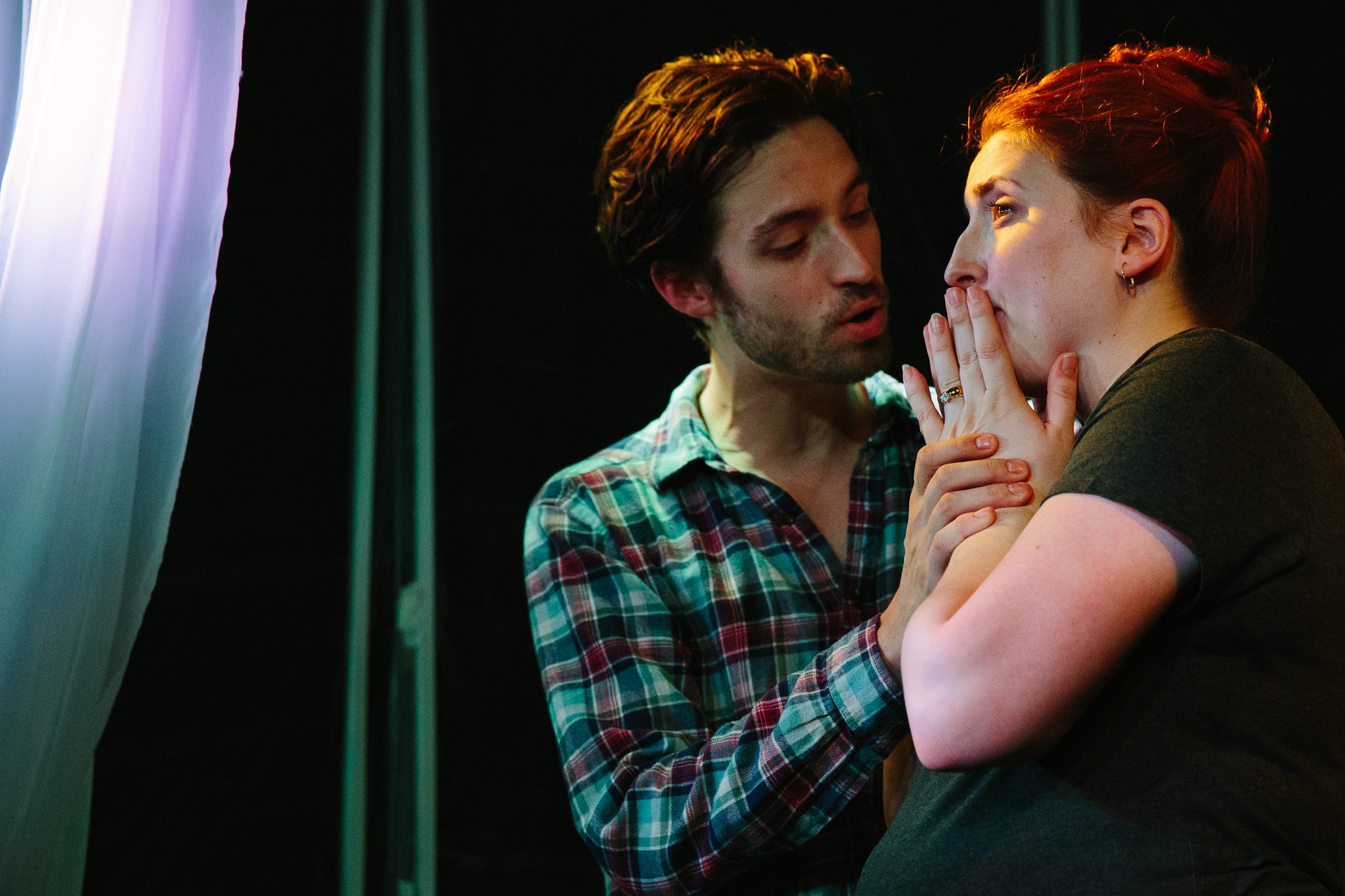
Photo credit: Greg Goodale

The two-hander play deals sensitively with issues of pre- and post-natal depression, with Idgie Beau giving a strong performance as an increasingly distressed Grace. Charles Warner is equally impressive as Jimmy, whose initial amusement soon gives way to concern for the wellbeing of his wife and baby, balanced against his frustration over her neglect of their family. Although there are moments in the story of their relationship that feel unlikely, the actors’ portrayal of it is entirely convincing.

Covering five years without ever leaving the couple’s bedroom, it would have been easy for scenes to run together, but director Dave Spencer breaks up the action with costume changes and brief musical interludes, while references in the script keep us up to speed on how much time has passed. Even so, things do start to slow ever so slightly towards the end, as the subjects of Grace’s obsession go through a personal crisis, and she dissolves again and again into panicked tears on their behalf while Jimmy tries to console her. It’s only when she finally takes action that the cycle is broken, and Grace’s recovery can begin – a moment that’s beautifully played by the actors but in terms of plot development feels a bit too neat, given all that’s gone before.

There are a few other moments where we’re required to suspend our disbelief in order to make the story work: the fact that the neighbours would never, in five years, consider closing the curtains or turning the light off, for instance; or that given the ever more blatant gawking from Grace and Jimmy, who can clearly see every detail, the other couple would never notice them. But that’s what makes the play such a perfect metaphor for social media – by putting our lives on display, we effectively open the curtains and allow anyone to see in. We know they’re there, and we kind of like it that way… but providing others with free access to our everyday lives means they inevitably see the bad as well as the good.

Photo credit: Greg Goodale

The situation in which Grace and Jimmy find themselves is one that the vast majority of us will never need to deal with (or let’s hope not, anyway) – but that doesn’t stop Window being highly relevant to a generation that’s as addicted to sharing as we are to observing. Although it could use a little more pace towards the end, this is an entertaining and unsettling new play that will definitely make you think twice about leaving the curtains open.


Can’t see the map on iPhone? Try turning your phone to landscape and that should sort it. I don’t know why but I’m working on it… 😉

Review: Eyes Closed, Ears Covered at The Bunker

In Alex Gwyther’s thriller Eyes Closed, Ears Covered, two teenage boys bunk off school and go on an adventure to Brighton. It’s obvious from the start that the two friends have a complex and potentially unhealthy relationship – and when something terrible happens on the beach, it falls to two frustrated police officers to try and make sense of the day’s events.

Much like the officers, the audience must piece together the clues to work out the real story behind Aaron and Seb’s day trip – and when the final piece of the jigsaw slots into place moments before the play ends, the truth turns out to be as shocking as it is satisfying. I love a well-written thriller that really keeps you guessing, and this play definitely falls into that category.

Photo credit: Anton Belmonté of 176 Flamingo Lane

Many of the characters in Derek Anderson’s production feature only as Big Brother-esque voiceovers, which means all our attention is focused on the story’s three leads. Danny-Boy Hatchard takes control in the first act as Aaron, who’s the mastermind behind the adventure. Outgoing and often very funny, he can also be unpredictable and aggressive when things don’t go his way… and he wields a disturbing amount of power over the naive and socially awkward Seb.

Act 2 abandons the police station and is carried by the excellent Joe Idris-Roberts, who takes us back in time to explore the tender relationship between ten-year-old Seb and his mother Lily, played by Phoebe Thomas. As well as answering a lot of the questions posed by Act 1, this part of the play also leads us into increasingly dark territory (there’s very little laughter to be heard after the interval), touching on themes of domestic violence and mental health as it paves the way for the story’s dramatic conclusion.

A simple set proves no obstacle to the storytelling, with some impeccably timed movement (directed by Jonnie Riordan) helping to build a picture of the characters’ surroundings, and Norvydas Genys’ lighting design keeping the action moving between locations, as well as back and forth in time. There’s also a great moment at the beginning of Act 2, when Lily replaces a photo of herself, appearing on stage as if by magic.

Photo credit: Anton Belmonté of 176 Flamingo Lane

There’s just one niggle for me about the play, namely the decision to set it in the 1980s. This isn’t particularly borne out by the story (I remember just one popular culture reference to Tom Selleck as a relevant movie star), and putting 30 years between the events of the play and its audience suggests they have no relevance today – when in fact the opposite is true.

That said, this is without doubt a compelling and well executed piece of theatre, which grabs our attention from the start and never loses its intensity. With three brilliant performances and a dramatic twist ending, this dark thriller is well worth a visit.


Can’t see the map on iPhone? Try turning your phone to landscape and that should sort it. I don’t know why but I’m working on it… 😉

Interview: Anthony Orme, Sanctuary

2040. The war is over, and the world is resolved… so why can’t Kari remember anything? What is S.A.M. and how can she escape Sanctuary?

So begins Anthony Orme’s feminist sci-fi thriller, Sanctuary. “In the aftermath of the war, Kari Allwood wakes in a cell with no recollection of how or why she got there,” explains Anthony. “We see as she struggles to survive her life as a woman in the army and to comprehend the mistakes that she has made and conquer her own mental instability. Tackling the subjects of women at war, PTSD, and the essence of human self-preservation, Sanctuary creates an exciting and thrilling whirlwind of a show that will leave you questioning your own view on life as we currently understand it.”

Anthony was inspired to write Sanctuary by two main factors: “The first was my own history and exploration of mental health and its effect on my own life, and secondly the lack of representation of women in war and theatre,” he says. “Having struggled with mental health issues all my adult life but never really having a way to present parts of it, I wanted to create a piece that discussed this as well as being entertaining and enthralling – which is where the idea of Sanctuary was born. From there I started to look closely at PTSD and the women who suffer from it and how little we hear about them, much like strong females in the arts. All three combined became the perfect inspiration for a play.

“I’ve always been a massive fan of sci-fi. I think when done correctly, it enables viewers to see and acknowledge problems in their own society without even realising. The entertainment and escapism of future and the unknown wraps the audience in a blanket of theatre and art which allows them to soak in the political and social undertones of a piece. With a piece like Sanctuary there is no other genre it could have been. Plus it’s also very rare to find a strong piece of sci-fi on stage and so I was very up for taking on the challenge.”

As writer and director, Anthony is full of praise for actors Elizabeth Robin and Catalina Blackman. “They are two of the most hardworking and dedicated cast I have had the pleasure to work with. Sanctuary is not an easy play – it’s intense, real and a challenge for any actor, yet these two incredible women have been stoic throughout. Both characters are equally challenging – one is never on the stage and so has to express empathy, fear and desire using only her voice, while the other never leaves and has to hold the show and bare a lifetime’s worth of emotions alone and exposed. They truly are artists of their craft.

“It’s fair to say that we have had our fair share of personal trauma throughout the rehearsal process, which leaves me in even more awe of the incredible performances they have delivered.”

With themes of feminism, LGBT, mental health and war, Anthony believes every audience member can take something from the play. “Maybe I’m biased, but I feel that Sanctuary speaks to people from all ages and creeds,” he says. “I might add that due to very adult themes and language it may be best to restrict the viewing to audiences above the age of 16… but we all learn sometime.”

In addition to winning Best Play at the Stockwell Play House One Act Festival, Sanctuary is also Bechdel approved. “The Bechdel Test and Bechdel Theatre are in my opinion one of the most important companies in the arts at the moment,” says Anthony. “Their aim is to bring awareness to pieces of theatre that have strong feminist bases. The test is simple:
1. Are there two women on stage?
2. Are they talking to each other?
3. Does that conversation involve anything except men and relationships?
Congrats – you have been approved.

“Why it is so important to me? In short, there is too little theatre around with strong female characters, and too much that thinks their characters adequately represent real women. It has always been a strong passion of mine to create parts for women and to prove that feminism and equality aren’t fads… they are here to stay. Having Sanctuary Bechdel approved not only proves that we have been able to, but also helps to raise awareness of this glaring issue and highlights to fellow feminists the theatre they should be seeing.”

London and Merseyside-based Now You Know Productions was founded four years ago. “We started as most small companies do, with a few friends, in a bar, wanting to take a piece of theatre to the Edinburgh Fringe, and we did,” says Anthony. “We took I Love You, You’re Perfect, Now Change up and haven’t looked back since.

“Since our first outing, Now You Know has grown and developed into the company it is now, a company who creates new and exciting theatre that constantly tries to break the mould and highlight the real issues at hand. We are always looking for the next best play and team and constantly growing. Commercial theatre to some extent has forgotten what theatre is for, which is to enlighten, to teach and to empower… we have not forgotten this message.”

Sanctuary opens at the Tristan Bates on 14th August. “I think people should come and see the play because it’s exciting, different and the themes are important,” says Anthony. “It’s not just another millennial piece of theatre where boy meets girl – it has a message and a purpose, one which I think matters. That’s why we decided to go to the Tristan Bates, a space that prides itself on fringe theatre at the front of change.

“Also having won best play, as well as highly commended directing and acting at the Stockwell Playhouse One Act Festival, people don’t need to just take my word for it.”

Book now for Sanctuary at the Tristan Bates Theatre from 14th-19th August.

Review: Kicked in the Sh*tter at the Hope Theatre

The title of Leon Fleming’s new play could hardly be more appropriate, because watching it actually does feel like being kicked, if not in the sh*tter then somewhere equally painful. Fearless and brutal, the play forces us to confront two of our society’s most common and damaging assumptions – that anyone on benefits must be a work-shy scrounger, and that anyone who suffers with depression must be a malingerer – and establishes an unsurprising but often-forgotten link between poverty and mental health issues.

Photo credit: Ashley Carter

We first meet the two unnamed siblings, Her and Him, as kids – planning their futures with an optimism that becomes increasingly heartbreaking as we flash forward to how things have actually turned out. She’s now a single mother of two, while he’s struggling with depression and living in squalor. Neither has a job – he because he doesn’t feel able to work; she because someone needs to stay home and take care of their sick mum – and both ultimately find themselves at the mercy of a system that deals in check boxes and endless forms, rather than the many shades of grey that make up real human lives. Which is not to say Kicked in the Sh*tter is necessarily a political play – Fleming’s careful to make clear that the health and social care professionals are doing their best within a flawed system, and that’s as far as the criticism goes. This is a story about people, not politics.

In keeping with this, director Scott Le Crass (who previously collaborated with Fleming on the critically acclaimed Sid) keeps things simple. The set, designed by Justin Williams and Jonny Rust, is made up of large boxes that resemble dark concrete, and are manoeuvred into position by the actors to become a bed, sofa, table… Consequently, our focus remains on the characters, and particularly on the powerful performances given by Helen Budge and James Clay. In a series of short, punchy scenes that jump around in time and space, they show us the despair of a mother unable to provide tea for her kids, and the helplessness of a young man fighting not only his illness but also the assumptions of those who think he’s faking.

Between the two we see genuine affection, but also a constant battle as to who’s got it worse, resulting in a downward spiral from which there seems to be only one escape. As Scott Le Crass points out in his programme notes, this is not poverty porn; there’s no abuse of the system here, no smoking, drinking or fancy phones at the taxpayer’s expense – just two people genuinely struggling to survive against ever-increasing odds.

Photo credit: Ashley Carter

At the heart of the 75-minute play is a raw, honest account of mental illness, and the sobering realisation that it can strike anyone, anywhere, at any time – even those who think they’re holding it all together. But it’s not all doom and gloom. There’s actually a lot of humour in the play, a hopeful message that desperate times may reveal us to be capable of much more than we thought, along with an encouragement to share our struggles with those closest to us, rather than battling on alone.

It’s not necessary to read the programme notes from Leon Fleming and Scott Le Crass to understand this is a passion project; there’s an intensity to the writing and production that grabs you by the throat and doesn’t let go. And for those of us who are able to put dinner on the table every night, it’s a wake-up call – a reminder of just how fortunate we are, but also of how unfairly we sometimes judge those who most need our help.


Can’t see the map on iPhone? Try turning your phone to landscape and that should sort it. I don’t know why but I’m working on it… 😉

Interview: Sophia Del Pizzo, Assmonkey: In Conversation

“‘Science’, cats, Rick Astley and wank jokes,” is Sophia Del Pizzo’s concise and intriguing summary of her one-woman show, Assmonkey: In Conversation, which has its first full preview at the Rosemary Branch on 31st March.

Expanding a little, she continues, “The show is about anxiety and mental health, and what I and a lot of other people do to self help. I wanted to do this show to encourage people to talk about it more. I perform methods of coping strategies I’ve learnt over the years, which I think other people could hopefully use with their own problems. I wanted to pass on things I’ve learnt. Share the knowledge and confidence in speaking out.

“What I’d like audiences to take away is that we need to start talking more and to encourage people, especially men, to open up more. But also to take away the core message of the show, which has really helped me. Mysterious I know, but come and see the show. Smooth…”

But surely performing for an audience – especially solo – must be one of the most nerve-wracking things you can do. How does Sophia overcome her anxiety about going on stage? “I don’t,” she answers simply. “I really don’t; I’m terrified, as it’ll be its first full public showing. People might hate it, but at least I would have tried. Anxiety is fear and this is something I need to overcome. The good thing is I am able to use my nerves and fears, as some of the characters in the piece require it. I’ve never done anything like this before, but the nerves are all part of the show and I just have to allow that. For better or worse.”

Sophia had the idea for Assmonkey: In Conversation about a year ago. “I’ve been writing it for about six months and only this year started to preview it. I’ve never written a show before, so this preview will be the first time it’s been performed in full. Scary, but I guess everyone has to have their first show, right? I started by noting conversations I had in therapy and really looking at what I do to manage anxiety and how I’ve gone wrong in the past. I’ve thought of ways to bring character work and humour into it because I still want people to be entertained, even though it’s a difficult subject. I improvise a lot of the characters and write from there.”

Though she’s never performed the full show before, Sophia did preview an excerpt at last month’s HerStory festival at Theatre N16, and received some great feedback. “It’s been useful to realise different audiences get it and some don’t, which really has amped up the fear factor,” she explains. “My first preview at the HerStory festival was glorious. I was touched by the comments and people seemed to laugh a lot – I hope all shows are like that, it was great to know the tone of the show can work. I’m performing a snippet at the awesome Hatch night too, so I will be loaded with useful feedback. What is really nice is that people who’ve seen bits have thanked me for being so honest, which is reassuring because at times it can feel very self-indulgent making people sit down and listen to your story. Typical actor.”

Sophia’s a member of the Soho Theatre Writers Lab, a course that offers writers the chance to develop and refine their voice, with support, motivation and guidance from the course leaders and members of Soho Theatre’s Artistic Team. “Shout out to the Soho massive,” says Sophia. “I applied online with some short comedy sketches I’d written and I’m loving the course, I’d say it’s definitely been one of the reasons I’m doing this show. The support and encouragement from the staff and from peers is so inspiring, and it’s meant I’ve gone to see a lot more theatre and talked ideas with my peers, to a point where my confidence as a writer and performer has grown enough to prompt me to do this show. But it’s also changed how I look at forming a journey and a story. I have nothing but good things to say about Writers Lab and the resources to new writers. The Soho Theatre also do amazing talks and workshops that are open to everyone.”

For anyone who’s suffering with anxiety, Sophia has a little (spoiler-free) advice: “Without giving my show away, I’d say everything I explain, in roundabout ways relates back to meditation and asking for help. Charities like SANE have great resources and of course organisations like this have websites packed with information. But I think the most important thing is to make sure you surround yourself with supportive people if possible. Try therapy, if you haven’t. Also try looking at anxiety not as something bad, but maybe as something you just need to understand.”

Assmonkey: In Conversation previews at the Rosemary Branch Theatre on 31st March.