Review: Three Unrelated Short Plays at Theatre N16

Three Unrelated Short Plays is the debut production from Blank Tin Productions, and does exactly what it says on the… er, tin: three 20-minute plays, none of which bears any relation to the others – or indeed to reality as we know it. The press release promises weird and unexpected, and that’s exactly what we get.

In The Stuttgart Syndrome, John (James Messer) wakes up tied to a chair in a basement, next to Mickey (Dan Thorn), who seems worryingly chilled about the whole situation – possibly because his grandfather was an escapologist, or maybe just because he doesn’t actually know what kidnapping means. One Scotch sees friends Tony, Danny and Jack (James McClelland, Abe Buckoke and Will Jeffs) play a drinking game that will supposedly allow them to meet God, but it turns out (s)he isn’t quite what they were expecting… and that’s not the only surprise of the night. And in Who the Fuck is Dr Deathzo? mild-mannered Kevin (Jimmy Roye Dunne) learns that he’s got an evil alter-ego who only comes out on Saturday nights – and as if that’s not bad enough, now superhero Assorted Props Girl (Elle Banstead-Salim) and her sidekick Tape Boy are out to vanquish him.
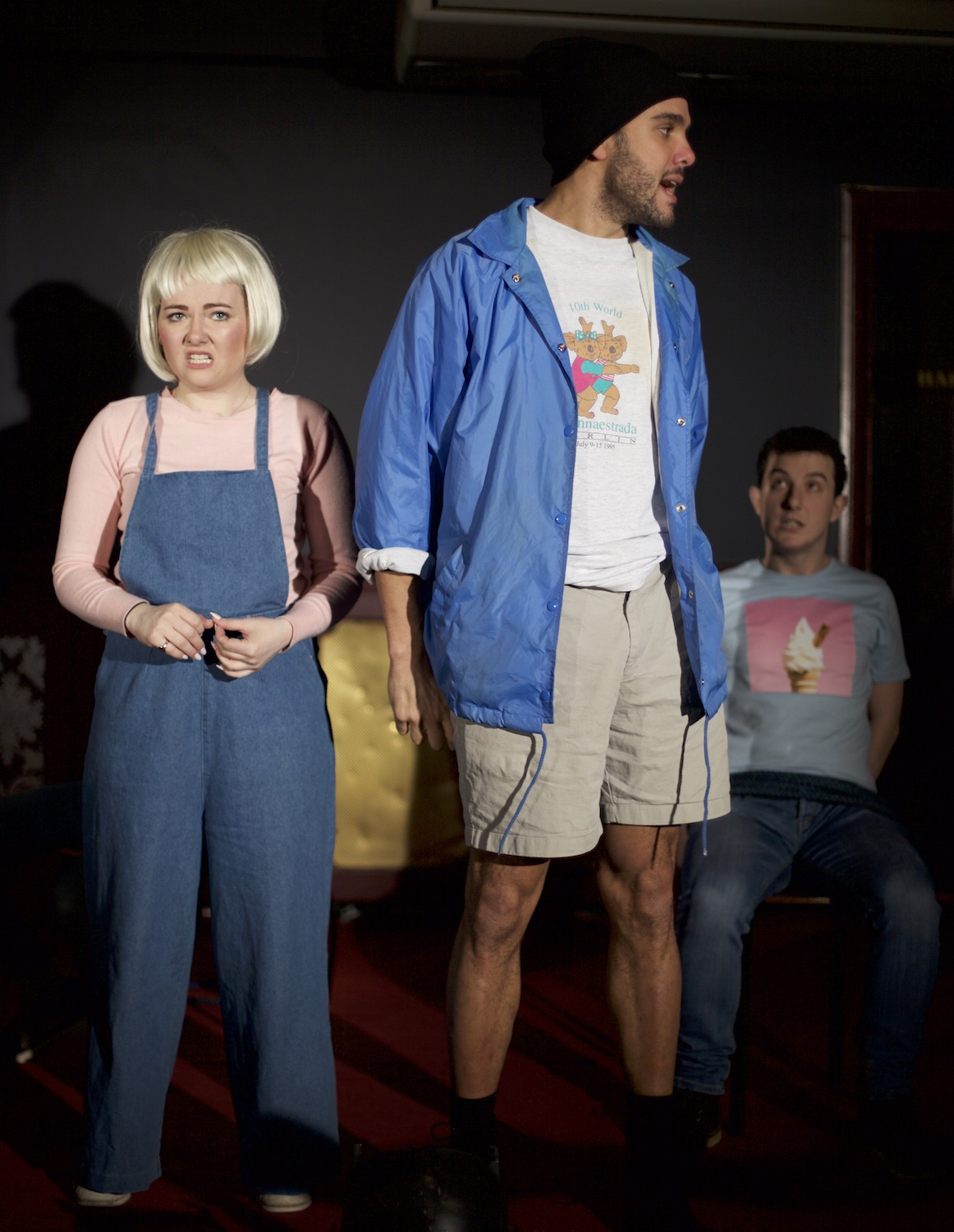
three-unrelated-short-plays-5
Photo credit: Oliver Malam
So. You get the idea. Nothing here makes any sense, but then it’s not really supposed to. Writer James Messer has let his imagination run off pretty much wherever it wants to go, resulting in a show that’s entirely bonkers and very very silly – but hey, who doesn’t enjoy a bit of silliness every now and then?

Each play has a different director (Will Jeffs, Oliver Malam and James Messer each taking a turn) and cast to keep things fresh, and as promised in the title each is a completely separate, self-contained story. Personally, I found the middle piece, One Scotch, to be the strongest, possibly because despite being quite as mad as the others, the plot felt just a touch more coherent, and I loved the twist in the tale. But there’s something here for everyone (unless you’re not a fan of random), and it’s likely everyone will have their own favourite, for different reasons.

The show has a charming, homemade feel, with frequent references to the limitations imposed by a fringe theatre budget. And far from making excuses, it revels in its own chaos; the transitions between plays are part of the fun, with cardboard signs imploring us to look at the guy juggling, or dancing, rather than the frantic scene changing going on behind him.
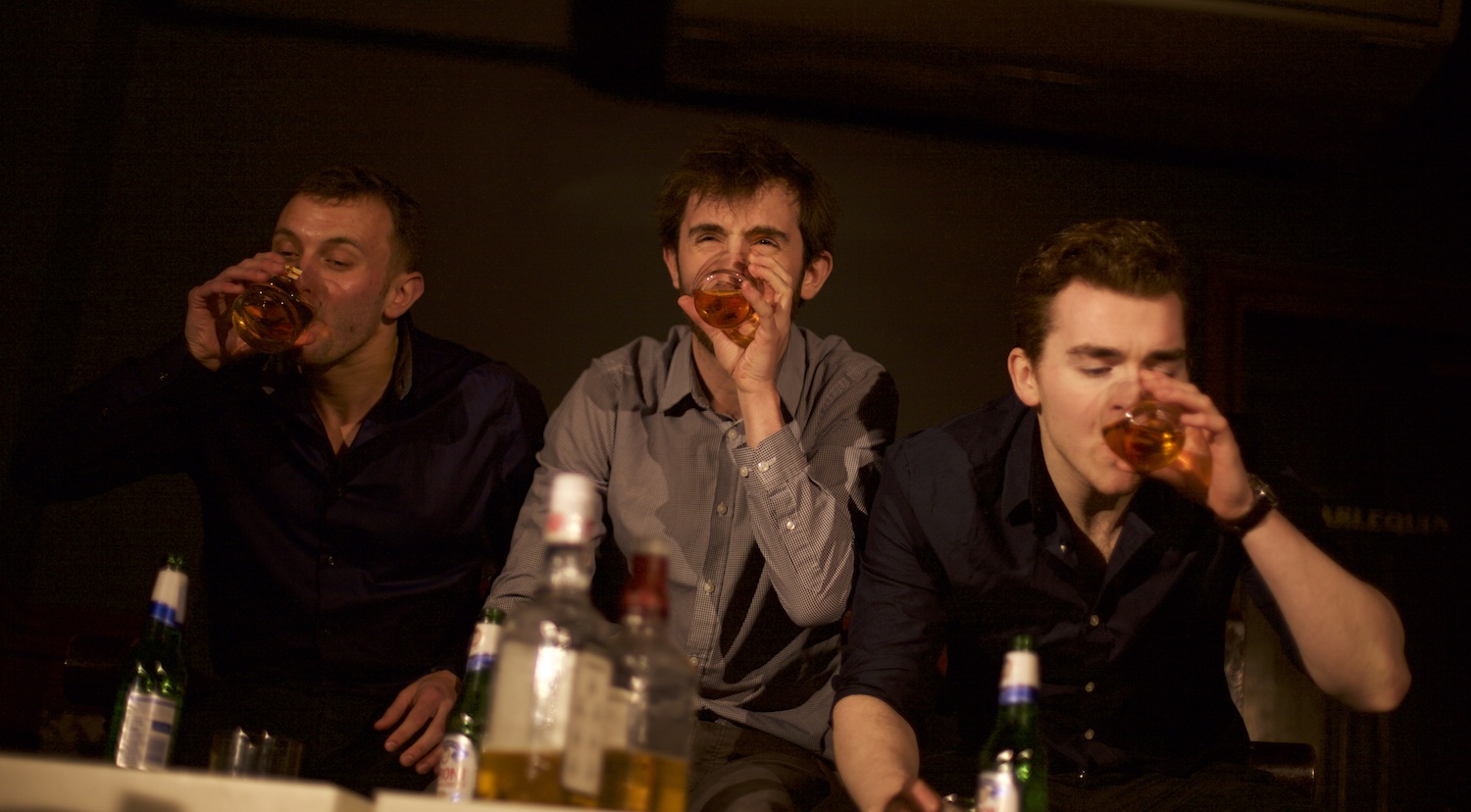
three-unrelated-short-plays-4
Photo credit: Oliver Malam
The cast display a similar exuberance, throwing themselves into their assorted roles with an enthusiasm that borders at times on the hyperactive. Most appear in more than one play, with Blank Tin co-founder Elle Banstead-Salim popping up in all three as a selection of increasingly feisty women; as the only female cast member it’s down to her to bring all the girl power, and she doesn’t hesitate to accept the challenge.

As a reviewer, I often feel I have to find the meaning in every play I see, so it’s a rare pleasure to see a show that isn’t trying to tell us anything. Blank Tin just want to have a good time, and to make sure the audience have fun too. And in that they definitely succeed. It’s a surreal night out, don’t get me wrong – but it’s also a thoroughly entertaining escape from reality, and that’s something we could all do with these days.


Can’t see the map on iPhone? Try turning your phone to landscape and that should sort it. I don’t know why but I’m working on it… 😉
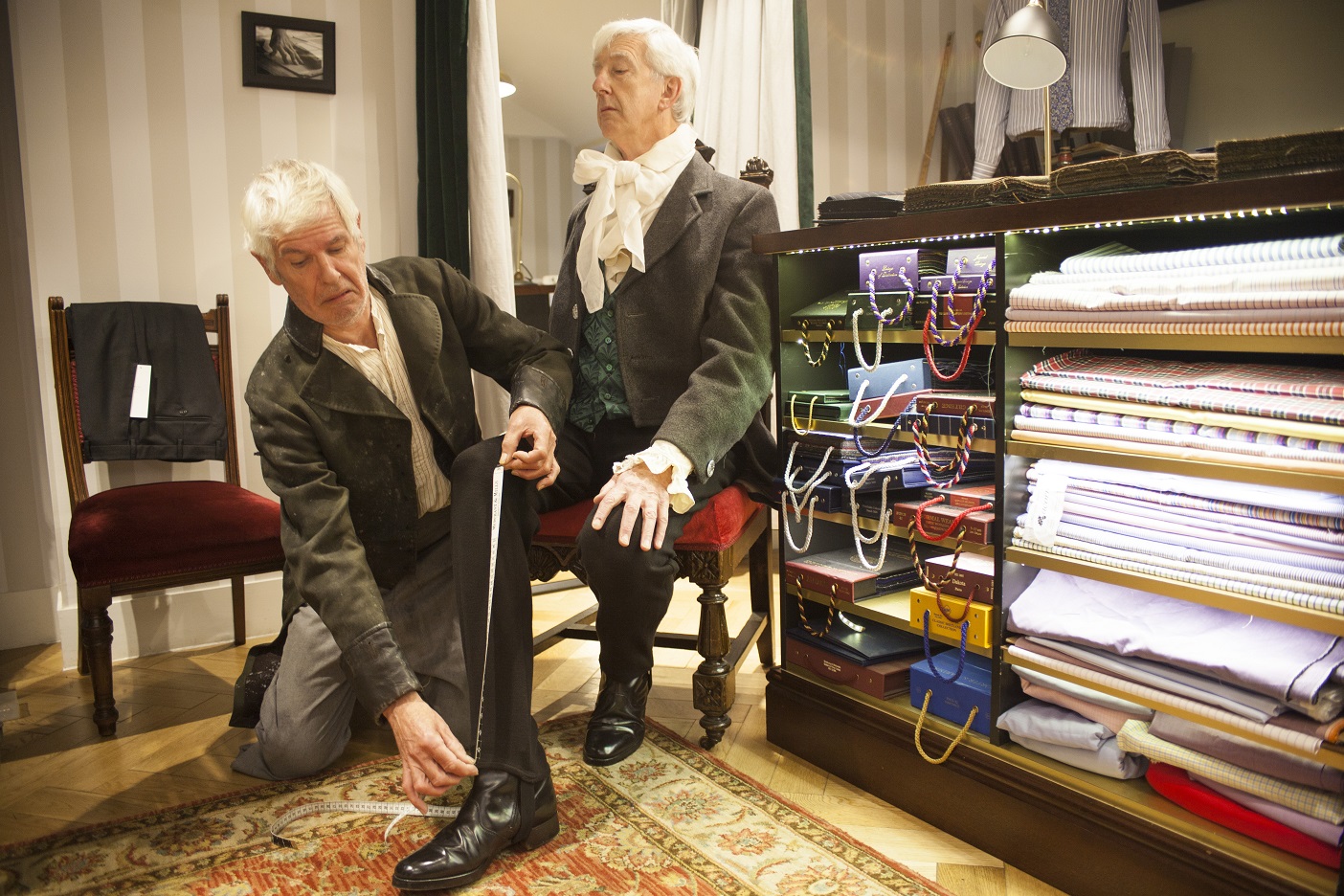
Interview: Sean Brosnan, Beau Brummell – An Elegant Madness

Written by Ron Hutchinson back in 2001, Beau Brummell – An Elegant Madness is a black comedy about the downfall of George Bryan Brummell, known as The Beau. This week the play returns to London for the first time in 15 years, opening tomorrow at Jermyn Street Theatre, just a couple of blocks away from Brummell’s commemorative statue.

Photo credit: Emily Hyland

So who was Beau Brummell? “The play is a fascinating and amusing insight into the world of ‘celebrities’, featuring the original dandy, wit and revolutionary Beau Brummell,” explains Sean Brosnan, who plays him. “Brummell was in many ways a self made man. He seized opportunities where he could and without concern for the consequences. In fact the more he could pique someone with a barbed comment, the happier he was.

“He bucked the trend in fashion and his influence reigns today in the tailored suit. Without him we may all be flouncing around in overly flamboyant colours and fabrics. Imagine a world of Grayson Perry. Today’s equivalent I would say is a cross between David Beckham for style, Kim Kardashian for fame for fame’s sake, and Stephen Fry for biting wit. Imagine that if you will!”

Set in the winter of 1819, the play finds Brummell living in exile in a madhouse in Calais. He’s convinced his old friend King George IV will come and see him on his visit to Calais – but his valet has other plans. “Beau Brummell has so many facets to his character; joy at his past glory, despair at his current situation and a fascinating, complex relationship with his valet, played with great skill and panache by Richard Latham,” says Sean. “Brummell was unique and playing him at this stage of his life, when he is facing desperate reality but also believing his former glory will be restored, is a challenge and a delight.”

Jermyn Street Theatre, in the fashionable St James’s district, is an appropriate home for the production: “Jermyn Street was at the heart of Brummell’s world. He lived close by and bought his wine at Berry Brothers in St. James Street. With his statue at the end of Piccadilly Arcade he must surely be looking down on us with pride. He has not been forgotten. Playing him here is very special.”

Photo credit: Emily Hyland

Although the play’s set nearly 200 years ago, the story of Beau Brummell remains hugely relevant in today’s celebrity-obsessed world. “Brummell was the most famous man of his day and yet is now largely forgotten. Like Oscar Wilde, he had a spectacular fall from grace,” says Sean. “Even today, one mistake in the public eye, be it ever so small, can bring the media’s wrath and vilification. If you’re famous, watch out. They’re out to get you!”

Sean hopes the play will help bring Brummell’s story to audiences who may never have heard of him. “It’s a play that manages to balance the regency farce of Blackadder III with the grandeur of King Lear and has been called ‘Waiting for Godot for the fashion conscious!’ If our audiences leave feeling they understand a little more about the madness and brilliance of Beau and have had a good chuckle along the way, then I will be delighted.”

Beau Brummell – An Elegant Madness is at Jermyn Street Theatre from 13th February to 11th March.

Review: Crime and Punishment at Jack Studio Theatre

In the centenary year of the Russian Revolution, Arrows & Traps have got in early with their production of Dostoyevsky’s Crime and Punishment. But put aside any off-putting thoughts of epic 600-page novels; this short, sharp adaptation by Marilyn Campbell and Curt Columbus cuts straight to the heart of the story and is all over in a gripping hour and a half.

Focusing less on either the crime or the punishment, instead this adaptation gives us a disturbing insight into the mind of a murderer during the days between the two. By the time the play begins, the murder – of an elderly pawnbroker and her sister – has already been committed, and Raskolnikov (Christopher Tester) finds himself drawn into a cat and mouse game of psychological warfare with police inspector Porfiry (Stephen MacNeice), who’s convinced of his guilt. In desperation Raskolnikov turns to Sonia (Christina Baston), a virtuous young woman forced into prostitution to save her family, who offers his only chance of redemption.

Photo credit: Davor Tovarlaza @ The Ocular Creative

Flashbacks give the audience an opportunity to piece together the events that preceded the murder, as well as the crime itself – but also demonstrate the fractured state of mind of the killer, who himself looks back in an attempt to justify his actions. In the present, Raskolnikov explains to Porfiry that he believes some crimes – including this one – are necessary for the greater good. This is the debate at the heart of Dostoyevsky’s novel, and Campbell and Columbus’ adaptation gets straight down to it, mercilessly axeing several additional characters and plotlines, without losing any of the essence of what the story’s all about.

Director Ross McGregor has assembled a brilliant new cast for this production. Stephen MacNeice is an affable Porfiry, a self-confessed “freeform” investigator whose complex relationship with the suspected murderer begins to feel more like that of father and son than detective and criminal. As Sonia, Christina Baston has a physical fragility that contrasts with the spiritual and moral strength that sustain her – before transforming in flashbacks into the hunched, sneering old pawnbroker who’s about to meet a messy end. But this is ultimately Raskolnikov’s story, and Christopher Tester is captivating as the tormented killer. Despite being a violent criminal driven by his own arrogance, he’s also charming, articulate and capable of great kindness… and so like the biblical Lazarus who’s referenced throughout the play, we desperately want to believe he has the potential for salvation.

Anyone who’s seen Arrows & Traps in action before knows that they have a signature style – but they’re also not afraid to take a risk and step into new territory. Crime and Punishment is the company’s 10th production, and in a lot of ways is quite different to anything they’ve done before, with a cast of just three actors and a running time of only 90 minutes. Yet this is also recognisably an Arrows production, not just in its strong acting performances, but in the use of contemporary music, atmospheric lighting (courtesy of Karl Swinyard) and a dreamlike quality, particularly in movement director Will Pinchin’s exquisite slow-motion murder scene. (I never thought I’d be able to describe watching two old ladies get bludgeoned with an axe as beautiful, but there we go.)

Photo credit: Davor Tovarlaza @ The Ocular Creative

So what we really get with this production is a super-concentrated Arrows experience, stripped back to basics but bearing all the hallmarks of a company and director who know exactly what they’re doing. An intense psychological drama, the play has the entire audience holding our breath throughout, and asks some very real, and relevant, questions about the nature of crime and whether there’s actually any such thing as good and evil.

Think you know Crime and Punishment? Think again.


Can’t see the map on iPhone? Try turning your phone to landscape and that should sort it. I don’t know why but I’m working on it… 😉

Interview: Owen Calvert-Lyons, Ovalhouse Spring 2017

“It’s a season of new beginnings – new artists, new works, new ideas,” says Owen Calvert-Lyons, Head of Theatre and Artist Development at South London’s Ovalhouse. This week sees the launch of his first major season since taking over last year, featuring an imaginative and innovative programme of shows that runs until the end of April.

“I had a number of ambitions for this first season,” Owen explains. “I wanted to signal a return to our roots as a 
home for radical artists and radical ideas. I wanted to build a community of artists at all
 stages of their career. I wanted to take a risk on some young artists – giving them the 
opportunity to create work for our main stage. I also wanted to provide opportunities for a
 whole series of artists to work with Ovalhouse for the first time, which is why my first season 
is weighted towards experimentation – with eight new works-in-development.

“I think it’s a great season – there are shows that I can’t wait to see again
 and shows which I’m desperate to see for the first time. I am really pleased that five artists 
presenting work in my first season are graduates of our participation programme, which tells 
me that we have a strong future ahead of us.”

joan
JOAN, 11th-22nd April

With so many exciting shows to choose from, how does Owen go about putting a season together? “I start with a series of principles – ideas that I want to see within the season: radicalism,
 diversity, politics, feminism, gender politics. Some shows I see at festivals – both JOAN and
 Eurohouse were at the Edinburgh Festival Fringe – and I saw a work-in-progress of Focus Group
 over a year ago and loved it. Other shows, such as Custody, have come to me more recently
 but have an urgency about them which demands to be heard.

“Then there are the FiRST
 BiTES – eight work-in-progress productions which we are testing out for the first time. All of
 these start with an artist bringing us a great idea; an idea which just needs some time, some
 resources and some love to start the journey towards becoming a great play. This season, I’ve also launched a regular strand of work for children and families. We want this work to 
have the same principles as our work for adults, so our first two productions explore grief 
(The Many Doors of Frank Feelbad) and gender politics (Moonshine’s Entirely Necessary 
Adventure).”

Moonshine’s Entirely Necessary Adventure, 13th-14th February

Presented with the thankless task of choosing some season highlights, Owen tactfully rises to the challenge: “It’s impossible to pick a favourite, but I would recommend Focus Group – a dark and
 unsettling journey into the world of Mister Kipling cakes, and JOAN – a beautiful re-telling of the
 story of Joan of Arc. Lucy, who plays Joan, won The Stage award for her performance, and
 rightly so, she’s brilliant. And Custody – Urban Wolf has been trying to get this play made for
 the past two years; it explores the injustices by the police which he’s witnessed first-hand
 in Brixton. He’s put together a great creative team, with a brilliant script from Tom Wainwright – it’s an urgent story and I’m really proud that we are going to bring it to an
 audience.”

For first-time visitors, he has a few additional tips. “I’m still amazed when people say to me that they’ve never been to Ovalhouse – it’s a
 hidden gem, right in central London. If you’ve never been before and want to dip your toe in,
 then come for a FiRST BiTE show for just £5. Or if you’re feeling more adventurous, come to
 one of our *Discuss nights, where you see a show, immediately followed by an audience-led 
discussion over a glass of wine.

“I’m not sure we’ll ever be the sort of venue that pleases everyone – but this season has a
 pretty broad appeal. If you’re ever unsure if there is a show for you, just call our box office -
 we have a brilliant team who can talk you through the brochure and find a show that suits
 your tastes.”

Ovalhouse’s Spring Season runs until 29
th
 April 2017.

Review: Doctor Faustus at Theatro Technis

London’s most active amateur theatre company, The Tower Theatre, has been in business for more than 80 years – but shows no sign of getting tired. Their new production of Doctor Faustus at Theatro Technis is dramatic, intense and gripping, and while it may not have Kit Harington in his pants, at least in this version we can all keep track of what’s going on.

Doctor Faustus, or to give Christopher Marlowe’s play its full title, The Tragical History of the Life and Death of Doctor Faustus, is the story of a bored German intellectual, who sells his soul to Lucifer in exchange for 24 years on Earth, the ability to use magic, and the devoted service of the demon Mephistopheles. The years pass, and Faustus becomes famous all over the world – but it’s only when his time begins to run out that he realises what a huge mistake he’s made.

Photo credit: David Sprecher
Tower Theatre’s production, directed by Lucy Bloxham, is a relatively traditional interpretation of Marlowe’s text, featuring two central performances that wouldn’t look out of place on a professional stage. Jonathon Cooper is charmingly eccentric as Faustus, skilfully embodying every side of the character: the frustrated genius, the cocky celebrity and the terrified dead man walking. It’s hard to feel sympathy for a man who’s entirely responsible for his own downfall, but Cooper’s Faustus is just likeable enough that we can’t help hoping he’ll find a loophole as his final minutes tick away.

He’s joined by Tower Theatre veteran Robert Reeve as Mephistopheles, the demon charged with sweet-talking Faustus into giving up his soul, and then being his constant companion for 24 years until it’s time to collect on the debt. Dressed all in black, Reeve radiates a quiet authority, and it’s clear from his sly grin whenever Faustus isn’t looking who’s really in control of the situation.

The rest of the cast take on multiple roles, most memorably having a bit of fun with the seven deadly sins (in the case of Lust, played by Matt Cranfield, perhaps a bit too much fun). This and a couple of later scenes provide welcome moments of light relief in what is, let’s face it, not exactly the happiest of stories.

Photo credit: David Sprecher
First-time director Lucy Bloxham makes effective use of the large stage area at Theatro Technis, with multiple entrances (including the one to hell, which is positioned alarmingly close to the audience) and a curtained off area behind which Lucifer himself appears to Faustus. There’s one slightly clunky set change in Act 2, which could benefit from something for the audience to look at while the furniture’s cleared away, but on the whole transitions between scenes are clean and efficient. And the clock that regularly appears to tick down the minutes until Faustus’ downfall is a nice dramatic touch, as is Adam Taylor’s lighting design, which creates a suitably hellish atmosphere throughout.

Once again, The Tower Theatre Company have made it clear that amateur doesn’t have to mean unprofessional or poor quality. Every member of the company volunteers their time and talent for the sheer love of theatre, and that passion shines through in this and every production I’ve seen. Who needs Kit Harington?


Can’t see the map on iPhone? Try turning your phone to landscape and that should sort it. I don’t know why but I’m working on it… 😉