A little over a year ago, I was reviewing Annie McKenzie’s solo show Happiness is a Cup of Tea at the 2016 VAULT Festival. Since then, life’s changed a bit for Annie; a few months later, she was performing for a very different audience on her way to becoming a semi-finalist in the 2016 series of BBC’s MasterChef. And now she’s bringing together her two passions in new project Scripts for Supper, which launches in Battersea next week.
“Scripts for Supper is a theatrical dining experience that combines food and theatre in the only way I know how – by feeding people, getting them drunk and telling them a good story,” she explains. “Be that Shakespeare, Chekhov, Lorca or Beckett – it’d be the same, but we choose our food, plays and vices as carefully as possible.”
For her first production, Annie’s chosen one of Shakespeare’s best-loved comedies, Twelfth Night. The reason? “‘If music be the food of love, play on!’ Need I say more?”
The play will be accompanied by a five-course dinner, with a cocktail and canapés upon arrival, and a menu specially designed for the occasion. “It’s inspired by Shakespeare and Elizabethan England, but has me written all over it,” says Annie. “I cook food that people want to eat. Things that make people go: YUM! You can expect cockles, brown shrimps, pork, potatoes, rhubarb, cheese, cream, booze, booze, booze and a lot more besides! Oh – and did I mention booze?”
The project is a collaboration with Battersea’s London Cooking Project: “My lovely friends Billy and Jack of MasterChef 2016 final fame have done a few fabulous evenings at The London Cooking Project, which is how we came to be put in touch with them,” explains Annie. “If I’m honest though, I think it was pure luck and a bit of serendipity that led to us teaming up. I can’t tell you how wonderful Emma and the team at LDN Cooking Project are. Please look on their website to find out about all the incredible community projects that they’re up to.”
The idea to bring together food and theatre has been brewing for some time, and Annie’s excited about the prospect of combining two of her favourite things. “I had the idea that I wanted to create something with food and theatre ever since I was on MasterChef – it just took a long time to develop it and make it into a reality. It means a huge amount, of course. I’m giving everything I have to this project and am working with people I love dearly. It might be weird not to be ‘acting’ – but I am, in a way… I’m still on show… well, my food is.
“There have been many wonderful projects recently around theatre and food – Faulty Towers, Les Enfants Terribles – let’s just hope my idea can be a contender.”
Following the recent Women’s Marches across the globe, Piers Morgan took to Twitter to complain about “the creeping global emasculation of my gender by rabid feminists” – thereby revealing his ignorance of not only what the marches were all about, but more broadly what feminism even is. But unfortunately, he’s not alone in thinking that being a feminist must necessarily mean that you’re anti-men.
Maybe Piers and co should get themselves down to Theatre N16 in Balham some time and check out the Herstory feminist theatre festival. If they did, they’d find not a horde of hysterical women screaming at an audience of cowering males, but a room buzzing with mutual support and a passionate desire to make a positive change.
Which is not to say there isn’t anger too; in fact it was anger that inspired Nastazja Somers to start Herstory last year, to say to the theatre industry and society in general, “We’ve had enough.” But Herstory channels that rage into promoting women, not tearing down men – and it does so through a varied programme of topical and courageous work. The first of two nights at Herstory 3 featured eight such pieces, the majority of them solo performances, each representing the female voice on issues including politics, race, dating and mental health.
Not surprisingly, some of the work featured made difficult viewing. In the haunting Promise by Sarah Milton, an occasion that should be joyful – the birth of a baby – is revealed in fact to be a dark tale of child exploitation. All the Colours by Davina Cole is a heartbreaking story of a mother’s struggle to support herself and her son after fleeing the war in Sierra Leone to seek refuge in the UK. Donald Trump makes a (perhaps inevitable, and you can guess in what context) appearance in Grab by Pussy Patrons, and Isabelle Stokes’ Imprints concludes with a graphic account of sexual assault, powerfully performed by Francesca Burgoyne.
There’s a lot of laughter too, though – whether it’s at Sophia Del Pizzo’s fluctuating accent in Assmonkey: In Conversation, Julie Cheung-Inhin’s patient explanation of the geography of East Asia in No More Lotus Flower, or the anxious attempts of Katie Arnstein to write a feminist anthem in Bicycles and Fish: A Girl’s Guide to Feminism. Yet even these stories are shot through with frustration and emotion, as they tackle the devastating impact of anxiety and social pressures on young women, the racial stereotyping faced by actors of East Asian descent, and the shame of a young waitress forced by her manager to ask a breastfeeding mother to leave.
Amidst all this hurt and anger, Julie Vallortigara’s Welcome Home, a movement-based call for authenticity and self-expression, shone like a beacon of hope, summing up beautifully what the festival is all about. And despite the difficult topics explored across the course of the evening, the overwhelming mood as we made our exit was one of optimism. There are many challenges that are and will continue to be faced by women across the globe, but Herstory and its contributors are facing those challenges head on – and the sell-out audience and enthusiastic response to every single performance prove they’re not alone. Sorry, Piers.
Follow @HerstoryN16 on Twitter for details of future festivals.
Can’t see the map on iPhone? Try turning your phone to landscape and that should sort it. I don’t know why but I’m working on it… 😉
“Four Thieves’ Vinegar is a character driven piece of new writing, set in London during the plague of 1665, which explores the behaviour of ordinary people in times of disaster,” says Adam Bambrough, Artistic Director of The 42nd Theatre Company. The play, written by Christine Foster, opens next month at the Barons Court Theatre and is the company’s debut production.
“I set up The 42nd Theatre Company as I wanted to be involved in the creative process from the ground up,” explains Adam. “I was a theatre actor for years and grew tired of working for companies who used their actors as pawns, rather than assistant story-tellers, so moved into directing with the aim of being more creative. This company was meant to be a side project in-between directing published plays elsewhere, but it has evolved into so much more.
“Our underlying ambition is to become the leading theatre company for unproduced writers and emerging artists in the UK.We’re a long, long way from achieving that, but hopefully, this production will be the first step along that path.”
Since being established in 2013, Adam and the team have received over 2,000 plays, but Christine Foster’s first professional full-length play stood out from the crowd. “We work with writers who’ve never had their work produced before, so most plays that we receive are a long way from being ready for the stage – but we read every submission that we receive in full, looking for signs of an interesting story, told with relatable characters and memorable moments.
“Even in the first draft, Four Thieves’ Vinegar had those qualities, more so than any of the other submissions that we read.There was a story that immediately interested me, characters who I connected with and moments that I could imagine audiences going to bed at night thinking about. If there’s one word I’d like people to use after seeing this show, it’s ‘relatable’.”
Four Thieves’ Vinegar follows alchemist Matthias, who’s been thrown in jail and must enlist the dubious help of his cellmates Hannah and Jennet to make a cure for the Black Death. But even though it’s set in 1665, the story is still very relevant to our lives today. “The play examines the human spirit, the most connectable theme of all,” says Adam. “Every one of us is faced with circumstances at some point in our lives that we do not know how we will react to until we are faced by them, whatever the scale – and the parallels to modern life can be found all over the world, be it in the current migration crisis or the outbreak of Ebola in West Africa a few years ago.”
As well as their passion for supporting new writers, The 42nd Theatre Company are also committed to fair wages for the artists they work with, and to equal representation for women. “Starting a new theatre company is the perfect opportunity to remodel the way things are done and a lot of our core principles came from my experiences as an actor – and, to a lesser extent, as a director for hire,” explains Adam. “I am a firm believer that artists should be treated with respect from the outset and paid for their work, which is why we are a proud supporter of Equity’s Professionally Made Professionally Paid campaign.There should be opportunities for new voices to be heard in theatre, as there is so much potential out there, it just needs to be nurtured.
“There are also some principles that stem from my personal life.I have a three-year-old daughter and I often wonder what the theatre landscape will look like for her when she is older.I want her to be treated as fairly and equally as any man, which led me to commit to ensuring that at least half of the cast and creative team on our every production, including Four Thieves’ Vinegar, will be women.There really should be equally representation and opportunity for all in theatre, regardless of gender, race or social background.”
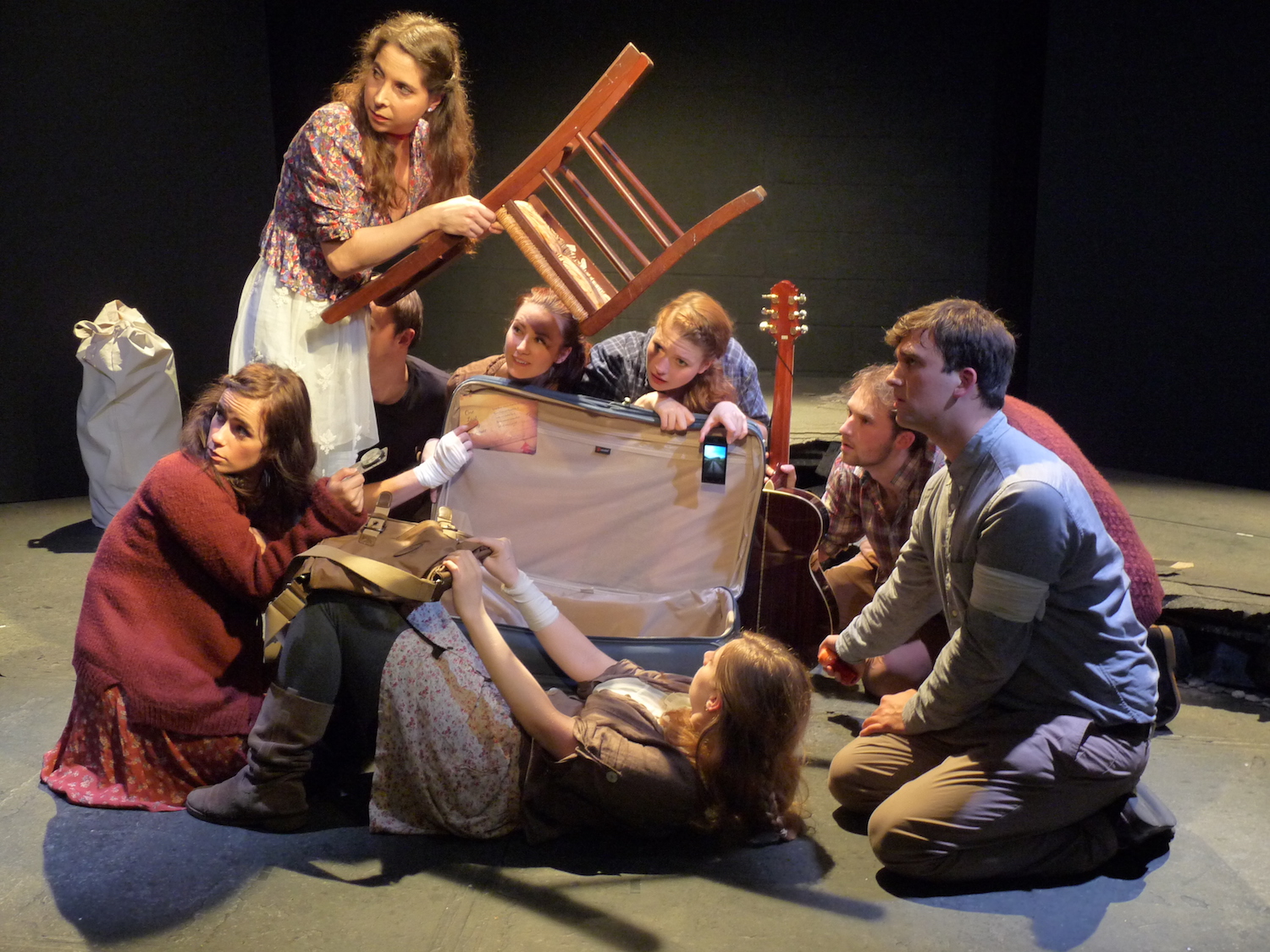
After more than two years in the making, Althea Theatre’s One Last Thing (For Now) has its world premiere at Islington’s Old Red Lion Theatre next month. Conceived by director Lilac Yosiphon, this ambitious project has been developed by the internationally diverse company, including cast members Tom Shah and Sam Elwin, and offers “a universal look at the language of love, the wounds of war and everything in between”.
The play’s creation was inspired by love letters from times of conflict in different cultures and languages. “The concept came from our director, Lilac, whose first instruction was to start reading,” says Tom. “Often they were the letters that were only intended to be read ‘should the worst happen’, and what is important to people in those situations – the words that they can’t leave unsaid – is more than enough inspiration.”
Photo credit: Laurie Field
“Alongside discussing the letters’ common themes, we began to develop a physical language for the show,” continues Sam. “We then attempted writing our own letters and began writing scenes inspired by the stories that had stood out to us. We selected and adapted from this pool of scenes to create a number of more cohesive storylines, which we then overlapped with each other, using the physical language to bind them together and enhance the storytelling.”
The development process began in September 2014, when the basis for most of the storylines was formed. Sam explains: “The process is still ongoing; since the initial development process we’ve had a rehearsed reading of a full length version of the script and we have two more days of R&D (research and development) before rehearsals start, during which we’ll finalise the script. Moreover, rehearsals themselves are a process of devising and discovery, so the show will continue to develop and change during the rehearsal weeks.”
“Initially, it was about using the fact that we were a group of people of different ages, genders, and nationalities with different experiences to draw us to as wide and varied subjects as possible,” says Tom. “Since then we have periodically come back to One Last Thing (For Now) to get it to the point it’s at now. That said, we still have one more story to write; Islington will be our home for the duration of the show’s run, and we’ll be creating an entirely new scene based on letters sourced from the Islington borough.
“One of the themes of the show is that for all our differences, we have the fundamentals in common. We’re asking for letters from Islington that we will workshop with people from the borough to help create this brand new scene for the show. We want to make our show part of the local community, because with such a global spread of stories, we don’t want it to feel like it’s about other people.”
This additional scene is a crucial part of the audience experience, wherever the show is being performed. “We believe that everyone has a story that needs to be heard,” explains Sam. “The intention is to use the letters to inspire a new storyline or scene which is specific to the Islington area and will only be performed while the show is at the Old Red Lion – a new venue would result in a new scene being devised; again inspired by letters, emails, texts etc from the local area. We also wanted to create a direct link with the local community in the performance they would see. To give the audience a sense of ownership and participation – these stories belong to all of us in that they have shaped and continue to shape the world we live in.”
Dealing with such universal issues as love and war, the company hope that the show has something for everyone. “We can certainly all learn something from it, and indeed, since one if its primary themes is cross-cultural understanding, we hope everyone would,” says Sam. “That said, the people most likely to want to see it are those who are interested in stories from around the world; those who have experienced war, either through family and friends or directly; people with an interest in the history; and people who enjoy visually arresting theatre.”
Tom agrees, and adds, “I do think anyone would take something away from seeing the show, but it will probably resonate most with people who at one time or another have felt cut-off from the people they love. I hope audiences will leave with a better idea of what it is that’s important to them.”
The show brings together stories from several different conflicts across the world – stories that the cast have come to know well during the development process. “One of my favourites follows a Colombian woman as she travels the world in search of someone she loves,” says Tom. “Even though she’s from a country most of us have never been to (and probably couldn’t name the capital of), speaks another language, and the ‘foreign’ environment she finds herself in is London, our connection to her is almost instantaneous.”
Sam has a few favourites: “That’s a really tough question to answer, all of the stories are so special. I think three in particular stand out. One is a letter conversation between an American soldier in Vietnam and his wife at home in the US, because it highlights the gap between what is written home and what is experienced and the couple’s struggle to deal with that.
The second is a storyline concerning a French resistance fighter, because it asks how much can love forgive and can we escape the roles we have chosen for ourselves? Thirdly, the story about a woman who sends her touch, because it’s in the tradition of the Brothers Grimm and Struwwelpeter – full of the fantastical and the macabre.”
Photo credit: Laurie Field
The fact that the different stories cross so many historical and geographical borders inevitably presents some challenges: “First, with so many of the storylines featuring non-British characters we had to devise ways of translating or having enough English to be understood by English speakers without repeating ourselves,” explains Tom. “Second, was to have some form of connection between what could otherwise be unconnected stories from different times and places.”
“As part of this some of us have to learn new languages and accents,” adds Sam. “Russian and Hebrew were a particular challenge…”
He concludes: “I hope our audiences will go away with an empathy for people from countries other than their own, an insight into the effects of war after the shooting stops, a remembrance of those who have died on all sides, and a hope that these three things can reduce conflict.”
Max Gill’s adaptation of La Ronde by Arthur Schnitzler launches the second season at The Bunker, and it’s already causing quite a stir. Partly this is down to the star cast, but it’s fair to say the major draw of this production is its unique and fascinating format.
Four actors – Lauren Samuels, Amanda Wilkin, Alex Vlahos and Leemore Marrett Jr – play between them ten gender-neutral characters. There are ten scenes, each featuring two of the actors. But who appears in which scene is entirely down to fate, and decided by the slow, deadly spin of a roulette wheel. Altogether, there are over 3,000 possible different versions of the show, so it’s no surprise that it cries out for multiple viewings. Fortunately, it’s also entertaining enough to ensure that wouldn’t be a chore.
Photo credit: Ray BurmistonThe use of a roulette wheel is appropriate, because La Ronde is a risky enterprise in more ways than one. Firstly, there’s the danger that one of the actors might find themselves repeatedly out of the loop; I saw very little of Amanda Wilkin until the comparatively short final two scenes, which she appeared in by default. (On the other hand, the mounting suspense of waiting to see if she would finally get her moment meant we never got bored of watching the wheel spin every few minutes.)
The format is also incredibly demanding for the actors, who have to learn every part and really think on their feet – but this outstanding cast have more than risen to the challenge. Every individual performance is confident and believable, as are the relationships between the different pairings, regardless of gender combination.
The overarching theme of the play is sex, and there’s some form of sexual encounter in every scene, whether consummated or not (which prompts the interesting question, what even counts as a sexual encounter; where do we draw the line?). Some are illicit, many unsatisfying, others quite poignant… And all of them are unseen, because the stage is plunged into darkness at the critical moment – an interesting choice that suggests the deed itself may not be quite as critical as what leads up to it, or what happens afterwards.
The script is necessarily gender-neutral, which creates a few awkward moments and rather excessive use of the characters’ (unisex) names, but on the whole flows more naturally than I expected. The different combinations of male and female force us to examine our own expectations about gender roles within sexual relationships and society as a whole. Questions of power, vulnerability, even career stereotypes (why should a female bus driver or a male cleaner be any more unusual than the opposite?) are all eloquently addressed, without labouring the point; the scenarios are unfolded before us and we’re left to consider our own response.
Photo credit: Ray BurmistonThe modern setting and individual scenes are the work of writer/director Max Gill, inspired by stories he collected over several months from Londoners – snippets of which we hear during the transitions between scenes. But the structure of the play comes from Schnitzler, and is just as enthralling. Each character appears in only two consecutive scenes, with the first actor selected by the wheel returning at the play’s conclusion to close the circle. So within this big loop are lots of little ones, all linked both directly to their neighbours, and also indirectly, with events and characters referenced from earlier scenes. (Weirdly, the pattern reminded me a bit of that magic roundabout in Hemel Hempstead – which is not something I ever thought I’d write in a theatre review, and is honestly a lot more flattering than it sounds.)
The biggest disappointment of La Ronde, for me, is that I probably won’t have time to see it again and compare last night’s version with another – and so in a way, I feel like I can only half appreciate how clever the show is. But that’s really a compliment; this is an original and endlessly fascinating idea, brilliantly executed by both cast and creatives. It’s not without its risks… but I’d say this particular spin of the wheel is a winner.
Additional note on 7th March:
As it happens, I did get a chance to see La Ronde again, a few days ago, and it was just as interesting as I suspected it would be. With the exception of one scene, every pairing was different to the last time, and in one case involved the same people but in opposite roles. And though the script was familiar, the different combinations – not only of gender but of personality and style, too – made it into a brand new story. Some scenes were funnier than before; others much more emotional. Some characters were more likeable; others harder to relate to. And though the sexual encounters were the same in location and circumstance, the responses to them were different – not because, for instance, it was between a man and a woman instead of two men, but because it was between two unique human beings.
There’s something slightly addictive about La Ronde; having been twice I now want to go again (and again). It’s a show of – almost – infinite possibilities, and one that you sense will remain constantly fresh and exciting, for audience and actors alike.
Can’t see the map on iPhone? Try turning your phone to landscape and that should sort it. I don’t know why but I’m working on it… 😉





 Theatre Things