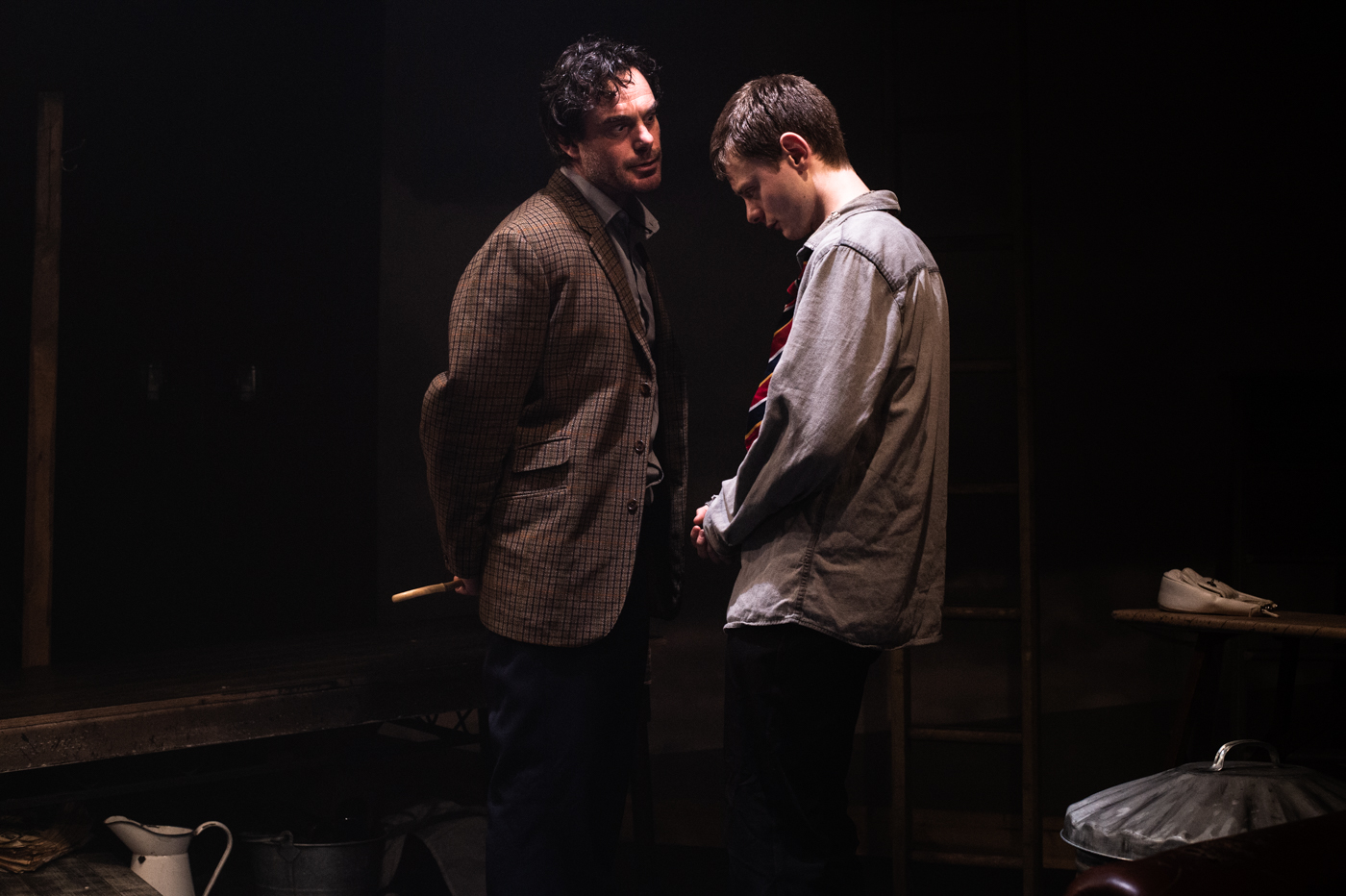
Review: H.R.Haitch at the Union Theatre

Reading the papers this week – or indeed most weeks – you have to wonder how being a princess could ever be considered a fairy tale ending. Sure, you might bag yourself a handsome prince, but I think Meghan Markle would confirm by now that marrying into royalty also brings its fair share of trauma.

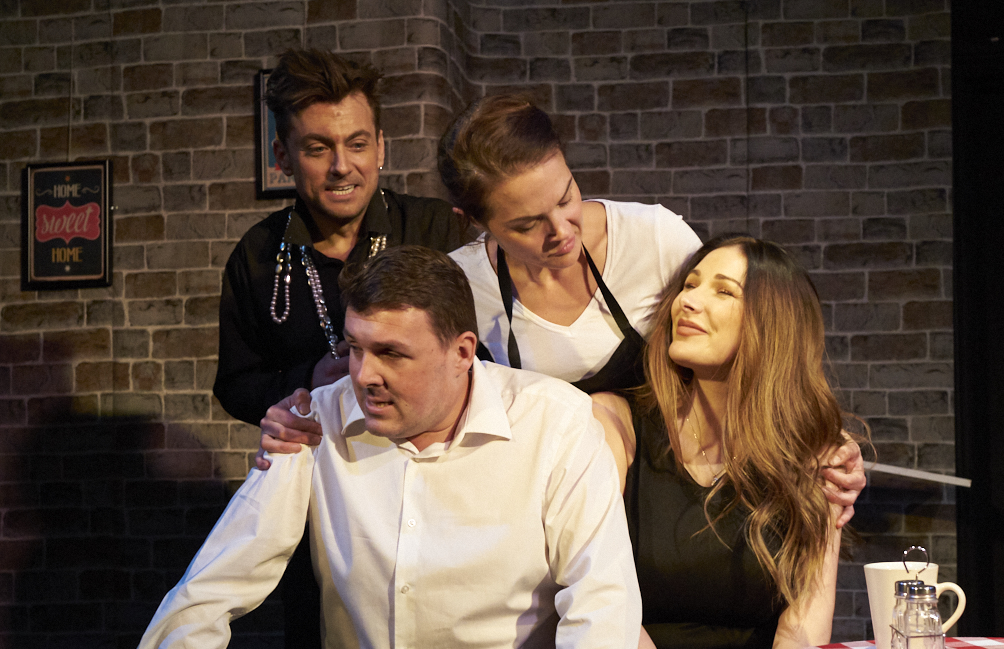
Spare a thought then for poor Chelsea in Maz Evans and Luke Bateman’s royal romcom H.R.Haitch, who’s about to discover her posh but dim boyfriend Bertie is actually Prince Albert, and second in line to the throne. Bertie’s been sheltered from public attention for the last 20 years, but his identity is about to be revealed and he wants Chelsea at his side when the big moment arrives. Which is all well and good, except she’s not exactly a believer in the merits of the monarchy, and is more than happy to rant about that fact to anyone who’ll listen. Meanwhile the new prime minister wants a referendum on the future of the royal family, Chelsea’s dad’s East End pub’s about to be shut down, and Bertie’s scheming older sister Victoria is tired of being spare to the heir just because she had the bad luck to be born female.

Photo credit: Nick Rutter

That’s a lot to get through in a couple of hours, but somehow it all comes together in this by-the-book romantic comedy about an unlikely couple who somehow overcome what would in real life certainly be insurmountable obstacles to find happiness. H.R.Haitch is enjoyably silly and entirely predictable, but there’s nothing wrong with that; so are most romantic comedies, after all. And because it’s set in the infinitely simpler time that was 2011, there are plenty of opportunities for humour at 2018’s expense. Granted some of these are rather over-milked (the Uber gag in particular gets old fast), and others feel ill-timed (wishing Ant and Dec a speedy recovery is a bit close to the bone) but there are enough genuine laughs in between to ensure the audience is kept entertained. Daniel Winder’s production also makes use of seamlessly integrated multimedia content, as a reminder that just outside the doors of the pub/palace, the world’s media lies in wait…

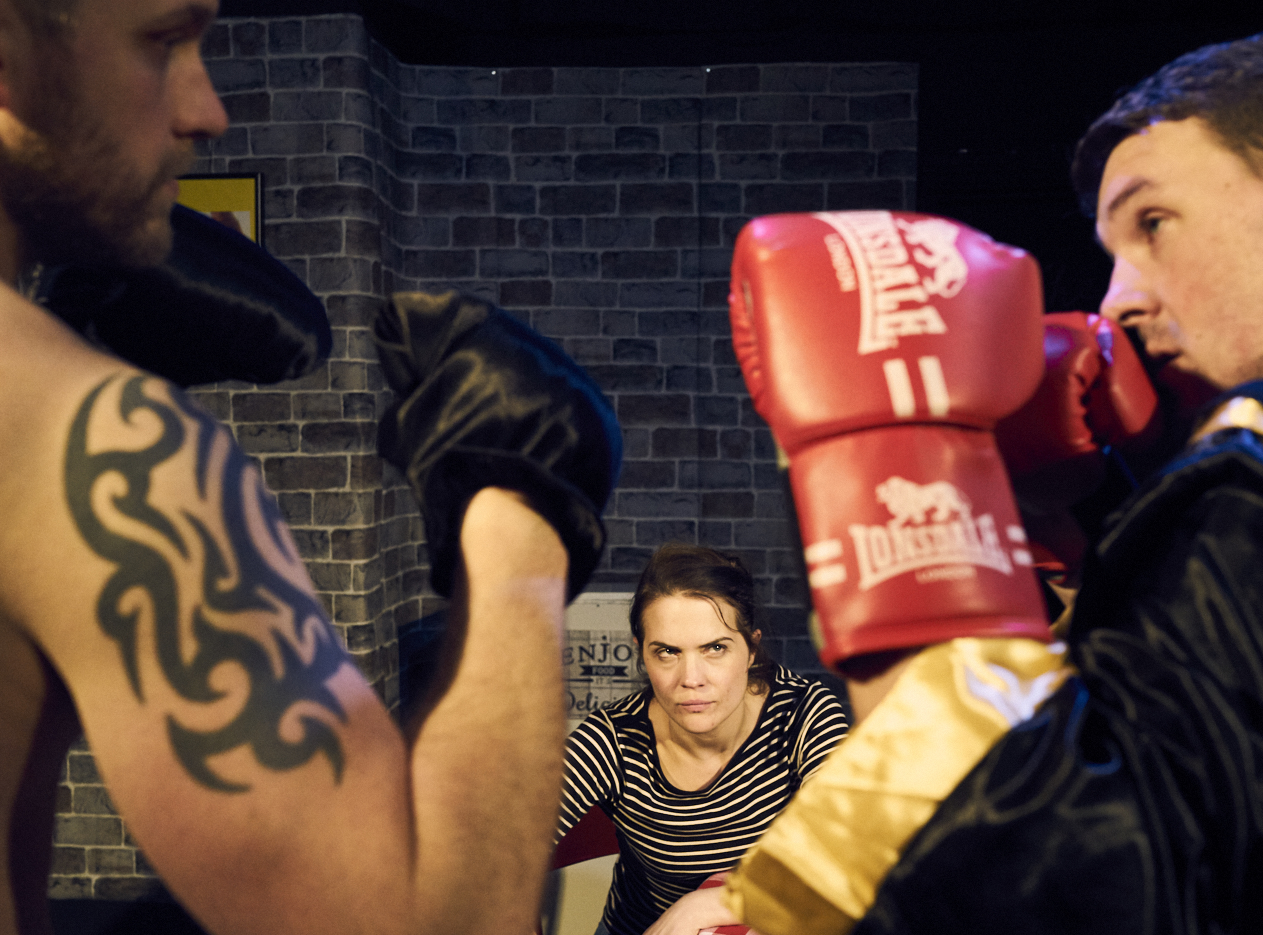
Likeable leads Tori Allen-Martin and Christian James lead a universally strong cast of six, three of whom – Andrea Miller, Christopher Lyne and Prince Plockey – appear in comically opposite dual roles that further highlight the vastly different worlds in which Chelsea and Bertie live. Meanwhile Emily Jane Kerr quite literally sneers for England in a brilliant stand-out performance as the villain of the piece, Princess Victoria.
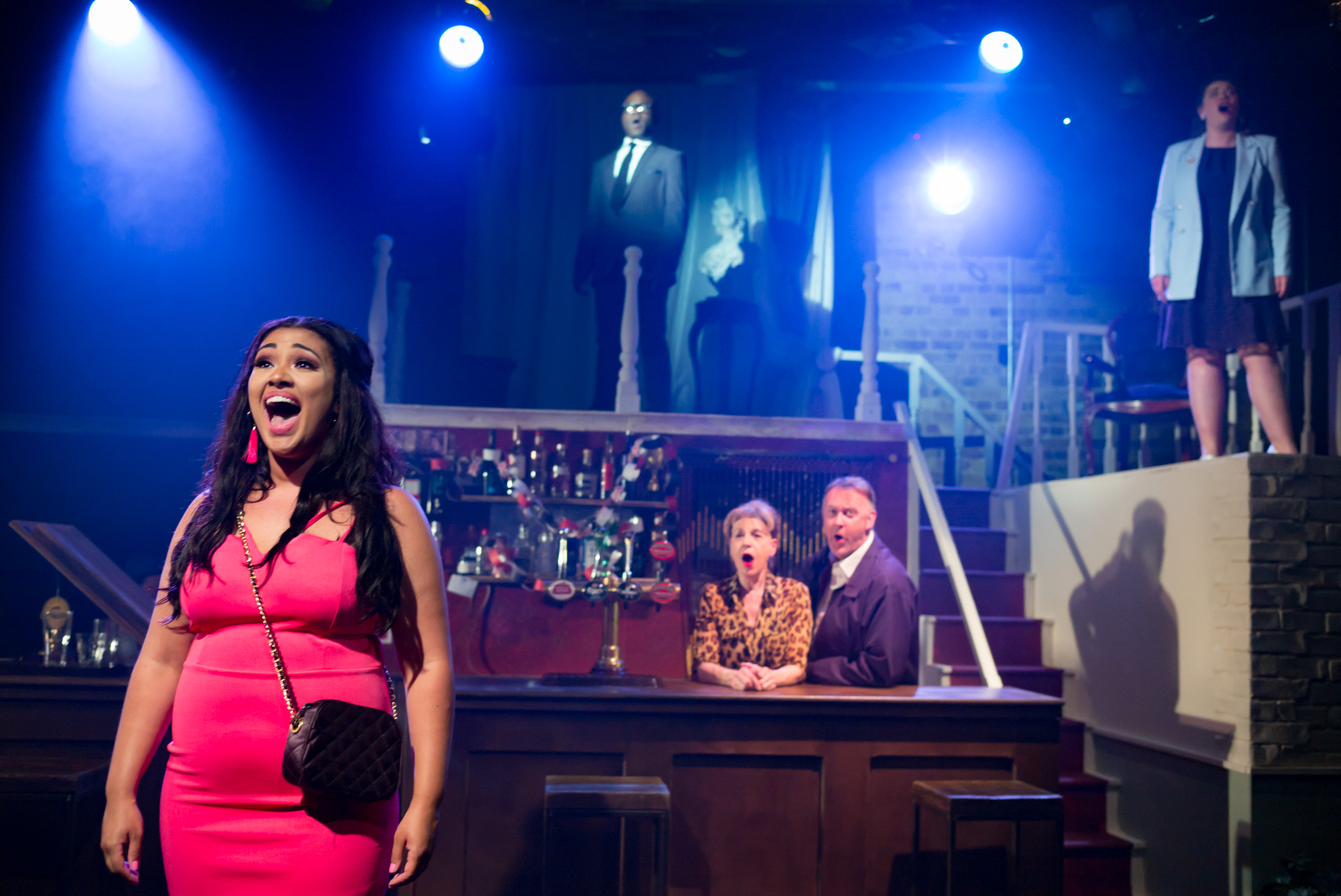
Photo credit: Nick Rutter

The songs are pleasantly catchy and for the most part keep the action moving along, with a repertoire that includes everything from heartfelt ballads to lively East End knees-ups. This varied musical menu allows the cast to showcase some impressive vocal talents, accompanied by musical director Oli George Rew, who’s discreetly installed on a piano in endangered Barking boozer the Dog and Duck.

Much like Chelsea and Bertie’s romance, H.R.Haitch might not always be particularly elegant, but it’s good fun, and its heart is in the right place. And if nothing else, it gives us a couple of hours’ escape from wondering who’s going to walk Meghan down the aisle.


Can’t see the map on iPhone? Try turning your phone to landscape and that should sort it. I don’t know why but I’m working on it… 😉

Interview: Jennifer Davis, Adam and Eve

Following its critically acclaimed debut last year at the Brockley Jack, Broken Silence Theatre’s Adam and Eve returns next week for a longer run at Islington’s Hope Theatre, now with new director Jennifer Davis at the helm.

Adam and Eve is about a young couple who have moved to the country in search of a better life,” explains Jennifer, who takes over from the show’s previous director Paul Macauley. “Everything’s going pretty perfectly until one day Adam is sent home from school following accusations made by a student… It’s a story about truth, lies, temptation and sin.”

Tim Cook’s play was a five-star hit last year, with reviewers describing it as “utterly phenomenal” and “absolutely chilling”. Unsurprisingly, Jennifer is pretty excited to be involved in its revival. “The writing is exceptional. In just 60 minutes Tim has managed to create a gripping, relatable experience that will leave an audience really questioning which version of the truth they believe. I’ve wanted to work with Broken Silence since seeing their production of Crushed at the King’s Head Theatre in 2015; I really admire their commitment to supporting regional writers and new work.”

Some might be daunted by the prospect of taking over such a critically acclaimed play, but Jennifer is looking forward to putting her own stamp on the show and exploring the opportunities that come with a new cast and venue: “I was honoured to be asked, and fingers crossed I create something that will do the previous production justice. We have two new wonderful cast members in Lee Knight and Melissa Parker – not forgetting the brilliant Jeannie Dickinson who was in the original run. There’ll also be a new set design and perhaps a few surprises…

“I’m excited about exploring the Hope’s space, too. It’s such an intimate venue and I can’t wait to see how the play develops when the audience are quite literally eyeball to eyeball with the actors.”

Jennifer studied Drama and Theatre Arts at the University of Birmingham, graduating in 2013. “Originally I wanted to be an actor but at university quite quickly realised that wasn’t for me,” she explains. “I’ve been freelancing as a director for five years now and have really found my happy place – working with new writing!”

Those five years have kept her busy; she’s now a Junior Associate at the King’s Head Theatre and an Associate Artist with Theatre Absolute, and she also founded Shoot Festival, which supports emerging artists in Coventry and Warwickshire. “I’ve been very lucky to work on some incredible projects, so highlights are hard to choose! But if I had to… I’d probably say directing (sorry) by Susie Sillett at the Birmingham Repertory Theatre. It’s a one woman show that explores what it’s like to grow up as a millennial and the pressures we face in today’s current economic, social and cultural climate.”

Review: Fox Hunting at the Courtyard Theatre

With the soaring rate of knife crime in London making almost daily headlines, David Alade’s Fox Hunting couldn’t be any more topical. Based on transcripts of interviews with south Londoners, this verbatim piece explores the multiple and far-reaching effects of knife crime on the lives of five young men, and in doing so turns faceless statistics into an urgent human crisis.

The five guys in question have gathered to pay their respects – although to whom, we don’t yet know. When one of their number recounts an incident on the way in which he had to swerve to avoid a fox in his path, a surprising debate is sparked over the nature of innocence, and what it is and isn’t okay to do if you think your own safety might be at risk. From there, it’s a small side step to get to the heart of the play, as each member of the group shares his own unique experience. Some of them were victims of knife crime, others were perpetrators; all have had their lives changed irrevocably by what happened, and it’s only now that they’re starting to wonder what it was all for.

It’s a cleverly constructed piece of writing from 21-year-old Alade, who also performs – alongside Chris J. Gordon, Devante Mavour, Joshua Lewis and Quinton Arigi. Each of the five stories stands alone, with the other actors stepping in to play supporting roles, and yet they’re united by a strong discursive thread that allows those most affected by knife crime to be part of finding the solution. What emerges very clearly from the play is the realisation that for many young people, in London and elsewhere, the idea of leaving home unarmed is as unthinkable as heading out without their phone, keys or wallet. There’s a constant fear of violence which becomes a self-fulfilling prophecy, and it’s this attitude, Alade argues, that needs to be addressed if there’s to be any hope of halting the increasing rate of knife crime.

Despite the heavy subject matter and some moments that are genuinely quite frightening (particularly if you sit close to the aisle), the play also contains a surprising amount of proper laugh out loud humour. These aren’t hardened criminals; they’re just five young, normal, likeable guys, who all have plenty to live for – education, career, love, faith – and are just going about their everyday life in the best way they know how. It just so happens that everyday life involves carrying a knife, and being prepared to use it.

Photo credit: David Alade

The five actors all perform with energy and conviction, unafraid to engage directly with the audience, and creating characters who are as believable in moments of violence as of reflection. Their stories might not always be the ones that make headlines – with nearly 40,000 knife crime offences recorded in the UK last year, it’s no wonder we only tend to hear about the most serious – but that doesn’t make them any less devastating to that one individual whose life has been changed forever, and that raw emotion really comes through in each of the performances on stage.

What is clear from reading the papers is that something needs to be done, but first it’s important to try and understand the root causes of the problem. Fox Hunting is a clear and powerfully effective attempt to do just that – let’s hope both the play and its talented writer have the successful future they deserve.


Can’t see the map on iPhone? Try turning your phone to landscape and that should sort it. I don’t know why but I’m working on it… 😉

Review: Kes at Brockley Jack Studio Theatre

At just under 70 minutes, Kes – adapted by Robert Alan Evans from Barry Hines’ 1968 novel A Kestrel for a Knave – isn’t a long play, but in the hands of director Kate Bannister and the dream team at the Brockley Jack, even that brief amount of time flies by. The theatre’s latest in-house production is, in fact, something of a masterclass in every sense: performance, design and direction all come together to tell a great story really, really well.

That story is all about Billy Casper, who at 15 years old already knows he’s unlikely to ever get out of the northern mining town he calls home. Bullied by his older brother Jud, ignored by his mother (except when she can steal the wages from his paper round) and victimised by most of the teachers at his school, Billy’s life offers very little to look forward to, until the day he finds a wild kestrel and decides to raise and train her. Through Kes he discovers a freedom, friendship and passion that he’s never known before – but all it takes is one bad decision to put his precarious new happiness in jeopardy.

Photo credit: Timothy Stubbs Hughes

We never actually see Kes, obviously (bird of prey plus small pub theatre would probably be a bad idea; you certainly wouldn’t get me in there), but her presence is very powerfully felt, thanks to two spellbinding performances from Simon Stallard and Rob Pomfret, who both interact with the young kestrel as if she were right in front of them, and to some wonderfully evocative sound design by Jack Barton. And it’s not only the bird who’s conjured into life by the production’s design; Karl Swinyard’s set perfectly encapsulates  each aspect of Billy’s uninspiring everyday world down at floor level, but opens up on higher ground – with the help of some beautiful lighting from Ben Jacobs – to reveal the vast rural landscape where Kes flies free. When she soars through the air, it’s not only Billy’s heart that lifts.

In a production that clearly doesn’t believe in limits, perhaps it should come as no surprise that two actors doesn’t equate to only two characters. Alongside Simon Stallard’s sympathetic and touchingly innocent Billy, Rob Pomfret plays a dizzying array of other roles, from a bullying headmaster to Billy’s mum, slipping from one to the other with ease. Perhaps most interestingly, though, he also plays Billy: an older, wiser version, who tries to protect his younger self from the heartbreak he knows is to come. It works both ways, however, and in looking back and confronting the pain he felt all those years before, the older Billy is also reminded of the joy that came before it – and it’s this emotion that lingers longest as the play comes to an end.

Photo credit: Timothy Stubbs Hughes

2018 marks the 50th anniversary of the publication of Barry Hines’ novel, and I can think of no better way to mark the occasion than with this exquisite production. For some, Kes will bring back memories of the book; for others, it offers an introduction to this timeless story. Either way, it’s a must see.


Can’t see the map on iPhone? Try turning your phone to landscape and that should sort it. I don’t know why but I’m working on it… 😉
Review: Worth a Flutter at The Hope Theatre

Inspired by his memories of growing up in South East London, Michael Head’s Worth a Flutter is an enjoyable comedy with hidden depths – a love story whose protagonists are simultaneously too flawed to be heroes and too likeable to be villains.

The plot follows two men, Matt (Michael Head) and Sam (Jack Harding), as they compete for the affections of a waitress at their local greasy spoon cafe. The twist: both are already in committed but unhappy relationships, and are basically just using the unfortunate Helen (Clare McNamara) as an escape from their current misery. But then things get complicated when they both fall for her, and she’s forced to choose between them. Or is she?

As the story unfolds, Head challenges both the questionable attitudes of his male characters and the traditional damsel in distress paradigm, with Helen emerging as more than capable of looking after herself. What makes the play interesting is that both Matt and Sam seem like decent enough blokes, who both recognise and challenge the outrageous sexism displayed by their cartoonishly obnoxious friends – but both fail to see the same, less explicit, attitudes in themselves.

Michael Head, Jack Harding and Clare McNamara are all strong in the central roles, delivering some enjoyable comedy performances but also revealing their characters’ vulnerabilities as each relives a past trauma which has played a part in bringing them to this point. They’re joined by Paul Danan and Lucy Pinder in a variety of supporting roles. Pinder makes her stage debut playing both Matt’s fiancée Paige and Sam’s wife Emma, but is perhaps most memorable for her exuberant portrayal of a penis with a Scottish accent (yes, really). Danan, meanwhile, is clearly enjoying himself immensely as ageing Lothario Paul and pervy pensioner Mr Edwards.

Directed by Jonathon Carr, the play has a choppy structure that sees the action interrupted frequently by scenes of direct narration from Matt or Sam, with both Head and Harding quickly establishing a connection with the audience. There are also some surreal sketch scenes – including the aforementioned Scottish penis – which are largely superfluous to the story, but are good fun and give the actors a chance to demonstrate their comedy talents (Clare McNamara’s outspoken grandpa and Michael Head’s parade of exes – each of them conveniently from a different bit of the UK – particularly stand out).

Like most romantic comedies, the story relies heavily on coincidence and characters impulsively falling in love and making life-changing decisions. But if the plot is at times simplistic and the comedy a bit silly, the play does shine a light on the prevalence of everyday sexism, even from “nice guys”, and the three central characters have interesting backstories which add new layers of meaning to the plot. Recommended for light-hearted entertainment; if not quite a dead cert, then certainly a strong contender.

Can’t see the map on iPhone? Try turning your phone to landscape and that should sort it. I don’t know why but I’m working on it… 😉