Review: Peepshow at Underbelly Festival

Acclaimed Australian circus ensemble Circa have taken up residence for the summer in the Spiegeltent at London’s Underbelly festival, and are already looking very much at home. The European premiere of their latest offering, Peepshow, opened this week on the South Bank to unanimous gasps of disbelief and awe from a spellbound audience.

Photo credit: The Other Richard

The show moves away from the traditional with an intriguing blend of circus and cabaret, performed by a seven-strong cast under dramatic lights, to music so loud you can feel the beat of it in your chest. There’s a hula hoop routine that’s like nothing you’ve ever seen; a trapeze act that’s as mesmerising as it is terrifying to watch; bodies contorted at seemingly impossible angles; human towers that spring up out of nowhere, then tumble towards the ground at frightening speed. In a fun twist, an unwitting audience member chosen seemingly at random is revealed to be another performer only after she’s been forced to change her outfit on stage, get extremely hands on with a fellow cast member, and suddenly finds herself standing on the others’ shoulders, high above the stage.

The concept of the production, as explained by director Yaron Lifschitz, is to turn the traditional seedy connotations of the “peepshow” on their head, in a show that’s “about looking and about being seen” – inviting us to step through the mirror and view life from the other side. There’s certainly a knowing, almost flirtatious quality to the artists’ performance, which veers at times into burlesque territory; they’re fully aware that we’re there watching and admiring them, and as a result the audience and our reactions become as much a part of the show as the artists we’re observing. Apart from that, though, it’s not really clear what story Peepshow is trying to tell; what we have, essentially, is an hour of mind-blowing set pieces that aren’t really linked in any cohesive way.
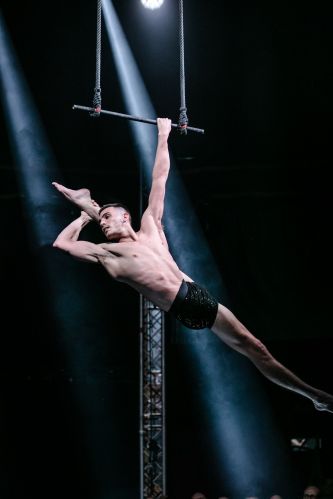
Photo credit: The Other Richard

Whether that matters or not is debatable, however; the skill on display is so astonishing that the audience is guaranteed a good time regardless. Every member of the cast shines as an individual, but Peepshow is all about the ensemble, and when all seven work together – whether they’re nimbly shimmying up a human tower, flinging their fellow cast members into space or balancing at impossible angles in mid-air – the visual impact is stunning. This is particularly true of the finale, which is all the more powerful for the fact we don’t see it coming, preceded as it is by a relatively subdued dream-like sequence that builds almost imperceptibly to the show’s incredible climax.

There’s a reason Circa are known as the rockstars of the circus world; they certainly know how to put on a great show that thrills and entertains. What the show lacks in narrative thread, it more than makes up for in energy and daring, and earns every second of the standing ovation that concludes the evening.

Interview: Liam Ashmead and Laura Shoebottom, Blue Tights, Red Knickers and an ‘S’ on Her Vest

Liam Ashmead and Laura Shoebottom are the co-founders of Thematic Theatre, a company they set up last year to specialise in new writing. Next week they’ll open their debut production, Blue Tights, Red Knickers and an ‘S’ on Her Vest, at the Bread and Roses Theatre in Clapham. Written by Laura and directed by Liam, the play follows the effects of anxiety and workplace bullying on the central character, Jenna, and the toll it ultimately takes on her health.

Laura, who also plays Jenna, has previously had work performed at Theatre 503, The Churchill Theatre and The Tabard Theatre. Blue Tights, Red Knickers and an ‘S’ on Her Vest is her first full production, and was inspired by a conversation with her mum: “Around a particularly stressful exam period, she told me it was ok to ‘take the superwoman outfit off once in a while’ and look after myself rather than trying to be all things to all people. It’s always stayed with me and the message is the essence of the show really, that it’s impossible to be everything to everyone.”

As a new company making their debut, Laura and Liam are looking forward to sharing their show with audiences within their local area, and taking the opportunity to start a conversation about mental health. “We hope that audiences will empathise with Jenna, but mostly it’s about raising awareness for mental health. We’re so happy that we’re fundraising for Mind because it’s a charity that’s very close to both our hearts.

The two friends graduated last year from Italia Conti, where they decided to set up their own company – and Thematic Theatre was born. “We knew that we enjoyed working together as creatives and we were both passionate about creating new work for ourselves, so we thought a theatre company would be a great route to go down.

“We want to collaborate with as many people as we can and make contacts with others who share the same passion as us. We’ve both been involved in many scratch nights and new writing festivals and we believe they are great platforms for creatives. We want to offer these same opportunities to others and we aim to do this through our own new writing event ‘Box of Themes’, where we pick out a theme and then get writers/ directors and actors to create a short piece based around it.”

Both founders agree that starting their own company has been both exciting and challenging: “The biggest challenge has been trusting our work and making sure it’s sensitive to the subject matter. We’re very excited about it but as it’s our first time producing we naturally have moments of doubt. It’s also very expensive putting on a show so there’s always money to consider, and balancing rehearsals and promotion alongside our other jobs.

“Creatively, though, it’s been amazing. We both work well together and we’ve enjoyed the freedom and fun we’ve had in the rehearsal room – there’s equal control and it’s relaxed since we’re good friends. There’s always been that mutual trust and respect there so we’ve been able to be totally honest about whether something works or not from the get go; that’s something we’re both really thankful for.”

Following next week’s short run at the Bread and Roses, Laura and Liam are looking ahead to the show’s future. “We plan to take it to The Vaults and the Edinburgh fringe next year. We’re really happy with where the play is at the moment and we want to use this run in London to get an idea of how audiences react and develop it even more.”

Review: Knock Knock at RADA Festival

Now in its seventh year, the annual RADA Festival brings together past graduates and a network of theatre-makers from different backgrounds in a ten-day celebration of new writing, emerging talent and the possibilities of theatre today. Key among the aims of the festival is to ensure that theatre is open to all; in line with this objective, tickets start at £5 and the three headline shows each place a strong emphasis on accessibility.

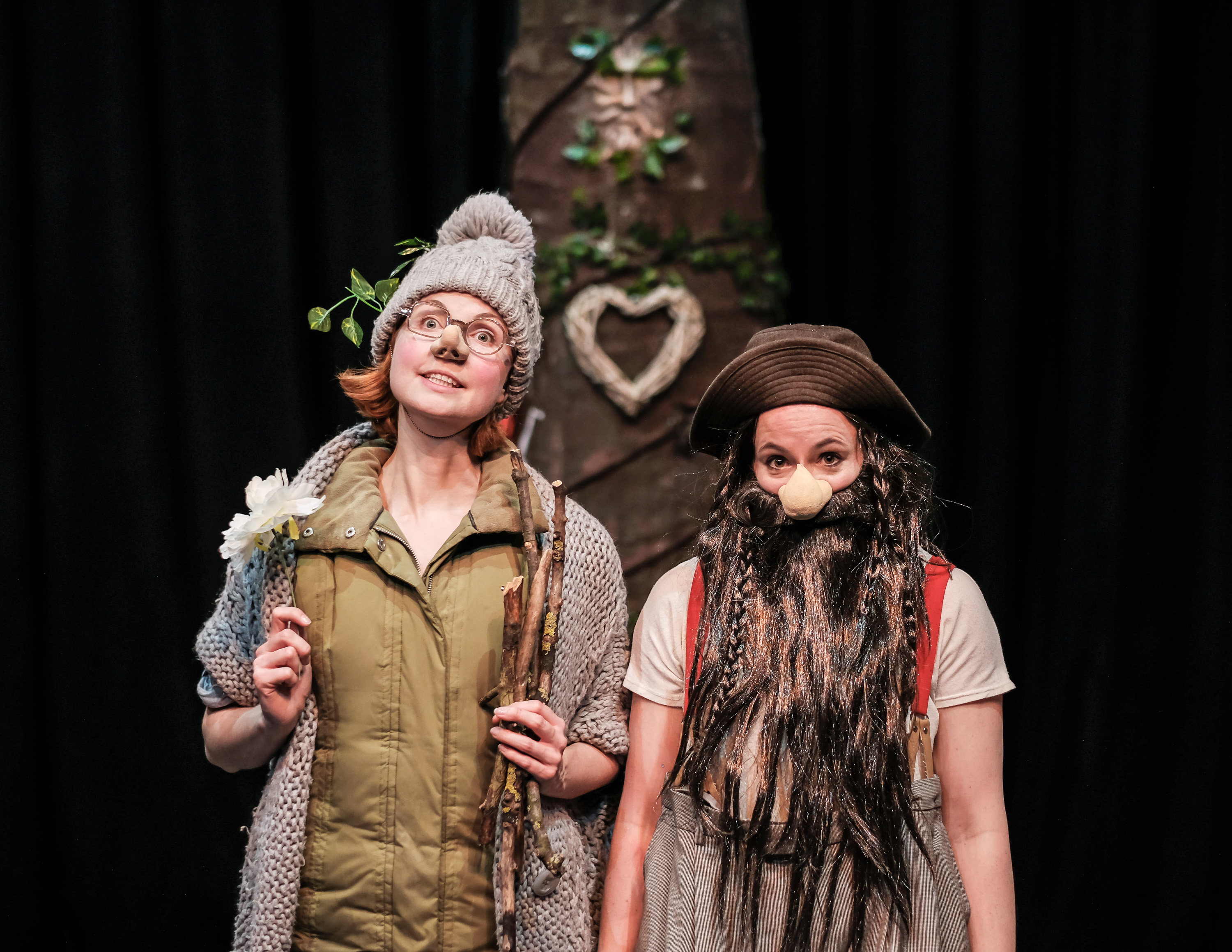
For Hot Coals Theatre, this is nothing new: since 2008 the company has specialised in work that’s fully accessible to d/Deaf and hearing audiences, and their latest show Knock Knock is also designed to be accessible to all ages. highly visual performance style, combining comedy, clowning and physical theatre, removes any need for spoken word or sign language while still ensuring the story and its message are easy to understand.

Photo credit: Hot Coals Theatre

Modern fairy tale Knock Knock tells the story of a woodcutter whose solitary existence is interrupted when a woman he’s never met before knocks at his door. It’s love at first sight, but when they both succumb to the pressure to live up to “traditional” gender roles, the happiness of their perfect union is threatened. Can they see past what’s expected of them and live the way they want to, or is their relationship doomed?

It’s impossible not to be charmed by the story’s loveable characters, who are brought beautifully to life by Hot Coals founders Jo Sargeant and Clare-Louise English. Spoken word proves to be unnecessary as the two communicate their thoughts and emotions through movement and facial expressions (Sargeant’s twinkly eyes above her bushy beard are a particular highlight). We share all their joy and heartbreak, and also enjoy some moments of cheeky humour that lift the characters out of the two-dimensional fairy tale world and make them real, imperfect human beings we can relate to.

A meticulously observed set also aids the storytelling, dividing the stage in two so the characters can move easily between their cosy living room and the mysterious, magical woods just outside their door. The structure of the show is based around the establishment of patterns; the opening sequence takes turns to introduce the two characters in their individual routines, while the second half of the story shows how their domestic activities change little by little as each day passes. Visually this works very successfully to demonstrate the gradual transition in their lives – we can see the way things are going long before they do – although the musical soundtrack does start to become a bit overbearing by the third or fourth repetition.

Photo credit: Hot Coals Theatre

Sweet, funny and with a powerful and very topical message for audiences of all ages, Knock Knock packs a surprising emotional punch. Within minutes, I was completely caught up in the story and rooting for the characters to resist the stifling social expectations that stand in the way of their happy ever after, both as a couple and as individuals. All in all, it’s a very worthy headliner for the RADA festival, and hopefully a show with a great future.

Can’t see the map on iPhone? Try turning your phone to landscape and that should sort it. I don’t know why but I’m working on it…

Review: A Midsummer Night’s Dream at Wilton’s Music Hall

You know it’s officially summer when A Midsummer Night’s Dream comes to town. Like A Christmas Carol in December, it seems like every year brings us at least one new production of Shakespeare’s comedy, and it’s easy to give in to Dream fatigue and assume the play can’t possibly have anything original left to say.

The Faction have taken this on board with their stripped back production, and director Mark Leipacher keeps things simple so that the focus returns to the original text without the distraction of elaborate new interpretations. By having so little in the way of set or costumes – all the characters wear modern everyday clothes, and the only nod to the Athenian setting is the orb of the moon which hangs above the stage – we’re able to see the story through fresh eyes and draw new conclusions as to what it’s all about. Personally, I picked up on several themes and textual elements that I’d never considered before in 20 years of seeing A Midsummer Night’s Dream performed; it’s both refreshing and exciting to see such a well-worn classic through fresh eyes.

Photo credit: The Other Richard

Having said all that, ironically you do need to know the play reasonably well to keep up with the complex and fast-moving plot – particularly as the multi-roling cast can change character in the blink of an eye, without any change of costume and often without even leaving the stage. For the most part the versatility of the actors means this works well, but there are some moments where scenes blur together and it takes a while to unpick who’s now playing who. (On the plus side, doubling up the roles does mean that the Mechanicals get to conclude the show and perform their gloriously terrible Pyramus and Thisbe uninterrupted by the mocking taunts of the newly-weds.)

Given the treatment of women in the play (and – let’s be honest – most of Shakespeare’s plays), it’s good to quickly see some strong female leads emerge. Tamarin McGinley doubles as Hippolyta, who might be marrying Theseus (Herb Cuanalo) against her will but has no intention of entering the union meekly, and Titania, who refuses to give up her page to Oberon despite all his threats. Meanwhile Lowri Izzard’s Hermia risks everything to avoid her own arranged marriage, and fiercely defends her virtue even against the man she’s just eloped with, insisting that Lysander (Jeremy Ang Jones) sleep further away from her despite his best efforts to convince her otherwise.

Photo credit: The Other Richard

In many ways this is a play of two halves; while Act 1 sets the scene and explores some of the story’s darker themes, Act 2 is pretty much wall-to-wall laughs, with Laura Evelyn’s bewildered Helena, Christopher Hughes’ hilariously over-the-top Bottom and Christopher York’s self-conscious Snout (a.k.a. The Wall) stealing the show. The whole cast display great physicality throughout – the lovers’ fight is a particular highlight, as is the moment Linda Marlowe’s Puck enters on Bottom’s back, her hands raised to create his donkey ears.

If ever we needed proof that Shakespeare can still be relevant to a 21st century audience, we have it in this production. It’s got royal weddings, climate change and honour killings, gender roles, body image and the question of consent, all wrapped up in a joyously entertaining evening with great physical comedy and strong performances from a talented ensemble. It takes some doing to breathe new life into such a well-known text, but The Faction have pulled it off. Dream fatigue – what’s that?

A Midsummer Night’s Dream concludes its run at Wilton’s Music Hall on 30th June. Visit The Faction’s website for details of future productions.

Review: The Tempest at St Paul’s Church

Amidst the chaos and bustle of London’s Covent Garden, St Paul’s Church feels like a little oasis of calm and tranquility. Affectionately known as The Actors’ Church, St Paul’s has been home to Iris Theatre since 2007, and the company’s tenth summer season gets off to a strong start with their promenade production of The Tempest.

Believed to be Shakespeare’s last solo play, The Tempest is a story about love, magic and redemption on a deserted island, where exiled duke Prospero and his faithful spirit Ariel plot revenge on his enemies after they’re washed ashore in a shipwreck. Meanwhile, Prospero’s slave Caliban has run off with some drunkards, and his daughter Miranda’s fallen in love with the third man she’s ever seen in her life – who conveniently happens to be the king’s lost son Ferdinand.

Photo credit: Nick Rutter

The first thing to say about Daniel Winder’s production is that it’s visually gorgeous. Mike Leopold’s nature-inspired set looks perfectly at home within the beautiful garden setting, Anna Sances’ costumes are full of rich, vibrant colour, and as the daylight fades, Benjamin Polya’s lighting design brings the play to an atmospheric conclusion. Throw in a clever sleight of hand magic scene, a singing spirit and a handsome prince, and you’ve pretty much got a fairy tale come to life.

Jamie Newall leads the cast of seven as a quietly authoritative Prospero; it’s a sympathetic interpretation of the character, whose actions seem motivated more by a sad weariness than by rage or tyranny. Linford Johnson and Joanne Thomson make a sweet and charmingly awkward couple as Ferdinand and Miranda, and Paul Brendan and Reginald Edwards offer great entertainment as the drunkards Trinculo and Stephano, who tempt Prince Plockey’s Caliban with booze and inadvertently find themselves talked into an ill-fated attempt to murder Prospero. The star of the show, however, is Charlotte Christensen as Ariel – a quirky, omnipresent figure, watching both characters and audience with a bird-like curiosity that’s both endearing and ever so slightly sinister.

Photo credit: Nick Rutter

The promenade aspect of the production, which takes us to three different locations within the gardens and briefly inside the church, works as well as can be expected. Waiting for the entire audience to move from one location to another (particularly when the paths are narrow and require us to travel single file) inevitably breaks up the action, but the actors work hard to keep the atmosphere alive in between scenes, and we’re always encouraged to feel like we’re part of the action. While I wouldn’t quite describe it as an immersive production, this also isn’t a show you just sit back and watch – so be prepared to potentially get a little bit involved…

I’d recommend The Tempest to anyone looking for a traditional Shakespearean production with a bit of a twist. While it may not bring us any radical new interpretations of the text, it does make for a thoroughly enjoyable evening, taking full advantage of a lovely setting to offer a welcome retreat from the madness of the city.

Can’t see the map on iPhone? Try turning your phone to landscape and that should sort it. I don’t know why but I’m working on it…