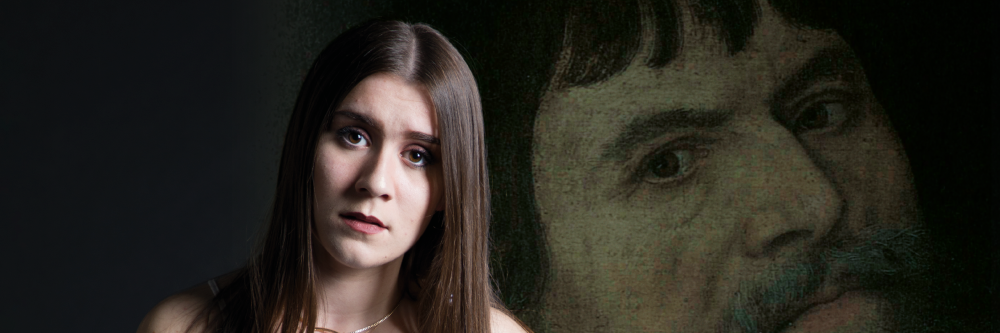
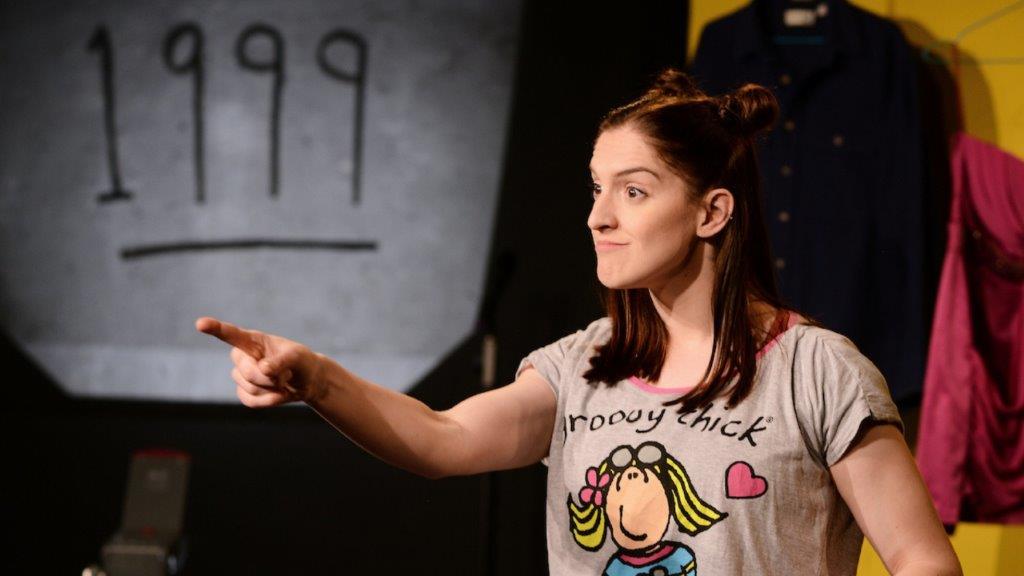
Review: Dark Sublime at Trafalgar Studios

Marianne (Marina Sirtis) is an actress, best known for her role in cult 70s sci-fi TV show The Dark Sublime. She’s done plenty of other acting work in the intervening four decades but the role of Ragana is the one she can’t shake off, even though to her, it’s the one that means the least. When Dark Sublime superfan Oli (Kwaku Mills) – who wasn’t even born when the series first aired on TV – tracks her down, an unlikely friendship develops. But what begins as an opportunity for Marianne to bask in the glory of her past ultimately forces her to confront the complications of her present, and in particular the unrequited love she feels for her best friend Kate (Jacqueline King).
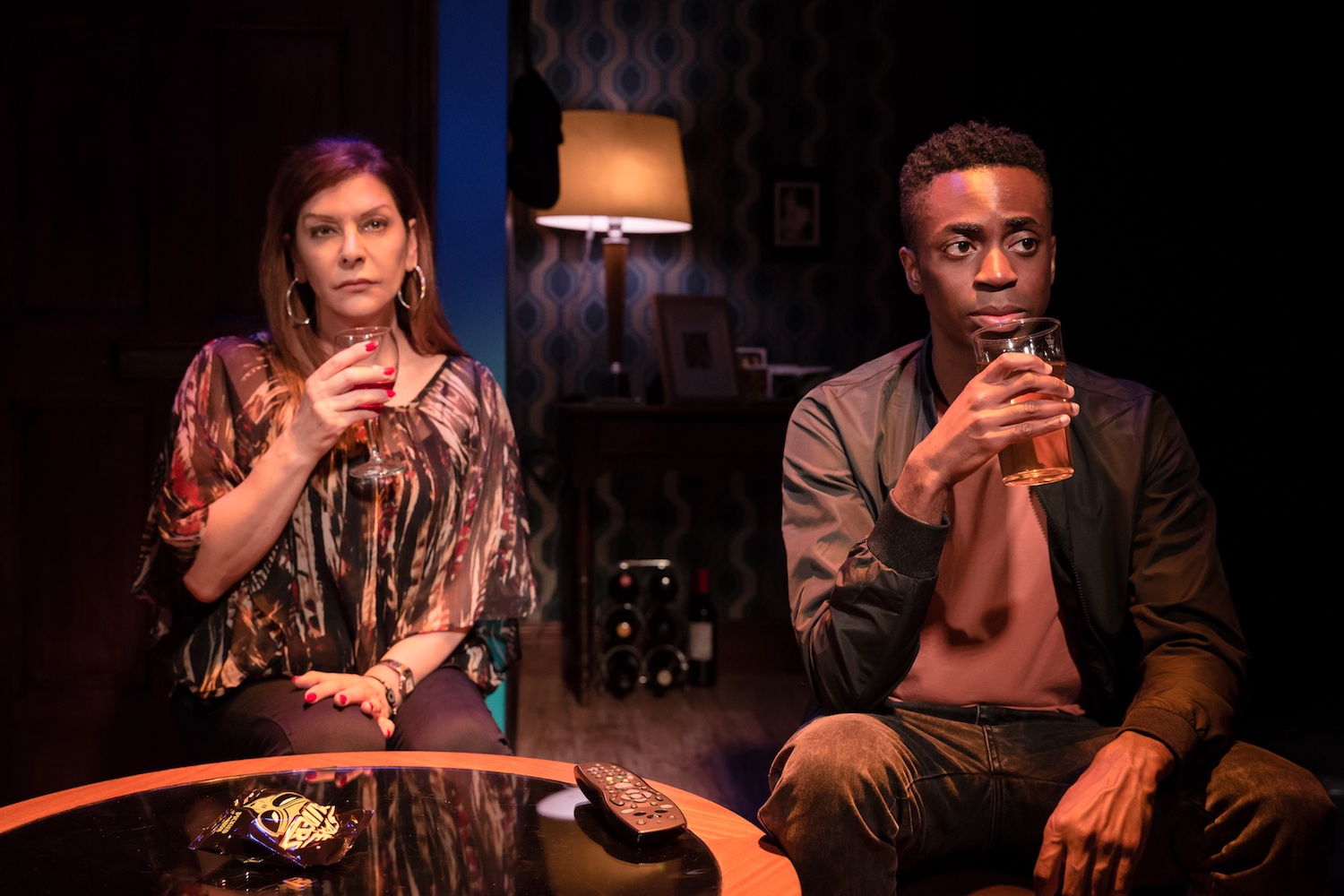
Photo credit: Scott Rylander

One of the production’s biggest draws (the other being Mark Gatiss as the voice of a robot) is star Marina Sirtis, who is herself well known for playing the role of Deanna Troi in seven series of Star Trek: The Next Generation. While writer Michael Dennis didn’t create the role of Marianne specifically for Sirtis, he could very well have done, and this gives the character a sense of genuine depth; each time she expresses bewilderment at the unquestioning adoration of her fans, the audience understands that the emotion comes from a real place.

Real world parallels aside, Sirtis generally impresses with her portrayal of Marianne. Though she’s always quick with a witty comeback, it’s clear quite early on that the character is also really struggling to figure out where she fits in a world that no longer seems to have a place for her. Kate has a new partner – the younger, attractive, intelligent Suzanne (Sophie Ward) – and Marianne’s acting career seems to have stalled to the point where earning even £40 feels like a windfall. It’s little wonder she jumps at the chance to meet Oli, who idolises her Dark Sublime character and reminds her of who she used to be.

Speaking of Oli, Kwaku Mills is a delight, his charm and enthusiasm lighting up the room every time he’s on stage. Oli has issues of his own that mirror Marianne’s – he’s also in love with his best friend, but unlike Marianne, he’s prepared to do something about it. Much is made of his youth and his obsession with The Dark Sublime, as if those are reasons to dismiss him, and yet he repeatedly shows more maturity and a deeper understanding of the world than Marianne, who prefers to drown her problems in alcohol.

During one of their early conversations, Marianne reveals to an excited Oli that another episode of the show was written but never shown on TV, scenes from which are revealed intermittently throughout the show. These are, for the most part, played for laughs by Simon Thorp, who’s clearly enjoying himself immensely as the heroic Commander Vykar (and just as much in a brief appearance in the real world as obnoxious actor Bob). So it comes as something of a surprise when the final scene, which brings in the whole cast, gets pretty deep and is ultimately revealed to be symbolic of Marianne’s own personal journey.

Tim McQuillen-Wright’s attractive and intimate set design places us right in Marianne’s living room, although not all the action takes place there. There’s a console cunningly concealed in the coffee table, suitably 70s sci-fi lighting when called for, and a TV screen that doubles as a backdrop when scenes occur elsewhere. This sort of works, although the size of the screen isn’t really sufficient to properly distract us from the stylish decor of the flat and convince us we’re really in the park or a cheap hotel.

Photo credit: Scott Rylander

The other issue with the play is that at 2 hours 40 minutes it just feels a bit longer than it needs to be. Even before bringing in the deleted scenes from the TV show, there are several plot threads going on – Marianne’s career and her relationships with both Kate and Oli, Oli’s friendship with Joel (who never actually appears), Kate’s romance with Suzanne – and in tying them all up the script begins at times to feel slightly sluggish and repetitive. That said, the closing scene, which references the poem by W.H. Auden that gives the play its title, is rather lovely and feels like a fitting end to the story.

For fans of British TV from the 70s and 80s, Dark Sublime is probably a bit of a must-see, if only so you can sit and cheerily sing along to the Cadbury Fudge jingle before the play begins (yes, I did that). But there’s lots more to recommend it besides nostalgia. This is a rare personal drama about an older gay woman trying to find her place and identity in a changing world, with plenty of laughs – particularly aimed at the world of showbiz – and some interesting questions about the nature of fandom. A bit long perhaps, but still well worth a watch.

Dark Sublime is at Trafalgar Studios 2 until 3rd August.

Review: Bare: A Pop Opera at The Vaults

A couple of weeks after a priest in the USA tweeted that “Catholics should not support or attend LGBTQ ‘Pride Month’ events held in June”, Bare: A Pop Opera – the story of two teenage boys at a Catholic boarding school who are forced to keep their love a secret – feels depressingly topical. Damon Intrabartolo and Jon Hartmere’s show premiered in California nearly two decades ago, but there’s nothing historic about the issues it tackles, as is emotionally demonstrated in the powerful finale of this new London production at The Vaults.

Photo credit: Tom Grace

Set against the backdrop of a school production of Romeo and Juliet, Bare‘s own star-crossed lovers are Peter (Daniel Mack Shand) and Jason (Darragh Cowley), who know all too well the dangers of making their relationship public. While Peter tries to come out to his mum (Jo Napthine), Jason allows himself to be drawn into an ill-fated liaison with Ivy (Lizzie Emery) – with inevitably tragic consequences. Meanwhile, as the seniors prepare to graduate, Jason’s twin sister Nadia (Georgie Lovatt) and classmate Matt (Tom Hier) each deal in their own way with living in the golden boy’s shadow.

The show tackles several important issues, and on the whole does so pretty well, though the storyline feels at times a bit predictable. Intrabartolo’s rock score, performed by Alasdair Brown’s band from the balcony at one end of the theatre, is not instantly memorable but still exciting enough to hold our attention, and there are several highlights among the extensive list of musical numbers; it has the feel of a soundtrack that would really grow on you after a few repeat listens. Though the cast is universally solid, it’s the female vocalists who really stand out, especially Georgie Lovatt (in a sensational professional debut), Lizzie Emery and – not altogether surprisingly – X Factor USA finalist Stacy Francis as the delightfully exasperated Sister Chantelle.

Julie Atherton’s production gets a lot of things right, and showcases some considerable talent among its young cast. Unfortunately, though, the staging at The Vaults feels badly thought through, and results in an audience experience that isn’t nearly as enjoyable or comfortable as the show and its hardworking cast deserve. A very long, narrow stage and poor venue acoustics mean that frequently lyrics and dialogue go unheard by half the audience because the actor’s so far away, and with the stage raised at eye level, parts of the action get completely hidden from view by whatever’s happening in the foreground. In addition, there’s a thrust stage out into the auditorium that means part of the audience must watch a lot of the action over their shoulder – including the big finale, which takes place towards the back of the room – and run the risk of being dazzled by spotlights at fairly regular intervals.

Photo credit: Tom Grace

It’s a pity that we don’t get to see everything that happens, because what we do see is visually very striking. At the rear of Libby Watson’s otherwise functional set, forbidding religious art looks down on the teenagers, while at the other end stands a single tree covered in glorious autumnal foliage, the significance of which only becomes clear in the show’s emotional closing moments. Andrew Ellis’ lighting design brings extra vibrancy to certain key scenes, particularly when coupled with Stuart Rogers’ choreography.

Recent headlines have made it all too clear that Bare is a story the world still needs to hear, and this production is a decent attempt at telling it. In a different venue, it’s easy to imagine the show making quite an impact; unfortunately in its current home, it just misses the mark.

Bare: A Pop Opera is at The Vaults until 4th August.

Starved: Q&A with Michael Black

Following a short run at the Bread and Roses in May, Michael Black’s award-nominated play, Starved, transfers to the Hope Theatre next month. A grimly realistic portrayal of life below the poverty line, the third production from new writing company Faded Ink is directed by Matt Strachan, with Michael reprising his role as Lad alongside Alana Connaughton’s Lass.

The Starved team will be hoping to repeat the success of the show’s previous run, which earned several five-star reviews and a nomination for London Pub Theatre’s Standing Ovation Award. Michael chatted to Theatre Things about introducing Lass and Lad to new audiences, and why it’s so important for people to hear their story.

Can you sum up briefly what Starved is all about?

Starved is a two-hander set in a scruffy bedsit on a council estate in Hull. It’s a character driven story about a couple on the run, with hard hitting themes such as mental health, poverty, addiction, toxic relationships. Starved also has a lot of comedy, fast paced and witty Yorkshire humour.

Where did the inspiration for the story come from?

The play is semi-autobiographical and based on my life growing up in Hull. I wanted to really turn the heat up on these characters and look at what people can be driven to when they feel isolated. When they feel like they have no meaningful purpose or place in society. Starved is based on things I’ve heard, seen, been through, but taken to that extreme.

Why do you feel is this story an important one for you to tell, and for a London audience to hear? And why is now the right time to tell it?

I wanted to put a Northern working class story on a London stage. The North of England feels under represented in Theatre, which is a shame because the people I’ve met and stories I’ve heard would make for really gripping and exciting new work. People I’ve spoken to are feeling scared, alone, pissed off, not listened to, ignored etc, especially in areas like where I grew up. I feel a story such as Starved can help break that London bubble slightly and show that there is a whole other way that people are forced to live, which might go some way in explaining the current divide.

What do you hope that audiences will take away from seeing the play?

I hope a sense of understanding that there are people out there that are having a really shit time of it. If we can be more compassionate towards those that have fallen under then hopefully we can start a conversation about how we can work together to see eye to eye. Also, I hope it’s refreshing to see a play set in Hull.

What are you most looking forward to about reviving the play at the Hope?

Really excited to work with a new group of people, we’ve got new designers and stage manager etc so looking forward to collaborating with them. Also, for new audiences to see the show and to just get back out there and see where it takes us.

Did you always want to be a playwright, and if not what was it that first sparked your interest in theatre?

I always had an interest in writing as a kid, I’d write episodes of The Simpsons and short stories. But it wasn’t until I moved to London to train as an actor that I really started to combine the two and realised that I had some stories in me that were worth telling.

On a related note, how did Faded Ink get started as a company, and how would you describe your mission?

Faded Ink was founded with the aim of producing high quality work that reflects working class backgrounds. We want to perform stories which represent communities that are not regularly touched upon in the theatre. Bringing something raw, passionate and based on personal experience to our work.

Book now for Starved at The Hope Theatre, 16th July to 3rd August.

Director: Matt Strachan

Cast: Michael Black and Alana Connaughton

Reformation: Q&A with James Martin Charlton

James Martin Charlton is an award-winning playwright whose previous work includes the critically acclaimed Fat Souls, I Really Must Be Getting Off and Coward. This week sees the premiere of his new play, Reformation, which runs at the White Bear Theatre until 13th July. The play was inspired by the life and work of the Renaissance artist Lucas Cranach and tells the story of Eva, a young woman caught up in a world of powerful men. Directed by Janice Dunn, the production – staged in contemporary dress – strikes a topical note, with clear connections between Eva’s story and the #metoo movement.

As Reformation approached its opening night, we spoke to James about the importance of telling untold stories, getting to know Cranach, and just how much really has changed over the last 500 years…

Can you sum up briefly what Reformation is all about?

Reformation is the story of a young woman from a poor background who becomes involved with a celebrity artist and his son. The son falls in love with her and the artist uses her as a life model. When the powerful man who commissioned the artist sees a sketch of the model, he not only wants the painting – he wants the girl. It’s about what a person might be faced with doing in order to survive.

Where did the idea for this story come from?

An exhibition in Berlin of works that Lucas Cranach and other Renaissance artists did for the Berlin royals. I became fascinated by the portraits by Cranach of Joachim the Elector and his brother, and also by Cranach’s self-portrait. Looking at Cranach’s moral scenes, I was struck by how much flesh was on display. These were paintings which ostensibly counselled the viewer against being led astray by desire. At the same time they provoke desire. And I noticed a small, anonymous sketch of the Berlin of the time, with a gallows on the outskirts. Powerful men, desire, the consequences of upsetting the powerful were all there. I began to tell myself a story which put all of this together…

Why was this a story you wanted to tell, and why is now the right time to tell it?

I tend to write about people whose stories don’t usually get told. People on the side-lines. People who are neglected. People the media ignores. We hear a lot in the history books about the movers and shakers, artists and rulers, but what of the people around them? Each of their lives were important, and each life has profound depths. Luckily, we’re living in a time when such people are beginning to tell their stories and be heard. Obscure individuals are telling us how they brushed up against the wealthy, the powerful, the influential, and how that encounter then shaped their subsequent lives.

What would you like audiences at the White Bear to take away from seeing the play?

I hope that they’ll feel entertained, thrilled, moved, a little disturbed perhaps. I do not write plays with messages in them. I want each individual in the audience to encounter the story and think about what it might mean to them. I believe that stories should be democratic, and so I give the audience the choice of how to respond, what to think about what they have seen.

#metoo has been a frequent theme in theatre over the last couple of years. What is it that makes Reformation unique as a contribution to this ongoing conversation?

I conceived of the play sometime before #metoo hit the headlines. I choose stories which can be applied to any time and place. It is important for us to remember that our problems have been bothering humanity forever. The play, uniquely I think, connects #metoo to the Reformation. There seems to me to be some ongoing process of reformation which is happening with human beings, where we challenge power structures which become too rigid, bring their failings to light. Yet history tells us that new power structures emerge, which themselves become rigid. Have we really reformed?

Photo credit: Max Harrison

How much of the play is based on historical fact – and does that significantly change your approach or process as a writer?

The powerful, famous characters are based on real people. Lucas Cranach and his son, the Elector Joachim and his Bishop brother Albert all existed. The peasants in the play are invented. Their encounters with the powerful are speculations. If I am writing a historical piece, I try to soak myself in the period as much as possible. I consume volumes of books, paintings, music, anything that helps. Then I treat all of this as the material for the play. No play is entirely a fiction, it’s all based in something one has encountered, either in one’s own life or in finding out about somebody else’s life. I take found material in and use it rather in the way the unconscious mind uses stuff when we’re dreaming. Any play of mine is a dream based on the real, with its own rules and roads.

Finally, as a successful writer, what would be your top tip to aspiring playwrights or those just starting out?

Find out as much as you can about everything you can. Keep up with what is happening in the world but don’t just look at contemporary stuff. Read myths, folktales, history. See and hear as much as you can, in any medium you can. But never lose sight of your own perspective. You’re a unique individual, and will have encountered things in a way in which only you individually could have. Try to talk to the individuals in your audience from that place which is known only to you.

Director: Janice Dunn

Cast: Jason Wing, Ram Gupta, Alice De-Warrenne, Imogen Smith, Adam Sabatti, Simeon Willis and Matt Ian Kelly

Review: Hedgehog at the Lion and Unicorn Theatre

Remember being a teenager, when the most important thing in the world was what other people thought of you? Yep, me too. And so does Manda (Zöe Grain), the protagonist in Alexander Knott’s Hedgehog; she’s living it right now, and it’s not going so well. She’s just lost her job at the local vet – over a hedgehog, of all things – and her parents are in the slow and painful process of splitting up. Her “friends” seem barely to even tolerate let alone like her, and every time she meets a nice guy, she thinks he’s the one… until she finds out he definitely isn’t.

Photo credit: Charles Flint Photography

The problem is that it’s the 90s, she’s a teenager, and nobody’s told her that it’s okay to not be okay. So Manda puts on a smile and gets dressed up for a night out she knows she won’t enjoy, at a club she’s too young to legally be in, where she’ll down shot after shot in a futile attempt to smother her fear, loneliness and insecurity, and – even if just for a moment – to try and make sure that someone actually sees her.

Though Hedgehog is essentially a monologue and has the feel of a one-woman show, Manda is not in fact alone on stage. She’s joined throughout by “Them” (Lucy Annable and Emily Costello), who not only take on the role of all the people in Manda’s life, but also become the little whispering voices in her head that tell her she’s not good enough, not cool enough, not lovable enough. This brings Manda’s turmoil and desperate need for validation out of her head and gives it a physical manifestation that’s perfectly embodied by Lucy Annable and Emily Costello. The two of them are a constant, vibrant and versatile presence on stage, but without ever distracting from Zöe Grain’s brilliant central performance.

What makes the story of Hedgehog so sad, and at the same time such an absorbing 70 minutes of theatre, is that Manda seems great. She’s funny, caring and refreshingly down to earth, she really does look amazing in her pink prom dress, and she does an awesome Spice Girls dance routine. Grain engages fearlessly with the audience from the moment the play begins, and we like her from the off – which is why it’s so hard to watch her chasing the approval of her awful “best friend” Claire, her absent mum or her latest crush, just to make herself feel better.

Photo credit: Charles Flint Photography

Set to a soundtrack that incorporates 90s classics alongside original composition from Sam Heron and James Demaine, Hedgehog is a fast-paced and often unpredictable ride. Timelines get tangled, scenes switch in the blink of an eye, and the audience is not so much carried as dragged along with Manda as she reaches the point that will either break her or give her the fresh start she so desperately needs. The emotional climax of Georgia Richardson’s production is particularly powerful, a poignantly simple and unexpected moment of human connection that anyone who’s ever felt alone or helpless can’t fail to be moved by. Insightful, relatable and beautifully performed, this play is a must-see – and let’s hope, unlike the eponymous hedgehog, it has a long life ahead.