To film or not to film, shouldn’t even be a question

Oh, Benedict Cumberbatch. As if we didn’t love you enough already.

Exactly a year ago today, I’d just triumphantly completed my booking for Hamlet at the Barbican, after several hours monitoring multiple browsers and waiting impatiently to make my way up from 8,000th in the queue to number 1.

I won’t be seeing Hamlet until September, but a lucky few already have; the production finally opened for previews at the Barbican last week… and it’s already making headlines.

First, there were all the fans who flew in from across the world to catch a glimpse of their idol, whether they had tickets for the play or were just hoping to spot him outside the theatre.

Then there was the controversy caused by the Times, the Telegraph and the Daily Mail, who published reviews based on the first preview, rather than waiting until press night like everyone else. (If we can really use the word ‘review’ to describe Jan Moir’s gushing report, which included illicit and poor quality photos, and totally ignored the rest of the cast. Who knew Hamlet was a one-man show…?)

And now Benedict Cumberbatch himself has made a special stage door appearance to plead with fans not to record during the play. Which really should be common sense – but apparently isn’t.

Personally, I don’t understand why anyone would want to record a live performance. Doesn’t that sort of negate the whole ‘live’ part? If you’re watching it through your phone, then you’re not really watching it, and even if you view your video again later, it’s hardly the same thing. It’ll probably be pretty poor quality, and a bit wobbly, and the sound won’t be great, and you’ll realise, too late, that maybe you should have watched it live in the first place. I don’t know about anyone else, but when I see Hamlet next month, I want to remember watching and experiencing the play – I don’t want to remember filming it.

Then there’s the fact that it’s really distracting – for people sitting nearby, and, more importantly, for the actors. It always amazes me how many theatregoers don’t realise that when their phone lights up, they’re not the only person who can see the glow, especially in a dark theatre.

And finally, there’s the all-important question of respect. The actors on stage – any stage – have worked for months to prepare for this performance; it’s not like they’ve just rocked up on the day like we have. So don’t we owe it to them to sit quietly, pay attention and listen? And if not, there doesn’t seem much point in going to the theatre at all – we might as well just wait for the inevitable DVD version.

I don’t honestly know if this latest appeal is going to have any impact (neither Kevin Spacey nor James McAvoy seem to have had much luck getting people to put their phones away), and I’m willing to bet most of the fans who were at the stage door, and – ironically – recording, were more excited to have seen Benedict Cumberbatch than interested in what he was actually saying. But hopefully the fact that the video’s gone viral will at least get people to consider the issue, and think about why it’s so inconsiderate. We live in a generation that’s programmed to take photos first and look later – but there’s a time and a place for that, and the theatre is neither.

We’ve all waited a long time for this, so let’s not ruin the experience – for the actors, for the audience or for ourselves.
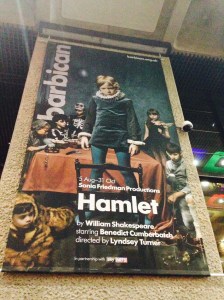
Hamlet at the Barbican

Theatre round-up: 3 August 2015

Bit later than usual, but here’s this week’s theatre round-up, and what an interesting week it was. It also included another Edinburgh preview, so more on that next week.

Impossible

Escapology, mind-reading, card tricks and sleight of hand. Women get cut in half and cars disappear. Members of the audience are invited to lie on a bed of nails, and a bald man fires a crossbow at his wife. It’s all in a day’s work for the eight illusionists who make up the cast of Impossible, a magical extravaganza directed by BAFTA winner Anthony Owen at the Noel Coward Theatre. It’s full of jaw-dropping moments – I figured out one tiny bit of one trick and I was really proud of myself. As for the rest, I’ve no idea.

Sure, it’s all a bit macho, and it would have been nice to see a man get cut in half for a change. And we know how all the tricks are going to end, but that doesn’t stop them being amazing. This is a genuinely incredible show and really good fun (and only mildly terrifying at times).

Impossible review for LondonTheatre1.com

American idiot

Ah, finally a jukebox musical based on a band from my generation… American Idiot is a show based on the 2004 Green Day concept album, and telling the story of three childhood friends in the wake of 9/11. It’s not for the faint-hearted or easily offended, with scenes of drug use, violence and explicit language, but then again, was anyone really expecting anything different? It’s not your typical jukebox musical, but personally, I’m not a massive fan of them anyway, so that’s okay. The show is fast, furious and full of energy, and I loved it.

And it’s got me back listening to Green Day again, so that can’t be a bad thing.

American Idiot review for LondonTheatre1.com

Secret theatre

Well, what can I say? Not much, actually, because it’s a secret. It’s not like me to go and see a play without knowing what it is, so I was feeling a bit anxious about my trip to the Secret Theatre last night. But I needn’t have worried, because not only did the play turn out to be a story I knew and loved, it was also really fun. A totally immersive theatre experience, from the moment you arrive you’re part of the show; be prepared to interact with the cast, and to do a lot of walking from location to location.

Though the second act could probably have done with being a bit shorter, I loved both the experience and the play, and might even consider trying secret theatre again some time. Which, considering I don’t do surprises, is quite a compliment.

Secret Theatre review for Carn’s Theatre Passion

This week's theatre

This week’s theatre:

Dirty Dancing, Marlowe Theatre

Theatre round-up: 19 July 2015

Just the two trips this week…

Shakespeare’s R&J

A unique take on Shakespeare’s Romeo and Juliet, in which four students at a strict boys’ boarding school read extracts from the play to each other after class. What starts out as a bit of fun soon turns more serious as story and real life merge, and the boys are forced to confront their feelings of love, jealousy and friendship. The result is funny, moving and at times violent, and though the words may be familiar, this is unlike any adaptation of Romeo and Juliet I’ve ever seen.

The play itself, by Joe Calarco, was written almost twenty years ago, and has been performed all over the world, including the West End. This production by the Chapel Lane Theatre Company features an impressive young cast, and will be at the Tabard Theatre until 8th August.

Shakespeare’s R&J review for LondonTheatre1.com

The Gathered Leaves

A family drama written by Andrew Keatley and directed by Antony Eden, The Gathered Leaves explores the complex relationships between three generations of the Pennington family. For the first time in seventeen years, the whole family are all together for the long Easter weekend, trying to put the past behind them in the face of an uncertain future.

An excellent cast is led by Jane Asher and Clive Francis as William and Olivia Pennington, along with Asher’s real-life daughter Katie Scarfe, and father-son duo Alexander and Tom Hanson. But for me, the star of the show is Nick Sampson, who’s delightful as the Penningtons’ autistic son, Samuel. The Gathered Leaves is a story of one family on the brink of significant change, but is also a more general reflection on what family really means. It’s on at Park Theatre until 15th August.

The Gathered Leaves review for LondonTheatre1.com

The Gathered Leaves and Shakespeare's R&J

Next week’s theatre

A Land Without People (Palindrome Productions), The Courtyard

To She Or Not To She (Joue le Genre), Morley College


Review: To Kill a Mockingbird at the Barbican

Unbelievably, until late last year I’d never read Harper Lee’s classic novel, To Kill a Mockingbird. (My school made us study Of Mice and Men instead.) And so, in a moment of madness, I decided not to see the production at the Regent’s Park Open Air Theatre in 2013 – then regretted it, when everyone started telling me how good it was.

Well, I wasn’t going to make that mistake again, so when the production transferred to the Barbican at the end of a national tour, I jumped at the chance to go and see what all the fuss was about. And now I get it.

For anyone else like me who’s been in the dark all this time, To Kill a Mockingbird is a story about innocence and injustice in the Deep South, seen through the eyes of a young girl, Jean Louise ‘Scout’ Finch. Scout and her brother, Jem, live a comfortable life in the small town of Maycomb, surrounded by the eccentric townsfolk and morbidly fascinated with their reclusive neighbour, Boo Radley. Then their father, Atticus Finch – who both children think is pretty old and boring – is hired to defend Tom Robinson, a black man accused of raping a white woman. Suddenly Jem, Scout and their friend Dill are exposed to a new world, in which an innocent man can be condemned because of the colour of his skin, and the most unlikely characters can suddenly become heroes.

To Kill a Mockingbird, Barbican
Zachary Momoh as Tom Robinson. Credit: Johan Persson – http://www.perssonphotography.com

The charm of the novel lies in its narrator, Scout, who makes us reconsider the horrifying events of the story from a child’s perspective. Timothy Sheader’s production captures that childlike spirit to perfection, as the company take it in turns to read aloud from the novel, slipping into costume to play their part in the story, and crawling around the stage on their hands and knees to draw a rough outline of Maycomb in chalk.

The three young stars of the show – on this occasion played by real-life siblings Jemima and Harry Bennett, with Leo Heller as Dill – give incredible performances. I couldn’t believe it was Jemima’s professional debut; she’s warm, funny and has all the simple innocence of a child, and yet there are moments, particularly when dealing with the men in her life – Jem, Dill and Atticus – where a matter-of-fact young lady can be glimpsed hiding just beneath the surface.

To Kill a Mockingbird, Barbican
Jemima Bennett as Scout.
Credit: Johan Persson – http://www.perssonphotography.com

Meanwhile, the true hero of the story, Atticus, is brought to life by Robert Sean Leonard. Seen first through the eyes of his children, he seems a little dry – but his wry smile, and, later, his fierce passion as he stands up for what’s right, soon reveal him to be a far more complex character. Leonard’s performance is spellbinding; I’ve rarely heard a theatre so silent as the moment when he sums up his defence case, with the desperate look of a man who knows it’s probably futile, but is determined to try.

To Kill a Mockingbird, Barbican
Robert Sean Leonard as Atticus Finch.  Photo by Manuel Harlan

What I enjoyed most about this production, though, is its loving homage to the original text. Each member of the company, as they file on to the stage, picks up a copy of the novel and holds it aloft in a silent salute, before beginning to read. There’s no need for a fancy set or dramatic effects – the production allows Harper Lee’s work to speak for itself in a faithful retelling of a classic story. After all, why change something that was already perfect to begin with?

If you get the chance to see this production before it closes on July 25th, don’t pass it up, because you might live to regret it. To Kill a Mockingbird, like the novel on which it’s based, is deeply troubling and yet, at the same time, utterly charming. It makes you question things that as adults, we tend to take for granted, and leaves you feeling a little like a child yourself. But I think we all need to feel that way from time to time; being a grown up is overrated.


Can’t see the map on iPhone? Try turning your phone to landscape and that should sort it. I don’t know why but I’m working on it… 😉

A brief guide to life as a theatre blogger

I’m relatively new to the world of theatre blogging. About eight months ago, I spotted a tweet from London Theatre Direct looking for people to join their blogging team, and thought I’d give it a try. When they said yes, it’s fair to say I was more than excited – not least because they were the first people to ever publish something I’d written.

My first post for LTD was a rant about bad behaviour in the theatre (talking, eating, using phones and the like), which is something I still get very worked up about, and will no doubt have a rant about on here before too long. And since that first post, life’s changed a bit; I now regularly review for London Theatre 1 as well as LTD, and I’m on the press list for a couple of local theatres. I’ll also usually write a review of anything I’ve actually paid to see – because there’s still plenty of those shows as well. It’s been a great few months, and I’m loving it, even if I’m not completely sure what I used to do with my time before.

If you’re thinking of becoming a theatre blogger, here are a few tips.

A brief guide to life as a theatre

Be prepared to see a lot of shows

From making a resolution at the start of the year to get to at least one show a month, I’m now seeing on average 2 or 3 plays a week. I’ve discovered some great new theatres across London that I never knew existed, and seen several fantastic West End shows. My colleagues have stopped asking what I’m doing after work, and now just go straight to the more obvious question, ‘Which show is it tonight, then…?’ Be prepared also to see things you wouldn’t usually go to – I’ve found a few gems that way.

Get ready to network

I’m not very good at this, because I’m horrible at walking into a room full of people I don’t know and making conversation. But fortunately there are ways around that. I now spend a lot more time on Twitter than I used to, following actors, directors, playwrights, theatres and companies and occasionally saying hello if I’m feeling brave. I’ve made friends with other theatre bloggers too, and have even written a guest review for one of them (the very lovely Caroline at Carn’s Theatre Passion). All of which means when I finally meet them in person, we already sort of know each other. And even if I do have to meet complete strangers, at least I know we all have a love of theatre in common, which is a pretty safe place to start.

Don’t expect to sleep much

Because it generally takes me at least an hour to get home from a London performance, on a theatre night I’ll invariably be up till 1am or later, writing up my review while it’s fresh in my mind. I choose not to take notes during the play, so I usually spend the train journey home jotting down thoughts on my phone, before starting the review proper on the computer when I get in. The latest I’ve ever been up working was 4am, but that was a one-off. (And it was a Friday, so at least I could sleep in the next morning.) Generally a review will take me a couple of hours; sometimes a bit less if it flows easily.

Get familiar with star ratings

Not everyone uses star ratings; personally I don’t when I’m writing reviews for my own blog, but some of the sites I write for do, and it can be difficult to decide what to award. My instinct initially was to give pretty much everything five, because if I gave it any less, I felt a need to justify my decision by finding something wrong with the play. (Four somehow seems a lot less than five.) But since I learned that five stars means basically the best production of its kind ever made, I try to use them a little more sparingly – unless I genuinely think it was brilliant. Which I often do, because I’m far too nice.

Get organised

I used to keep most of my diary in my head, and – a few minor double booking disasters aside – it worked pretty well. These days, I can’t do that, because I have so many plays booked in that it would just be asking for trouble. As soon as something’s confirmed, it goes in the diary on my phone, and then when I get home it goes on the calendar so I’ve got a back up. And it’s not just about dates; with theatres dotted all over London, it’s important to be familiar with the location beforehand, so as not to run in gasping for breath at the last minute – or, even worse, arrive late (especially if you’re representing another company).

Prepare to drink

Many theatres either have a reception at the interval of a press night show, where you’ll be plied with drinks and snacks, or they’ll thrust a drinks voucher into your hand when you collect your tickets. Either way, lately I’ve been finding myself drinking a lot more wine than I used to. Not that I’m complaining, but I just thought it was worth mentioning.

So there we have it: a brief guide to life as a theatre blogger. It’s a lot of fun, and I’d recommend it to anyone. You don’t need any qualifications, just a love for theatre and the ability to write about it. And we’re a friendly bunch, so why not join in the fun?

If anyone has any more tips to add, please share them in the comments 🙂