Interview: Louise Breckon-Richards, Can You Hear Me Running?

Louise Breckon-Richards is an actress, performer and playwright, with an inspiring true story to tell. That story, about how Louise lost her voice due to a rare condition, and tried to overcome it by running the London Marathon, is the subject of her upcoming one-woman show Can You Hear Me Running? at the Pleasance.

Can You Hear Me Running? tells the story of a woman’s quest to re-find her voice and run a marathon – never giving up till the finishing line,” explains Louise, who’s collaborated with writer Jo Harper and director Steve Grihault on the show. “I had a basic idea for a play based on my real experiences of running the marathon and having vocal problems. I met the writer Jo Harper and together we created Can You Hear Me Running?!”

Photo credit: Graham Saville

The show’s based on Louise’s notes, blog and diary entries written while she was recovering from vocal chord surgery, and training for the marathon. That experience has led her back to the stage, in a fun and thought-provoking show about defiance against all the odds, featuring live music, video projection and storytelling.

I feel excited and terrified in equal measure to be back on stage,” she says. “It’s great to be doing what I love and what I trained to do. I’ve missed it so much. I hope audiences will feel inspired, informed and moved at the story we’re telling, but equally that they’ll have been entertained and had fun too.

“The show has universal themes running through it such as loss and grief, but it’s also about finding new ways to overcome difficulty. I don’t think there have been many plays about the voice and running, so hopefully it will be informative, but also fun, moving and hopeful.”

When she lost her voice, Louise turned to running as a new challenge. “I ran a little before, but my real passion for running grew when I was struggling with other aspects in my life,” she explains. “My voice was failing and I needed to find a strength somewhere else. I watched three of my closest friends run the marathon years before and they were always a source of inspiration to me and this just felt like the right time.

“I think everyone’s journey is different with vocal problems, but for me as a performer, I had to find another muscle and form of creative expression that would help alleviate the stress of what was happening. Running definitely helped me, and also writing and painting as I found that I could still have an identity. Come and see the show to find out more!”

Louise still runs regularly: “Running is now a habit for me – a ritual and I can’t imagine life without it. The best runs for me are the ones with my friends where we chat and put the world to rights. I did a half marathon in March, but I’d love to do another marathon, maybe when I’m 50!”

So what are Louise’s top tips for surviving the London Marathon? “My advice would be: get your long training runs in, don’t eat every single jelly baby that the hugely supportive crowds offer you, and enjoy every minute!”

Can You Hear Me Running? is at the Pleasance from 4th-23rd October.

Review: Vanities: the Musical at Trafalgar Studios

We’ve waited ten years, but it’s finally here. ‎The London debut of Vanities: the Musical has been hotly anticipated, and it’s easy to see why. David Kirshenbaum’s show, which in turn is based on a 1976 play by Jack Heifner, has all the ingredients of a smash hit: an uplifting story, a catchy, toe-tapping score, a stellar cast of West End stars, and direction and choreography from American Idiot’s Racky Plews.

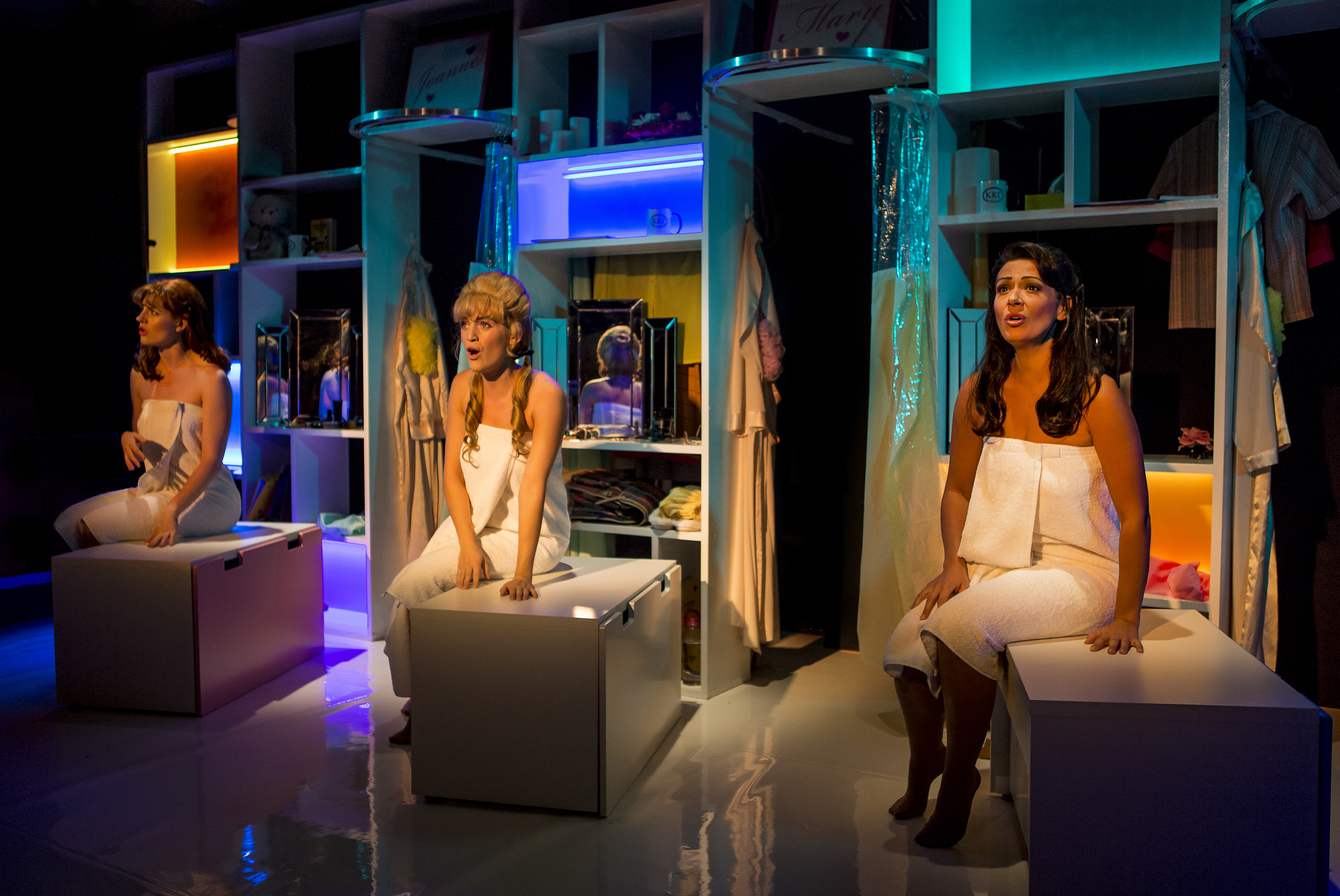
Kathy (Ashleigh Gray), Mary (Lauren Samuels) and Joanne (Lizzy Connolly) are cheerleaders from Dallas, Texas, preparing to graduate high school in 1964. Life’s been kind to the three best friends, who are used to being pretty and popular, and generally getting what they want. They have their whole lives planned out – but as the years pass, reality intrudes on their insular, superficial world, and the young women begin to realise things don’t always turn out quite like you thought they would. Can their friendship survive?

Photo credit: Pamela Raith

It’s essentially the plot of every classic American chick flick we’ve ever seen, and certainly doesn’t stand up to scrutiny in terms of realism. But those movies are wildly popular for a reason, and as cheesy and predictable as Vanities is, it’s also very easy to relate to. We might not all have been cheerleaders or sorority girls (and we definitely don’t all own erotic art galleries), but we were all teenagers once, and it’s easy to recognise ourselves – albeit sometimes a bit reluctantly – in the characters at each stage of their lives.

Because of limited space at the tiny Trafalgar Studios, where the audience sit so close to the stage that there’s a very good chance of getting hit in the face by a flying pom-pom, Vanities needs to have more up its sleeve than dazzling song and dance numbers. Racky Plews’ necessarily restrained production means the cast have nowhere to hide (unless you count the curtained changing rooms into which they disappear occasionally to age a few years), and Lauren Samuels, Lizzy Connolly and Ashleigh Gray rise to the occasion magnificently.

Photo credit: Pamela Raith

Alongside strong vocal performances, the three manage to bring a depth to their characters, even in the fluffy opening scenes when all the girls care about is make-up, hair, and if the president getting shot will interfere with their football game. Lizzy Connolly is hilarious as the naive and often gloriously tactless Joanne; her champagne-fuelled antics bring some much-needed light relief to Act 2. Ashleigh Gray’s Kathy is wound so tight you feel she might snap at any moment, and her stunning performance of Cute Boys with Short Haircuts, a significant turning point for the character, is an emotional highlight. Finally, Lauren Samuels plays Mary, on paper the least sympathetic of the three, with a haunted vulnerability that constantly contradicts the abrasiveness of her words and actions.

Andrew Riley’s pastel-coloured set is another star attraction, allowing the action to continue flowing seamlessly despite the need for multiple costume changes. Unusually, these changes actually become quite enjoyable, and even exciting, because each time the girls emerge from their changing room, their choice of outfit and hairstyle gives us an initial glimpse into the direction their life’s taken in the intervening years.

Vanities is a fun and ultimately uplifting show, with an irresistible score that will get stuck in your head for days afterwards. And whatever your views on chick flicks, there’s no doubt that this production is a triumph – so while it might not change your life, it’ll certainly brighten it for a couple of hours.


Can’t see the map on iPhone? Try turning your phone to landscape and that should sort it. I don’t know why but I’m working on it… 😉

Review: Sister at Ovalhouse

How to describe Born Mad’s Sister? It’s a tricky show to review, actually, because there’s no easy way to sum up what goes on without it sounding a bit… eccentric. So let’s just say this: Sister is beautiful, powerful, inventive, moving and heartwarming. It will make you laugh. It will almost certainly make you cry. It’ll make you hear sounds in a whole new way, and it’ll send you home reflecting on your own relationships – with sisters, if you have them, and with family in general.

The show is made up of many different memories, all of them collected from real women. Some make only a brief appearance, while others resurface throughout the hour-long production. Through these recurring stories we meet Mira, who was separated from her sisters for 15 years by the Albanian civil war; Tara, “a bit of a pyromaniac”, whose earliest memory of her younger sister is the day she accidentally burnt their house down; and Annabel and Jessica, who are best friends as well as sisters. Some of the memories shared are of life-changing events, while others are totally mundane, but together they build up a picture of what it means to have – and be – a sister, with all its highs and lows.

Photo: Ludovic Des Cognets
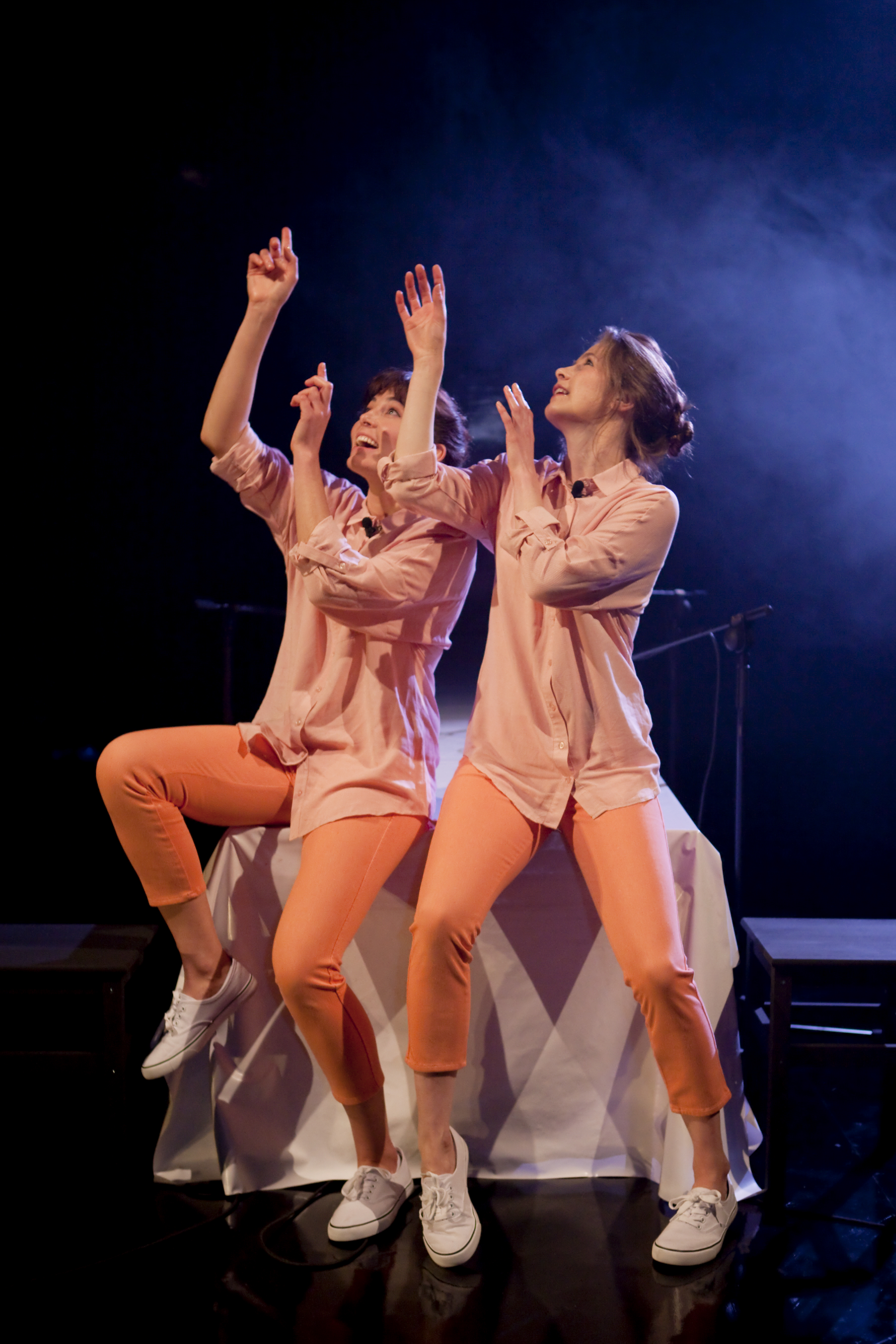
The identically dressed Daisy Brown and Nia Coleman are in perfect harmony throughout – and not just when they’re singing (beautifully), but also in their movements and even the way they speak. They’re so in sync, in fact, that at times it becomes hard to believe we’re watching two individuals. The pair present the verbatim accounts that make up the show, bringing to life women of all ages and backgrounds, keeping each persona distinct and instantly recognisable when we return to them later.

Directed by Rebecca Hanbury, Sister is a very visual show, both in terms of the performers’ body language and facial expressions, and in Ben Jacobs’ incredible lighting effects (at one point I genuinely thought the theatre was on fire). But what makes this production unique is its use of sound and music, composed by Alex Groves and all created live on stage by the performers, then amplified by the microphones that cover the set. Gentle opera combines with the simplest of sounds – a hesitant ‘um’, the sound of tea being poured (and the satisfied sigh after that first sip), a crying baby – looping and soaring to build a sort of audio patchwork quilt, each sound bringing to mind a particular story or character, and reminding us once again that life doesn’t always have to be glamorous or exciting for it to mean something.

Photo credit: Ludovic Des Cognets
There are a few moments when the sounds intrude and make it difficult to hear the performers – on at least one occasion this is clearly very deliberate (and spine-tingly effective in a climactic scene), but there are also a couple of times when it’s not so obvious, and we find ourselves straining to hear the spoken words over the speakers above our heads, without really knowing if we’re supposed to be.

But I’m nitpicking. Sister really is a beautiful production, and packs quite a punch emotionally, too – one story in particular, towards the end of the show, very nearly broke me. Ultimately, though, this is a celebration of a unique bond. It doesn’t matter if you have sisters, brothers or neither of the above; if you’re interested in human relationships and enjoy unique, creative theatre, Sister is well worth a look.


Can’t see the map on iPhone? Try turning your phone to landscape and that should sort it. I don’t know why but I’m working on it… 😉

Review: The Gospel According to Philip, Theatre N16

For Arrows & Traps, known for their popular adaptations of Shakespeare and other classic works of literature, The Gospel According to Philip is unfamiliar territory. A brand new comedy written by Richard Melchior and Heidi Svoboda, the play couldn’t be more different to the company’s last two shows: a bloody and politically charged Macbeth, preceded by a gripping adaptation of Tolstoy’s epic novel, Anna Karenina.

So, a bit of a gamble perhaps for Arrows director Ross McGregor, but did it pay off? Absolutely.

Photo credit: Davor Tovarlaza
To be more exact, The Gospel According to Philip left me wondering why it took Arrows & Traps so long to tackle their first outright comedy. Not to mention giggling all the way home over the brilliantly bonkers dance routines. (If you need only one reason to see this show, make it the unforgettable sight of Jesus Irish dancing. You’re welcome.)

The play is an irreverent re-imagining of the story of Jesus and his disciples, leading up to the crucifixion, all set down in often quite unnecessary amounts of detail by Philip, the newest member of the gang. Will Mytum, who plays the eager apostle, is irresistible from the moment he steps on stage – even before he opens his mouth, he has us laughing with his earnest expression and childlike excitement… and he only gets more adorable as the play goes on.

As in previous Arrows productions, every member of the cast excels, with most of them taking on multiple roles, and all proving themselves to be gifted comedians. Adam Elliott is full of charisma as bad boy Judas, while Elle Banstead Salim is a whirlwind of energy as feisty chatterbox Mary Magdalene (and also puts in a couple of fantastic cameos as a bride upstaged by Jesus at her own wedding, and Pontius Pilate’s Catherine Tate-inspired receptionist). Alex Stevens has perhaps the most challenging role as Paul, whose wildly homophobic language only thinly veils his private confusion and vulnerability. And then there’s Jesus, played by Pearce Sampson, master of the beatific smile, albeit often through gritted teeth, who grows increasingly frustrated as the disciples persist in asking awkward questions he can’t answer.

Photo credit: Davor Tovarlaza
Which brings us to the message at the heart of a play that’s undoubtedly very funny, but has a serious point to make as well. In a scene that even the script acknowledges is a bit preachy and makes everyone uncomfortable, a smiley, likeable Devil (Olivia Hanrahan-Barnes) paints a vivid picture for Jesus of the bleak future ahead, in which human beings will commit acts of horrifying violence in the name of their faith – but even this can’t deter him from the path laid out for him. Later, Jesus asks Matthew Harrison-James’ Geordie-accented God (who has a few issues of his own to work out) why he has to die in such a horrific way, and – while clearly dissatisfied with the response – goes ahead and does it anyway, because that’s The Plan.

Perhaps it sounds like Melchior and Svoboda’s play is anti-religion, or out to cause offence. It’s true that it plays fast and loose with the Bible as we know it – although I must admit I quite enjoy the idea that the Last Supper might have consisted of crisps and rum instead of bread and wine. But ultimately, the unexpectedly sombre final speech of an older, wiser Philip is one of acceptance. Some people have faith; some don’t, and ultimately it doesn’t really matter – as long as we exercise caution. Believing something just because “it is written”, without question, is just as dangerous as believing nothing at all – and that’s a rule that could be applied to all kinds of things, not just religion.

The Gospel According to Philip is witty, cheeky, sometimes very silly and ultimately pretty challenging. And it’s been brought to life for the very first time by a company who, it seems, can turn their hand to just about anything. Including Irish dancing, apparently.


Can’t see the map on iPhone? Try turning your phone to landscape and that should sort it. I don’t know why but I’m working on it… 😉

Review: Ctrl+Alt+Delete at Camden People’s Theatre

Ctrl+Alt+Delete, written and performed by Emma Packer, is a solo show introducing us to Amy Jones, a bubbly, optimistic young woman who adores her granddad, loves the Spice Girls, and writes repeatedly to her idol Nelson Mandela, never once considering that he might not reply. But there’s a darker side to Amy’s story; she’s been mentally and physically abused by her manipulative, violent mother throughout her childhood and teenage years, for reasons that she’s never been able to understand.

Photo credit: David Packer

The piece is beautifully written, reflecting Amy’s love of creative writing; the language evokes some stunning images and often sounds more like poetry than prose. At times, the show flows almost like a stream of consciousness, jumping back and forth in time as both Amy and her mum share their memories with the audience. Packer plays both women, keeping the two totally distinct in accent, tone of voice and even appearance; while Amy has a wide-eyed, earnest expression, her mother wears a constant snarl as she remembers the many people who’ve angered her – above all, her young daughter – and the cold, calculating way she’s taken her revenge. Even when she finally reveals her motivation, there’s very little redemption in store for this character.

Alone at the centre of a bare stage, with only a chair for company, Emma Packer’s compelling performance absolutely commands our attention. Whether she’s laughing with her friend about Simon Cowell’s trousers, or tearfully remembering the death of her grandad (an event hinted at but never fully explained), we’re with Amy all the way. It’s at the end of the show that things start to go slightly off course, as the focus suddenly switches from Amy’s personal journey to a broader political statement, in which parallels are drawn between the betrayal of an abusive parent and the lies of those in power that have led to everything from the London riots to Brexit. It’s not that the metaphor doesn’t make sense – it just happens very suddenly and, frustratingly, interrupts a story that isn’t quite over yet, and in which we’ve become increasingly absorbed.

Photo credit: David Packer

As the story of a young girl struggling to understand why her mother – the one person who should love her unconditionally – seems to despise the very sight of her, Ctrl+Alt+Delete is a powerful show. As a political statement, though there’s no doubting Emma Packer’s passion, it feels slightly clumsy and a touch heavy-handed in its conclusion. That said, there’s a lot of food for thought in this story about abuse on many levels, and an important message in there if it could only be worked in a little more smoothly from the start of the show.


Can’t see the map on iPhone? Try turning your phone to landscape and that should sort it. I don’t know why but I’m working on it… 😉