Review: Pygmalion at the Nuffield Theatre

Guest review by Edward Learman

Playing at the Nuffield Theatre last night I had the opportunity to see the latest reinterpretation of George Bernard Shaw’s classic Pygmalion, a co-production performed by Southampton University’s own Nuffield Theatre company and the two touring companies Headlong and West Yorkshire Playhouse.

I knew little about Shaw’s play, except that both he and HG Wells (The Time Machine) had at one time written propaganda romanticising the Russian Revolution and Stalin’s disastrous five-year plans. The title sounded Greek or Roman, and I’d remembered reading that it was an interpretation of the ancient myth, but this could just have easily been on the sleeve notes for My Fair Lady (1964). Interestingly, Pygmalion’s themes can be charted in such films as Titanic (1997), Pretty Woman (1990), She’s All That (1999), and probably a countless number of books and films across the world, making it a truly universal story about love, self-discovery and freedom.


The German term ‘Bildungsroman’ is often used to describe the fairy-tale journey of a hero from poverty to enlightenment; the forming of the ‘true self’ which they are destined to become. Having not seen Shaw’s original version and only familiar with its pop-culture references, I had incorrectly assumed that the play was a romantic Cinderella-tale similar to Oscar Wilde’s comedy of manners, An Ideal Husband and The Importance of Being Earnest, neither of which I’d seen either.

Just 30 seconds into the first act, it was immediately apparent that Sam Pritchard and company had little interest in making the show about either manners or love. This was not a British romance like Four Weddings and a Funeral or Bridget Jones, but then perhaps Shaw’s original never was; without a doubt it did not contain lines like, “Are you going to walk?” / “Of course not, I’m going to get a f***ing taxi.”

The first scene that introduces the pauper Eliza Doolittle (Natalie Gavin) to her sponsor and nemesis Henry Higgins (Alex Beckett) shows the main cast standing on a street, sheltering from the rain, but reading their lines in dubbed recordings using different dialects and voices. A visual projection onto the set’s background shows the text of each individual line as it’s mouthed by the actors. This is jarring for the audience, hearing the same character speak their lines like ventriloquists, but makes it so that the projected subtitles is the only way of following the conversation.

The programme contains a short interview between one of the show’s creators Caitriona Shoobridge and Dr. Bronwen Evans (from the UCL’s Speech, Hearing and Phonetic Sciences Department), in which they discuss this scene and how people often change their accents, and what this means culturally. Perhaps this device undermines the purpose of the scene, which starts as a banal conversation about the bad weather, but ends with Henry and cast humiliating Eliza as she tries to earn money selling flowers.

Afterwards, the scenes revert back to a formal staged drama without the subtitles. The play becomes a slapstick, sometimes musical, foray as Henry coaches the naïve Eliza in order to win his bet that he can transform her into a duchess. The stage set combines film projection and large set changes, the most striking of these being Mrs. Higgins’ dining room, which resembles a huge iguana tank, and shows her camouflaged against the tropical-green wallpaper in her matching costume.

Photo credit: Manuel Harlan

The cast give high-energy and flamboyant performances, delivering characters that go from Mighty Boosh-style slapstick to restrained moments of personal reflection. Its mixed-race cast of professional actors speak like bourgeoisie elitists, slipping in some modern phrases, to create a peculiar anachronism with Shaw’s original text. The supporting actors are versatile, especially Raphael Sowole as Colonel Pickering and Ian Burfield as Alfred Doolittle, showing their pitch-perfect timing at comic relief. The two leading actors, Alex Beckett and Natalie Gavin, whose performances require them to use different accents whilst showing the turns of the characters, are fascinating throughout.

The play is as much about bullying as it is about class prejudice. Inevitably, after being conned into a verbal contract by Henry and her father, Eliza chooses to turn her back on him when he tries to convince her that cruelty is really what class is all about.

Pygmalion is at the Nuffield Theatre until 13th May.

Review: This Beautiful Future at the Yard Theatre

Guest review by Lucrezia Pollice

“If I could do it again I would…”

Funny, witty and effective. A story about war, love, youth, confusion and choices. A youthful romance arises in the mist of WWII. Two teenagers from diverse paths of life are brought to face intricate questions as they experience love for the first time. The performance is lively, charismatic and charming, with a modernised setting making it evermore relatable and the past more tangible.

The stage is minimal, a round bed, a bowl, water tap, clothes and two karaoke booths. The story episodically shifts slightly forward and backward, but is made very clear to follow. Elodie is a French girl, Otto is a German soldier. They are fighting on opposite sides of the battle. She is 17-years-old and he is 15-years-old. He sees her bathing in a lake, she lets him watch for a while before introducing herself. She’s curious, excited by his gun and asks to touch it, and after some convincing he finally gives in.

Photo credit: Richard Lakos

In an abandoned house they find out about each other after overcoming first embarrassments. The writing is witty and light, but constantly acknowledging the underlining backdrop of the war which has become the norm to them. Their time together is what is most important. They are trying to figure it out and nervously break into pillow and water fights, to then awkwardly start kissing again. Meanwhile, two older counter figures Alwyne Taylor and Paul Haley accompany their telling by singing in the karaoke booths.

It seems like a beautiful coincidence they met… until their beliefs and views come into play. The war seemed to be distant, present in the destruction of bombs. Its consequences are present in the room as Elodie brings back an egg she’s rescued, which it becomes their mission to keep warm. The conflict is far away though, it has nothing to do with them, although it still affects them. Otto is constantly scared, pointing his gun at the floor with extreme terror that someone might find them. Elodie has an epileptic attack on stage; she looks happy and strong but there is something lurking behind them. Soon they discover the war is actually between them.

Photo credit: Richard Lakos

Otto, played by Bradley Hall, interprets the Nazi SS stereotype, with oil-slick blonde hair, a youthful face and grey uniform, boasting his adoration for Hitler. Elodie, played by Hannah Millward, does not agree with Otto’s views, but she is torn as to what to do. She knows the war is over, but Otto is still parading his leader and dreams. The performances are acted with such conviction it makes the choices and actions hard to watch. Can the power of love be so irrational? How could it? But then again, don’t we all do irrational things for the people we love?

Artistic Director Jay Miller does an incredibly brilliant job at finding the right aesthetics; a delicate beauty surrounds the stage. The set is minimal, with a stunning backdrop by Cécile Trémolières, which together with the simplistic but effective lighting and music, creates a powerful aesthetic, all elements perfectly in harmony. Spectators were very engaged around me, perhaps partially for the limited participatory moments or for the slightly bizarre non-binary elements in the representation. An extremely enjoyable evening, I highly recommend it.


Can’t see the map on iPhone? Try turning your phone to landscape and that should sort it. I don’t know why but I’m working on it… 😉

Review: Day Job at the Bread and Roses Theatre

Guest review by Ross McGregor

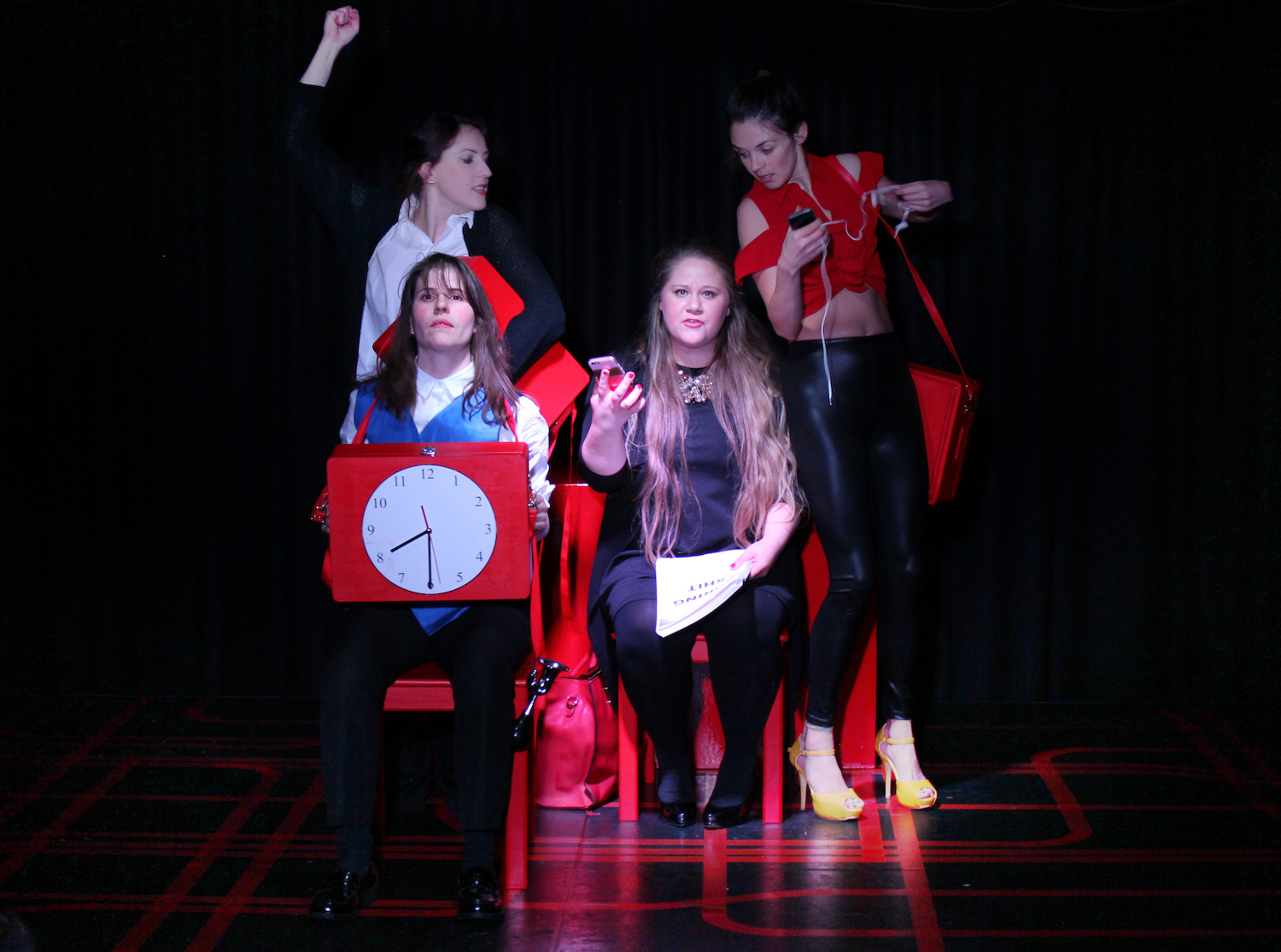
Written and directed by Evi Stamatiou, this is the first production from Fanny Pack Theatre, an all-female collective founded by Rachel Scurlock and Maria Alexe. Their company seeks to produce “contemporary stories about contemporary women”, and has been set up to tackle theatrical gender inequality. In a recent interview with The Stage, the co-founders said they wished to focus on working with women who are “outside the industry norm”, and although this is perhaps a lofty way of saying “give character actors a chance”, Day Job proves that the actresses in this project should be anything but overlooked.

Photo credit: Minglu Wang

Constructed as a series of interlocking tales about the lives of four female artists struggling to make ends meet in modern day London, Fanny Pack Theatre have created an energised, vibrant, engaging and at times hilarious piece of new writing. The device that links the narratives is the fact that all four women share the same bus journey to work, and scenes switch and intersect with ease thanks to Minglu Wang’s simple yet effective (and entirely blood-red) set. There is a degree of physical theatre and symbolised movement that is incorporated more or less well into the piece and melds fluidly with the more script-based moments.

Of the three stories, Maria Alexe’s songstress French teacher stands out as the highlight. The tale of a woman needing to get to a potentially life-changing audition whilst being stuck between a gaggle of remedial students and an overbearing teaching supervisor was played to perfection by Maria Alexe, and the fact that it involved a degree of comfortable audience participation made it all the more enjoyable. As Alexe’s frustration and desperation with her predicament grew, so in turn did the hilarity of the scene, and for me it was the highlight of the production. 

Because unfortunately the other tales, one of baby-stealing escort service and a receptionist-murdering Devil Wears Prada rip-off were far too absurd and long-winded to maintain the laughter. With the French Class tale, it seemed obvious what we were in for: an hour of semi-autobiographical tales of the plight of being a part-time actress/full-time barmaid, but then shortly afterwards the subsequent stories descend into surreal tales from the underworld, with an infernal and demonic escort agency (with their contact phone number even ending in 666 we wave goodbye to subtlety) owning the rights to every baby their escorts produce, and a team of receptionists for “Dirty Business Inc.” (a company along the lines of Enron one assumes) being slaughtered by their line manager as the police break down the doors. The jokes started to flag here, and the characters, whilst ably held up by the talented cast, are just too two-dimensional and grotesque to warrant concern.  It’s also a shame that the writer/director/devisers picked sex worker as a generic female job – surely this experience is not as widespread and relatable as teaching, bus driving or receptionist? This decision is so clichéd that it feels like Fanny Pack are actually promoting the theatrical views their company attests to strive against. A misstep here, to my mind.

8-copy
Photo credit: Minglu Wang

These script qualms aside, it is the cast that deserve the highest praises. Switching from role to role in a matter of seconds, handling pathos and comedy with a clear aptitude, this quartet of actress prove that they’re a force to be reckoned with. Rachel Scurlock chews the scenery in every role she assumes, and is a complete delight to watch – she steals every scene and comes complete with an electricity in her eyes that makes her almost impossible to stop watching. Maria Alexe has a sultry, captivating and vivacious presence on stage, as well as a truly beautiful singing voice. Clare Langford is perhaps the most introverted and demure of the group, though this may be due to the selection of roles she’s given, and thrives when she is given the opportunity. Out of the four, Langford is the most underused, and this is a shame as she seems capable of tackling so much more than the material she was given. Stephanie Merulla as the enigmatic bus driver is the heart of the piece and holds the shows thematically together with a wry and knowing delivery, knowing how to hold back when needed and sharply point every punchline she’s given. 

Day Job is an entertaining night out held together by four very talented young women. The script needs work in terms of its focus, but the performers deal with this ably, allowing their natural talent and creativity shine through.

Find out more about Fanny Pack Theatre on their website.


Can’t see the map on iPhone? Try turning your phone to landscape and that should sort it. I don’t know why but I’m working on it… 😉