Review: Oh What A Lovely War at Oldham Coliseum

Guest review by Aleks Anders

Starting in 2014, and no doubt continuing right up until the end of 2018, Britain has been commemorating the centenary of World War 1. The Great War, The War To End All Wars. I have seen some extremely moving tributes both theatrical and musical, and now The Coliseum Theatre in Oldham opens its Autumn season with something which is a little of both, Oh What A Lovely War. A pioneering and daring work in its time, Joan Littlewood and her Theatre Workshop in London’s Stratford East came up with a dark satire which parodies the war and those in charge of it, commenting on its futility and political motivations through sharp humour and song.

Photo credit: Joel Chester Fildes

If this doesn’t sound too hard to imagine and a little lame, then remember this was premiered in 1963 when the constraints of theatre were much more rigid than today, and also that at that time, it was less than 20 years since the end of World War 2, with both The Cold War and The Vietnam War still continuing.

Littlewood uses the songs of the period to great effect, interspersing them throughout with little vignettes as the cast of ten dressed in costumes reminiscent of the old Music Hall Pierrettes take on multifarious characters ranging from civilian, military and political persons from Britain, France, Germany, Belgium, Russian etc, presenting “the ever popular, ‘War Games'”.

To aid us all in this, since this is a history lesson on four years of fighting on a scale never before encountered, there is a large screen in the centre of the stage upon which helpful photographs, documents, maps and information – all historically accurate – are displayed. In fact, Foxton has designed a simple and yet superb set. A circular ‘stage’ around which the performers and their props and instruments wait in Brechtian fashion, with a false gallery and prosc arch, bunting, the royal Coat Of Arms, and footlights. Just what one would have expected to find at the theatre at the end of a pier in those days.

There are ten performers in all; but don’t ask me to tell you how many characters they play between them! However, their character changes are swift and clever, with the simple addition of a hat or scarf, or perhaps even just an umbrella. They are also multi-talented as indeed they all must also sing, dance and play at least one musical instrument, as they were also the show’s band, “The Merry Roosters”. And so, piano, bass, clarinet, trombone, drum kit, and goodness knows what else were played by those members not actually involved in the acting of each scenelet.

I must say right now that under normal circumstances I am absolutely no fan of actor-musicians; and I still think I would have enjoyed the show more had they been separate, but it certainly didn’t bother me anywhere near as much as I thought it would, and for a show of this particular style, and the lovely Brechtian directing by the Coliseum’s Artistic Director Kevin Shaw, it was apt and fitted well. I do feel though that some of the songs would have benefited from a fuller sound vocally; although the harmonies were lovely, they were a little sparse.
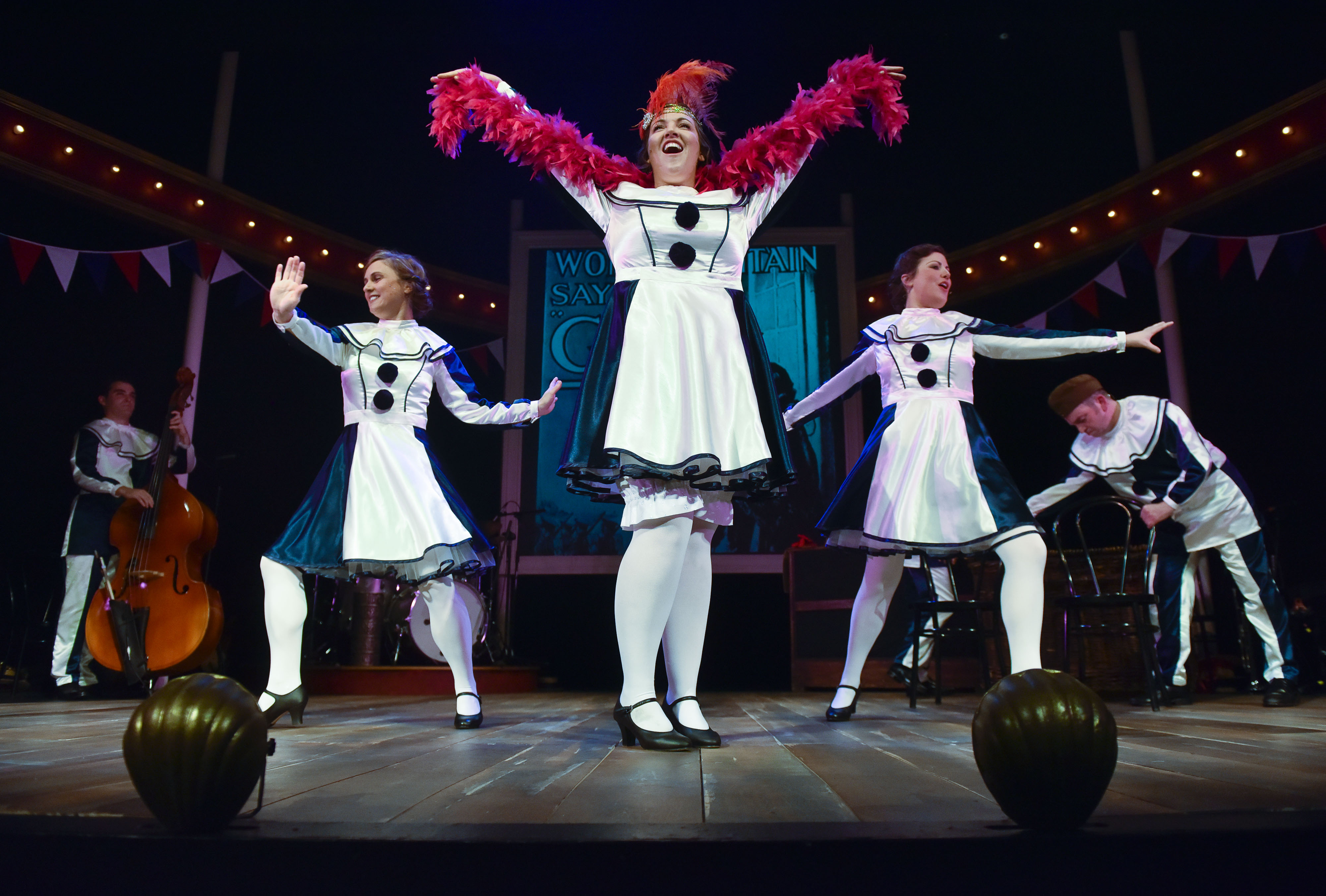
Photo credit: Joel Chester Fildes

In fact Shaw has brought out the best from both his cast and the show in this. It could do with being a little pacier; I felt especially the first half dragged ever so slightly (perhaps because the audience didn’t really “get it”) but hopefully given a few more runs for it to “bed-in” the pace will naturally quicken anyway. Beverley Norris-Edmunds should also be commended here too for her lovely choreography. Stylistically perfect and worked excellently.

It is almost impossible to single out certain cast members from others in a show such as this, a true ensemble piece in every regard, but I cannot leave this review without mentioning them, as they are all excellent. They are Isobel Bates, Matt Connor, Richard J. Fletcher, Jeffrey Harmer, Barbara Hockaday, Anthony Hunt, Thom Petty, Lauryn Redding, Reece Richardson, and David Westbrook. My favourite number from the evening though simply has to be the lovely acapella rendering of When This Lousy War Is Over.

Oh What A Lovely War may not prove to be everyone’s cup of tea (but I guess the same can be said of any piece of theatre); however, I do believe that the Coliseum have got another hit show on their hands with this one. Poignant, relevant, and also very funny, true to the spirit and concept of the original production. Well done chaps!

Oh What A Lovely War is at the Oldham Coliseum until 30th September.
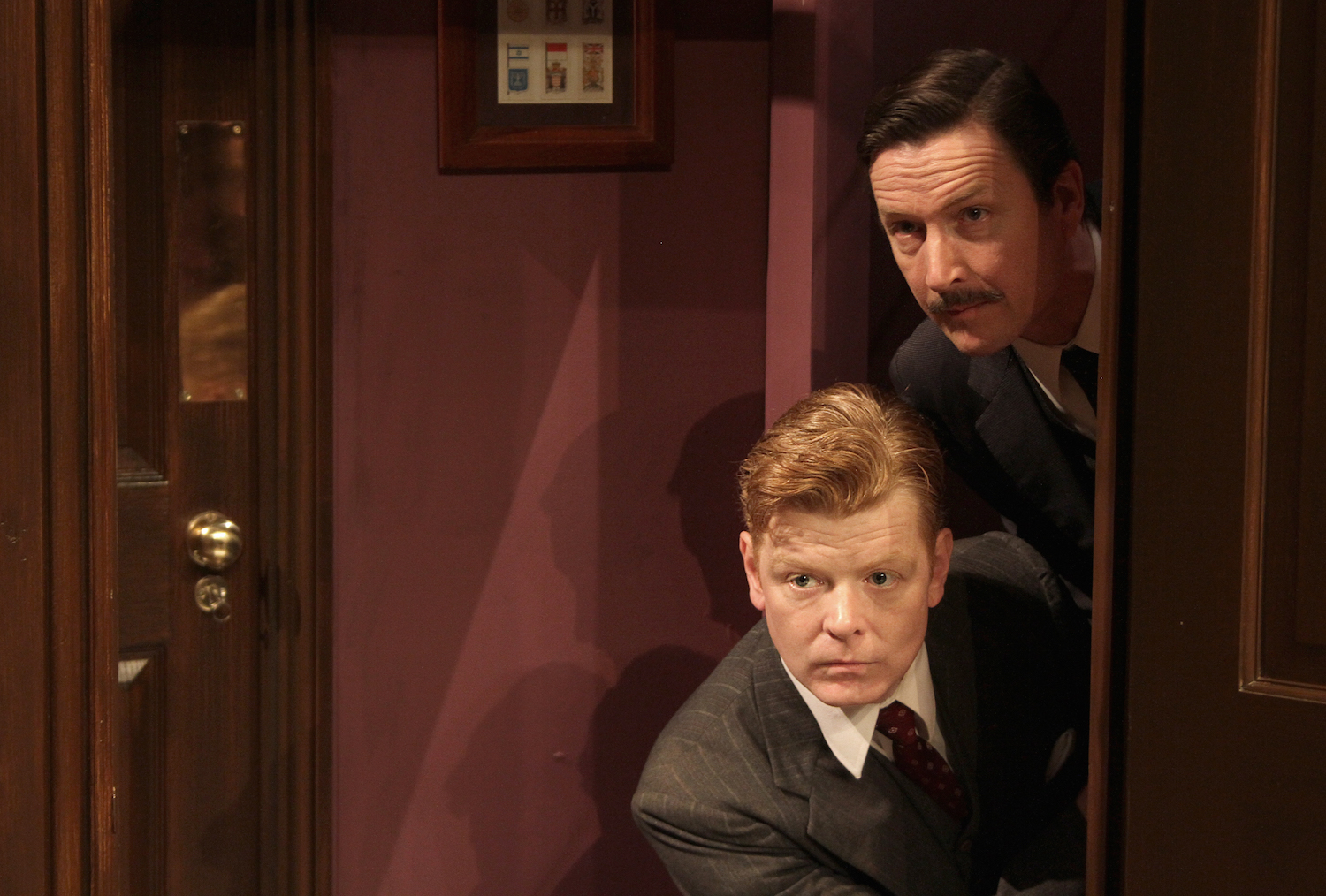
Review: A Murder is Announced at the Orchard Theatre

Guest review by Sarah Gaimster

Last night I was lucky enough to be invited to review the Middle Theatre Company Ltd’s latest production of Agatha Christie’s A Murder is Announced on its opening night of a five-night run at the wonderful Orchard Theatre in Dartford.

While young Agatha Christie’s husband was away fighting in the First World War, she worked in the dispensary of the University College Hospital, London, where surrounded by poisons the idea of writing her first detective story was conceived. Her elder sister Madge was an avid supporter of the idea, so Agatha rose to the challenge, and the rest as they say is history.

Mrs Christie was appointed Dame of the British Empire in 1971 to honour her many literary works. Known as The Queen of Crime, Dame Agatha penned thirteen novels in the  Miss Marple series. A Murder is Announced is a firm favourite amongst fans of the series.

As Act One of A Murder is Announced opens, the audience are invited into Letitia Blacklock’s drawing room at Little Paddocks, her typically Victorian home in Chipping Cleghorn.

Within minutes of the opening the audience are gripped by the storytelling (adapted for stage by Leslie Darbon) when Dora Bunner, the delightfully dizzy and slightly senile Bunny reads an article from the local paper which reads:

“A murder is announced and will take place on Friday October the twenty-ninth, at Little Paddocks – at six thirty p.m. Friends please accept this, the only intimation.”

The residents are thrown into an excitable turmoil, not sure whether to be thrilled by the excitement in this unexpected event for a sleepy country village or scared by the threat to them. Is it a practical joker taking things a step too far, or is the threat real and the residents should be in fear of their lives…?

Not wanting to spoil the surprise and give the plot away, I’ll just say that the second half of the investigation into the running order of events at Little Paddocks after 6.30pm on that evening is methodically unraveled by Inspector Craddock, along with Sergeant Mellors.

Local resident – and in Inspector Craddock’s view the interfering – Miss Marple (Louise Jameson) decides to get involved and make her own discoveries about the order of events.

It is a small cast of just twelve, but you’ll be thrilled with the star studded line up from Janet Dibley (Fat Friends and Eastenders) as Letitia Blacklock, Louise Jameson (Bergerac and Tenko) as Miss Marple, Tom Butcher (The Bill and Emmerdale) as Inspector Craddock and Dean Smith (Waterloo Road and Last Tango in Halifax) as Edmund Swettenham, to name just a few that you’ll recognise.

There are comic interludes when the wonderful Hungarian housemaid Mitzi (Lydia Piechowiak) takes to the stage, which lighten the audience’s mood amongst the more serious elements of the story.

A Murder is Announced plays at the Orchard from 15th to 19th August. Grab your ticket while you still can to find out whodunnit!

Review: Il Matrimonio Segreto at Mill Hill Music Festival

Guest review by Lucrezia Pollice

Pop-up Opera attempts to engage and give agency to audiences who would not normally attend the opera. To do this, Cimarosa’s 1792 comedy Il Matrimonio Segreto (The Secret Marriage) has been modernised to a 21st century setting, acting is exaggerated and the concept is at times ridiculous, playing on the comedic side of the narrative.

It is a comedy to be taken with a laugh and an open mind, it pushes many boundaries and manages to reach many people in meaningful ways. Most importantly the music and quality of the performers is of really high quality, and that is the strength of the company. If anyone thought the opera was boring, go and see this performance and you will not be disappointed – this one is definitely not boring!

Photo credit: Richard Lakos, The Other Richard

The show was quick, did not bore the spectators and did receive laughs from the public. Although in Italian, large screens project short colloquially translated captions and satirical images accompany the story in a very easy to follow manner. The story commences with the secret marriage of Carolina (Chiara Vinci) to Paolino (Mark Bonney). However, Carolina’s father Geronimo (Joseph Kennedy), a rich and mean merchant, is Paolino’s master and would never approve their marriage. Around them is the classical comedic scene of that time – Elisetta (Emily Blanch), her sister, the English Count Robinson (Tom Asher) who wants to take Carolina’s hand and the rich widow, auntie Fidalma (Vivien Conacher), who also has a burning desire for Paolino. Conflict and tension are obviously present. Carolina’s father is determined to have his daughters married to respectable people and with the excitement of knowing that English Royalty is planning to take one of his daughters as a wife, stakes are raised high.

The performance is full of comedic over the top tableaux. Auntie Fidalma’s passion is exaggerated into a blazing sexual need – as she presents the audience with her book Sex and Joy and reproduces orgasms on stage – it is so ridiculous that it cannot be found funny! The sisters fight with boxing gloves and the English count is disturbingly but realistically extremely sexual.

Photo credit: Richard Lakos, The Other Richard

However, as an opera native and lover it was very difficult to watch the performance the entire way through. The musicality of the performance was lovely to listen to, but unfortunately modern satirical references, costumes and acting would override the music and in my opinion destroyed the magical poetics of the opera. Having said this, for non-opera goers this might be a very interesting beginning to engage in the art form.

Review: HerStory 4 at Theatre N16

Guest review by Jemima Frankel

What might you expect from a feminist theatre festival at a small fringe theatre in Balham, in June 2017? What issues, events, people, stereotypes – laws, even – might compel feminist theatre makers to, well, make theatre right now? The more cynical amongst us might expect a hipster-infused horde of angry, “snowflake” millenials shouting loudly about the “pale stale male”.  What they would find, however, is a potent and welcome remedy to such limiting cynicism. HerStory, founded by Nastazja Somers, was born out of frustration at the repetitive, singular storyline of female characters in theatre and wider society. She invites feminists to perform work that platforms the untold stories – the real faces of intersectionality – that are so routinely trampled over in the charge for more palatable voices. HerStory does not just demand our attention; it grabs it, with consent, by the pussy.

The second of two nights at HerStory 4 (the big sister of the HerStorys 1, 2 and 3 in preceding years) was a showcase of eight richly varied solo performances. We heard the female voice on topical issues such as abortion, domestic abuse, child rape, LGBTQ issues, sexual harassment, social media, war and… Iranian mothers. What shot through the hurt, the anger, the raw and gutting sadness of several of these stories was the resounding support buzzing from the audience. Huge cheers, belly laughs and tenterhooked-gasps filled the air – testament, of course, to the quality of the performers who took to the stage.

As expected, some of the work made emotional viewing. Dannie-Lu Carr’s Just Another C*nt told the incredibly moving story of a toxic relationship with an alcoholic man who encouraged an abortion. The Twilight Zone by Suzy Gill tackles cultural discrimination and homophobia, as a young woman’s Muslim girlfriend is called away again to fight for the American army in Iraq. In one of Tolu Agbelusi’s powerful spoken word performances she spoke of the rape of a seven-year-old girl at the grabbing, angry hands of two young boys. In Mission Abort, directed by Claire Stone and performed by Therese Ramstedt, the Pro-Life words of Donald Trump – “there must be some form of punishment” – seared through the graphic re-enactment of a painful and intrusive abortion. The audience was left open-mouthed and wide-eyed, shocked into reflective silence before roaring applause acknowledged the bravery and resilience of these women.

Humour rippled in welcome and powerful moments through the evening. Amanda Holiday’s The Art Poems took artworks by diverse female painters as the inspiration for witty words, and the ridicule at the price of a handbag (that she will use as a hat, thank you very much). Social Media Suicide by Clare McCall showed us the behind-the-scenes of a very special, perfectly set up, live streamed 27th birthday party, at which she – for the benefit of you lucky viewers – was going to kill herself after much cam-girl style foreplay. The show goes out, quite literally, with a bang as the likes come rolling in. Shahbanu brilliantly performed by Lydia Bakelmun (and written, directed and produced by Melina Namdar, Anna Jeary and Penny Babakhani) revisits the childhood of a girl raised in London to an overbearing Iranian mother and English father. In the nostalgic tales of Iranian princes and (always – eye roll) beautiful princesses, we unravel the feeling of loss, displacement and desperate need to reconnect to heritage and culture. Roxanne Carney’s I’m the Hero of This Story tickled the audience with Tinder one-liners and the jaw-dropping realisation that these were lifted from real conversations with real men, probably within about five miles of you.

The Museum of Women, the poignant closing poem of Tolu Agbulesi’s set, speaks of the great women “quietly shaping” her. “This body is a monument of many women; I was not built alone,” she speaks; a perfect beacon of support and solidarity that resonated with the diverse mix of men and women in the audience. As the audience left chattering and tweeting, I was reminded once again of the power of performance – if not as a way to change the world, then as a way to get the conversation well and truly started.

Follow @HerstoryFTF for details of upcoming events and performances, as they move to a more central London location.


Can’t see the map on iPhone? Try turning your phone to landscape and that should sort it. I don’t know why but I’m working on it… 😉

Review: The Last Ones at Jermyn Street Theatre

Guest review by Lucrezia Pollice

The wonders of human behaviour will never fail to inspire. Politics, domestics and history are all intertwined. In The Last Ones the Russian playwright Gorky, knowingly admired by Chekov, creates an honest tableau of life, power, conflict, love and devastation.

The play is set in the bloody aftermath of the 1905 revolution but focuses on the struggles of a corrupt tsarist police chief named Ivan Kolomiitsev and his family. After a failed assassination and unjust accusation, the family is left in utter confusion, not knowing who to trust nor what to believe. The father’s gambling, drinking and affairs waste away all their money, and the family is forced to take refuge at wealthy Uncle Yakov’s house.

Photo credit: Scott Rylander

The play asks us: do we really know each other? How can one come to terms with their father, husband, brother, lover being wrong? Looking into the life of a despised and hated man – we grow affectionate to his family and begin to unpeel the layers and grey areas present in the human body. Conveying these grey areas – evil is not absolute, it is not binary nor concrete.

It is not an easy play; character journeys are very weaved together and are slightly difficult to follow. Ivan, played by Daragh O’Malley and Sonia, played by Louise Gold, have five children: Alexander, Peter, Nadia, Vera, Lyubov. Some of the children follow the father’s footsteps into corruption, greed, alcoholism and gambling, whilst the younger ones are faced with many questions. The latter, Lyubov, is damned for being “crippled” by Ivan, who she discovers in the play is actually not her biological father. This is not news to the family as Ivan’s brother Yakov, played by Tim Woodward, and Sonia’s old love affair is not as secret as they would hope.

Ivan is attempting to bribe his way back into the police force and regain his power. However, power has a price. Peter and Vera begin to learn the truth about their father when a young man, a revolutionary, explains to him the facts. Then the mother of the innocent child incarcerated for Ivan’s assassination comes to the house to speak to Sonia, and things begin to unravel. Conflict increases throughout to finally culminate in a desolate open-ended finale, in which corruption and evil triumph over the rest.

Photo credit: Scott Rylander

Anthony Biggs’ production is intense and moving at times. The set, designed by Cecilia Trono, is simple, but appropriate to the atmosphere created. The performances fluctuate between moments of truthfulness and other slightly weaker moments, although the show kept my attention throughout and moved me with its passionate honesty. It is a play about people, the human body and mind. We too often forget the importance of focusing on the reasons and objectives behind our actions. The Last Ones brings them to the forefront, putting us face to face with difficult questions. What would you have done in their position?


Can’t see the map on iPhone? Try turning your phone to landscape and that should sort it. I don’t know why but I’m working on it… 😉