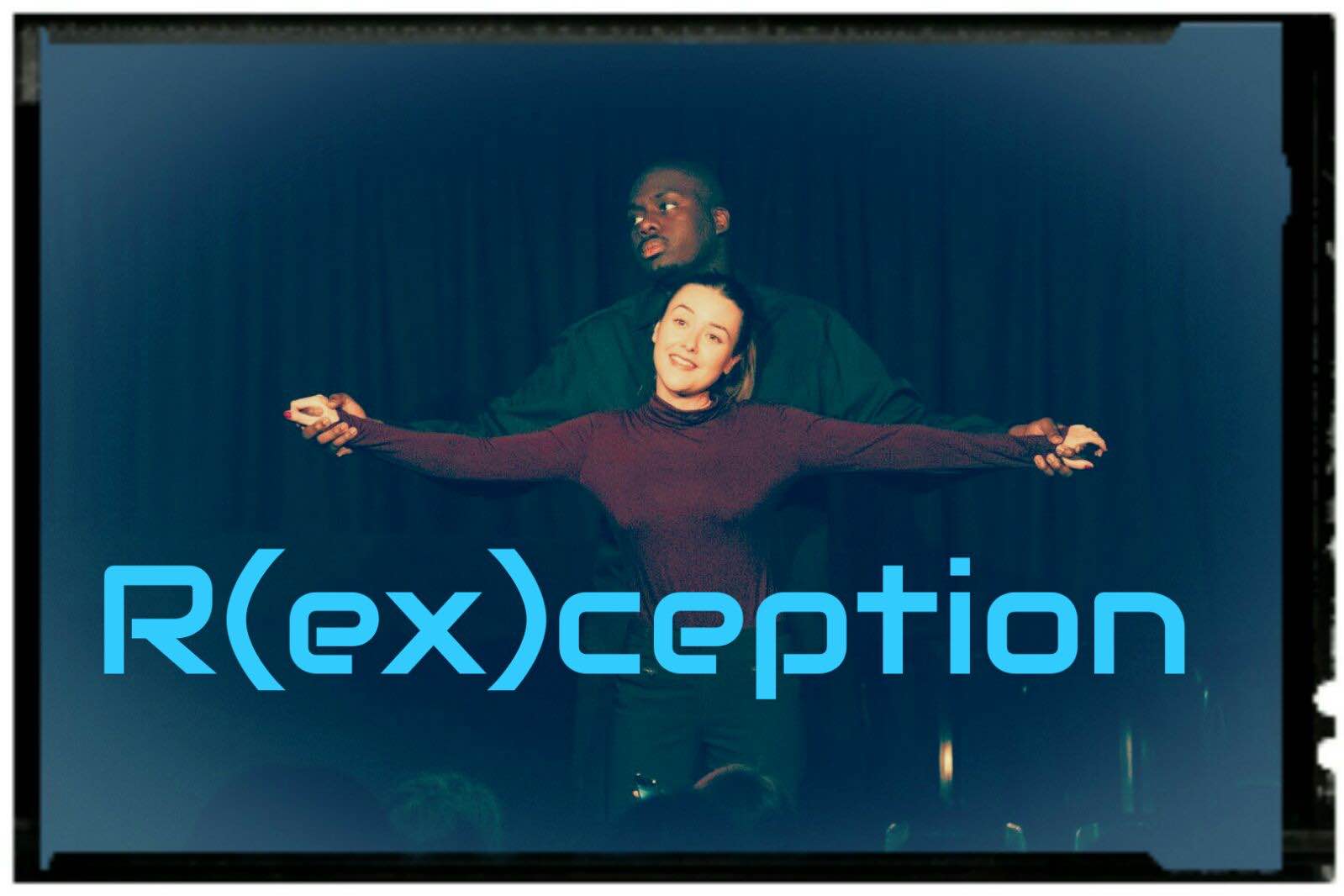
With 1 in 5 of us reportedly now meeting our other halves in the workplace, what happens when a relationship between colleagues breaks down? R(ex)ception, a comedy about two exes working together on an NHS reception desk, is a short but entertaining portrayal of a situation many of us will be able to identify with.
Written by Francesca Mepham and directed by Adam Morley, the play gets its first full-length performance this weekend as part of the Clapham Fringe at the Bread and Roses Theatre. Hannah (Charlotte Hunt) and Mark (Glyn Manfo) recently broke up – but they still have to see each other every day at work. The stage is set for arguments and awkwardness… and we certainly get plenty of both, as they deal not only with their relationship issues but also with the demands of their job.
Following its debut outing at the first Actor Awareness scratch night late last year, the extended play takes us outside the office, as the couple attempt to rekindle their romance by going to the cinema and out for dinner. As they argue over everything from broccoli to The Danish Girl to Hannah’s overly friendly relationship with Mark’s dad, they’re interrupted by an array of characters. These are all played by Rachael Hilton, who adopts a variety of accents and accessories as she revels in the role of mischief maker.
R(ex)ception draws an insightful picture of a couple who can’t live with or without each other, and who deal with their problems in different ways. Charlotte Hunt’s attention-seeker Hannah is all about in-your-face conflict, constantly throwing around revelations and accusations to try and provoke an argument, while Glyn Manfo’s Mark is master of the muttered retort (which can mean it’s sometimes hard to catch what he’s saying, particularly during the restaurant scene where he’s facing away from us) and seems to enjoy playing the victim in the whole situation. Yet while neither of them is showing their best side, there’s a certain charm and relatability to the characters that makes us feel for them and wish they could figure things out.
The play is also good fun for anyone who’s ever worked for the NHS – like writer Fran Mepham – who’ll recognise the eccentric patients and bureaucratic red tape (I particularly enjoyed the health and safety scene, which reminded me of the time I sat through a whole day of training even though as admin, all I had to do in an emergency was “get out”), as well as the implied hierarchy that places Mark, as the son of a doctor, on a slightly more elevated footing than Hannah.
It’s very early days for R(ex)ception, so perhaps it’s no surprise that while what’s there is enjoyable, it feels there could be more of it. The ending comes abruptly and catches the audience off guard, so we never get to see how the ex-partners’ story ends. Do they get back together, or do they finally learn how to move on? There’s lots of potential here for a more developed story, and all the delicious awkwardness that comes with it.
Can’t see the map on iPhone? Try turning your phone to landscape and that should sort it. I don’t know why but I’m working on it… 😉
“Good evening, Ladies and Gentlemen, and let me invite you into my askew little project…”
So begins The Gog/Magog Project, a dark comedy and “absurdist circus in a cage” from Random Acts Theatre, making their London debut at the Lion and Unicorn Theatre in Camden. More than a decade ago, Alexander Gog embarked on a radical experiment, caging himself in a theatre and delivering nightly performances from his cell for a period of one year as part of The Gog/Magog Project. Tragically, what was meant to be one year has become fifteen, with Gog moved from venue to venue, country to country, and made to survive on a diet of The Daily Telegraph and Banana-Flavoured ‘Moon Pies’.
“Broadly speaking the show is about the lengths a person will go to for the sake of artistic expression,” explains Kate Wilson, the show’s producer, “though it is also something of a critique of much contemporary commercial theatre. Alexander Gog acts as a voice against the mundane, run of the mill plays we are so often subject to. The Gog/Magog Project is a witty social commentary with culture at its heart.”
Gog’s situation has caught the attention of civil rights authorities, who claim that he’s being exploited for the financial gain of the pharmaceutical industry, sporting goods manufacturers, and government interests, and call for his immediate release despite his seemingly voluntary imprisonment. From behind the bars of his home, Gog – played by Random Acts co-founder Adam Brummitt – takes audiences with him in “a virtuoso performance which is as unnerving as it is hilarious”.
It all sounds a bit disturbing, particularly since the show is billed as “not for the faint hearted”. Should we be scared…? “No, I don’t think so,” says Kate. “The humour is somewhat dark, and sometimes a little uncomfortable, though even as Gog’s grip on reality begins to recede the play continues to draw laughter.”
Random Acts Theatre was founded in 2001 by Adam Brummitt and Khnemu Menu-Ra, when they were both drama undergraduates. Since then, the company has produced work consistently in St Louis, Chicago, and Exeter, where Kate came on board and helped produce the first two runs of The Gog/Magog Project. “As a company, Random Acts Theatre is dedicated to confronting issues from which people might otherwise shy away. Given this, the idea of a play which critiques mainstream theatre seemed an obvious choice. It is also an outstanding piece of writing in its own right, from a playwright whose work has not been produced in London before now.”
In fact The Gog/Magog Project is Random Acts’ first London show in their 15-year history. “We are extremely excited about the first of many shows in the capital, and the prospect of introducing audiences to a host of innovative and original productions.
“The Gog/Magog Project is the perfect antidote to the sameness of many of the plays housed on the West End. Jason Lindner’s script, with Adam Brummitt’s additions, make for an entertaining and memorable evening, and one which will make viewers consider their role as an audience member.”
Two actors playing all 21 characters in an adaptation of one of the most popular novels of all time. What could possibly go wrong?
As it turns out, nothing. Not a thing. In fact I may need to issue a gushing alert for this review, because I loved Two Bit Classics’ adaptation of Jane Austen’s Pride and Prejudice so much I’m already trying to work out how I can fit in a return visit. Hilarious, inventive, yet completely faithful to Austen’s original text, it’s a work of genius and I didn’t want it to end.
Photo credit: Carrie Johnson
Joannah Tincey and Nick Underwood play all the characters – and that really does mean all the characters. At two and a half hours long, this is not an abridged version of the story, and so we have Bennets, Bingleys, Lucases, Mr Darcy, Mr Wickham, Mr Collins, Lady Catherine… A couple of minor characters get the chop, but anyone with any significance to the plot makes an appearance, and gets the opportunity to narrate their own part in the story.
With so many parts to play, there’s an obvious need to make each one distinct, and this characterisation is where the production really excels. Each individual has their own unique identifiers – be it a habit, an accessory or piece of clothing (often produced from one of the many nooks concealed around Dora Schweitzer’s abstract set), their way of speaking or their bearing – and we always know exactly which of Austen’s brilliant creations we’re looking at, often before they’ve even started speaking. There’s also a fair bit of gender switching, which proves yet another source of fun, with Nick Underwood taking on at least four female roles from the giggling Kitty to the demure Jane, and Joannah Tincey regularly sweeping aside her skirt to reveal the trousers of Mr Bingley.
The production is fully aware of its limitations and doesn’t try to gloss over them, but instead plays them for laughs. And so Mary – the forgotten Bennet sister – is replaced by a music stand, while one of the biggest laughs of the evening is prompted by the inventive recreation of Pemberley’s family portraits.
Photo credit: Laura Martin
Most mind-blowing of all is the stamina of the performers, who never flag in energy and easily hold the audience’s attention for the entire two and a half hours. Under the direction of Abigail Anderson, the action is non-stop, moving seamlessly from one episode to the next, with the actors frequently having to play several characters even within one scene, yet they never falter. This astonishing feat of endurance and dexterity alone justifies the standing ovation at the end of the evening.
For P&P fans and newbies alike, this is a glorious celebration of Austen’s book; the drama, comedy and romance we know and love are all there to be enjoyed almost word for word. But with so many ‘classic’ adaptations already in existence, this production brings with it a unique twist that makes the story feel simultaneously fresh and familiar, and – dare I say it – even funnier than the original.
Can’t see the map on iPhone? Try turning your phone to landscape and that should sort it. I don’t know why but I’m working on it… 😉
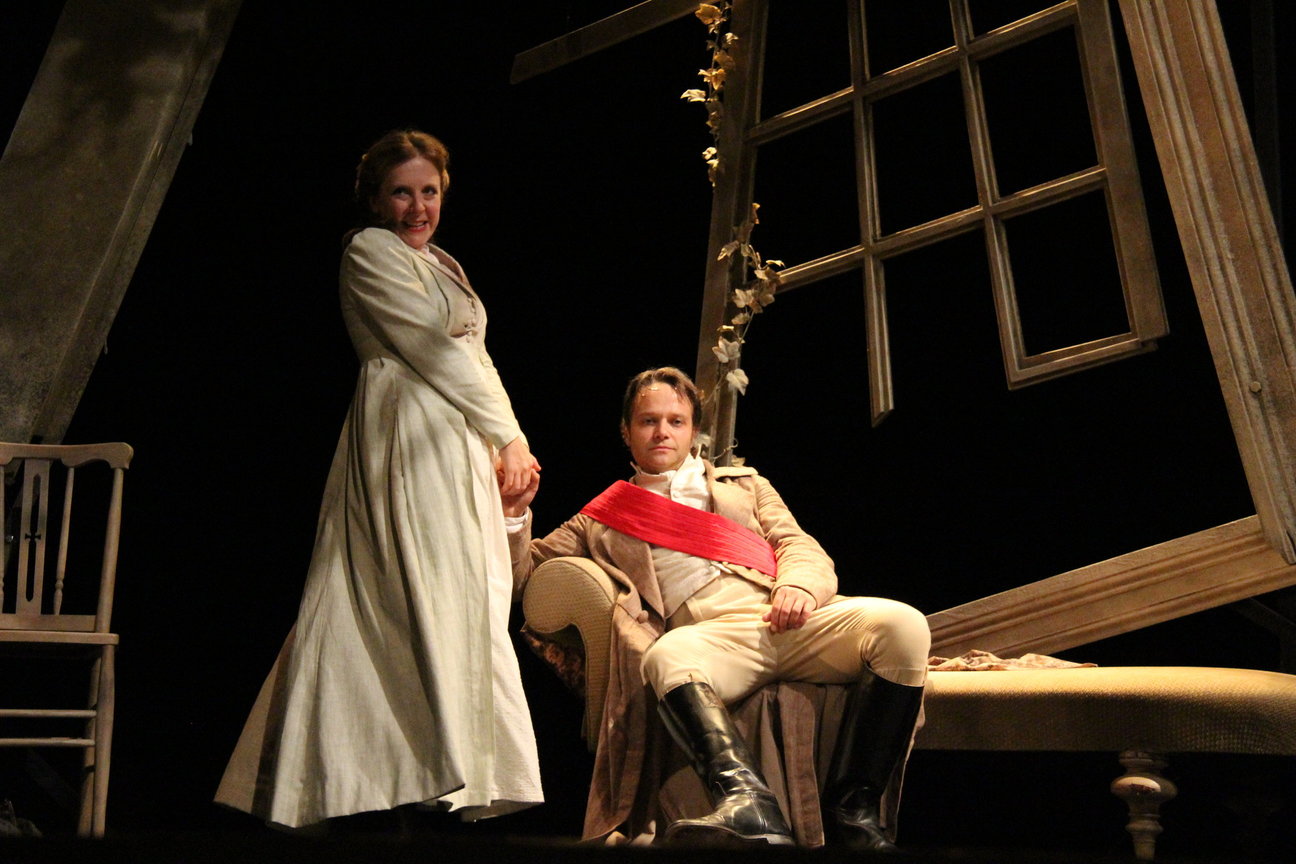
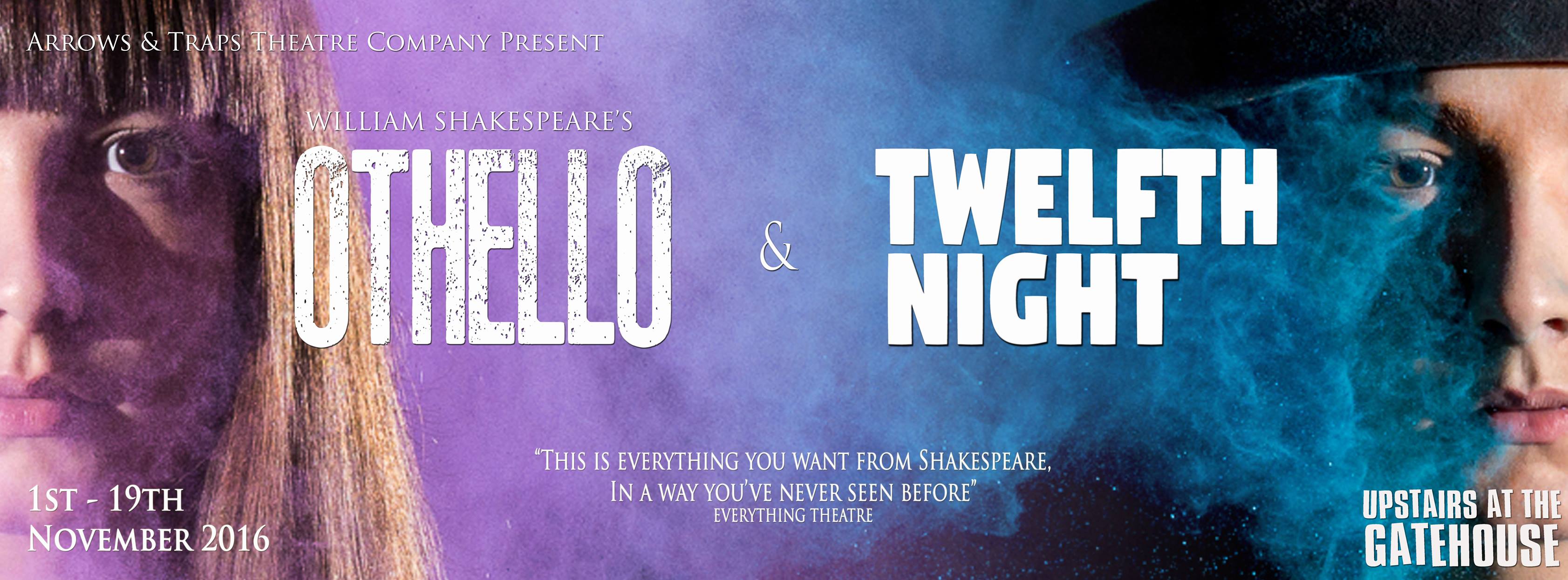
Over the past three years, Arrows & Traps have become well known for their unique adaptations of Shakespeare and other classic works – most recently Macbeth and Anna Karenina. But the company’s latest project is their most ambitious to date, as they prepare to perform Twelfth Night and Othello in repertory at Highgate’s Upstairs at the Gatehouse this November.
The decision to take on two plays simultaneously stemmed from director Ross McGregor’s interest in exploring the duality in Shakespeare’s work. “Shakespeare’s comedies are not just simply throwaway funny things that end in orgiastic shotgun weddings. His tragedies are not just gloomy tear-stained stab fests. Iago, the antagonist in Othello, is darkly funny whilst he does unspeakable things to innocent people, and the comic treatment of Malvolio in Twelfth Night descends into dark cruelty and manipulation. The blending of light and dark seemed to be interesting to explore.
“But it was also a practical decision. If I was asking audiences to come back and see a second show, I wanted to provide a varied menu. Twelfth Night is an unrelenting carnival fun fair of laughter, love and lyricism – and it’s also a full blown musical – whereas Othello is a psychological thriller, set in a hyper-sexualised, racist and cut-throat world of politics and militia. So I thought people would enjoy seeing the same ten people navigate the different worlds and present two sides of the same coin: the birth and demise of love.”
Of course, performing two plays at once brings with it new challenges: “I’m currently running a sweepstake on which of the cast comes onstage in the wrong costume and says the wrong opening line,” says Ross. “It does impose more time constraints on us; we have to work faster, move on quicker, correct and evaluate with more brevity, there’s less room to devise and experiment. Choices are still being made, options are still being explored, but there is now a much more pressing sense of the need for producing work each day and drawing a line under it.
“The line-learning element doesn’t seem to be too much of an issue; I’ve structured the castings so that each actor has a main role in one of the shows, and a supporting part in the other, so no-one is drowning under a tidal wave of iambic pentameter. We use the same set for both, so I suppose that might challenge us to create different stage pictures across the two shows, but with the material being so different, and the characters each actor plays being so contrasting, I haven’t noticed any repetition. In fact, there’s some nice echoes in there across the shows, for instance the bed that Pearce Sampson (Orsino) woos Pippa Caddick (Viola) in is the same one where he (now as Iago) contrives her death (as Desdemona). So I’m enjoying that aspect of it.”
Anna Karenina
Unusually, the cast for the two plays features only two new faces: “We usually have more, but this project seemed to represent the culmination of the last three years, so I wanted to show that in the casting. We have David Grace, playing the lusciously adorable and insipid Sir Andrew in Twelfth Night, and then the lovesick puppet Rodorigo in Othello, an altogether darker and more tragic role. I’ve been a fan of David for about two years, so it’s an honour to finally get to work with him. He brings an energy and dedication to his work, he’s one of the most specific actors I’ve ever heard in terms of his delivery and responses to the text; he’s flourishing as an Arrow and it’s a pleasure to support.
“Then we have Lloyd Warbey playing Feste in Twelfth Night – the lady’s fool and her “corrupter of words”, and Lodovico in Othello. You may be familiar with Lloyd from his work on Art Attack on the Disney Channel, and he’s worked all over the country, so it’s a privilege to have him involved. For Feste, you need a showman, an entertainer and a comedian, and yet there’s a melancholic sadness to him; he’s broken, lonely and jaded, and it’s great to see Lloyd switch in and out, hear him spin the language with a cheeky grin on his face.
“The other eight members of the cast are my core members, the people I would trust with any script, and the people that without them there would be no Arrows & Traps. There’s no greater gift for a director than having a cast like this. They’re a pleasure to see every day, and the amount of effort and energy they put into both shows is humbling.”
As always, the Arrows are keen to delve into the text and find something fresh and original: “I think the main element of Twelfth Night that feels new to me is the darker and melancholic elements. I’ve seen quite a lot of productions of the play that focus on the comedy but ignore the other elements. Shakespeare first staged Twelfth Night on the anniversary of the baptism of his own twin children, one of whom had drowned several years before. I think this was deliberate. On one of the days of the year where he perhaps thought of his son the most, Shakespeare put on a play where two twins find each other again after both nearly drowning. There’s a wish-fulfilment, a consoling father fantasy in that which is heartbreakingly sad. Twelfth Night to me is a dreamscape where your wildest dreams can come true, where gender and sexuality are fluid and transient, where chaos flies with majestic abandon.
“In terms of Othello, I wanted to examine what it means to be a Moor in modern times. So often, we take the word “Moor” to simply refer to someone’s race, to be black or North African, but it originally referred to their faith – that they were Muslim. We’re staging this in November, during the month where Donald Trump may or may not become leader of the most powerful nation in the world – a man who’s built a campaign on fear-mongering against Muslims, a man who campaigns for power on the promise that he will exclude, interrogate and remove people of a particular religion. Othello seems timely to me in that regard.
“I also wanted especially to show Desdemona in a better light. So often she’s portrayed as this weak, blonde willowy girl who meekly accepts her own murder, but to me she’s incredibly strong-willed and independent. She goes against her father for the man she loves, she rejects prejudice and society’s expectations of her and is unwilling to let it oppress or minimise her. She’s seduced by stories of battle and violence, tales of the unexpected and grotesque, which to me shows that this is an adventurous, outspoken, and vivacious young woman, and I wanted to show a Desdemona like that, which is something I’d never seen before.”
Macbeth
And now for the big question – to see just one play, or both? “I’ve directed the two shows to be able to stand on their own two feet independently of each other, but there’s something exciting about seeing both,” Ross suggests. “There are also five days in the run where you can see both in the same day, which would be something of a marathon, but since the Gatehouse is above a pub, you can have dinner in-between, have a drink and make a day of it.
“But if you could only see one of them, you have a choice between a clown-filled chaotic musical of love and passion and confusion, or a darkly thrilling study of the breakdown of a relationship in a violent and brutal society. They’re two hours each, so we’re not talking about a four-hour snore fest, but two fast-paced, visceral rollercoasters. Of course, the producer in me would like to add that if you book for both you get £2 off your second ticket…”
“Our aim is to devise innovative work that tells stories which provoke question, thought, laughter and enjoyment. We want to excite and stimulate our audiences, making them experience the world in a slightly different way,” explains Jesse Dupre, one of the five founders of Haste Theatre. Since meeting while doing a Masters in Physical Theatre together in 2012, the all-female group has been working continuously, making a total of three shows. Where the Hell is Bernard? will be their fourth.
“Where the Hell is Bernard? is a futuristic dark comedy about daring to be individual when everything is forcing you to blend in,” summarises Jesse. “We started talking about the book that inspired the show just before Christmas last year, thought about it over the holidays, then did a very initial couple of R&D days in January. In April we read books, watched films and studied historical events that we individually thought could work with the story to inspire new ideas. As we were still touring our other shows from May, we came back to the devising process again in August before the intensive rehearsals began in September and October.”
So where did the idea come from? “The idea of four women looking for a man named Bernard came up over a cup of tea with one of our brothers in a garden in Canterbury when we were on tour last June. It wasn’t a fully formed narrative at that time, but just before Christmas we found a book called The Year of the Hare by Arto Paasalina, about a photo journalist who runs away from his normal life to follow a hare through the wilderness of Finland for a year, after nearly killing it with his car. The idea of a man deserting life in a city and going completely off the grid really stuck with us, so we started thinking about city workers, interviewing some about their daily routines and what it means to disappear so suddenly and entirely. As we spoke about this, the idea of the four women searching for Bernard came back to us!
“We brought in a wide range of other influences including 1984, Logan’s Run, Black Mirror and the art movement ‘Vortism’. We also researched life in cults and life under totalitarian governments, to shape a new narrative that reflects a lot on modern society, retaining the essence of but not entirely mirroring The Year of the Hare. We hope that audiences will be immersed in our highly intense world, while we tackle potentially dark and troubling subjects through a light-hearted and playful approach, and that they’ll be surprised and entertained by our creative use of set and other design elements.”
The show features a mix of puppetry, clown, music and song. “It’s got something for everyone,” says Jesse. “The fact that we’re an all-female group, with different talents and skills including various languages – Italian, French, Russian – musical abilities – clarinet, saxophone, ukulele, guitar – and dance and physical training – tap, ballet, contemporary, gymnastics – helps us to bring unique touches to all of our shows.
“Our specialities are in dark comedy and clown-like characters, which has shaped the material a great deal. We knew that we wanted some ‘set pieces’ which would be choreographed movement sections, a song, multi-use of set and props etc, which act as anchors that drive the story and characters forward. These are then linked together with slightly more realistic scenes.”
Haste Theatre have performed their shows – and won awards – all over the world. “I would say that one of the best places we’ve performed is San Diego,” says Jesse. “We were there in 2013 for their inaugural fringe festival, and were the only international artists that year. We were performing on a great outdoor stage, and the audiences were so enthusiastic and supportive. Touring internationally was an amazing opportunity for us as a young company, as it was a totally new experience and helped us to develop as artists.”
The world premiere of Where the Hell is Bernard? is supported by the Arts Council, which has proved invaluable: “It’s meant so much to us, to be able to practically make the show we want. Often we work with very small budgets that do spark creativity, as we have to come up with new ways of making things, but it can also bring about challenges for us. With the Arts Council funding, it has been amazing to be able to employ professional designers and choreographers to help us fully realise the world we imagined. They bring so much more to the show, and we are very appreciative.”





 Theatre Things