Review: Foul Pages at The Hope Theatre

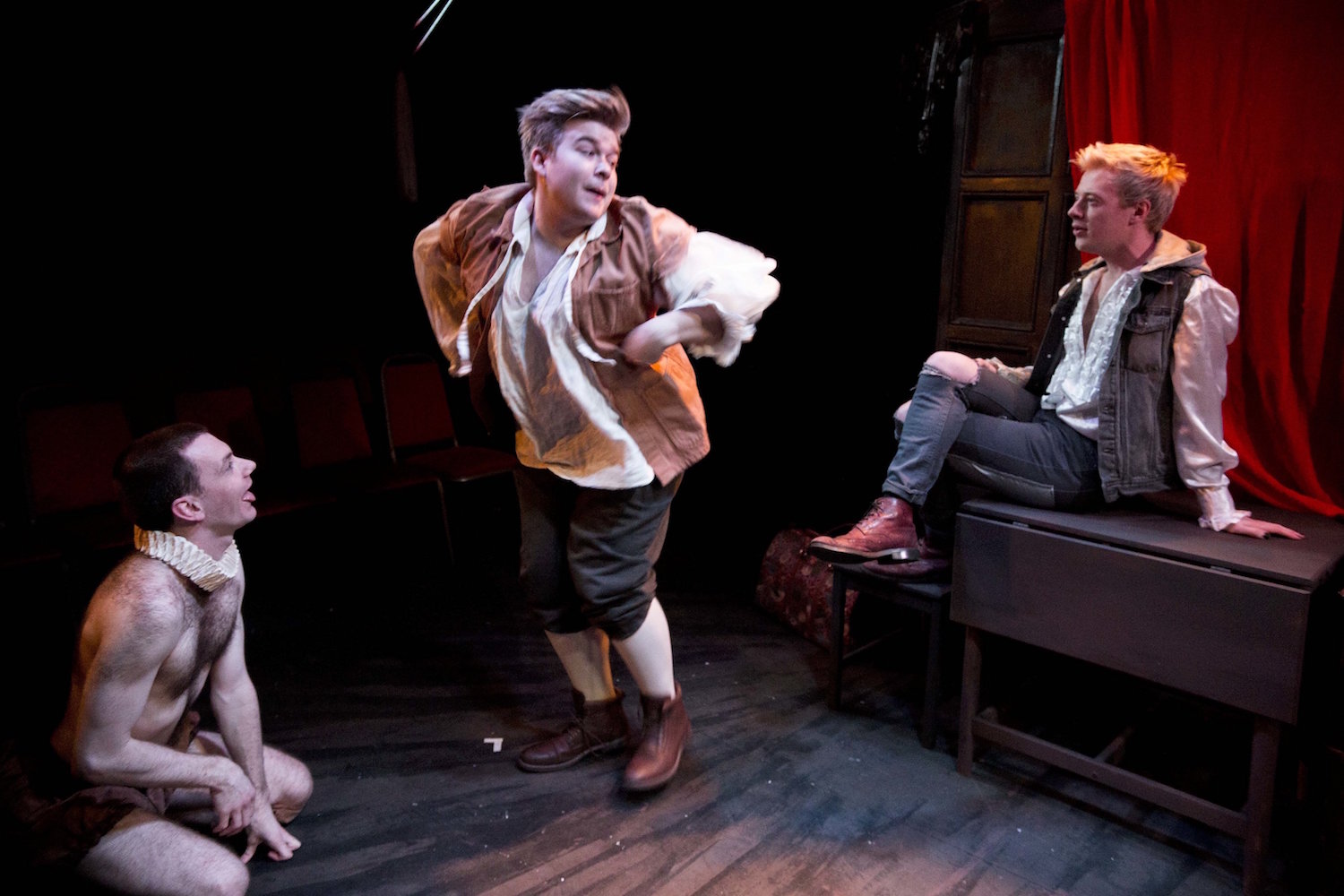
To quote the timeless classic Shakespeare in Love (not sarcasm, I love that movie): “Love, and a bit with a dog – that’s what they want.” Robin Hooper clearly subscribes to the same belief; his play Foul Pages has both – and Shakespeare too, though in this case it’s not him who’s in love but pretty much everyone else. Will, meanwhile, is more interested in refining his latest work, As You Like It, whilst fending off interference from the Countess of Pembroke, a fellow writer full of helpful suggestions, and from King James I, who’s become infatuated with one of the actors and insists that he be given the lead role. The purpose of the production is to charm the monarch into pardoning Sir Walter Raleigh, who’s days from execution for treason – but pleasing the king comes at a cost for more than one member of the company.

Oh, and there’s also a talking dog.

Photo credit: LHPhotoshots

Ian Hallard appears as Shakespeare, but such are the scandalous goings on that for once the legendary playwright isn’t the centre of attention. As his all-male company is torn apart by jealousy, ambition and more than a little sexual tension, all Will can do is watch in bemusement and do his best to hold everything together, along with straight-talking maid Peg (Olivia Onyehara) and the king’s devoted Scottish bodyguard Mears (Jack Harding).

Meanwhile it’s the more flamboyant characters – Lewis Chandler’s shunned actor Alex, Clare Bloomer’s eccentric Mary, Countess of Pembroke, and Tom Vanson’s lovelorn King James – who take centre stage, each driven by their own desires to take potentially catastrophic actions. There’s poignant work from Thomas Bird and Greg Baxter as actors Rob and Ed (also Shakespeare’s brother), whose fledgling relationship is threatened by the king’s interference. And then there’s Chop the dog, played to scene-stealing perfection by James King, who’s not only got all the animal behaviours down but also gets the most laughs, with wry observations on the bizarre human behaviour going on around him.

Photo credit: LHPhotoshots

Though the action is set in 1603, director Matthew Parker gives the production a modern twist; the costumes are an intriguing mix of 17th and 21st century, and rapid scene changes are punctuated by loud music and flashing lights, creating a sense of urgency as the stakes become ever higher and events take an unexpectedly tragic turn. Rachael Ryan’s economical set allows us a glimpse of goings on both upstairs and downstairs at Wilton, while still somehow allowing enough room on the tiny Hope stage for nine people to come out and treat us to an energetic jig at the end of the show.

There’s a political detour in the plot that doesn’t quite fit – it arrives out of nowhere and is just as quickly dealt with and forgotten – but that aside, Foul Pages is a compelling and irresistibly entertaining tale of love, lust and theatrical ambition that may just make you see As You Like It, and Shakespeare himself, in a whole new light.

Can’t see the map on iPhone? Try turning your phone to landscape and that should sort it. I don’t know why but I’m working on it… 😉

Review: Moments That Changed Our World at the Royal Exchange Theatre

Guest review by Aleks Anders

The Royal Exchange Elders, a group of keen theatre-going amateurs over the age of 60 who attend weekly sessions at The Royal Exchange, have put together this quite extraordinary and quirky piece of theatre which celebrates age. With some pathos each of the 11 strong cast – including a couple of recorded stories from other members – tells us the moments in their lives which shaped them, changed them and made them the person they are today.

The stories intertwine, and the chronology is lost after the first sentence, but somehow this doesn’t matter. There is humour, bonhomie, and a sense of fellowship amongst the cast that one seldom sees, or at least is aware of, amongst professional actors.

Though entitled rather grandiosely as Moments That Changed Our World, the large global political or geographical events which can and do shape many peoples’ lives are in short supply in this one hour long celebration of the third age of mankind. Instead it focuses on the smaller and more personal instances which affect the individuals in their own special ways. Becoming an actress and receiving her first applause; being homosexual at a time when it was illegal and offensive; turning 60; the joys and dangers of computer technology; a divorce.

The stage is set with audience on two opposing sides whilst the other sides of the rectangle are used as a screen to project film, photos and other footage to exemplify and augment the narrative. The space is intimate, and when not acting, the cast sit on the front row; but the staging is far from optimal. End on would have worked much better.

There are darker and more serious moments aplenty too. A young black lady coming over to work for the NHS, and finding our island cold, unwelcoming, insular and above all, intolerant and racist (so, nothing has changed then??!!); another lady in her youth fighting for Women’s Lib and equality (and still nothing has changed!); whilst an ardent CND campaigner tells of his moments in rallies, and asks if in reality, his campaigning has actually amounted to anything changing on a global scale.

With group hugs and plenty of friendly encouragement, these tales are spoken about with a hint of nostalgia, but with a huge zeal and zest for life. And hooray to that!

As the final lines of the play ring out… “Time is not on our side, so let’s live for today; and tomorrow I will… tomorrow I will wake with a smile and be grateful. I WILL!”

Directed by The Elders’ Company leader Andrew Barry, and created by him and the company through workshops and devising, the 11 members telling their moments on stage are Sheila Colman, Christine Connor, Gordon Emerson, Graham Gillis, Brenda Hickey, Christopher Littler, Jacquie Lang, Estelle Longmore, Don McGregor, Glyn Treharne, and Kenneth Walker. Well done to all of you, it’s a wonderful idea, bravely and sensitively told, and since “it’s easy to stop playing as you get older” – please, don’t stop!

Review: What Goes On In Front Of Closed Doors at the King’s Head Theatre

Ask pretty much anyone, and if we’re really honest we’ll probably admit to some preconceived ideas about the causes of homelessness. We might mention drugs, alcohol, mental illness, criminal records, domestic abuse… All problems we don’t – and assume never will – face ourselves.

It’s not entirely our fault; the media plays a significant role in shaping society’s view of homelessness, and the more horrors someone has been through on the way to losing their home, the more sympathetic – and therefore interesting – their story. But it also places the homeless at even more of a distance from those of us lucky enough to have a roof over our heads and a nice warm bed to go home to. We may shake our heads at the sadness of the story; we may even buy someone a coffee or make a donation to a homelessness charity – but then we go on our way, safe in the knowledge theirs isn’t a problem we’ll ever face ourselves.

Photo credit: Caz Dyer

The truth is, though, homelessness isn’t necessarily the result of a dramatic crisis; sometimes it’s simply the product of a wrong move here or there. Molly, the central character in What Goes On In Front Of Closed Doors, doesn’t quite know how she ended up homeless; she didn’t even fully register that she was for a good two weeks after being evicted. Maybe it’s because she was bullied at school. Or because she didn’t go out with that guy from her class. Maybe because her dad left, or her mum died, or she decided not to go to uni. Maybe it’s because of a combination of these, or something else entirely.

Molly’s played by Emma Bentley, who wrote the show along with Calum Finlay, and whose engaging performance quickly wins us over as she attempts to make sense of where she went wrong. Articulate, funny and resilient, Molly’s completely honest about her own lapses of judgment and the slow disintegration of her life – even before she ends up on the street in a thunderstorm, messaging a random guy on Tinder just to have somewhere to stay the night. While not solely a victim of circumstance, she also doesn’t do anything obviously wrong; she’s not a drug addict, or a criminal – she’s just like anyone else, and this relatability is both enjoyable and rather unsettling.

The Tinder scene is just one reference to technology in a show that makes frequent use of it. Images from Molly’s phone are projected on to a sheet at the back of Rasa Selemonavičiūtė’s set, and there’s inventive use made of a webcam to take us on a tour of the home that exists now only as a memory. Katharina Reinthaller’s production also introduces several other characters to the story through the use of audio clips, with which Molly interacts throughout the play. It’s an ambitious project, and not without an element of risk, but it pays off; the inclusion of these extra characters helps to build up a more complete picture of Molly’s life and relationships, and also emphasises her loneliness once all those voices fall silent.

Photo credit: Caz Dyer

Developed with the benefit of Emma Bentley’s volunteering experience at St Mungo’s, the play also has a feeling of authenticity, particularly when Molly starts sharing details about her current state of “purgatory”, as she waits to find out if she’ll get permanent housing or end up back on the street. In a series of short scenes, we also learn about the lengthy, repetitive bureaucratic process she had to go through just to get temporary accommodation. With her fate out of her hands, all she can do is wait and hope for the best.

What Goes On In Front Of Closed Doors clearly aims to make us think, but resists the temptation to preach or tell us what to do. Instead, by sharing one person’s story, the show invites us to process for ourselves the uncomfortable home truth at its heart: but for a different decision somewhere along the road, Molly could have been – and could still be – any one of us.

Interview: Lydia Rynne and Caley Powell, Hear Me Howl

Hear Me Howl is the first project for new theatre company Lights Down Productions. The one woman show by Lydia Rynne addresses the taboo issues of abortion and a woman’s choice to remain childless, exploring the central character’s journey through her discovery of punk music.

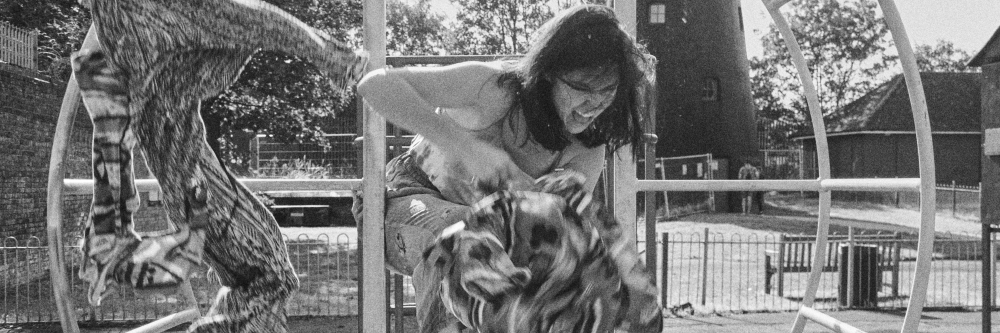
“It’s a late coming-of-age tale following the story of Jess – played by Alice Pitt-Carter – who’s just hitting the big three oh,” explains Lydia, a member of the Soho Theatre Writers Group. “She has a job, a long term, loving boyfriend and a rented flat that’s bigger than your average garden shed. Oh, and of course she also has that pesky body clock that everyone keeps banging on about. As she approaches her milestone birthday, Jess begins to question the life she’s plummeting towards and decides to join a punk band, cos why not? Jess tells her story from behind and with the aid of a drum kit before her first gig.”

Lydia was inspired to write the play after noticing a lack of shows about women who choose not to have children: “There have been plenty of plays and books about women or couples trying desperately to conceive. And of course there is a place for these works – wanting, and then struggling, to conceive is a heartbreaking ordeal. But for every woman who is pining for a child of her own, there is a woman considering a life without children. This is, crazily, still a taboo subject. I’m also a huge advocate of women – of any age – picking up an instrument and making NOISE.

“From a young age girls are given plastic babies, prams, tiny kitchenettes with rubber sausages to fry up like a good girl. Meanwhile our male human counterparts who just happen to have a dangly bit between their legs are handed toy racing cars, railway sets, a rocket: an open highway to go any place they like, as fast as they bloody well can. Society tells us from birth that we are born with a maternal instinct that, if not acted on within our allotted time, will leave us empty and bereft of our true life purpose. The weight of this expectation is not only offensive – how many childless male actors or politicians are probed about their lack of sprogs?! – but also a huge mental drain on a gender who are already busy enough trying to achieve equality in the workplace and combat sexism on a daily basis.”

Producer Caley Powell adds, “This will be my first play with my new theatre company Lights Down Productions, and I chose it because I saw myself in the lead character of Jess. I’ve recently turned 30 and have known for a long time that I don’t want children, so seeing a play that dealt with this topic in such an open, fun way is so rare and so necessary that I immediately wanted to come on board to produce this play.

“For me Jess is so relatable, when you’re about to turn 30 you do end up having a crisis about where your life is and what it is you want from it, and have an urge to do something drastic, like join a punk band to break out of the monotony of your life. This play shows it’s never too late to make a change in your life and that through regaining control and also through the power of music you can find your voice and your power.”

Lydia met the play’s director, Kay Michael of Empty Deck Theatre, when they were in a production of Caryl Churchill’s The Skriker together at Warwick University. “I had yet to ‘come out’ as a writer and still fancied myself as a physical theatre performer. As much as I loved playing varieties of goat-like creatures, making sense of the world through the written word quickly became my raison d’être. So I finally allowed Kay, one of my best mates – and conveniently a wonderful director – to take a peek. The rest is history. Or herstory…”

Caley’s involvement with the show came about more recently. “I met Kay whilst producing my previous play A Great Fear Of Shallow Living with In Tandem Theatre Company, and she got in touch in November 2017 to let me know about this play. I was in the process of setting up Lights Down Productions to produce new writing, particularly female writers, and I was looking for new projects so it seemed perfect timing!”

In developing the show, the team have spoken to women with varying opinions on having children, and have also thrown themselves into the world of punk ideology and music. “One particular book that inspired us is Viv Albertine (of punk band The Slits)’s autobiography, documenting her growing obsession with punk music in the 70s and 80s as she grows from girl to woman,” Lydia explains. “As Hear Me Howl is very much structured as a coming of age story, we have also, as a team of female creatives, interrogated our own lives as a series of lightbulb moments – questioning the people, experiences and music that we now know impacted our life choices. We then got into a garage full of instruments we’d never played before and bashed about for hours, and got some great audience feedback when we tested an extract, with accompanying drums, in a scratch night back in 2016.

“We hope Hear Me Howl will inspire discussion about the expectations we place on women to have kids. But we also want our audiences to have fun, to maybe take up drums, and to definitely dance around their kitchen like no-one’s watching.”

The play was performed as a work in progress at The Landor Space in March, and returns for a full run at the Old Red Lion Theatre this month.

With Lights Down Productions Caley’s also currently producing a new play, Shards by Catherine O’Shea. “Shards is a play about memory, architecture, relationships, dating, particle physics and swing dancing… and what happens when you throw those things at each other. We just had a reading of the play at The Playwriting Suite at Canal Cafe Theatre, and have a four-week run at a major London venue later this year.”

To keep updated on Lights Down Productions follow @LightsDownProd or find them on Facebook

Interview: Lou Stein, Chickenshed

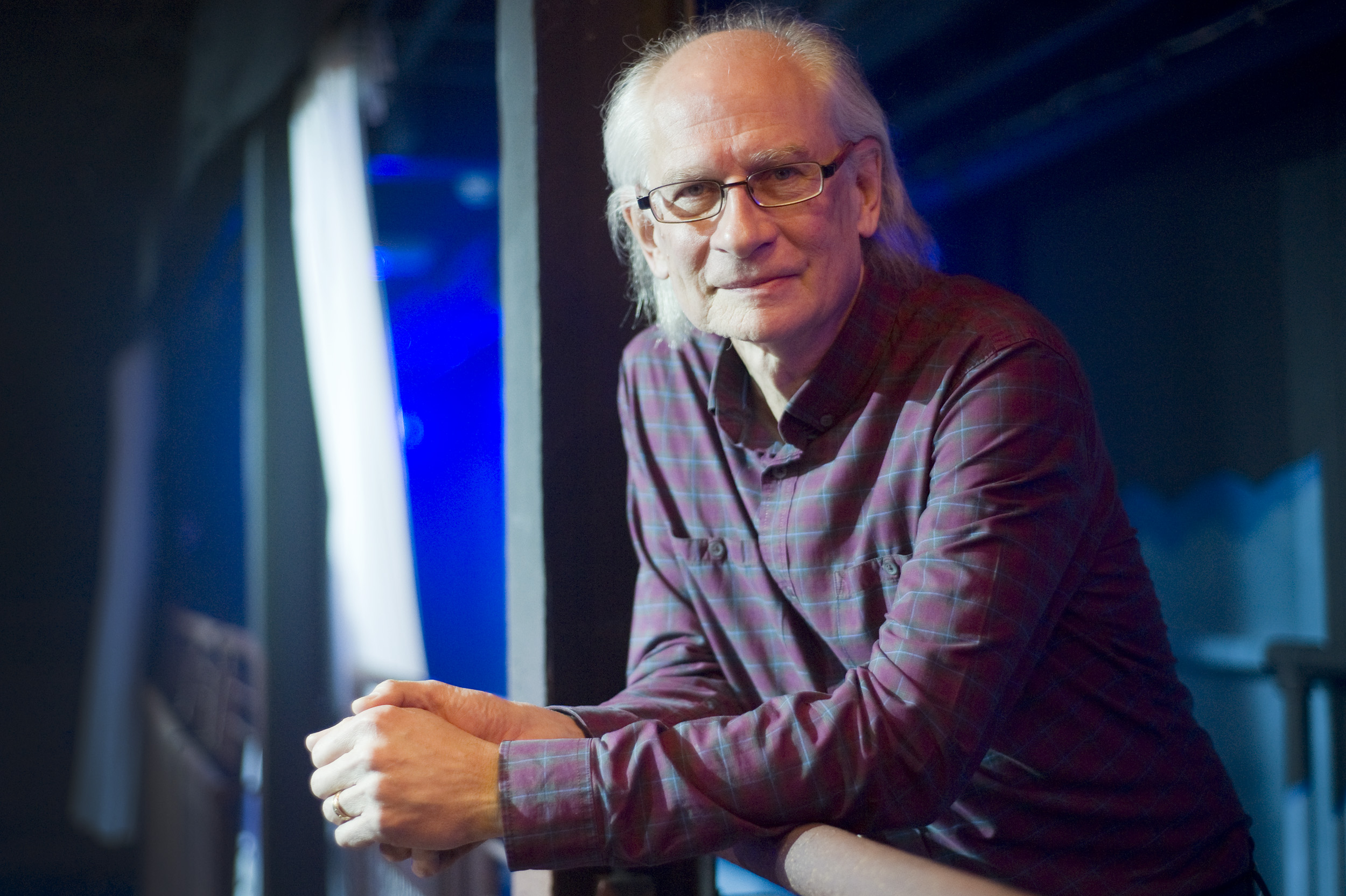
When Lou Stein became Artistic Director of Chickenshed in 2016, it was the latest move in an already long and distinguished career. As founder of Notting Hill’s Gate Theatre and former Artistic Director of Watford Palace Theatre, he brings to the role a wealth of professional experience – but also a unique personal appreciation for the value of Chickenshed’s work.

My son Ethan, who is now eleven, has been a member of Chickenshed’s Children’s Theatre since he was seven, and it was he who brought me to Chickenshed,” explains Lou. “He has Down Syndrome and I began to see the organisation through his eyes – the eyes of a young person with ambition who doesn’t want to be labelled as having a disability, and who loves theatre. When I saw the job advertised, I saw it as an opportunity to re-focus the direction of the company to re-energise its purpose.”

That purpose is to pioneer inclusive theatre practice, something Chickenshed has been doing for over 40 years, since the company was established in 1974 by its founder – and Lou’s predecessor – Mary Ward. In addition to its professional theatre programme, Chickenshed also has a Children’s Theatre membership programme, a Youth Theatre, an Outreach Programme, a Performances for Children division, and runs an expansive Education programme ranging from BTEC to BA courses.
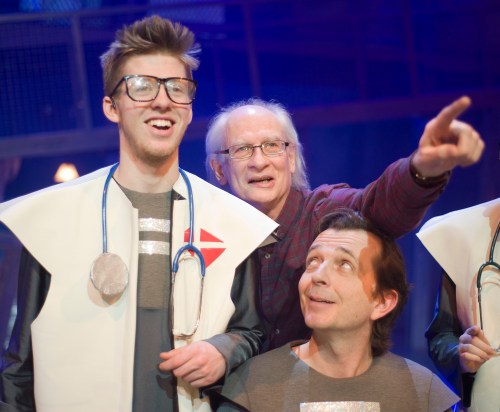
The uniqueness of Chickenshed is that all our various parts work together to embed notions of inclusion and diversion across everything we do,” says Lou. “In short, inclusive theatre is the language which propels all of our activities. The most exciting thing about Chickenshed for me is that when you walk through our doors, all labels are dropped. When I talk about it, I always love the fact that we have the most diverse performers and audiences in the UK. My biggest challenge as Artistic Director has been to harness the amazing core ethos of the company, which has been in development now for 44 years, and work with the company to make our current work relevant to the future and to our societal goals.”

Originally from New York, Lou arrived in London in 1978 with a life-long interest in European theatre and politics. That passion found an outlet the following year in a room above Notting Hill’s Prince Albert pub, which would become the Gate Theatre. The Gate reflected the then bohemian community in Notting Hill and the work there was devoted to international drama, particularly work that hadn’t received an outing in the UK,” says Lou. “At that time, the chance to see innovative international work was limited and the Gate filled a very important gap. When I left to become the Artistic Director of Watford Palace, I ensured that the core of the Gate’s future work was always to centre on daring, political, and innovative premieres of international drama. And that has been the bedrock of the Gate’s success throughout the years. I am so proud that it has spawned so many brilliant directors, actors, designers and playwrights.”

After ten years as Artistic Director at Watford Palace, where he worked with some of the best talent in the UK – including Helen Mirren, who turned down a stint at the RSC to appear in a new version of Madame Bovary – Lou formed his own production company to begin creating new work which explored collaboration between art forms, particularly contemporary music and theatre.

I have always been proudest of work that I’ve done which has somehow broken ground or pointed to new directions in how things can be done,” he says. Highlights come in many shapes and forms, and the projects that stand out have somehow either changed me or people around me. Certainly the raw creativity and freedom of those early years at the Gate was a huge highlight. The Gate story is a bit of a Cinderella story. With no funding in what was a very down at the heel pub, a group of outsiders came together to create work which was highly recognised very quickly.”

Another highlight for Lou is his adaptation of Hunter S. Thompson’s Fear and Loathing in Las Vegas, which was the first production at what was then called the Gate at the Latchmere (now Theatre 503), before transferring to the Fortune Theatre in the West End. “I’ll never forget Hunter Thompson – a notoriously reclusive writer – saying that he was flying in from his home in Aspen, Colorado to see the show, and if he didn’t like it, he was going to tear the theatre apart,” he recalls. “Luckily, he loved it.”

Before coming to Chickenshed, Lou wrote, produced and directed regularly for BBC Radio 3 and 4.After my son Ethan was born, I was commissioned to write and curate a five part programme for The Essay about how children affect the creations of their artist-fathers – The Father Instinct,” he explains. “In the first episode I wrote about how Ethan positively changed my work as a director and writer, and how I approach my work. His birth was the biggest highlight of my career in that what I choose to do, and how I do it, changed dramatically. Without Ethan, I wouldn’t be at Chickenshed.”

Chickenshed’s spring season recently opened with monolog, featuring a timely revival of Alan Bennett’s Her Big Chance, the world premiere of Diane Samuels’ This Is Me, and six new monologues commissioned by Chickenshed from within the creative community. This will be followed in March by a new musical piece about climate change, called Don’t Stop Thinking About Tomorrow, which features nearly 150 performers drawn from young members and professional creatives who are part of Chickenshed.

Finally, in April the company presents One Flew Over Cuckoo’s Nest, using a physical theatre approach and working with actors drawn from its professional staff, and a number of Chickenshed actors who will bring a special understanding of the play by drawing on their cognitive disability. “I don’t know of any theatre in the country who have the courage to do a play like this with a cast as diverse, in all ways, as ours will be,” says Lou.

The professional theatre programme is the spearhead for all our activities, and by producing high quality inclusive work, all of our various strands are pulled together. My vision for Chickenshed is that it will be a confident and highly skilled professional inclusive theatre company, which clearly places itself at the centre of London theatre’s consciousness, producing unmissable work – regularly partnering with similarly minded companies and institutions. It would be good if the Arts Council recognises this new direction and helps us to sustain this goal in the future.”

To find out more about Chickenshed, visit chickenshed.org.uk