Review: That Girl at the Old Red Lion Theatre

Hatty is 29 years old and works in advertising. When one of her housemates gets engaged, she and best friend Poppy prepare to move into a new place together. Except Poppy’s just got a new boyfriend, whereas Hatty is still single, bored with her job and suffering from frequent bouts of anxiety – all of which is a far cry from her glamorous past as a child movie star.

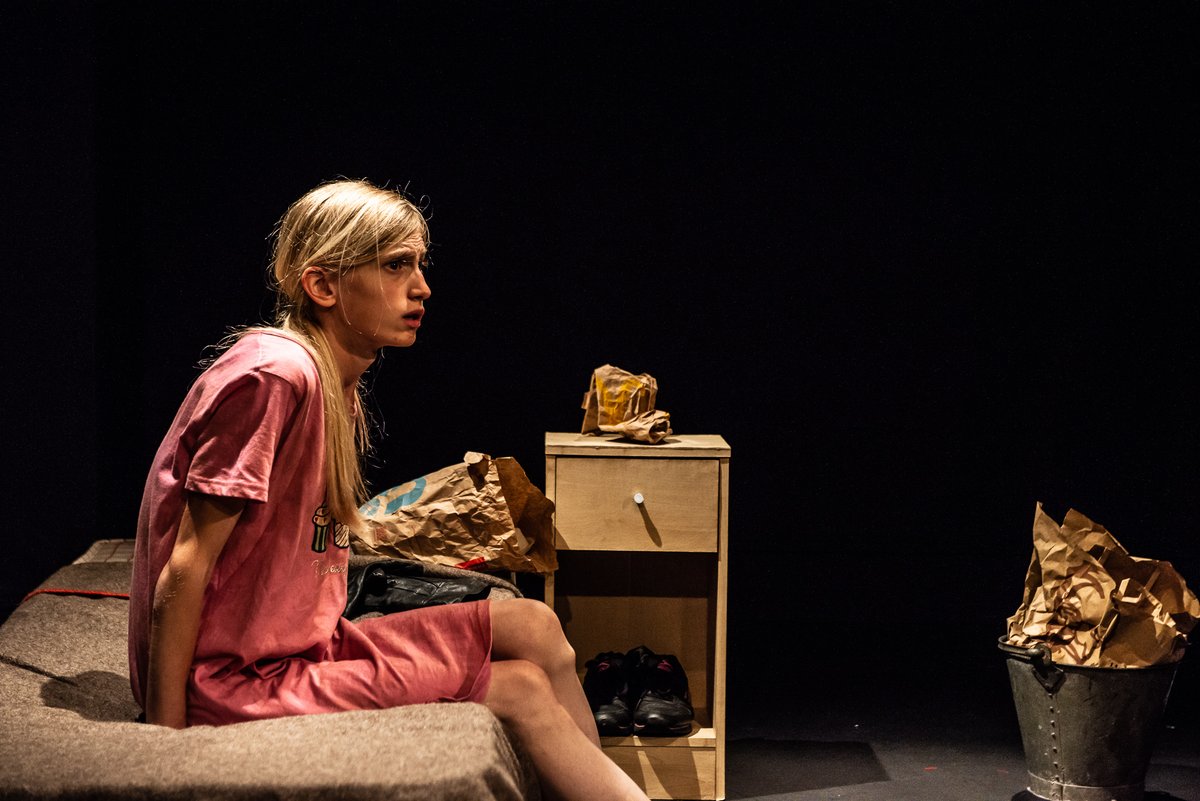
Written by and starring Hatty Jones, That Girl is the story of a young woman who still hasn’t quite figured out who she is or where her life is going. Based on the writer’s own experience as the star of 1998 children’s movie Madeline, it examines how this early fame continues to affect her as an adult, long after giving it all up in favour of a “normal” life.

Photo credit: Sunny Smith

Although Hatty the character has the same backstory as Hatty the writer, it’s not clear how much the two now overlap – though it does seem unlikely that the Hatty on stage would allow herself to be portrayed the way we see her. Insecure and needy, this Hatty is unable to celebrate even her best friends’ successes and, despite her protests to the contrary, only really comes to life when given an opportunity to relive her childhood fame.

Even these opportunities aren’t as frequent as she’d like everyone to believe, and it’s often Hatty herself who brings up the subject, shoehorning her early success into conversation by any means possible. It’s clear that her memories of Madeline are a comfort blanket, a reminder of a time when life was exciting, and a stark contrast to her current mundane existence. These days, she’s just like everyone else – a young woman approaching her 30th birthday, watching her friends settle down with boyfriends and mortgages, and panicking about being left behind. While we’re able to relate to her motives, it’s difficult to approve of her methods as, in her desperation to hold on to her lifelong friendships, she ends up putting them at risk.

Whatever our feelings about the character, it’s difficult not to warm to the real Hatty Jones, who makes a powerful playwriting debut with That Girl, and also gives a thoroughly engaging performance as “herself”. She’s joined by fellow cast members Alex Reynolds as Hatty’s colleague Lola and housemate Poppy, and Will Adolphy, who plays Poppy’s boyfriend Adam and Hatty’s date Dylan. Both actors move seamlessly between their two characters with just a quick change of outfit, to show us a cross-section of the people that make up Hatty’s world – a superficial world of Tinder, bloggers, avocados and brunch.

Photo credit: Sunny Smith

Directed by Tim Cook, the action moves at a steady pace as we follow Hatty over two days. They’re not particularly eventful days – which is sort of the point – but that certainly doesn’t mean there’s a lack of tension. With cardboard boxes scattered around Sunny Smith’s set, we’re constantly reminded of the impending move and the pressure it’s placing on Hatty and Poppy’s already strained relationship. This eventually comes to a head after a deeply uncomfortable moment between Hatty and Adam, which is so well written that it feels like watching a car crash in slow motion; we know what’s coming, but can do nothing to stop it.

Simultaneously funny and heartbreakingly sad, That Girl is a very relatable story about fame, friendship and the pressures of adulthood. Madeline may be all grown up, but if this play is anything to go by, her adventures aren’t over yet.

Review: Hamilton (Lewis) at the King’s Head Theatre

As you may have heard, a little show called Hamilton opened last year in the West End. It’s been fairly successful, and it’s no big surprise that it’s already been the inspiration for more than one comedic parody. One of these is Hamilton (Lewis) by Fiona English and David Eaton, freshly returned from Edinburgh to the King’s Head, which tells the somewhat less epic story of – you guessed it, British Formula 1 star Lewis Hamilton.

Photo credit: The Other Richard

Born and raised in Stevenage, young Lewis (Letitia Hector) wants only one thing: to become world champion. Until 2007, when he’s taken on by Big Ron Dennis (Jamie Barwood) to join the team at McLaren, and meets his villainous teammate/rival Fernando Alonso (Louis Mackrodt), who advises him to “drive less… smile more” and focus instead on building his brand. Cue a seven-year celebrity romance with the only Pussycat Doll anyone ever remembers, Nicole Scherzinger (Liberty Buckland), which gets them on the cover of Hello! magazine but otherwise proves wholly unsatisfying on both sides. Driven by an increasingly obsessive ambition to regain his world champion title at all costs, Hamilton loses sight of what’s important and – well, that’s it really; it’s hardly a spoiler to reveal that this story doesn’t end in a deadly duel.

A pre-show disclaimer from the cast makes it clear we shouldn’t get our hopes up too much; after all, it took Lin-Manuel Miranda over four years to write Hamilton, and who has that kind of time on their hands? Instead, Benji Sperring’s production openly plays to its disadvantages, turning its lack of budget, actors and stage space into a running joke. Similarly, there’s no hesitation about admitting that compared with the charismatic Hamilton (Alexander), Hamilton (Lewis) is considerably less interesting, and much of the humour takes aim directly at the characters; nobody comes out of this story in a particularly positive light.

The main joke, though, is obviously the references to Hamilton. Some of these are blatant, others more subtle – but while the story can and does stand alone, the nods occur frequently enough in both script and musical numbers that to fully appreciate what’s going on, you probably need to have at least listened to the Hamilton soundtrack once or twice. Taking such a universally adored show as its inspiration pretty much guarantees a warm reception from an audience who are quickly able to spot the successful jokes, and willing to forgive when a few of them fail to land.

Photo credit: The Other Richard

The production’s biggest success is its excellent cast, who deliver strong vocal performances even as they embrace the madness, hamming it up to outrageous levels in the name of comedy. There’s nothing more enjoyable for an audience than seeing the actors having a good time on stage, and this cast are clearly enjoying themselves immensely.

If you turn up at the King’s Head expecting Hamilton, you’ll be disappointed on several different fronts. But then again, Hamilton (Lewis) never claims to be Hamilton – in fact the cast take great pains to point out to any lawyers in attendance that it definitely isn’t. Chaotic, silly and 100% unendorsed, it nonetheless makes an enjoyable pit stop while you wait for your next chance to buy tickets to the original.

Can’t see the map on iPhone? Try turning your phone to landscape and that should sort it. I don’t know why but I’m working on it… 😉

Review: Summer Holiday at the Orchard Theatre

Long before the Inbetweeners movie was even thought of, there was Summer Holiday, the classic 1963 film in which Cliff Richard and The Shadows enjoyed a far more innocent – but apparently just as action-packed – European adventure. I suppose it was only a matter of time until someone made a stage version of the film, and it’ll come as no surprise that Michael Gyngell and Mark Haddigan’s musical works, for the most part, very well.

The story is pretty simple, and very much of its time. Four lads (Ray Quinn, Billy Roberts, Joe Goldie and Rory Maguire) driving through France in a red London bus happen upon three gorgeous girls (Gabby Antrobus, Alice Baker and Laura Marie Benson) with a broken down car, and gallantly offer them a lift to their singing engagement in Greece. On their way to Athens they pick up various other damsels in distress, including a sobbing bride-to-be who’s late for her wedding, and runaway singing starlet Barbara (Sophie Matthew), who’s fled from her overbearing mother and agent (Taryn Sudding and Wayne Smith) in search of a simpler life. Not at all surprisingly, despite the best attempts of Barbara’s mum to put a spanner in the works, they make it to Greece in time, and everyone pairs off neatly, falls in love and lives happily ever after.

What the show lacks in originality (and political correctness), it fortunately more than makes up for in sunshiny entertainment value. Directed and choreographed by Racky Plews, it’s a feel-good ride crammed with slick dance numbers and a catalogue of classic hits including Living Doll, Do You Wanna Dance and Bachelor Boy, concluding with an extended and very well-received singalong medley of Cliff songs.

All of this is performed by a multi-talented all-singing, all-dancing cast whose energy and perkiness never flag – but as good as they certainly are, the stage really belongs to leading man Ray Quinn. Not only does he do a pretty accurate Cliff impression but his vocals are spot on, he’s a fantastic dancer, and he has no problem at all charming the pants off everyone in sight (himself included, at one point).

Lads’ holidays having “evolved” slightly since the 1960s, the show naturally feels rather tame to a 2018 audience – although the various excruciating attempts of the British characters to communicate with their European hosts remind us that some things (sadly) never change. It may not be the most memorable story, but it’s hard to fault the show in terms of performance – and as the evenings begin to draw in, anything that makes the summer last that little bit longer is just fine by me.

Review: The British Theatre Challenge at Brockley Jack Studio Theatre

The British Theatre Challenge was founded in 2012 by Sky Blue Theatre Company to support playwrights by giving them the opportunity to see their work professionally produced, directed and performed. This year’s five finalists have been whittled down from over 200 entries, and presented to audiences at the Brockley Jack over five evenings this week. Each night, the audience is asked to rank the plays in order of preference, with the overall winner – announced tonight – taking home the Anne Bartram Playwright Award. We were asked to cast our vote based not on the acting or directing, but on the quality of the writing alone. In keeping with this instruction, my review will do the same.

Three of the plays followed a similar theme, taking a look at how technology could shape the future – and funnily enough, the future doesn’t look great in any of them… In 2045 by Scott Lummer, a family prepare for The Transformation, a global programme that aims to combine all human bodies with machines. But what seems like a great idea to reduce consumption of limited resources can’t resolve the fact that people are people, and that even with mechanical bodies they still bring with them the potential for conflict and inequality. Like all the plays, 2045 is short – less than half an hour – but even in that limited time shows strong character development and gives us plenty to think about – though not all of it is particularly encouraging.

Photo credit: Rah Petherbridge

Tagged by Jim Moss takes an equally dark view of our relationship with technology as we meet Allie, who’s been kidnapped and locked in a room where she’s forced to meet clients and ensure they have “exquisite encounters”. If she objects, the cuff on her ankle injects her with a drug to make her comply. Moss skilfully builds the tension and keeps us guessing until the final twist; when Allie’s latest client turns out to be a police officer, we learn the truth about how she got there – and it’s all the more shocking because it’s a situation any one of us could easily get ourselves into, even today.

Far less dark but still with a bit of a sinister edge, Elspeth Tilley’s Bunnies and Wolves takes an extreme view of what a public-private healthcare system could look like. Riley and Casey’s daughter has been admitted to hospital, but it turns out everything, from the ability to purchase a cup of coffee to the quality of their daughter’s treatment, depends entirely on how many points they can earn on the in-house marketing programme. Though the play rapidly spirals from vaguely feasible to utterly surreal, it nonetheless makes some shrewd points about the consumer-driven society in which we live – and brings home more powerfully than ever how lucky we are in the UK to have the NHS.

Sheila Cowley’s Teatime is set in the ruins of a library during an unnamed conflict, and focuses poignantly on the ways in which human beings adapt to traumatic circumstances. When Kim stumbles into the library looking for an exit, she meets Archie and Annabelle, who live in an entirely imaginary world where everything’s fine – although we learn, in snatched asides, that both have suffered terrible losses as a result of the war. In its current form, it’s hard to really get to know the characters and appreciate what they’re going through before the play comes to an end; I’d love to see a longer version that tells us more.

Photo credit: Rah Petherbridge

Finally, easily the most emotional play of the five is Accident of Birth by Trevor Suthers.It follows the first meeting between Margaret and Anthony since she gave him up for adoption as a baby – a meeting that takes place at Broadmoor, where he’s detained at her Majesty’s pleasure for undefined crimes. What begins as an awkward but – in the circumstances – reasonably affable reunion becomes more and more uncomfortable as Anthony tries to make sense of who he’s become by finding out more about his biological parents from an unwilling Margaret. This gripping contribution to the nature versus nurture debate doesn’t give us the answers to all his questions, but it does tell us just enough to ensure we’re completely caught up in and moved by their encounter.

Taking all the plays together, this year’s British Theatre Challenge – hosted by Sky Blue Theatre’s John Mitton – made for a really enjoyable evening of new writing. Like everyone else I cast my vote at the end of the evening, but regardless of tonight’s outcome, all five pieces absolutely deserved their place on stage and will, I hope, be seen by audiences again in the future.

For more details about the British Theatre Challenge, visit the Sky Blue Theatre website.

Review: Eros at the White Bear Theatre

In June of this year, Instagram hit a new milestone: one billion active monthly users. Facebook, meanwhile, is still streets ahead with 2.23 billion people logging in every month. It’s becoming more and more difficult to remember (or for the younger generation, imagine) what life was like before the Internet – and particularly before we were able to take it with us wherever we go.

Obviously, it has its benefits; without the Internet I wouldn’t be here writing this review, for one thing. But there are growing and legitimate concerns about the amount of time we now spend in the digital world, being exposed to fake news and impossible ideals, and the risks this poses on both a global and a personal level.

Photo credit: Stephanie Claire Photography

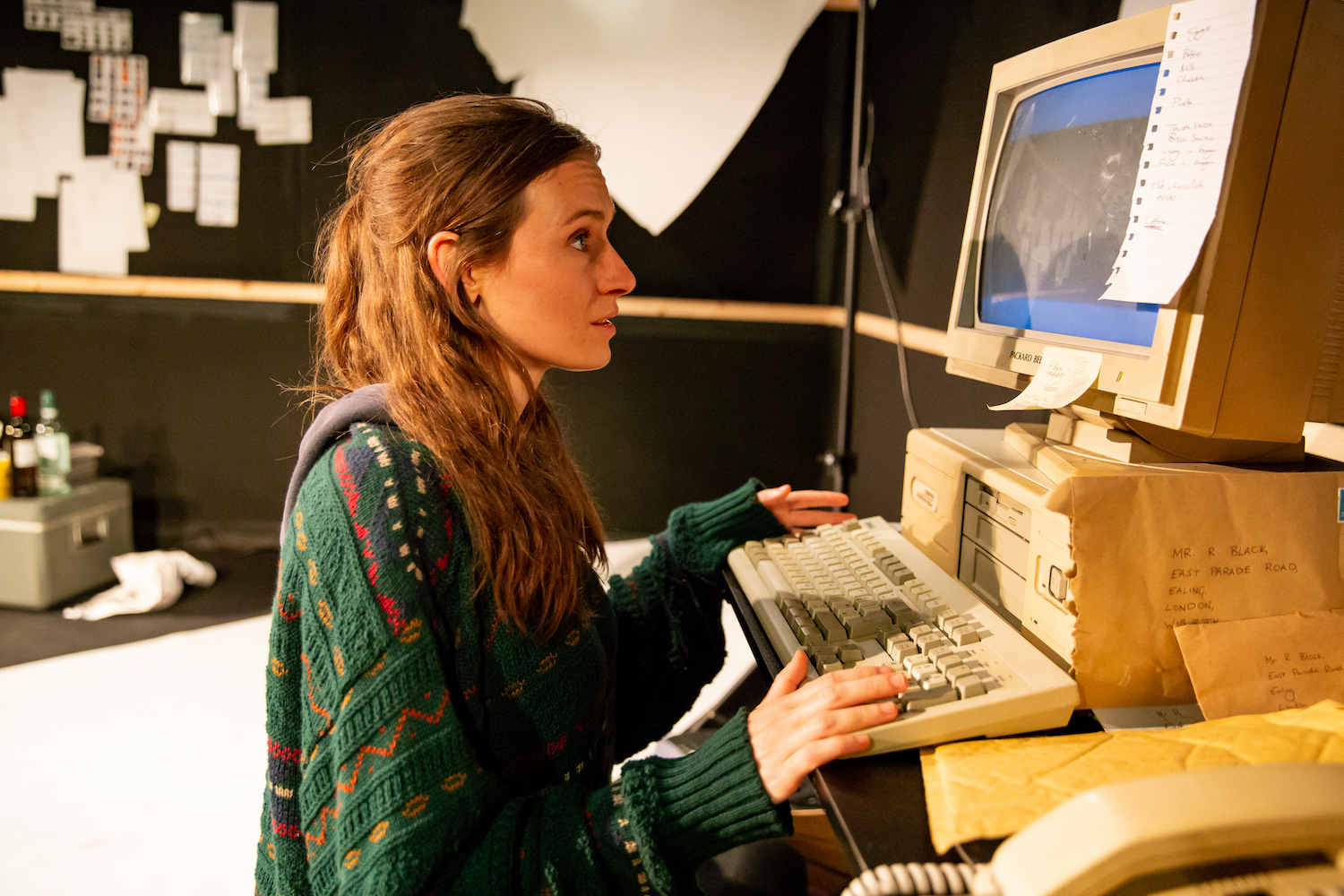
Set in the 90s, Kevin Mandry’s Eros takes us back to the early days of the Internet, and into the studio of Ross Black (Stephen Riddle). A former glamour photographer, he’s fallen on hard times and now scrapes a living helping small businesses produce marketing brochures. He dreams of giving it all up and moving to Scotland, much to the horror of his assistant Terri (Felicity Jolly), for whom the studio is much more than just a job. And then his ex-lover Kate (Anna Tymoshenko) arrives out of the blue to remind Ross of his glory days – and not in a good way.

The first thing to say about Eros is that it doesn’t necessarily go where you think it’s going… but it’s also difficult to pinpoint exactly where it does end up. Touching on various extremely topical themes – consent and female agency, our obsession with untouchable perfection, the growing influence of technology – it doesn’t really focus on any of them in any depth, and despite some intriguing details and hints that there could be a big twist coming, the explosive revelation we’ve been waiting for never arrives. As such the production, directed by Stephen Bailey, becomes somewhat lacking in pace before concluding on a disappointingly lacklustre note.

On a more personal level, as a portrait of the relationships between three disillusioned characters whose lives haven’t gone the way they hoped, the play is more successful. Felicity Jolly’s Terri is by far the most likeable of the three; after escaping a troubled past, she’s found some kind of stability with Ross, who she clearly idolises as a father figure. She’s terrified of losing both her home and her new-found Internet connection, which has allowed her to make new friends all over the world through the miracle of chatrooms.

Photo credit: Stephanie Claire Photography

The majority of the stage time belongs to Anna Tymoshenko and Stephen Riddle as Kate and Ross, whose relationship is complex and at times confusing. One minute Kate is bristling with righteous anger and hatred, the next she’s flirting, dancing around the studio, and even suggesting they get back together. She has what appears to be a picture perfect life – big house, successful business – but something’s missing, and it’s clear that despite everything she still feels some lingering affection for her former lover. There are a few moments where the two connect and it seems like this affection might be reciprocated, but they never last long; Ross has his own idea of a perfect life and Kate, it seems, has never featured in it.

Eros sets out to tackle some interesting questions about human nature and our relationship with the ever-changing world around us, and offers an enjoyable opportunity for those old enough to reminisce about the joys of dial-up internet. The personal story of the characters is intriguing to watch as it unfolds, but unfortunately a lack of focus reduces the topical contribution that the play could have made to more than one ongoing discussion.

Can’t see the map on iPhone? Try turning your phone to landscape and that should sort it. I don’t know why but I’m working on it…