Interview: BoxLess Theatre, LOOP

Opening next month at Theatre N16, LOOP is the debut production from BoxLess Theatre. The show charts three generations of one family, from 1965 to the present day, and explores how they evolve, change and fall in love along with the music that they listen to.

Resident Writer Alexander Knott and Artistic Director Zoë Grain collaborated on the creation of LOOP, combining words and moves with music from the 60s, 80s and present day. “The show was inspired by Zöe, who knew she wanted to do a piece that was intrinsically about music, and how it can be the soundtrack to our lives,” explains Alexander. “That, and the image of a Walkman and a set of 80s headphones. From there we brainstormed the characters and arrived at different ways of how they could be related. It was quite late on in the writing that it was apparent that they were all one family – for a while, it was just a series of unconnected vignettes, but now it’s more of a sequential story.”

“The project was jumpstarted when Second Sons Theatre asked us to devise a ten minute piece for their ‘Play Time’ festival of new writing, last September,” continues Zoë. “Alexander worked up some draft monologues and we devised a short scene, that gave the essence of the play. Half a year down the line, the rest of the play is written and that extract now comes in the middle of the story. Actors Aaron Price and Rubie Ozanne are reprising their roles as ‘The Boy’ and ‘The Girl’, with Emily Thornton and James Demaine completing the cast.”

Choreographer Zoë set up BoxLess Theatre last year, after graduating from Italia Conti. “My aim has always been to make physical theatre something accessible to people of different disciplines and experience, not just for classically trained dancers,” she explains. “The training at Italia Conti Acting, where the cast and creative team met, has always shown movement as a way of expressing the story of a play in a very immediate way, and BoxLess is taking this a step further with a piece that combines physical theatre and new writing. Dance for everyone, essentially, and not just for the few.”

After months in development, the show finally opens on 6th June at Balham’s Theatre N16. “We’re all feeling excited, with a definite hint of butterflies, and there’s still plenty to do,” says Alexander. “But N16 is a great space – intimate, yet versatile, and with a lot of atmosphere. The preview of the show was performed there, so we feel like we know how to move in that space. Rehearsals have a great, collaborative energy to them, with everyone bringing ideas to the table. There’s always going to be that ‘going out on a limb’ nervousness when creating a new piece of theatre, but the show is taking shape, and we’re starting to see it come to life.”

LOOP offers a great opportunity to enjoy a bit of musical nostalgia, but there’s a lot more to the show than a simple trip down memory lane. “We’d like audiences to go away with that feeling of having seen a satisfying story. Seeing the characters grow and change – after all, the story covers the best part of 60 years – and how something that happens to one of them in 1965 might influence choices made in the present, should be really engaging. We want the movement to be as slick and expressive as it can be – there’s something intensely satisfying in well-executed physical theatre. Also, perhaps, leaving the theatre with a sense of hopefulness; the play is, we think, about hope, about looking forward and letting go of the past.”

Book now for LOOP at Theatre N16 from 6th-10th June.

Interview: Margot Ravenscroft, The Exonerated

The U.S. death penalty is a huge and controversial topic, with strong opinions on both sides. But whatever you believe, there’s one anti-death penalty argument that’s hard to dispute: what if the state executes someone who turns out to be innocent?

That, as it turns out, is not as unlikely as we might hope; in the USA today, for every nine executed, one is proven innocent. Amicus, a small charity that helps provide representation for those facing the death penalty in the USA, hopes to raise awareness of this appalling statistic, and their own vital work to help those affected, in a special one-off production of Jessica Blank and Erik Jensen’s The Exonerated on May 16th at Middle Temple Hall.

The Exonerated is an amazingly powerful play that tells the story of six real-life cases of innocent people who were sentenced to death and subsequently exonerated,” explains Margot Ravenscroft, director of Amicus. “It’s not only their story but the story of many others still on death row, and the people in their lives. Told using extracts from actual court records and their own words, it’s beautifully woven together by the writers to leave the audience with a sense of the injustices and emotional anguish suffered by these people.”

The play debuted off-Broadway in 2002, and was later adapted into a movie starring Susan Sarandon and Danny Glover. For Margot and the team at Amicus, it’s become a very personal project: “I was incredibly moved the first time I saw this play, it’s a script that stays with you for life. And now, years on having personally met and worked closely with some of the people whose story this play tells, it is a real privilege to be able to produce it to benefit Amicus, in assisting people who still today face the death penalty without a fair trial process. To produce this play is something I have had in my mind for years; the impact of theatre and particularly this play on everyone who sees it live should not be underestimated.

“It’s the personal stories that touch us – the thought that but for the hand of fate it could be us, our daughter, our son. We are forced to be in their personal thoughts, drawn in by knowing the words are actually their words – not fiction but fantastical fact. The writers’ skill in bringing together these stories to a dramatic effect mean that you are left not only moved but emotionally wiser.”

The production brings together a stellar cast, including Jamie Parker, currently playing Harry Potter in the West End, barristers Leslie Thomas QC and Tunde Okewale MBE, and death row exoneree Sunny Jacobs, who plays herself. “I really wanted to have a cast with a mixture of professional actors and a few high profile legal personalities – barristers are perhaps all frustrated actors, after all,” says Margot. “Everyone who read the script was convinced. I gave Jamie Parker the script to read, knowing what a passion for justice he had. He agreed immediately, which was wonderfully touching. All of the actors have a real interest in the injustices of the world and an empathy to some of these powerful characters. Leslie and Tunde as civil rights barristers have a natural empathy with the issues of this play and understood its importance.

This production is particularly poignant too, as Sunny Jacobs will be playing herself. If you’ve ever heard Sunny speak generally, she speaks from the heart and it’s an incredible experience to have her in this production; you almost hold your breath so as not to interrupt her. Peter Pringle, another exoneree, will be playing the part of Gary – again, this really does bring the emotion of the play to the surface. Peter and Sunny are actually also husband and wife, after finding love and a rare level of understanding not only in their shared experiences of being wrongly convicted, but also in their strength of forgiveness and positive energy that’s palpable in the words and actions. They now use that strength to run a sanctuary for exonerated prisoners in rural Ireland called the Sunny Center.

“I know that people will come away from this performance with a greater understanding of the humanity of people facing the death penalty, and that they’ll be moved by these personal and touching stories. But I hope that they’ll also leave with an understanding of the importance of human rights, and support Amicus who are working with these stories every day; these are intensely dramatic and personal tales, but they’re the stories of many, many more people that we help every day.”

Amicus was founded in 1992 by Jane Officer, in memory of Andrew Lee Jones, who was executed in Louisiana in 1991. The two had met and become friends through LifeLines, a UK-based organisation that provides support to death row inmates through letter-writing. Despite a lack of scientific evidence linking him to the crime, Andrew was convicted of murder by an all-white jury, in a trial that took less than a day. Details of his mental illness were withheld by the prosecution, vital mitigation was not presented and he was represented by an inexperienced lawyer who had never tried a capital case. Good representation could have saved Andrew’s life, but instead his death became the inspiration for Amicus.

“Today Amicus takes on a huge scope of work, supported by dedicated staff and volunteers,” Margot explains. “We provide pro bono caseworkers based in the UK; working with over a dozen different firms and more than 200 individuals we’re able to coordinate key work remotely that makes a huge difference. We also send out 30-40 U.S. based interns a year, who work directly with capital lawyers in eighteen different offices across the breadth of death penalty states.

“Our bi-annual training attracts high profile experts in the field of capital defence, and introduces UK lawyers to the key issues faced and important training in preparing a capital case. We also work on various constitutional projects in support of fair trials in capital cases. Recent success in the Supreme Court in the Bobby Moore case demonstrates what can be achieved; many dedicated Amicus volunteers made this possible. The ruling in this case will affect a great many cases involving intellectually disabled people facing the death penalty.”

The statistics surrounding innocence on death row are undoubtedly shocking – but what can we here in the UK do to help“I think that coming to see The Exonerated would be a start!” answers Margot. “Human rights abuses internationally are everyone’s responsibility; educate yourself and find out what the issues are. Support Amicus; with more support we will do much more and help many more people. We have limited resources, and rely on donations in order to do our work.”

Tickets are on sale now for this special one-off performance of The Exonerated presented by Amicus on 16th May.

Review: Brimstone and Treacle at The Hope Theatre

Dennis Potter’s Brimstone and Treacle was originally written for the BBC, but banned from transmission for several years because of its controversial content. 40 years later, Matthew Parker’s revival proves the play has lost none of its power to shock and disturb. Trying to reconcile everything that goes on keeps making my head hurt – and not just because of Rachael Ryan’s spectacular 70s wallpaper (though that certainly doesn’t help the situation).

It all seems quite straightforward to begin with. Tom and Amy Bates are a middle-aged couple caring for their daughter Pattie after a hit and run two years ago left her brain damaged and helpless. Just as they’re reaching breaking point, a mysterious young man turns up on the doorstep claiming to know their daughter, and offering his help. Martin Taylor seems like the answer to their prayers, but despite Amy’s raptures, it’s clear from the start that he is not a good guy – an impression cemented when he commits an unspeakable act against the vulnerable Pattie while her mum’s out getting her hair done.

But then. Then it all gets very interesting (if headache-inducing) as events take an unexpected turn and suddenly we don’t know whose side we’re on any more. The lines between good and evil begin to blur, and the play evolves into a powerful and incredibly relevant debate on issues of immigration, national identity and what it really means to “take our country back” – before spiralling to a shocking but strangely satisfying conclusion.

Photo credit: lhphotoshots

Matthew Parker has assembled a small but perfectly formed cast, who handle the difficult material with sensitivity and skill. As the beaten down Amy, Stephanie Beattie’s weariness and desperation are palpable, and it’s easy to see why she so readily falls for Martin’s slick patter. Paul Clayton gives a nicely understated performance as her husband Tom, whose only way of dealing with his grief is being impatient with his wife and hankering for the way things used to be.

Olivia Beardsley has fewest lines but arguably the toughest role as Pattie; in a meticulously observed physical performance, she communicates everything she can’t say verbally through her eyes and movement. And at the centre of it all is Fergus Leathem, genuinely quite terrifying as the psychopathic Martin, with a fixed grin but empty eyes, and a discomfiting habit of turning mid-conversation to address his private thoughts to the audience. His emotionless (not to mention tuneless) rendition of You Are My Sunshine is the stuff of horror movies; I don’t think I’ll ever be able to listen to the song again without a small shudder of revulsion.

Photo credit: lhphotoshots

Potter’s play deals with difficult themes in a darkly humorous way, provoking nervous and slightly guilty laughter at unexpected moments. But at the same time, spooky sound and light effects from Philip Matejtschuk and Tom Kitney keep us on edge and remind us not to get too comfortable – we are, after all, in the presence of pure evil.

It’s safe to say Brimstone and Treacle may not be everyone’s cup of tea; it’s incredibly intense, really messes with your head and may be best avoided by the easily offended or those of a nervous disposition. But it’s also a gripping production, beautifully performed, and even four decades after the play was written, fascinatingly – and uncomfortably – relevant. Above all, it reminds us that while evil may be closer to home than we realise, good will always win in the end – though maybe not in quite the way we expect.


Can’t see the map on iPhone? Try turning your phone to landscape and that should sort it. I don’t know why but I’m working on it… 😉

Review: Pygmalion at the Nuffield Theatre

Guest review by Edward Learman

Playing at the Nuffield Theatre last night I had the opportunity to see the latest reinterpretation of George Bernard Shaw’s classic Pygmalion, a co-production performed by Southampton University’s own Nuffield Theatre company and the two touring companies Headlong and West Yorkshire Playhouse.

I knew little about Shaw’s play, except that both he and HG Wells (The Time Machine) had at one time written propaganda romanticising the Russian Revolution and Stalin’s disastrous five-year plans. The title sounded Greek or Roman, and I’d remembered reading that it was an interpretation of the ancient myth, but this could just have easily been on the sleeve notes for My Fair Lady (1964). Interestingly, Pygmalion’s themes can be charted in such films as Titanic (1997), Pretty Woman (1990), She’s All That (1999), and probably a countless number of books and films across the world, making it a truly universal story about love, self-discovery and freedom.


The German term ‘Bildungsroman’ is often used to describe the fairy-tale journey of a hero from poverty to enlightenment; the forming of the ‘true self’ which they are destined to become. Having not seen Shaw’s original version and only familiar with its pop-culture references, I had incorrectly assumed that the play was a romantic Cinderella-tale similar to Oscar Wilde’s comedy of manners, An Ideal Husband and The Importance of Being Earnest, neither of which I’d seen either.

Just 30 seconds into the first act, it was immediately apparent that Sam Pritchard and company had little interest in making the show about either manners or love. This was not a British romance like Four Weddings and a Funeral or Bridget Jones, but then perhaps Shaw’s original never was; without a doubt it did not contain lines like, “Are you going to walk?” / “Of course not, I’m going to get a f***ing taxi.”

The first scene that introduces the pauper Eliza Doolittle (Natalie Gavin) to her sponsor and nemesis Henry Higgins (Alex Beckett) shows the main cast standing on a street, sheltering from the rain, but reading their lines in dubbed recordings using different dialects and voices. A visual projection onto the set’s background shows the text of each individual line as it’s mouthed by the actors. This is jarring for the audience, hearing the same character speak their lines like ventriloquists, but makes it so that the projected subtitles is the only way of following the conversation.

The programme contains a short interview between one of the show’s creators Caitriona Shoobridge and Dr. Bronwen Evans (from the UCL’s Speech, Hearing and Phonetic Sciences Department), in which they discuss this scene and how people often change their accents, and what this means culturally. Perhaps this device undermines the purpose of the scene, which starts as a banal conversation about the bad weather, but ends with Henry and cast humiliating Eliza as she tries to earn money selling flowers.

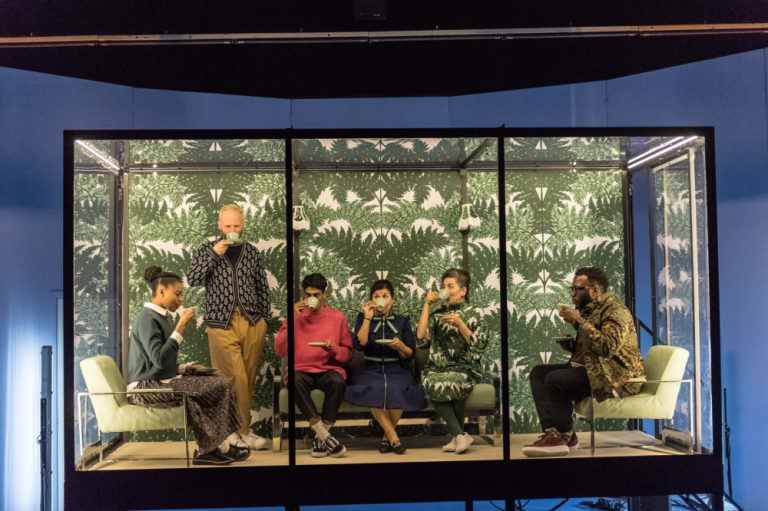
Afterwards, the scenes revert back to a formal staged drama without the subtitles. The play becomes a slapstick, sometimes musical, foray as Henry coaches the naïve Eliza in order to win his bet that he can transform her into a duchess. The stage set combines film projection and large set changes, the most striking of these being Mrs. Higgins’ dining room, which resembles a huge iguana tank, and shows her camouflaged against the tropical-green wallpaper in her matching costume.

Photo credit: Manuel Harlan

The cast give high-energy and flamboyant performances, delivering characters that go from Mighty Boosh-style slapstick to restrained moments of personal reflection. Its mixed-race cast of professional actors speak like bourgeoisie elitists, slipping in some modern phrases, to create a peculiar anachronism with Shaw’s original text. The supporting actors are versatile, especially Raphael Sowole as Colonel Pickering and Ian Burfield as Alfred Doolittle, showing their pitch-perfect timing at comic relief. The two leading actors, Alex Beckett and Natalie Gavin, whose performances require them to use different accents whilst showing the turns of the characters, are fascinating throughout.

The play is as much about bullying as it is about class prejudice. Inevitably, after being conned into a verbal contract by Henry and her father, Eliza chooses to turn her back on him when he tries to convince her that cruelty is really what class is all about.

Pygmalion is at the Nuffield Theatre until 13th May.

Review: Becoming Mohammed at The Pleasance

Becoming Mohammed by Claudia Marinaro packs an unexpected punch. On the surface a relatively straightforward family drama, on another, deeper level, it forces us to question our own assumptions and what’s led us to form these opinions in the first place.

The story’s based on director Annemiek van Elst’s real-life family experience, and sees Sarah (Philippa Carson) return home after living abroad for two years, looking forward to indulging in a bit of nostalgia with her brother Thomas (Jack Hammett). But when she learns he’s become a Muslim in her absence, a horrified Sarah does all she can to talk him out of it, assuming he’s been brainwashed by new best friend Musa (Jonah Fazel) and his sister – now Thomas’ fiancée – Aminah (Nadia Lamin).

Photo credit: And Many Others

With time and understanding, Sarah and Thomas set out on the road to resolving their family drama. But there’s a bigger conflict brewing, as an enthusiastic Thomas attempts to bridge the gap between Muslims and non-Muslims within the local community, not realising he’s fighting a losing battle against the ignorance and fear that’s become such a natural part of our society we barely notice it any more. Musa and Aminah, on the other hand, exude a weary resignation to the prejudice against them and it’s perhaps this that hits hardest – the fact that an entire section of society feels there’s no point standing up for themselves because nothing will ever change.

In trying to shed a little light on what Islam is really all about, Marinaro has been careful to create well-rounded characters and a realistic portrayal of Muslim culture. So Aminah can’t be alone with Thomas without a chaperone until they’re married, and won’t let Sarah wear heels to visit the mosque because they “make you walk a certain way” – but all three Muslim characters also frequently swear like troopers and listen to the likes of Beyonce and Coolio. It’s interesting too to see Aminah go from shy bride-to-be in Act 1 to by far the strongest personality in Act 2, with Nadia Lamin revelling in her character’s transformation and delivering some brilliant one-liners as she figuratively bangs everyone else’s heads together. In direct contrast, Jonah Fazel’s Musa shifts from being a bit of a joker early on to take a more confrontational position when he sees his position as spokesman for the Muslim community threatened by his own protege.

Photo credit: And Many Others

While there’s a surprising amount of humour in the play (yet another assumption shattered – why should we be surprised that a play about Islam is funny?), there are also some really touching scenes between Jack Hammett and Philippa Carson as the estranged siblings. Sarah’s visit has been prompted by Thomas’ plans to sell their family home; they’re surrounded throughout by plastic boxes filled with childhood memories. It soon becomes clear that Sarah’s main concern isn’t really that her brother’s being radicalised; it’s a basic human fear of losing him to a world that she doesn’t understand. The problem is, he’s so excited about his new life that he’s blind to her vulnerability – and so the distance between them grows ever greater.

Becoming Mohammed may be based on one family’s story, but it’s representative of many more. The play shows how far we still have to go, not only in our understanding of Muslim culture, but in breaking down the stereotypes associated with it. Only by challenging the idea of “us and them” can society – and we as individuals – move forward together.


Can’t see the map on iPhone? Try turning your phone to landscape and that should sort it. I don’t know why but I’m working on it… 😉