Review: Pygmalion at the Nuffield Theatre

Guest review by Edward Learman

Playing at the Nuffield Theatre last night I had the opportunity to see the latest reinterpretation of George Bernard Shaw’s classic Pygmalion, a co-production performed by Southampton University’s own Nuffield Theatre company and the two touring companies Headlong and West Yorkshire Playhouse.

I knew little about Shaw’s play, except that both he and HG Wells (The Time Machine) had at one time written propaganda romanticising the Russian Revolution and Stalin’s disastrous five-year plans. The title sounded Greek or Roman, and I’d remembered reading that it was an interpretation of the ancient myth, but this could just have easily been on the sleeve notes for My Fair Lady (1964). Interestingly, Pygmalion’s themes can be charted in such films as Titanic (1997), Pretty Woman (1990), She’s All That (1999), and probably a countless number of books and films across the world, making it a truly universal story about love, self-discovery and freedom.


The German term ‘Bildungsroman’ is often used to describe the fairy-tale journey of a hero from poverty to enlightenment; the forming of the ‘true self’ which they are destined to become. Having not seen Shaw’s original version and only familiar with its pop-culture references, I had incorrectly assumed that the play was a romantic Cinderella-tale similar to Oscar Wilde’s comedy of manners, An Ideal Husband and The Importance of Being Earnest, neither of which I’d seen either.

Just 30 seconds into the first act, it was immediately apparent that Sam Pritchard and company had little interest in making the show about either manners or love. This was not a British romance like Four Weddings and a Funeral or Bridget Jones, but then perhaps Shaw’s original never was; without a doubt it did not contain lines like, “Are you going to walk?” / “Of course not, I’m going to get a f***ing taxi.”

The first scene that introduces the pauper Eliza Doolittle (Natalie Gavin) to her sponsor and nemesis Henry Higgins (Alex Beckett) shows the main cast standing on a street, sheltering from the rain, but reading their lines in dubbed recordings using different dialects and voices. A visual projection onto the set’s background shows the text of each individual line as it’s mouthed by the actors. This is jarring for the audience, hearing the same character speak their lines like ventriloquists, but makes it so that the projected subtitles is the only way of following the conversation.

The programme contains a short interview between one of the show’s creators Caitriona Shoobridge and Dr. Bronwen Evans (from the UCL’s Speech, Hearing and Phonetic Sciences Department), in which they discuss this scene and how people often change their accents, and what this means culturally. Perhaps this device undermines the purpose of the scene, which starts as a banal conversation about the bad weather, but ends with Henry and cast humiliating Eliza as she tries to earn money selling flowers.

Afterwards, the scenes revert back to a formal staged drama without the subtitles. The play becomes a slapstick, sometimes musical, foray as Henry coaches the naïve Eliza in order to win his bet that he can transform her into a duchess. The stage set combines film projection and large set changes, the most striking of these being Mrs. Higgins’ dining room, which resembles a huge iguana tank, and shows her camouflaged against the tropical-green wallpaper in her matching costume.
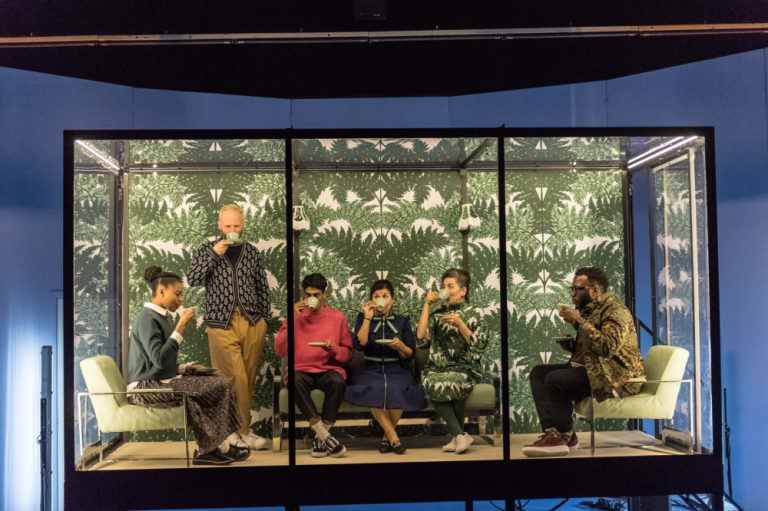
Photo credit: Manuel Harlan

The cast give high-energy and flamboyant performances, delivering characters that go from Mighty Boosh-style slapstick to restrained moments of personal reflection. Its mixed-race cast of professional actors speak like bourgeoisie elitists, slipping in some modern phrases, to create a peculiar anachronism with Shaw’s original text. The supporting actors are versatile, especially Raphael Sowole as Colonel Pickering and Ian Burfield as Alfred Doolittle, showing their pitch-perfect timing at comic relief. The two leading actors, Alex Beckett and Natalie Gavin, whose performances require them to use different accents whilst showing the turns of the characters, are fascinating throughout.

The play is as much about bullying as it is about class prejudice. Inevitably, after being conned into a verbal contract by Henry and her father, Eliza chooses to turn her back on him when he tries to convince her that cruelty is really what class is all about.

Pygmalion is at the Nuffield Theatre until 13th May.

Review: Becoming Mohammed at The Pleasance

Becoming Mohammed by Claudia Marinaro packs an unexpected punch. On the surface a relatively straightforward family drama, on another, deeper level, it forces us to question our own assumptions and what’s led us to form these opinions in the first place.

The story’s based on director Annemiek van Elst’s real-life family experience, and sees Sarah (Philippa Carson) return home after living abroad for two years, looking forward to indulging in a bit of nostalgia with her brother Thomas (Jack Hammett). But when she learns he’s become a Muslim in her absence, a horrified Sarah does all she can to talk him out of it, assuming he’s been brainwashed by new best friend Musa (Jonah Fazel) and his sister – now Thomas’ fiancée – Aminah (Nadia Lamin).

Photo credit: And Many Others

With time and understanding, Sarah and Thomas set out on the road to resolving their family drama. But there’s a bigger conflict brewing, as an enthusiastic Thomas attempts to bridge the gap between Muslims and non-Muslims within the local community, not realising he’s fighting a losing battle against the ignorance and fear that’s become such a natural part of our society we barely notice it any more. Musa and Aminah, on the other hand, exude a weary resignation to the prejudice against them and it’s perhaps this that hits hardest – the fact that an entire section of society feels there’s no point standing up for themselves because nothing will ever change.

In trying to shed a little light on what Islam is really all about, Marinaro has been careful to create well-rounded characters and a realistic portrayal of Muslim culture. So Aminah can’t be alone with Thomas without a chaperone until they’re married, and won’t let Sarah wear heels to visit the mosque because they “make you walk a certain way” – but all three Muslim characters also frequently swear like troopers and listen to the likes of Beyonce and Coolio. It’s interesting too to see Aminah go from shy bride-to-be in Act 1 to by far the strongest personality in Act 2, with Nadia Lamin revelling in her character’s transformation and delivering some brilliant one-liners as she figuratively bangs everyone else’s heads together. In direct contrast, Jonah Fazel’s Musa shifts from being a bit of a joker early on to take a more confrontational position when he sees his position as spokesman for the Muslim community threatened by his own protege.

Photo credit: And Many Others

While there’s a surprising amount of humour in the play (yet another assumption shattered – why should we be surprised that a play about Islam is funny?), there are also some really touching scenes between Jack Hammett and Philippa Carson as the estranged siblings. Sarah’s visit has been prompted by Thomas’ plans to sell their family home; they’re surrounded throughout by plastic boxes filled with childhood memories. It soon becomes clear that Sarah’s main concern isn’t really that her brother’s being radicalised; it’s a basic human fear of losing him to a world that she doesn’t understand. The problem is, he’s so excited about his new life that he’s blind to her vulnerability – and so the distance between them grows ever greater.

Becoming Mohammed may be based on one family’s story, but it’s representative of many more. The play shows how far we still have to go, not only in our understanding of Muslim culture, but in breaking down the stereotypes associated with it. Only by challenging the idea of “us and them” can society – and we as individuals – move forward together.


Can’t see the map on iPhone? Try turning your phone to landscape and that should sort it. I don’t know why but I’m working on it… 😉

Review: All Our Children, Jermyn Street Theatre

It was never going to be an easy play to watch. Stephen Unwin makes his debut as a playwright with All Our Children, a chilling expose of the brutal programme that saw Nazi Germany send thousands of disabled children to their deaths, ostensibly to ease the financial burden on the state. Over the course of one day, we see the situation through the eyes of five characters, each with a different perspective – and leave disturbed and shaken by the horrors human beings are capable of inflicting on each other.

The subject matter sounds grim, and it is – not for what we see but rather what we don’t. There are no children in the play; we never leave the comfortable office of Dr Victor Franz (Colin Tierney), chief paediatrician at a children’s clinic near Cologne. But we come to know them, through the pain of a mother who’s lost her son, the remorse of another who’s realised the patients in the clinic are, after all, “just children”, and through the cowardly attempts of a man who once swore to do no harm to justify sending his innocent charges to be murdered.

Photo credit: Camilla Greenwell

It’s this, more than anything, that really sends a chill down the spine. Franz is an experienced and compassionate doctor; he’s often funny, has an obvious affection for his devoted maid Martha (Rebecca Johnson), and dislikes the odious SS man Eric Schmidt (Edward Franklin) who’s there to make sure he toes the line and meets his grotesque quotas. Franz could be quite a likeable guy, in fact, but for the cold, clinical way he reels off the official justifications for his actions. Unlike the fanatical Schmidt, who simply hates the clinic’s patients and everything they represent, it’s obvious from the doctor’s hangdog expression, late night drinking and constant efforts to hide the truth from Martha that he knows full well what he’s doing is wrong. The arrival of David Yelland’s Bishop von Galen (a real historical figure, whose public opposition to the programme was key to its eventual abolition) could hardly be more timely, and his dignified rage in the face of Franz’s cowardice speaks for all of us.

The play is a very personal project for Stephen Unwin, who also directs, and there’s no doubting the passion or anger behind every word – but he resists the urge to preach his views, instead presenting a sensitive and balanced debate from which ultimately it’s the compassionate voices that cry out the loudest. While the men each get their turn to argue the intellectual and moral points of the debate, the two women – both mothers – represent the emotional heart of the play, and it’s their scenes that really drive home the horror of what’s happening. Lucy Speed’s Frau Pabst breaks our hearts as she describes her son with none of the eloquence of the men but a great deal more feeling; she knows Stefan will never have a job or pay tax – but he’s her son and she can’t bring herself to share the view that his is a life not worth living. And Martha’s softly spoken realisation that the patients she used to feel so sorry for are no different to her own three “normal” children has just as much impact as the bishop’s outrage.

Photo credit: Camilla Greenwell

A few slightly artificial sound effects aside, All Our Children is an incredibly effective and thought-provoking piece of theatre, a warning from history that reminds us of our continuing duty to look out for those who need our help, particularly at a time of government cuts and growing intolerance. We may not be in Nazi Germany, and it may not be 1941 – but that doesn’t mean there aren’t still lessons to be learnt, or battles to be fought.


Can’t see the map on iPhone? Try turning your phone to landscape and that should sort it. I don’t know why but I’m working on it… 😉

Review: This Beautiful Future at the Yard Theatre

Guest review by Lucrezia Pollice

“If I could do it again I would…”

Funny, witty and effective. A story about war, love, youth, confusion and choices. A youthful romance arises in the mist of WWII. Two teenagers from diverse paths of life are brought to face intricate questions as they experience love for the first time. The performance is lively, charismatic and charming, with a modernised setting making it evermore relatable and the past more tangible.

The stage is minimal, a round bed, a bowl, water tap, clothes and two karaoke booths. The story episodically shifts slightly forward and backward, but is made very clear to follow. Elodie is a French girl, Otto is a German soldier. They are fighting on opposite sides of the battle. She is 17-years-old and he is 15-years-old. He sees her bathing in a lake, she lets him watch for a while before introducing herself. She’s curious, excited by his gun and asks to touch it, and after some convincing he finally gives in.

Photo credit: Richard Lakos

In an abandoned house they find out about each other after overcoming first embarrassments. The writing is witty and light, but constantly acknowledging the underlining backdrop of the war which has become the norm to them. Their time together is what is most important. They are trying to figure it out and nervously break into pillow and water fights, to then awkwardly start kissing again. Meanwhile, two older counter figures Alwyne Taylor and Paul Haley accompany their telling by singing in the karaoke booths.

It seems like a beautiful coincidence they met… until their beliefs and views come into play. The war seemed to be distant, present in the destruction of bombs. Its consequences are present in the room as Elodie brings back an egg she’s rescued, which it becomes their mission to keep warm. The conflict is far away though, it has nothing to do with them, although it still affects them. Otto is constantly scared, pointing his gun at the floor with extreme terror that someone might find them. Elodie has an epileptic attack on stage; she looks happy and strong but there is something lurking behind them. Soon they discover the war is actually between them.

Photo credit: Richard Lakos

Otto, played by Bradley Hall, interprets the Nazi SS stereotype, with oil-slick blonde hair, a youthful face and grey uniform, boasting his adoration for Hitler. Elodie, played by Hannah Millward, does not agree with Otto’s views, but she is torn as to what to do. She knows the war is over, but Otto is still parading his leader and dreams. The performances are acted with such conviction it makes the choices and actions hard to watch. Can the power of love be so irrational? How could it? But then again, don’t we all do irrational things for the people we love?

Artistic Director Jay Miller does an incredibly brilliant job at finding the right aesthetics; a delicate beauty surrounds the stage. The set is minimal, with a stunning backdrop by Cécile Trémolières, which together with the simplistic but effective lighting and music, creates a powerful aesthetic, all elements perfectly in harmony. Spectators were very engaged around me, perhaps partially for the limited participatory moments or for the slightly bizarre non-binary elements in the representation. An extremely enjoyable evening, I highly recommend it.


Can’t see the map on iPhone? Try turning your phone to landscape and that should sort it. I don’t know why but I’m working on it… 😉

Review: Suddenly…! at the Cockpit Theatre

I always imagine it must be pretty terrifying making theatre for children. Grownups will (usually) at least pretend to look interested, but with kids there’s no such guarantee. Fortunately, Really Big Pants Theatre’s Suddenly…! had its young audience at the Cockpit Theatre spellbound from the start… and the adults had a pretty good time too.

Photo credit: ID Photography

Suddenly…! takes elements from different fairy tales and mixes them together in an original, exciting and heartwarming story about the importance of friendship. Red Riding Hood, Mr Wolf, a faulty genie and a wicked stepmother all make an appearance, as a young boy’s well-intentioned attempt to get his dad’s attention goes horribly wrong, and we set out on a quest to recover three special items and help Grandma save the day.

The show’s written and performed by Really Big Pants’ Joe Bromley and Willow Nash, who play all the characters with the help of assorted interesting headwear and a variety of accents, not to mention boundless enthusiasm and obvious enjoyment. It’s thoroughly entertaining, but there’s also a strong educational element to the show; besides its core message about how friendship and spending quality time together are more important than having lots of stuff, there are also brief lessons in history and science, a bit of feminism (no princesses waiting around for a man to rescue them in this story, thank you very much), and – to my delight – a tribute to the late great Roald Dahl. Afterwards, children can take away worksheets and even enter a story-writing competition for a chance to see their work published in the Ham & High newspaper.

Not surprisingly for a kids’ show, audience participation is encouraged, but in a gentle, positive way that means nobody feels singled out or uncomfortable – and it’s a testament to how enjoyable it all is that everyone’s more than happy to join in (yes, even I was up on my feet doing the genie dance). Judging by the enthusiasm of our relatively small audience at the Cockpit, I can only imagine the noise levels when the show’s performed in a school hall full of excited children.

Photo credit: ID Photography

The show is also very funny, and like any good kids’ story contains jokes for both children and adults, so everyone stays engaged and entertained throughout. But the humour isn’t the only thing that works on two levels – as the story itself points out, it’s not just children who need to be reminded that material possessions aren’t everything, or that we should put down our phones once in a while and spend some time with the people we care about.

Suddenly…! is a great story and a lot of fun for the whole family, performed with an infectious energy and enthusiasm by two ladies who clearly love what they do. It’s educational but never boring, and enjoyably silly without being patronising. And because Really Big Pants encourage their audience – young and old – to go away and write their own stories, the fun doesn’t have to stop when the show ends.

Really Big Pants Theatre perform at theatres, festivals, schools and community venues. For all upcoming dates or to book them for an event, visit reallybigpants.co.uk or follow them on Twitter @reallybptheatre.


Can’t see the map on iPhone? Try turning your phone to landscape and that should sort it. I don’t know why but I’m working on it… 😉