Review: Out There on Fried Meat Ridge Road at Trafalgar Studios

Keith Stevenson’s Out There on Fried Meat Ridge Road became a cult hit when it opened in the States in 2012 – even spawning two equally well received sequels – and it’s not difficult to see why. Transferring from London’s White Bear Theatre to Trafalgar Studio 2 under director Harry Burton, this joyously bonkers little story about a bunch of misfits in a remote West Virginia motel is 70 all too short minutes of good-natured fun.

Mitch (Robert Moloney) has just lost his job at the local spork factory, had his car set on fire and been kicked out by his girlfriend. When he answers an ad for a roommate placed by the eccentric but loveable JD (Keith Stevenson), little does he realise things are about to get even worse. Sleazy motel landlord Flip (Michael Wade) think he’s gay, next door neighbour Marlene (Melanie Gray) thinks he’s David Schwimmer – and then there’s Tommy (Alex Ferns)…
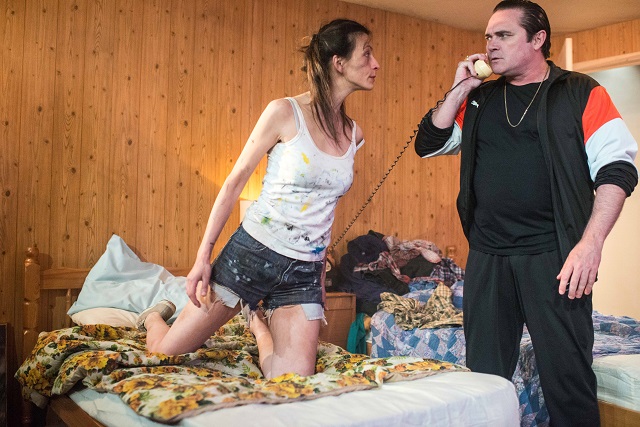
Photo credit: Gavin Watson

It’s all barking mad, but very enjoyably so; an hour of pure escapism in which literally anything could – and does – happen. The larger than life characters prove to be a cautionary tale in the dangers of judging by appearance; they might look like stereotypes, but none of them is quite what they seem. This is particularly true for Keith Stevenson’s JD, possibly the nicest man in the world, whose imposing stature hides a gentle nature, kind heart and interesting back story. In light of said back story, it later seems fitting that it’s JD who delivers the moral of the story, which is simply this: be kind. As he himself points out, that’s not something we should need to be reminded of – yet somehow in today’s often self-obsessed world it ends up feeling like something of a revelation.

Simon Scullion’s set is cosy and lived-in, a wood-panelled motel room littered with JD’s clothes, possessions and casually discarded mini vodka bottles. The familiarity with which all the characters enter and make themselves at home helps establish the relationship between the friends; JD is the centre of the group, the one everyone comes to when they need support – and he in turn is always ready with a supply of tuna sandwiches and a few words of advice.

Stevenson’s irresistible JD has excellent support from Robert Moloney as Mitch, whose appearance grows increasingly dishevelled even as his inner turmoil settles. Alex Ferns’ poet/gangster Tommy revives the crazy-eyed menace of evil Trevor (that’s his famous Eastenders character from 15 years ago, for younger readers). Michael Wade is hilariously creepy as Flip the landlord, but even he has a protective streak where JD’s concerned. And hysterical drug addict Marlene is played to perfection by Melanie Gray, who makes her likeable and sympathetic where she could have been incredibly annoying.

Photo credit: Gavin Watson

If I have one complaint about the play, it’s that – unlike its unwieldy title – it’s too short; we can only hope the sequels soon make their way to London so we can find out what the gang get up to next. Out There On Fried Meat Ridge Road is not deep and meaningful, and is at times utterly bizarre. But it’s also fantastic entertainment that leaves you with a smile on your face and a warm fuzzy feeling inside. And a craving for tuna sandwiches. (Just me? Oh.)


Can’t see the map on iPhone? Try turning your phone to landscape and that should sort it. I don’t know why but I’m working on it… 😉
Review: La Cage Aux Folles at the Orchard Theatre

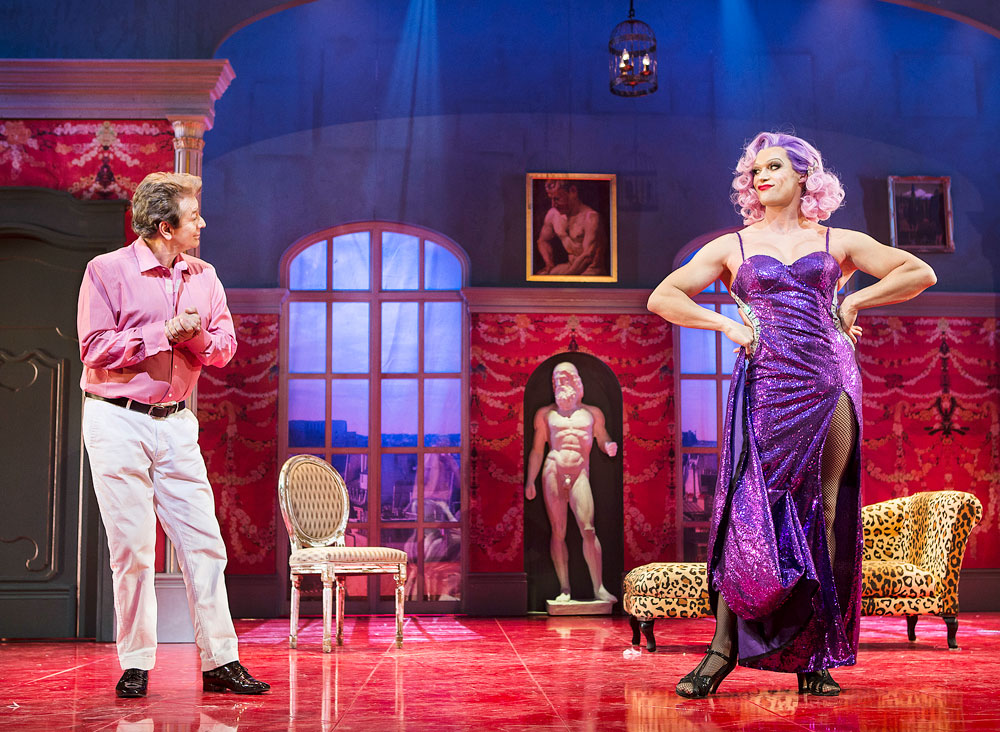
There are some shows that just make you feel good about life. La Cage Aux Folles is one such show. Setting the stage for more recent hits like Priscilla Queen of the Desert and Kinky Boots, Jerry Herman and Harvey Fierstein’s award-winning musical is a feel-good extravaganza that looks stunning, sounds fabulous and features a sensational starring performance from John Partridge.

Based in St Tropez, La Cage Aux Folles is the story of nightclub owner Georges (Adrian Zmed) and his partner Albin (John Partridge), the popular star of the club’s drag act. But then Georges’ son Jean-Michele (Dougie Carter) announces his engagement to the daughter of an infamous right wing politician, and hilarious chaos ensues as the couple attempt to tone down their flamboyant lifestyle and “act normal”.

Photo credit: Pamela Raith Photography

Act 1 in director Martin Connor’s production acts largely as an opportunity to set the scene and show off Albin’s jaw-dropping array of glittering gowns; “it’s like Black Friday at Primark back there,” he confides after yet another lightning-fast costume change. Perhaps inevitably given this frenetic backstage activity, parts of the first act – particularly during the title number – start to feel a bit like they’re only there to fill time while we wait for the next big reveal. Having said that, it does give us plenty of time to admire Gary McCann’s drop dead gorgeous set, and features one of the highlights of the evening as the distraught Albin, having learned he’s to be excluded from the meeting with Jean-Michele’s new in-laws, brings the house and curtain down with a heart-felt performance of I Am What I Am.

This, by the way, was the only song I knew from the show beforehand, but it turns out to be part of a fabulous, catchy score that’s hard to get out of your head, even 24 hours later. Song on the Sand, With You on My Arm and The Best of Times are just a few of the tunes that get the feet tapping and simultaneously pull on the heart-strings.

After the interval, there’s more action and fewer costume changes, so the comedy can begin in earnest as we head towards a somewhat predictable but still heart-warming conclusion; I’m not ashamed to admit I welled up at one point, and spontaneously cheered at another. As light-hearted as the show is, it still has an important message about accepting others and ourselves, and Dindon the homophobic politician (Paul F. Monaghan) unfortunately feels just as real in 2017 as he was when the musical was written in the 1980s.

Photo credit: Pamela Raith Photography

As Albin, John Partridge is exquisite – and not just in appearance, though he does look amazing in every outfit he puts on. Vocally, emotionally, comically, he pitches his performance exactly right, and his relationship with Adrian Zmed as Georges is both believable and touching. But while, much like his character, Partridge is undoubtedly the star of the show, the rest of the cast are by no means in his shadow. Zmed is easily likeable and a natural comedian, Marti Webb (literally) steals the limelight during her all too rare appearances as restaurant owner Jacqueline, and Samson Ajewole is particularly fun as the sassy maid/butler Jacob.

La Cage Aux Folles may not be one of the best known musicals for British audiences, but that deserves to change. A treat for the eyes, ears and heart, this dazzling production of a hugely entertaining and uplifting show is well worth a visit. If it doesn’t brighten your day, then I really don’t know what will.

La Cage Aux Folles is at the Orchard Theatre until 13th May.

Review: Care at the Courtyard Theatre

Guest review by Lucrezia Pollice

Funny, but is it?
It’s all lovely and nice to have children but what are the stories not told?

Care was first performed at the Royal Court Upstairs, with its first revival by the Angus Mackay Foundation at the Courtyard Theatre in Shoreditch. Set in a young couple’s living room, the play looks very intimately at the narratives of Terry and Cheryl, who seem to be dealing with something. It is this something that drives the narrative. An it – a she – something or someone hidden centre stage in a cupboard, which forces spectators to engage.

Terry, played by Marc Benga, is very charismatic and seems at first to be unaffected by the whole situation. Karen Mann’s Cheryl instead is distressed from the start. She is suffering from some pain of her own, trying to get attention from Terry and a love which is not given back. The TV glares throughout the scene as we watch their daily life over the course of a long weekend. The story is simple, but interesting; it gives actors more responsibility to deliver the script.

Throughout the performance, their friends David (Leo Shirley) and Cathy (Jaana Tamra) come round to the house. The relationships between the couples are strong, and create a comical scene in which Terry and Cheryl are in distress but cannot find the courage to tell Cathy and David to leave. The Polish stereotype of Cathy’s character is overly rude and sexual, and her lack of social understanding of the situation is made comical by the hilarious body language during the scene of her husband, who seems to have given up on her.

From what seems like a normal domestic, it escalates into what instead looks like an abusive relationship. Who is abusing who is unclear though. It begins as a physically abusive relationship from Terry’s part, to then shift to a loving relationship, to then seem like it is her who is abusing him. Slightly confusing, perhaps on purpose, who in the relationship was causing troubles. Terry seems to be innocent; he makes all the jokes and seems to be stuck in a house and situation he doesn’t want to be in. Or is Cheryl right in saying that he doesn’t respect her?

The playwright Roy Mitchell was a member of the National and Birmingham Youth Theatres, trained as an actor at the Manchester Polytechnic School of Theatre, and more recently has been participating in the creation of BBC1’s New Tricks drama. He touches upon very difficult topics in this play, making the audience work to understand the motifs behind the characters’ actions by not giving much away until the end.

Perhaps the simple narrative at times needs a bit more tension as this is lacking. Conveying a constant distress creates a slightly lamenting voice, which becomes uncomfortable after a while, and accents are slippery at times. The intentions between the two main characters are slightly unclear, and the grief of a baby’s loss is not conveyed as deeply as it could be in moments of despair. However, overall the performances are believable, and it was really lovely to engage with an ethnically diverse cast with such a powerful taboo topic which is death.

My favourite moment must be when Terry and Cheryl come back drunk from the pub and start watching a horror on TV. It is amazing to see how something so simple can be made into something so entertaining. The performance is overall touching upon very delicate topics, but is presented also with light moments of comedy and an obscurity as to what is happening, which might intrigue spectators.


Can’t see the map on iPhone? Try turning your phone to landscape and that should sort it. I don’t know why but I’m working on it… 😉

Review: The Pulverised at Arcola Theatre

Alexandra Badea’s The Pulverised is all about connection. Or rather, the lack of it. Globalisation may be bringing everyone closer together on a business level, the play argues, but at what cost to us as human beings? Following the stories of four professionals based in different countries but working for the same multinational corporation, Badea paints a catastrophic picture of lives without meaning, families who barely know each other, and identities lost to the corporate machine. In keeping with this, director Andy Sava situates Lucy Phelps’ translation in a scene of carnage; the stage is littered with smashed office equipment and rubble, and four bodies lie inert on the ground.

Photo credit: Dashti Jahfar

A Quality Assurance of Subcontractors Manager from Lyon (Richard Corgan) wakes up in a characterless hotel room and for a minute can’t remember what country he’s in. A factory worker in Shanghai (Rebecca Boey) spends her days on a production line in which any loss of speed and efficiency could cost her job – or worse. An ambitious Call Centre Team Leader in Dakar (Solomon Israel) can’t understand why a new recruit might object to adopting a French name in place of her own. And a Research and Development Engineer in Bucharest (Kate Miles) spends time with her family the only way she can – by spying on them via CCTV while she’s at the office.

The character profiles are deliberately vague; they’re all just one more nameless face in the rat race of global business, taking it in turns to address the audience in the second person and make the point that any one of them could be any one of us. The dialogue is rapid, and there’s a constant sense of urgency and pressure, of time being short – “the clock’s ticking, and you’re falling behind” is a frequent refrain, as is the supposedly motivational “aim for excellence”. In between their scenes, the actors crumple to the ground as if too exhausted to react to anything beyond their own experience, raising their heads to monotonously voice secondary characters in other stories, before powering back up to continue their own.

This unusual structure effectively conveys the isolation of the characters, though it does run the risk of becoming repetitive, particularly as the play is more a collection of snapshots than a story in the traditional sense, and we end pretty much where we began. It’s testament to the engaging performances of the four actors that the play holds our attention for the full 90 minutes, with each capturing the emotional and mental strain faced by their character, but also the absolute impossibility of breaking free from their soul-destroying routine. Simultaneously they – and we – are bombarded by a multimedia sensory overload, with video projections from Ashley Ogden particularly effective at demonstrating the constant flow of data and images that’s become part of 21st century life.

Photo credit: Dashti Jahfar

The Pulverised is a relentlessly bleak piece of theatre. Nobody gets a happy ending, and even for the characters who are offered an opportunity to escape, there’s a depressing sense that nothing is really going to change. But the play does force us to confront for a moment the damaging effects of progress, to reflect on that ‘made in China’ label that allowed us to pay half price, and also to consider our own priorities and work-life balance. The piece-by-piece breaking down of the set’s rear wall offers the tiniest glimpse of an emergency exit for those brave enough to take it, and the suggestion that while we may not be able to stop globalisation, we can at least save ourselves from being pulverised by it.


Can’t see the map on iPhone? Try turning your phone to landscape and that should sort it. I don’t know why but I’m working on it… 😉

Review: Brimstone and Treacle at The Hope Theatre

Dennis Potter’s Brimstone and Treacle was originally written for the BBC, but banned from transmission for several years because of its controversial content. 40 years later, Matthew Parker’s revival proves the play has lost none of its power to shock and disturb. Trying to reconcile everything that goes on keeps making my head hurt – and not just because of Rachael Ryan’s spectacular 70s wallpaper (though that certainly doesn’t help the situation).

It all seems quite straightforward to begin with. Tom and Amy Bates are a middle-aged couple caring for their daughter Pattie after a hit and run two years ago left her brain damaged and helpless. Just as they’re reaching breaking point, a mysterious young man turns up on the doorstep claiming to know their daughter, and offering his help. Martin Taylor seems like the answer to their prayers, but despite Amy’s raptures, it’s clear from the start that he is not a good guy – an impression cemented when he commits an unspeakable act against the vulnerable Pattie while her mum’s out getting her hair done.

But then. Then it all gets very interesting (if headache-inducing) as events take an unexpected turn and suddenly we don’t know whose side we’re on any more. The lines between good and evil begin to blur, and the play evolves into a powerful and incredibly relevant debate on issues of immigration, national identity and what it really means to “take our country back” – before spiralling to a shocking but strangely satisfying conclusion.

Photo credit: lhphotoshots

Matthew Parker has assembled a small but perfectly formed cast, who handle the difficult material with sensitivity and skill. As the beaten down Amy, Stephanie Beattie’s weariness and desperation are palpable, and it’s easy to see why she so readily falls for Martin’s slick patter. Paul Clayton gives a nicely understated performance as her husband Tom, whose only way of dealing with his grief is being impatient with his wife and hankering for the way things used to be.

Olivia Beardsley has fewest lines but arguably the toughest role as Pattie; in a meticulously observed physical performance, she communicates everything she can’t say verbally through her eyes and movement. And at the centre of it all is Fergus Leathem, genuinely quite terrifying as the psychopathic Martin, with a fixed grin but empty eyes, and a discomfiting habit of turning mid-conversation to address his private thoughts to the audience. His emotionless (not to mention tuneless) rendition of You Are My Sunshine is the stuff of horror movies; I don’t think I’ll ever be able to listen to the song again without a small shudder of revulsion.

Photo credit: lhphotoshots

Potter’s play deals with difficult themes in a darkly humorous way, provoking nervous and slightly guilty laughter at unexpected moments. But at the same time, spooky sound and light effects from Philip Matejtschuk and Tom Kitney keep us on edge and remind us not to get too comfortable – we are, after all, in the presence of pure evil.

It’s safe to say Brimstone and Treacle may not be everyone’s cup of tea; it’s incredibly intense, really messes with your head and may be best avoided by the easily offended or those of a nervous disposition. But it’s also a gripping production, beautifully performed, and even four decades after the play was written, fascinatingly – and uncomfortably – relevant. Above all, it reminds us that while evil may be closer to home than we realise, good will always win in the end – though maybe not in quite the way we expect.


Can’t see the map on iPhone? Try turning your phone to landscape and that should sort it. I don’t know why but I’m working on it… 😉