Review: Pride and Prejudice at Greenwich Theatre

Two actors playing all 21 characters in an adaptation of one of the most popular novels of all time. What could possibly go wrong?

As it turns out, nothing. Not a thing. In fact I may need to issue a gushing alert for this review, because I loved Two Bit Classics’ adaptation of Jane Austen’s Pride and Prejudice so much I’m already trying to work out how I can fit in a return visit. Hilarious, inventive, yet completely faithful to Austen’s original text, it’s a work of genius and I didn’t want it to end.

Photo credit: Carrie xxxx
Photo credit: Carrie Johnson

Joannah Tincey and Nick Underwood play all the characters – and that really does mean all the characters. At two and a half hours long, this is not an abridged version of the story, and so we have Bennets, Bingleys, Lucases, Mr Darcy, Mr Wickham, Mr Collins, Lady Catherine… A couple of minor characters get the chop, but anyone with any significance to the plot makes an appearance, and gets the opportunity to narrate their own part in the story.

With so many parts to play, there’s an obvious need to make each one distinct, and this characterisation is where the production really excels. Each individual has their own unique identifiers – be it a habit, an accessory or piece of clothing (often produced from one of the many nooks concealed around Dora Schweitzer’s abstract set), their way of speaking or their bearing – and we always know exactly which of Austen’s brilliant creations we’re looking at, often before they’ve even started speaking. There’s also a fair bit of gender switching, which proves yet another source of fun, with Nick Underwood taking on at least four female roles from the giggling Kitty to the demure Jane, and Joannah Tincey regularly sweeping aside her skirt to reveal the trousers of Mr Bingley.

The production is fully aware of its limitations and doesn’t try to gloss over them, but instead plays them for laughs. And so Mary – the forgotten Bennet sister – is replaced by a music stand, while one of the biggest laughs of the evening is prompted by the inventive recreation of Pemberley’s family portraits.
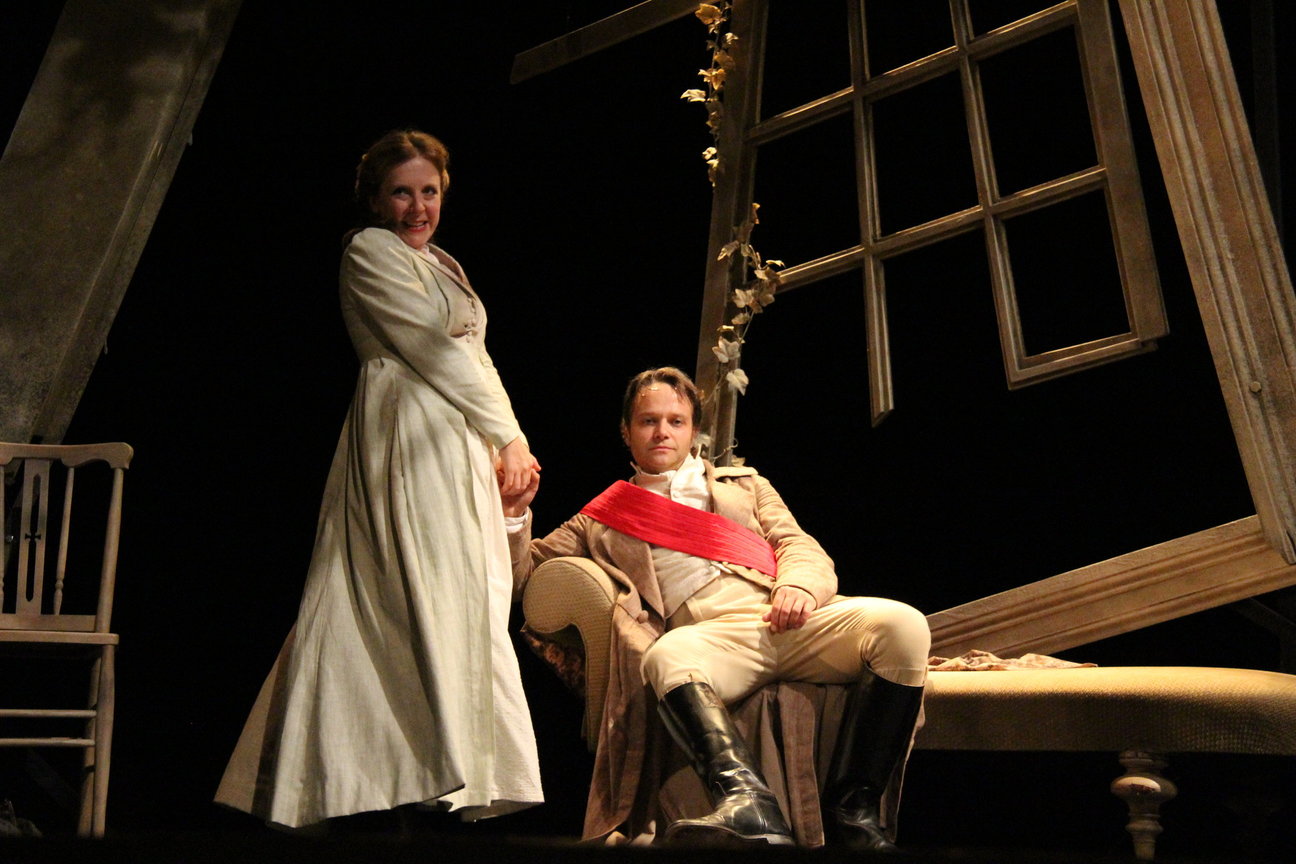
pride-and-prejudice-joannah-tincey-and-nick-underwood-courtesy-of-laura-martin
Photo credit: Laura Martin

Most mind-blowing of all is the stamina of the performers, who never flag in energy and easily hold the audience’s attention for the entire two and a half hours. Under the direction of Abigail Anderson, the action is non-stop, moving seamlessly from one episode to the next, with the actors frequently having to play several characters even within one scene, yet they never falter. This astonishing feat of endurance and dexterity alone justifies the standing ovation at the end of the evening.

For P&P fans and newbies alike, this is a glorious celebration of Austen’s book; the drama, comedy and romance we know and love are all there to be enjoyed almost word for word. But with so many ‘classic’ adaptations already in existence, this production brings with it a unique twist that makes the story feel simultaneously fresh and familiar, and – dare I say it – even funnier than the original.


Can’t see the map on iPhone? Try turning your phone to landscape and that should sort it. I don’t know why but I’m working on it… 😉

Review: When We Are Married at West Yorkshire Playhouse

Guest review by Dave Parkinson (newly appointed “occasional Yorkshire guest reviewer”)

When We Are Married is a play by Bradford-born J.B. Priestley, performed by Halifax company Northern Broadsides led by Hull-born Barry Rutter, originally at York Theatre Royal and currently touring in Leeds – it doesn’t get much more Yorkshire than that!

Priestley is probably now best known for his “time plays” such as An Inspector Calls. These were viewed with suspicion when he wrote them between the wars, as it was felt a playwright mucking around with time was somehow cheating. Now of course ideas about the fluidity of time are relatively mainstream in both arts and science – if Priestley were alive today he might be writing Doctor Who

When We Are Married is a relatively conventional play written in 1938, but set in 1908 when Bradford was at the peak of its power in the wool trade, and is a fine drawing-room comedy with elements of farce. In 1908, three smug well-off couples in “Cleckleywyke” (clearly really Bradford) are celebrating the 25th anniversary of their joint wedding when they make a terrible discovery – the priest wasn’t properly registered and they were never married at all, a potential social catastrophe. So in a way the characters again find themselves thrown into an alternative reality, and one that, in another characteristic Priestley theme, offers them a chance of redemption – and the audience a lot of laughs.

Photo credit: Nobby Clark
I must admit that the play is nostalgic for me, as I knew Bradford back in the sixties, when it still at least remembered its glory-days. My relatives weren’t as successful as the Helliwells, Parkers and Soppits – but it wasn’t for lack of trying, and staging of the play reminded me of my Great Aunt’s front room! I can confirm that Priestley’s ear for Yorkshire character and dialogue is absolutely spot-on as I remember it, equal to that other great modern Yorkshire playwright, Alan Bennet.

I must also confess that Northern Broadsides are a favourite company, capable of considerable subtlety as in their very moving First World War tribute, An August Bank Holiday Lark. But they always seem happiest when “going in with their boots on” – and they certainly do that here. The play starts fairly slowly, as Priestley needs to establish his characters before he blows their world apart, including just how DULL they are (trust me on the historical accuracy of this one) – though things are enlivened by a bit of upstairs-downstairs action involving a sassy housekeeper and maid. But once the bombshell is dropped, things heat up rapidly and the play finally finishes in a flash. All the players are first rate, but what really stands out is the strength of the ensemble playing – some of the responses are so perfectly timed that the audience spontaneously applauded.

Photo credit: Nobby Clark
Director Barry Rutter (probably best known for directing Lenny Henry in Othello) sensibly nicks the best role for himself, the drunken photographer Ormonroyd who turns up to cover the event for the local paper. An alternative view of When We Are Married might see it as a kind of satyr play, with Ormonroyd embodying the spirit of mischief that comes to overturn the characters’ lives. At any rate, Rutter is clearly enjoying himself, and his sense of enjoyment seems to spread to the rest of the cast – and to the audience of course!

The play is hugely enjoyable, funny, celebratory, perhaps just a bit over the top – what could be more Yorkshire, and as any Yorkshireman will tell you, what could possibly be better than that?

When We Are Married tours until 10th December – if you get the chance, do go and see it.

Review: The House of Usher at The Hope Theatre

With Halloween just around the corner, The Hope Theatre’s kicking off its gothic season with a new musical thriller written by Luke Adamson and Dan Bottomley. Inspired by Edgar Allan Poe, The House of Usher is creepy without being terrifying, at times darkly humorous and always faithful to Poe’s descriptive writing style.

The story begins with the Narrator (Richard Lounds) being summoned by old school friend Roderick Usher (Cameron Harle) to visit him at his ancient family home. But the House of Usher holds dark secrets, and with Roderick descending into madness and his sister Madeline (Eloise Kay) suffering from a mysterious affliction, will any of them make it out alive?

Photo credit: Elisha Adamson

Anyone familiar with gothic literature will recognise the minutely descriptive style, which is faithfully recreated in every monologue, dialogue and musical number. This attention to detail means the story takes quite a while to get going, and the pace in Act 1 feels at times a bit on the slow side. Act 2, in contrast, is a whirlwind of drama and madness – catching us off guard after a first act whose tone is decidedly tongue-in-cheek, and which includes several unexpected laugh out loud moments.

Dan Bottomley’s music is equally varied in style, with a score that includes folk, rock and classical, performed by the cast of three actor-musicians, accompanied by musical director Rob Gathercole on piano. The mournful tones of clarinet and cello make for a suitably chilling soundtrack at times, although there are also moments when the instruments and other sound effects build to a dramatic climax and render the vocals hard to catch.

This isn’t helped by the fact that the show’s performed in the round(ish), and the cast can’t be facing everyone at once. On top of that, a lot of the action takes place in three of the four corners, which means, depending on the choice of seat, audience members spend a good deal of the evening craning backwards over our shoulders to try and see what’s going on. (For the same reason, it’s difficult to appreciate all the finer details of Verity Johnson’s set.)

That said, this arrangement does help to build the atmosphere, which is oppressive and unnerving from the start. With the actors retiring frequently to their corners, it’s hard to shake the lingering knowledge that there’s someone behind you who may jump out at any moment (call me a wuss, but I find that unsettling). Add to the mix some fantastic light and sound effects from Tom Kitney and Matthew Williams, and a climactic scene that’s genuinely quite frightening – and you’ve got the recipe for, if nothing else, some pretty messed up dreams.

Photo credit: Elisha Adamson

The cast of three give it their all: Richard Lounds revels in his role as storyteller, interacting directly with the audience and reacting to all the horror he uncovers with a suitably British stiff upper lip. Eloise Kay is sympathetic as the beautiful damsel in distress who veers back and forth from playful to hysterical, and Cameron Harle falls somewhere between Heathcliff and Russell Brand as the sharp-tongued, wild-eyed, leather-trousered and increasingly deranged Roderick.

Once it gets going, The House of Usher is an enjoyably creepy story that takes pleasure in catching its audience unawares, in a variety of ways. It’s not all-out terrifying (for which I’m grateful, by the way), but it’s certainly unsettling and atmospheric enough to get the Halloween season started.


Can’t see the map on iPhone? Try turning your phone to landscape and that should sort it. I don’t know why but I’m working on it… 😉

Review: The Glenn Miller Story at the Orchard Theatre

Guest review by Sarah Gaimster

The Glenn Miller Story was born over a series of lunches between Bill Kenwright and Tommy Steele, when Kenwright discovered his friend’s passion for Glenn Miller and his Orchestra – he’s such an enthusiast that he’s travelled around the world for snippets of the original orchestral sounds. 

Tommy was quick to point out (as have critics been) the obvious problem; at 79, he’s too old to play Glenn, who tragically died aged 40 when his plane disappeared whilst crossing the English Channel in December 1944. Three years later they came up with a solution, and a show was born under the careful direction of Bob Tomson and Bill Kenwright.

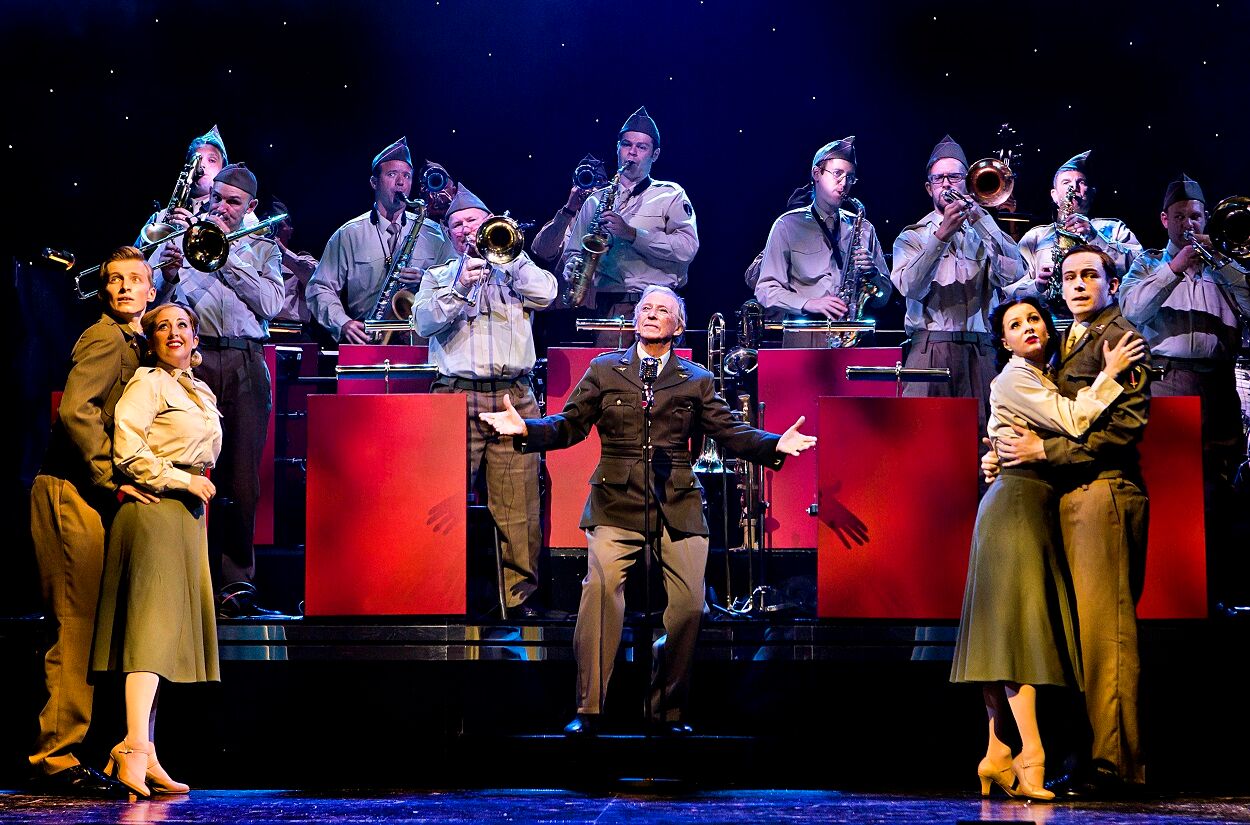
Photo credit: Pamela Raith

Act 1 is a nostalgic walk down memory lane, setting the story. In a Basin Street Jazz Club, a young Glenn Miller is trying to make his way in the world of music with his trusty buddy Chummy MacGregor (played by Ashley Knight) by his side. We’re treated to musical delights such as ‘It don’t mean a thing, if it ain’t got that swing’ and ‘Sing, sing, sing’ here.

Back home in Colorado, Miller bumps into childhood sweetheart Helen Burger (Abigail Jaye) and when he tells her of his musical passion, his new love encourages him to follow his dream to New York. Later, on their first anniversary, Miller presents his wife with the score for ‘Moonlight Serenade’, which he’s written for her. Abigail Jaye sings a heartfelt rendition of the song for us, accompanied by Tommy Steele on piano. 

Shortly afterwards Miller gets his big break, when dance hall owner Cy Shribman (Mike Lloyd) comes knocking; he hurriedly puts together a 16-piece orchestra and the unique Glenn Miller sound is born.

In Act 2 we’re treated to the classics we expect: ‘String of Pearls’, ‘Chattanooga Choo Choo’, ‘Pennsylvania 6-5000’ and more as the Miller sound spreads like wildfire around the world. The addition of the live Orchestra on stage throughout is a delight for our eyes and ears, as are the dance hall groovers who treat us to snippets of an array of dances such as tap, Charleston, tango, jive and jitterbug, to name a few. Ashley Knight thrills with his performance of ‘Perfidia’, performed with backing support of The Modernaires. The 1930s costume and hairstyling are delightful and transport us back to that era.

Photo credit: Pamela Raith

As World War II broke Miller enlisted in 1942, determined to rally the troops with his upbeat music. He gave military marching bands an injection of adventurousness and fun, which proved popular with his comrades as a morale booster both at home and abroad. It was during this time that travelling from the UK to Paris, tragedy struck. Miller was never to be seen again – and the rest is history.

It’s clear for all to see that Tommy Steele has a passion for the story, with charisma and enthusiasm for the role oozing out of him. He is a natural all-round entertainer, coming to life with a sparkle when in front of his audience. In addition to his speaking and singing roles we are treated to glimpses of his ability as a musician (piano and trombone), his comic sense of humour and eagerness to thrill his audience. At the end of his encore he seemed reluctant to leave the stage, to the audience’s delight. 

Come and decide for yourself if casting Tommy Steele in this role was a plausible decision, but even if you don’t agree you’ll be well entertained by one of our homegrown entertainers – so grab your ticket while you still can. 

Tommy Steele stars in The Glenn Miller Story at the Orchard Theatre, Dartford until Saturday 22nd October. 

Review: Poker Face at King’s Head Theatre

Legal Aliens are an international company, dedicated to telling European stories at a time when others might be tempted to shy away. The result of this determination is their Translating Europe series, which opens with the English premiere of Petr Kolečko’s Poker Face.

Translated by Eva Daníčková, the play tells the story of Jana (Lara Parmiani), a hugely successful international poker player, who in her youth may or may not have got pregnant by the writer, revolutionary, and later first president of the Czech Republic, Václav Havel. The resulting child was Pavlína (Daiva Dominyka), now a young woman and in a relationship with the idealistic Viktor (Mark Ota), who wants to start a revolution of his own, if only he had the funds…

Photo credit: John Watts

Considering the play was written by a Czech playwright, in Czech, (presumably) for a Czech audience, the story and its context are surprisingly easy to understand for British viewers. Although, inevitably, we may not catch every reference in Becka McFadden’s production, even someone with no knowledge at all of Czech history or politics – or poker, come to that – can make sense of what’s going on, and the family drama that unfolds between the characters could almost be happening anywhere.

At the centre of the story is Lara Parmiani’s Jana, whose poker face remains in place even away from the card table, in her troubled, brittle relationship with her daughter. Yet we also meet a younger, more emotional Jana, who longs for news from her absent father (Arnošt Goldflam, on screen) and looks forward excitedly to a meeting with her adored Havel. Lara Parmiani skilfully embodies both versions of the character, so that even as we dislike the woman she’s become, we can’t help but feel – if not sympathy, then at least understanding of the events that have brought her here.

Photo credit: John Watts

Pavlína, played by Daiva Dominyka, is the polar opposite of her cold-hearted mother; sensitive and romantic, she’s struggling to understand who she is and where she fits within her family and her society. As her boyfriend Viktor, Mark Ota probably has the closest to a comedy role within the play; a skilled speaker, he knows how to turn on the charm and deliver a good soundbite, and even his darker scenes are shot through with a surreal humour that’s as entertaining as it is slightly bewildering.

The use of video is effective, if occasionally a bit frustrating – this is particularly the case in the opening scene, when Arnošt Goldflam, the man we later learn to be Jana’s father, speaks at length in Czech. There are subtitles, but positioned as they are at the bottom of the screen, reading them involves a fair bit of neck craning for anyone not sitting in the centre of the front row. The later footage of Havel’s funeral works really well though, playing silently in the background and looming over the family’s dysfunctional attempt at a Christmas celebration.

Poker Face may be set in a foreign country, and it may make reference to events we’re not all that familiar with, but that doesn’t make it any less relatable. At a time when it’s becoming all too common to regard anyone not from our own country as inherently different, this play offers a timely reminder that while we may not speak the same language or share the same politics, at the end of the day we’re all human beings. And while that might not be an especially new or surprising message, it’s nonetheless one that – increasingly, it seems – needs repeating.


Can’t see the map on iPhone? Try turning your phone to landscape and that should sort it. I don’t know why but I’m working on it… 😉