Sunny Afternoon won a bunch of awards when it opened to rave reviews in 2014, with fans of all ages going crazy over it (I know of someone who saw the show over 100 times). When I finally got along to see the show in the West End earlier this year, I enjoyed it a lot – but didn’t fall for it quite as hard as most other people seemed to.
I’m not sure what was different this time. Maybe it was because I was closer to the action, maybe because I knew the songs a bit better. Maybe I was just in a better mood, who knows. Anyway, whatever it was – I’m now officially a convert. In fact I’d go so far as to say this is the best jukebox musical out there (sorry, Jersey Boys fans), and certainly one of the best shows we’ve seen at the Orchard this year.
Photo credit: Kevin CumminsWritten by Joe Penhall and Ray Davies, and directed by Edward Hall, the show charts the Kinks’ often bumpy ride to stardom, and includes all the familiar hits – You Really Got Me, Dedicated Follower of Fashion, Waterloo Sunset… – and a few unfamiliar ones too, at least for those of us who weren’t around at the time. There’s an enjoyable mix of full-on 60s rock ‘n’ roll and quieter tracks like Sitting in my Hotel and This Strange Effect, including a gorgeous a cappella rendition of Days, which give the cast an opportunity to show off their incredible vocals.
But although Sunny Afternoon follows what we might call the standard formula of the jukebox musical – humble origins, rise to fame, trouble at the top, feel-good finale – the story and its characters are also sufficiently interesting in their own right to ensure the show’s appeal extends beyond fans of the band. Feuding brothers, a shotgun wedding, breakdowns, break-ups – there’s more than enough here to keep anyone entertained. It’s also unashamedly British; the Kinks were London boys through and through (and actually got banned from America at one point), and it’s difficult to watch the show without feeling at least a little bit patriotic.
Photo credit: Kevin CumminsRyan O’Donnell and Mark Newnham lead the cast as the Davies brothers: Ray, the sensitive genius songwriter, and Dave, the band’s guitar player and full-on rockstar. Their troubled relationship with each other and those around them is the main focus of the story, but not to the exclusion of the other band members; they each get their moment in the spotlight too – Andrew Gallo wows the crowd with a spectacular drum solo, while Garmon Rhys is thoroughly adorable as permanently petrified bass player Pete. They’re supported by a cast of talented and versatile actor-musicians, who swap smoothly in and out of a multitude of roles (and wigs) as managers, fans, parents and more, so it seems like there’s a lot more of them than there really are.
Sunny Afternoon is a colourful (in more ways than one) celebration of the Kinks’ legendary music. But there’s more substance to the show than a lot of jukebox musicals, and maybe that’s why it’s been such a huge hit. Or perhaps it’s just because it’s disarmingly good fun. Either way, it’s one of the best of its kind and definitely worth checking out.
Sunny Afternoon is at the Orchard Theatre until 19th November.
Instinct Theatre’s first new writing night at the Hen and Chickens brought together four pieces of work around the theme “The World Today”. It’s a broad topic, and the plays being showcased were, unsurprisingly, pretty diverse. From the personal to the political, it was an evening of high quality new writing, with uniformly strong performances. Interestingly, regardless of their subject matter each of the four captured an element of both comedy and tragedy – which I suppose is very much like the world today. And more importantly, they all left me wanting to see more.
First up was Besides The C by Francesca Mepham, in which a young woman recently diagnosed with cancer struggles to cope in the face of her boyfriend’s cold indifference. The strength of this play, directed by Michelle Payne, lies in its balanced view; there’s no doubt whose side we’re supposed to be on, and James (John Dayton) freely admits his primary concern is how Natalie’s news affects him. But his honesty, and the fact he’s allowed to have a say at all, is actually quite refreshing – and at the same time, Natalie (Leanne Petitt) isn’t perfect either; terrified of being alone through her cancer treatment, she stays with James despite knowing they don’t have a future. So who’s using who?
This was followed by another equally insightful perspective on a flawed relationship, in Jonathan Skinner’s Suck, Squeeze, Bang, Blow. Directed by Hilary Burns, the play introduces us to a nameless couple (Felicity Huxley-Miners and Harrison Trott) forced to confront the fact they’re officially on the rocks. It’s much lighter in tone than the previous play – and provided arguably my favourite quote of the evening: “This is like walking through mud in flip flops” – but there’s a feeling of sadness too as the couple teeter on the edge, taking progressively more savage swipes at each other. Whether they hang on or go over… we’ll have to wait to find out.
The evening then took a turn towards the political in Guerrilla Kingdom by Saria Steyl, in which two young women carry out a terrorist attack. Or at least they would, if they could stop bickering and remember which button to press. Under the direction of Thomas Attwood, Laura Lawrence and Marina Tapakoudes give two brilliant comic performances as the incompetent rebels, but behind the laughter there’s sincere passion. We don’t know exactly who or what the women are fighting against, but an emotional recital of their mission statement shows how deeply their cause matters. And as with any play involving an explosive device, there’s also a certain degree of suspense involved…
Finally, we enjoyed an excerpt from Tea and Good Intentions by Felicity Huxley-Miners, directed by Dominique Gerrard. Student Elizabeth (Lily Driver) arrives home from uni to discover her mum’s taken in a Syrian refugee, much to the scandalised delight of the neighbours. While the play pokes good-natured fun at the misguided intentions of the middle-aged Margaret (Catharine Humphrys) and Mary (Erin Geraghty), it also makes a serious political point about what makes someone leave everything and become a refugee (hint: it’s not our benefit system). Yusuf Bhaimia gives a particularly powerful performance as the nonplussed Adar, who seems at first sight to have swapped one kind of trauma for another.
Each of the four plays featured in Scratch the Surface is complex and sensitively written, exploring different aspects of the world we live in. With enjoyable hosting from actor and presenter Paul Lavers and lively discussion in the bar afterwards, the scratch night was undoubtedly a big success; hopefully it’s the first of many.
Can’t see the map on iPhone? Try turning your phone to landscape and that should sort it. I don’t know why but I’m working on it… 😉
Stephen Daldry’s groundbreaking production of An Inspector Calls acquired legendary status when it was first performed at the National Theatre in 1992. Having completed yet another national tour, it’s now back in the West End, and as powerful and relevant as ever. In fact if anything, given the current sorry state of the world, the play’s message of social responsibility speaks to us now even more than it did 24 years ago.
Photo credit: Mark Douet
Though J.B. Priestley’s story is set in the early 20th century, the brilliance of Daldry’s production and Ian MacNeil’s astonishing set is that the events unfolding before us could be taking place anywhere, at any time. In 1912, the well-to-do Birling family are enjoying a dinner party in their elegant home, which resembles a large dolls’ house perched precariously above a dark, rainy street from the 1940s, when the play was written. But the family’s celebration of daughter Sheila’s engagement is interrupted by the arrival of a police inspector, bearing the tragic news of a young woman’s suicide… One by one, the mysterious Inspector Goole forces each member of the family to confess his or her part in the woman’s downfall, and draws them away from their luxurious surroundings to face judgment from a silent audience of “supernumeraries” – men, women and children to whom the Birlings would never usually give a moment’s thought.
The pouring rain, creeping mist and Stephen Warbeck’s ominous music help to build the tension towards an explosive climax and a final direct plea from the Inspector, delivered with genuine emotion by Liam Brennan as he begs us all to remember the responsibility we have to each other. But the story doesn’t end there, and a glimmer of hope can be found in the despair of the Birling children as they stand alongside the family maid Edna (played with quiet dignity by Diana Payne-Myers) and watch the others climb, cackling like pantomime villains, back into their wrecked house.
Photo credit: Mark Douet
As the Inspector, Liam Brennan embodies the very heart of the play, a gruff Scotsman who both ridicules and rages at these people who seem so stubbornly unaware of the damage they’ve caused. Clive Francis cuts a frail but defiant figure as the patriarch Arthur, and there are strong performances from Barbara Marten and Carmela Corbett as mother and daughter – one refusing to acknowledge her guilt, the other readily embracing it with appalled horror.
J.B. Priestley’s political stance as a socialist is well-known, and not at all glossed over in this production. But the story is not just about politics; it’s about humanity. This is the third time I’ve seen the play, but without a doubt it’s the most powerful. Priestley might perhaps have hoped that by 2016 his play would be redundant, but the events of this week show it’s anything but. We live in a world where intolerance and self-interest are increasingly the norm – and as long as that’s the case, this play will continue to resonate.
Can’t see the map on iPhone? Try turning your phone to landscape and that should sort it. I don’t know why but I’m working on it… 😉
On a night when, as it turned out, we needed a good laugh far more than we realised, there could have been few more appropriate plays for my first outing with Theatre Bloggers than Dead Funny; the clue is, after all, right there in the title. Interestingly, though – and not unlike the brewing news story we were trying to avoid – Terry Johnson’s play takes a sudden dramatic turn at the eleventh hour from absurd comedy to something much more serious.
It’s 1992, and Eleanor (Katherine Parkinson) is attempting to revive her failing marriage to Richard (Rufus Jones) with some exquisitely awkward sex therapy. Unfortunately, they’re interrupted at the crucial moment by their neighbour Brian (Steve Pemberton) with the news that comedian Benny Hill’s just died – which gives Richard, leader of the Dead Funny Society, just the distraction he’s looking for. But as he arranges a farewell gathering for Benny, little does he realise the surprises the evening has in store…
Photo credit: Alastair Muir
I was only 10 in 1992, so most of the references to deceased comedians went slightly over my head. But those moments feel dated for a very deliberate reason; the less we can relate to or remember them, the funnier the rest of the play becomes in comparison. And so we find ourselves firmly on Eleanor’s side in her scathing mockery of Richard and his friends, as they reproduce their favourite sketches for (presumably) the millionth time, while refusing to acknowledge the mess that is their own existence. Real life, as it turns out, is much funnier than any comedy sketch – but it can also be a lot more painful.
Katherine Parkinson is spot-on as the quite literally sidelined Eleanor; as the group outsider she’s rarely centre stage, yet still manages to steal the limelight with some perfectly timed and beautifully withering put-downs of the rest of the group – all the more ironic for the fact she’s the one who’s supposed to have no sense of humour. But as her world crumbles, she also shows us the pain of a woman who realises she’s devoted years to a man who can’t – or won’t – give her the one thing she wants. Steve Pemberton is wonderful too as the flamboyant Brian, the one member of the Society who seems genuinely likeable, and who’s also hilarious in his own right (though not always intentionally).
Photo credit: Grace Wordsworth
Rufus Jones, in contrast, is splendidly dull and pompous as Eleanor’s husband Richard, so much so you start to wonder why she’s wasted ten years on him. And a strong cast is completed by Emily Berrington – just the right amount of whiny as Society member and smug new mother Lisa – and Ralf Little as her indifferent husband Nick.
Somewhere around the middle of a fairly predictable food fight, everything suddenly gets a bit serious, and the final scenes are unexpectedly sombre – though of course there’s still room for a couple more gags before the curtain falls. And so this outrageous comedy comes to a rather messy and bittersweet end, reminding us that life, however ridiculous it might be, can’t be packaged up neatly into a half-hour sitcom. At some point – unfortunately – it’s time to stop laughing and face reality.
Othello forms part of the Arrows and Traps repertory season, alongside Twelfth Night (read more about that show, and the double bill as a whole, in my review). The two shows are both directed by Ross McGregor and performed by the same cast on the same set, but there the similarities end. While Twelfth Night is a riotous comedy full of romantic mischief, Othello is a dark, dramatic and gripping thriller, with a stunning climactic scene that I’d willingly watch over and over again.
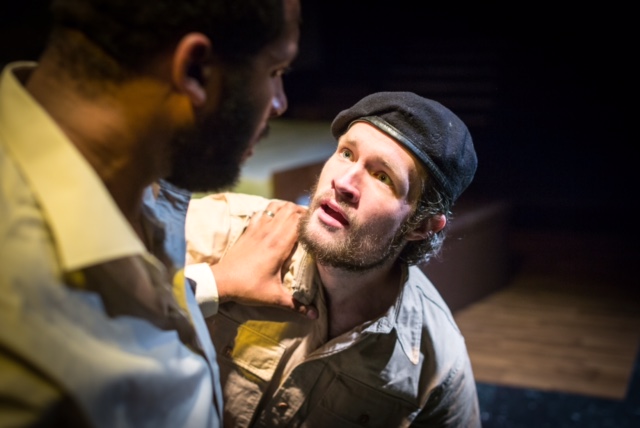
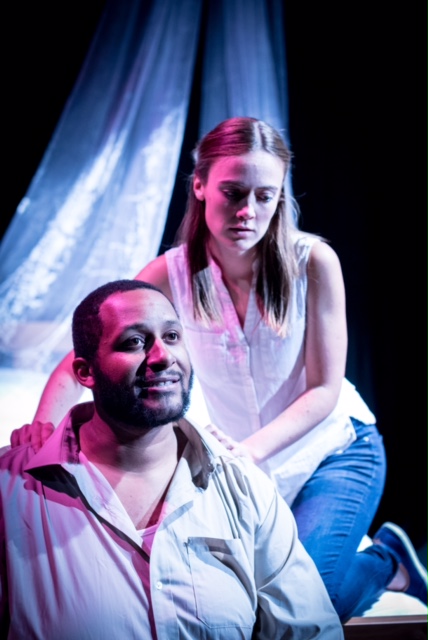
In a modern day setting, army general Othello (Spencer Lee Osborne), known by most as the Moor, has married Desdemona (Pippa Caddick) against her father’s wishes. The couple’s happiness is set to be shortlived, however, thanks to the machinations of Othello’s ensign Iago (Pearce Sampson), who was recently passed over for promotion in favour of Cassio (Adam Elliott). In revenge, and with the unwitting help of his wife Emilia (Cornelia Baumann), Iago convinces Othello that Desdemona has been unfaithful with Cassio, setting in motion a dramatic and ultimately tragic chain of events.
Photo credit: The Ocular Creative
While Arrows and Traps have proved they can turn their hand to pretty much anything, it seems tragedy is where they really excel. Othello, like their recent blood-soaked Macbeth, is intense, powerful and utterly compelling from start to breathless finish. And as in Macbeth, the production draws on the talents of movement director Will Pinchin, particularly in the murder scene, a dream-like montage of music and movement that’s quite spine-tinglingly beautiful to watch.
Unlike Twelfth Night, which draws on the cast’s talents as an ensemble, this play primarily focuses on three central characters: Othello, Iago and Desdemona. As the duped Othello, Spencer Lee Osborne shows us the insecurity of a man who’s always been an outsider, and can’t quite believe his luck that the woman he loves should return his feelings. My problem with Shakespeare’s play has always been in believing that a loving husband could be so quickly persuaded of his wife’s betrayal – but this Othello, though powerful in stature, has an emotional fragility that makes him easy to manipulate, and his willingness to believe Iago’s lies becomes therefore much more convincing for the audience.
Pearce Sampson, fresh from playing Jesus in the Arrows’ last production, here skilfully turns his hand to an altogether different role as the villainous Iago, his twinkly northern charm disguising his evil intentions. This is a bad guy who gets – and deserves – no sympathy from us. On the other hand, we feel nothing but sympathy for Pippa Caddick’s Desdemona, a devoted wife and kind-hearted, loyal friend, with an independence of mind and playful, ever so slightly flirtatious nature that unknowingly hasten her downfall at Iago’s hands.
Photo credit: The Ocular Creative
The Gatehouse has a much larger stage area than many fringe theatres, and the production takes full advantage of the space, with actors appearing from all directions and even on the balcony above the stage. The set’s divided into three parts, which removes the need to break up the action with scene changes, but more importantly allows scenes to unfold simultaneously, heightening the drama and creating the familiar cinematic effect seen in previous Arrows productions.
Othello is a deliciously dark flip side to the madcap comedy of Twelfth Night, but it also stands alone as an intense and thrilling drama about human weakness. In addition, it makes a powerful statement about the way we treat those we see as different to ourselves, a topic that could hardly be more relevant at this moment in history. And it’s confirmed my view that Arrows and Traps are one of the best companies producing Shakespeare in London right now. Check them out if you can; you won’t regret it.
Can’t see the map on iPhone? Try turning your phone to landscape and that should sort it. I don’t know why but I’m working on it… 😉


 Theatre Things