Review: A Year From Now at VAULT Festival

Where will I be a year from now? It’s a question most of us have asked ourselves at some point, particularly at the start of a new year – and the responses often reveal a lot about the person doing the speculating. It’s also impossible to predict; we can say what we’re hoping for, but in reality we never know when life’s going to throw a massive curveball at us – and even if we do get exactly what we think we want, it might turn out not to be quite as we thought it would be.

In RedBellyBlack’s A Year From Now, that question is the launch pad for a series of interviews with fourteen different people, which spin off in all kinds of unexpected directions and which are quite startling, and occasionally even slightly uncomfortable, in their honesty. We share the subjects’ hopes, fears, good news and heartbreak, all of which is interpreted on stage by five performers (Oscar Scott-White, Kate Goodfellow, Clementine Mills, Christopher Montague and Jessica Warshaw) who mouth the words along with audio recordings of the interviews. This is not as odd as it sounds – and I was surprised at how quickly I stopped remembering that the person on stage wasn’t actually the one speaking, even when there was a difference in age or gender. (I even found myself at one point marvelling at how many different accents they’d all mastered…)

Photo credit: Robert Boulton

Much of this is due to the quality of the performance; each of the five actors is absolutely spot-on with their lip-syncing, down to the tiniest hesitation, laugh, stutter or cough – I can only imagine the hours of rehearsal that have gone into getting every moment of the 60-minute show so totally in sync. In addition, each adopts the body language of the person speaking, from Kate Goodfellow’s bashful four-year-old to Oscar Scott-White’s elegant elderly lady, further enabling us to block out the physical appearance of the speaker and focus instead on their voice and movement, and ensuring that when the same people reappear later in the show, they’re instantly recognisable.

Though each scene takes the same format, there’s sufficient variety in the way they’re presented by director Vicki Baron to keep the show fresh and interesting (and some are separated by slightly surreal dance breaks – the meaning of which, I must admit, wasn’t totally clear to me). Some stories are told by just one person, others by a couple; one scene features four speakers whose stories share a common theme. And each is accompanied by choreographed movements that visually interpret the words we’re hearing, often performed by most or even all of the actors, again in perfect unison. These are striking without being distracting, and at times even quite moving – this is particularly true in the case of a comedian coming to terms with the loss of his mum, “voiced” by Christopher Montague and Jessica Warshaw, who both physically support and are supported by each other as they tell the story.

Photo credit: Robert Boulton

The original question, “Where will I be a year from now?” doesn’t actually feature heavily in the show, though we eventually circle back around to it at the end with an amusing twist. What it does do, though, is provide a starting point for stories covering everything from ill health to parenthood, perfect eyebrows to work pressures. Each of these accounts is unique, whether it’s a devastating look back at time past, a hopeful view of the year to come, or just an honest description of the way life is right now, and every member of the audience will be able to relate to particular voices more than others. There are a couple of moments when we – perhaps inevitably – veer into political territory, but we never stay there long; the power and heart of A Year From Now lie in its human stories, and it’s these that we take away with us.


Can’t see the map on iPhone? Try turning your phone to landscape and that should sort it. I don’t know why but I’m working on it… 😉
Review: Not Dead Enough at the Orchard Theatre

Guest review by Mandy Southgate

Prolific author Peter James requires no introduction to the stage. Adaptations of his books The Perfect Murder and Dead Simple were sell-out successes in the West End and toured around the UK. Not Dead Enough is the latest of his books to become a play and we are promised an evening of thrilling suspense and mystery.

Three murders. One suspect. No proof.

Detective Superintendent Roy Grace returns with a crime that will test him to the limits. On the night his wife is murdered, Brian Bishop claims to be sixty miles away, asleep in his bed. No matter how much DS Grace likes him for the crime, he simply can’t pin it on Bishop. Meanwhile, DS Grace is still dealing with the disappearance of his own wife. Could the two cases be related?


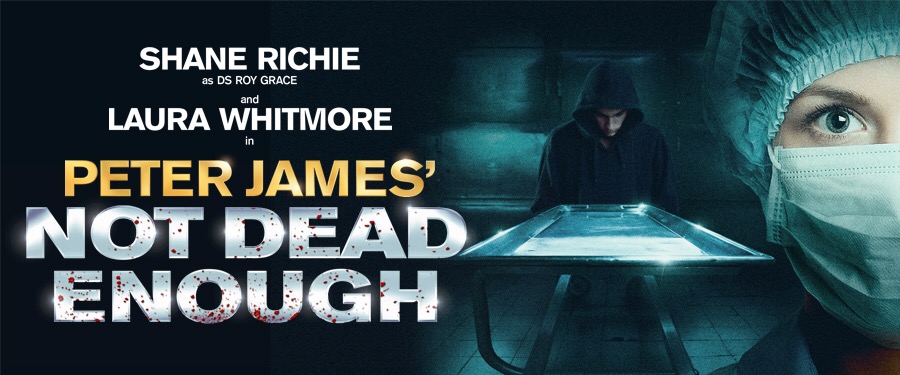
Directed by Olivier Award-winner Ian Talbot and starring Shane Richie as DS Roy Grace, Not Dead Enough begins its national tour at the Orchard Theatre in Dartford before moving to Milton Keynes and Woking.

Not Dead Enough is a lot of fun. It is quick-paced, full of suspense and the audience has to pay careful attention in order to sort through the plethora of clues and red herrings. If it is any indication, by the final minutes of the first half, I was balancing precariously on the edge of my seat, eyes fixed firmly on the stage. Just remember that you can’t always believe what your own eyes are telling you and sometimes it is a case of not looking closely enough.

Despite the serious subject matter, Not Dead Enough is very funny, sometimes intentionally and sometimes not. Then again, with the harrowing crimes being committed on stage, it may just be that the audience’s mirth was more nervous laughter than anything else. 

Not Dead Enough is small, with just nine people (ten if you include a dead body). Shane Richie is joined on stage by Michael Quartey as DS Glenn Branson. Where DS Grace is focused and often desperate, DS Branson is irreverent and daring. Laura Whitmore plays Cleo Morey, the chief mortician and love interest to DS Grace.

Stephen Billington, best known for playing the dastardly Greg Kelly in Coronation Street, plays Brian Bishop. It is only after the big reveal at the end of the play that you realise just how good his performance was and how he had been giving the audience very subtle clues as to the real story the whole time.

One of the most interesting aspects of any stage production is the set design and use of space. The stage design for Not Dead Enough was simple and static, dividing the stage into the mortuary, office, interview room and street. This clever design allowed the story to switch seamlessly between scenes, allowing a pace and dynamic more often seen in television productions than stage. It was very impressive.

I enjoyed Not Dead Enough and look forward to future plays in the Peter James DS Roy Grace franchise.

Not Dead Enough is running at the Orchard Theatre in Dartford until Saturday 28 January 2017. Visit Peter James’s website for details on future dates.

Review: The Nature of Forgetting at Shoreditch Town Hall

Theatre Re’s latest work, The Nature of Forgetting, premiered this week at Shoreditch Town Hall, where it was greeted by sell-out audiences and standing ovations. The three-night run was far too brief – but something tells me we haven’t seen the last of this beautiful and moving show.

Inspired by recent neurobiological research and interviews with people living with dementia, The Nature of Forgetting attempts to piece together their experience through the story of Tom, who’s 55 today. As he dresses for his birthday party, each item of clothing in his wardrobe brings back confused fragments of memory from his earlier life, and the people who played a part in it.

Photo Credit: Richard Davenport for The Other Richard

Though there’s a clear story behind the memories – school days, courtship, marriage, career – what makes this show so powerful is not the events themselves, but the emotions at the heart of them. So while the details of each memory may be a little hazy, we do get to experience the joy of a bike ride, the stress and anxiety of a wedding day, the heartbreaking sense of loss evoked by an empty chair… There’s humour too, in Tom’s overbearing mother and class clown antics – and through it all, the recurring sensation of panic that comes with trying to pin down these elusive memories as they slip away. And importantly, it’s also not just Tom’s story but also that of the people who love him, reminding us that dementia doesn’t only affect the person who suffers from it.

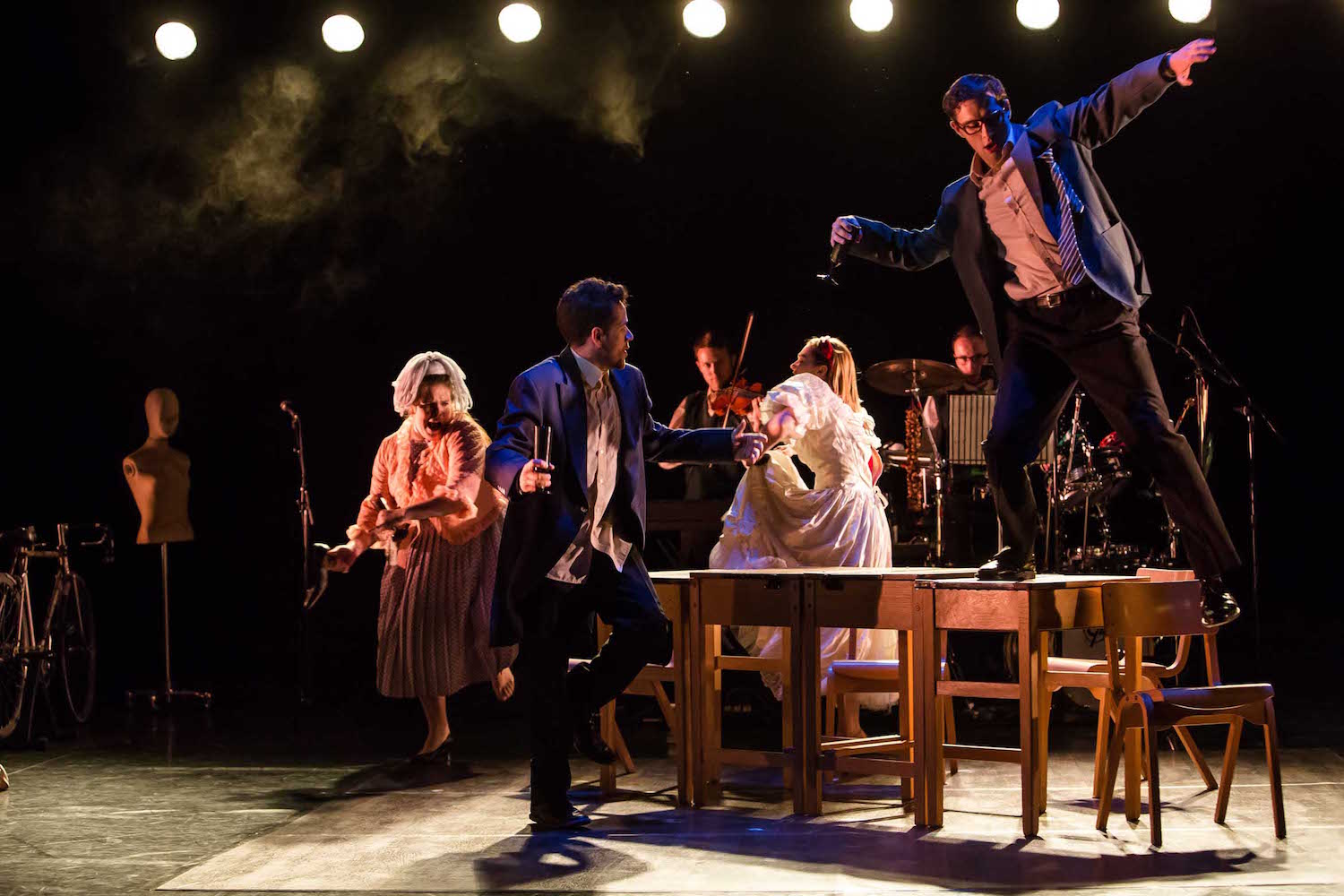
At just over an hour, the show is essentially one single scene, which fades and reassembles as Tom is transported into his memories. The cast (Guillaume Pigé, Louise Wilcox, Eyglo Thorgeirsdottir and Matthew Austin) are in motion almost the entire time, together forming a well-oiled machine that ensures every prop – primarily the wooden school desks that form the show’s central motif – is in position and every performer always in exactly the right place. The result is a whirl of movement that appears entirely fluid and effortless.

Photo Credit: Richard Davenport for The Other Richard

Just as important as the movement is the music, composed and performed by Alex Judd, accompanied by percussionist Keiran Pearson. Written in the rehearsal room as the show was taking shape, the score exquisitely mirrors the emotions on stage, and builds to a stirring climax for the final scene. There are some particularly powerful moments when Tom is struggling with his loss of memory and the soundtrack seems to bend and twist along with his ability to piece together his recollections.

It’s impossible for anyone who hasn’t been there to really experience what it must be like to lose their grip on memory, but this thoroughly researched and beautifully presented show offers us a glimpse into that world. It’s at times a scary picture – but The Nature of Forgetting reminds us that just because those events and emotions may be harder to recall, they’re not gone forever and will live on in Tom, however deeply buried they may be. It’s an uplifting note on which to end this unforgettable show.


Can’t see the map on iPhone? Try turning your phone to landscape and that should sort it. I don’t know why but I’m working on it… 😉
Review: Richard III at the Rosemary Branch

The last production I saw of Richard III was at the Globe a few years ago, which happened to coincide with a huge thunderstorm that raged for most of the play; every dramatic moment was punctuated by a crash of thunder, and when the evil Richard met his end, the rain immediately stopped and the sun came out. (I’m not making this up, by the way; it was spooky.)

No such assistance from nature inside the Rosemary Branch, where Godot’s Watch’s production of Richard III runs until the 29th – but when it comes to creating atmosphere, no help is needed. This modern take on the murderous rise to power of Richard, Duke of Gloucester is a taut, gripping thriller that looks amazing and breathes new life (not to mention sex appeal) into a 500-year-old story.

Photo credit: Caroline Galea

On an empty stage illuminated by coloured strip lights, the throne of England awaits… but to claim it, Richard must first dispose of both his brothers. This he manages with worrying ease, before turning his attention to his two young nephews. With the help of Buckingham, who’s won over by the false promise of wealth and titles, Richard finally becomes King – but how long can he hold on to the throne?

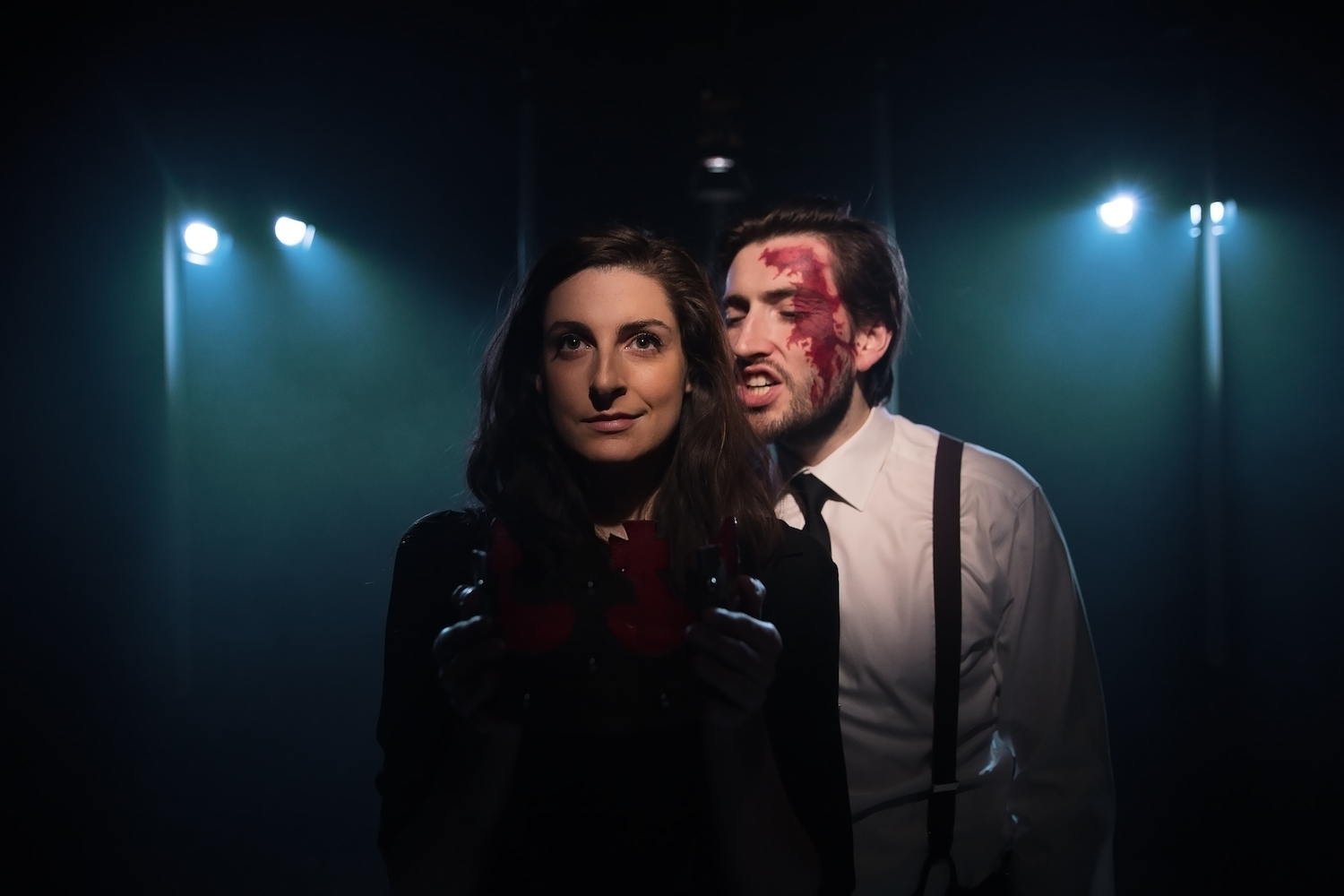
An excellent cast is led by Sam Coulson as the villainous Richard. No hunchbacks here – instead a blood-red birthmark stains one side of his face, foreshadowing the horrors ahead. This is a performance that walks the line between smoothly charming and violently unhinged; one minute he’s sweet-talking the grieving widow of one of his victims into marrying him, the next he’s roaring with crazed delight over the success of his evil schemes. And throughout, he takes the audience regularly into his confidence, making us complicit in his crimes as he bumps off victim after victim.

The inclusion of Elena Clements as Richard’s co-conspirator Buckingham brings a welcome shot of girl power to a play in which every other woman is forced into the role of victim, and I also really enjoyed the twist that turned Gloucester’s two killers into one conflicted soul; Michael Rivers brilliantly channels Gollum as he argues with himself over the rights and wrongs of proceeding with the murder.

Director Séan Aydon clearly isn’t afraid to take a few risks in modernising the story – the use of Siri to find a hitman willing to murder Richard’s nephews gets a lot of laughs, and there’s more than one reference to drug use in the royal court. Not historically accurate, maybe – but then as we’ve seen all too well in recent months, the storyline of a tyrant doing whatever it takes to claim power is one that works just as well in a modern context…

elena-clements-buckingham-sam-coulson-richard-caroline-galea

Another star of the show is the lighting design from Jack Channer, and sound from Daniel Harmer, which combine to create an atmosphere of drama and tension throughout. From Richard’s opening soliloquy, which plays out in semi-darkness like a scene from a black and white movie, to the harsh white flashes that accompany his victims’ deaths, it’s an ingeniously simple approach that shows you don’t always need fancy effects or a complicated set to make a powerful impact.

Godot’s Watch is a new company, and if this is what we get from their first production then it’s exciting news for theatre. Their Richard III is inventive, bold and utterly gripping (and don’t just take my word for it; my friend turned to me at the interval and said, “Why have I never seen this play before? It’s amazing!”) – I can’t wait to see more from them, and hopefully soon.


Can’t see the map on iPhone? Try turning your phone to landscape and that should sort it. I don’t know why but I’m working on it… 😉

Review: The Doppel Gang at Tristan Bates Theatre

The Doppel Gang by Dominic Hedges introduces us to four mediocre performers attempting to save their cash-strapped theatre. After stumbling rather inexplicably on a stash of unproduced Marx Brothers material, they decide to try and pull off the ultimate con, impersonating the rising American stars in front of a London audience desperate to escape the horrors of the Blitz. Can they pull it off and make their escape with the cash, or will they be caught out?

It’s a fun idea, and the cast certainly seem to be enjoying themselves from the outset. The play opens with a Fawlty Towers-esque sketch scene, in which frustrated theatre owner Lombard has to deal with an incompetent workman up a ladder. Though it has little if anything to do with the rest of the story, it’s a well-fashioned salute to British humour, and sets up a nice contrast with the all-American comedy that dominates Act 2.

Photo credit: Mitchell Reeve

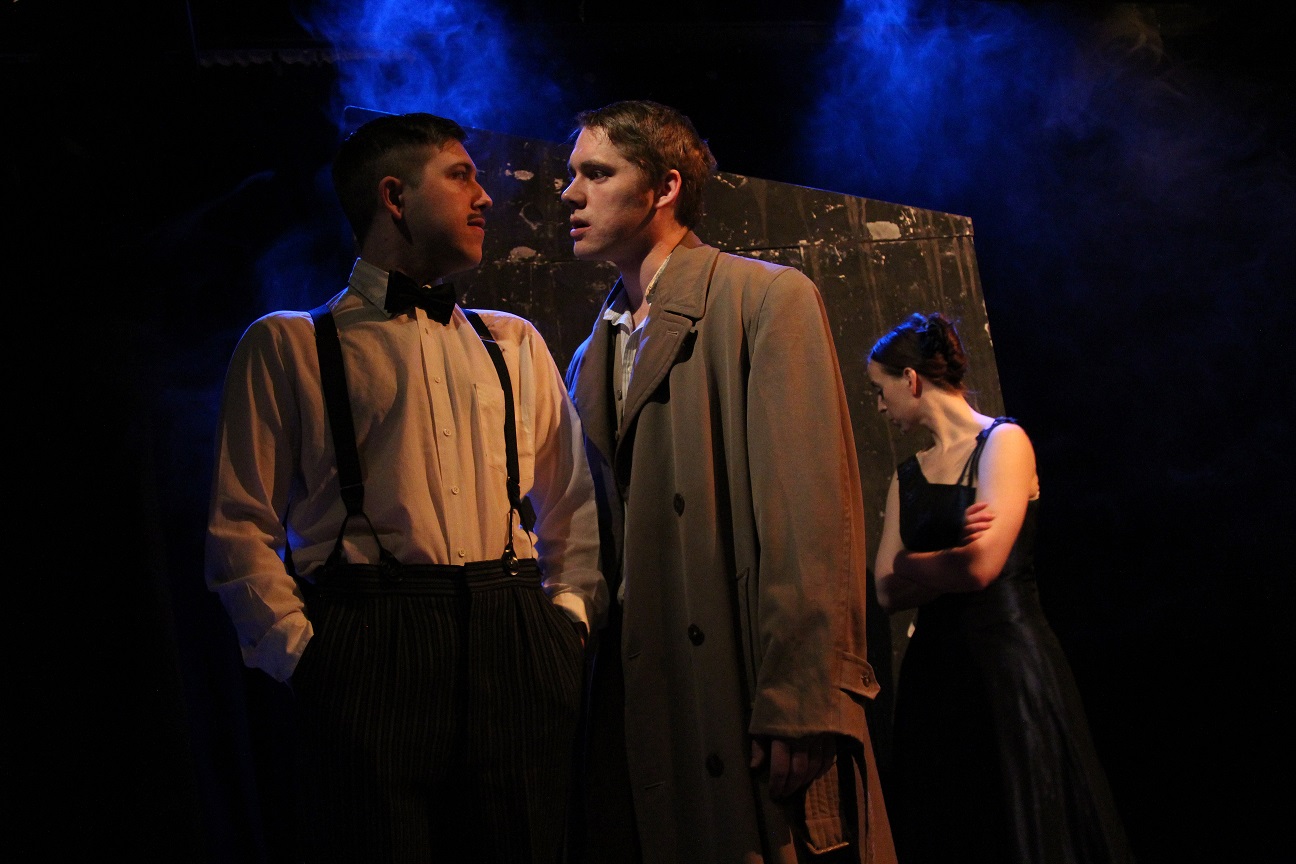
In fact, The Doppel Gang, directed by Terence Mann, takes great pleasure in lining up British and U.S. comedy alongside each other, and it makes the play very much one of two halves; Act 2 consists almost entirely of the group’s Marx Brothers act, whereas before the interval the focus is on establishing the characters and their often fractious relationships. Cyril (Jordan Moore) and Tommy (Peter Stone) can’t stand Lombard (Jake Urry), who they know full well is just using them for his own ends. And male impersonator Rachel (Rachel Hartley) is getting increasingly frustrated with the lack of respect she gets from the audience or her fellow performers – including her boyfriend Tommy.

The four characters’ constant sniping, and especially Rachel’s feisty disdain for the men she has to deal with, provided for me the funniest moments – although there are plenty of laughs to be found elsewhere too, especially for fans of the Marx Brothers. The cast’s enthusiasm for their subject is obvious, although not being an expert, I’ll leave it to those who know to judge the accuracy of their tribute act. And as the Brits, the four are just likeable and optimistic enough for us to overlook their conscription-dodging ways and wish them success.

There’s a subplot to all this, of course, in the threat of war that hangs over them all, and in the revelation of a secret that places one of the characters at even greater risk. The abrupt, subdued ending, coming so swiftly after half an hour of zany merriment, brings us back to earth with a bump, and out into the cold feeling slightly wrongfooted.

Photo credit: Mitchell Reeve

The set is really impressive for such a small space, with individual components – including a mobile proscenium arch – manoeuvred smoothly into position to take us on stage, off stage and on one occasion, underground. This gives the impression the stage is a lot bigger than it is, an idea backed up by Mitchell Reeve’s sound design, which recreates both the rumblings of war outside and the theatrical acoustics inside.

It’s a risky enterprise to make a comedy, because finding an approach everyone likes is practically impossible, but Just Some Theatre cover a couple of bases with The Doppel Gang, and do it well. I do feel that to fully appreciate this particular play you need to know and enjoy the Marx Brothers’ work (I was slightly in the dark at times during Act 2, if I’m totally honest), but nonetheless this is clearly a talented company with exciting times ahead.


Can’t see the map on iPhone? Try turning your phone to landscape and that should sort it. I don’t know why but I’m working on it… 😉