Review: Our Town at The Royal Exchange Theatre

Guest review by Aleks Anders

Of all twentieth century classics, Thornton Wilder’s Our Town must be one of the most difficult to produce and hardest to understand plays for both cast and audience alike. In fact, ever since its first performance in 1938, it has continued to be misunderstood and misrepresented. However, there is some theatrical irony in this, since the play itself deals with misunderstanding and misrepresentation on a human scale.

It’s a very odd play, there’s no denying that, and in 1930s America would have been considered ground-breaking too.

It uses the device of it being a play within a play, the play being set in the theatre where the play is taking place, if you see what I mean. The cast are on stage and the Stage Manager enters and mediates between being the actual Stage Manager of the one play whilst narrating the story of the play to the audience of the other play. And if you’re not confused by that, you might just “get it”.

The play is very Brechtian in feel. There is no set, no scenery, miming is the order of the day, as well as speaking directly to and questioning the audience, and all the cast are wearing modern contemporary informal clothes. The Stage Manager sets the scene… Our Town is the fictional small town of Grover’s Corners, New Hampshire, USA, and at the start of the play it is 1901. The play is in three acts and the first act is nothing more than a scene-setting scene, setting the scene and seeing the set-up (apologies to Mr. Bennett). However this first scene is not only necessary to allow us to understand the two acts that follow, it is also this act that has made directors and producers of productions past think that the play is a lyrical pastiche and a yearning on the part of the writer for simpler and happier times. But the play is darker, so much darker than that, and with the second act, despite the play’s upbeat documentary nature, we get a hint of what is to come. It is the third act which acts like a wake-up call to us all. Live our every moment to its fullest and feel, and see as hard and as long as possible, because there is beauty in the little things, and it is the little things that matter.

It’s also a very brave choice of play for any theatre company to attempt, and so kudos to The Royal Exchange for grabbing the challenge firmly and squarely and giving it their best shot. The only question is; did they score a goal? And the answer to that is, I am uncertain. I am not sufficiently learned on Wilder’s oeuvre to know whether or not this production ticked all the boxes for him; I can only go off my own reaction to the play, and of those around me in the theatre. Did I enjoy the play? I am again uncertain, since enjoyment seems the wrong terminology for what I witnessed. Although I wasn’t bored, and there was plenty of humour and bonhomie within the play, or at least the first two acts. But did the play stand up and grab me by the throat to leave a lasting impression on me? No, sadly it didn’t.

I think this is perhaps due to two things which I simply didn’t like about this production. I can only think these were directorial choices rather than scripted, and I must admit was somewhat put off the play because of them. The first is that some of the audience are invited to sit on plastic chairs on the stage, and become a part of the play for those not on the stage. I really liked the idea at first when I took my seat, as the stage was full of people sitting at desks crowded together and chatting. It looked like a school canteen. I understood the relevance for using audience in this way, as the director Sarah Frankcom is using every trick in the book to make this play relevant for our multi-cultural 21st century ‘town’ and therefore inviting audience to become a part of a play that challenges and distorts reality brings much more a community feel to the whole. It almost works in the first act, but in the second and third acts it’s odd and seems wholly inappropriate for them to be on stage.

And the second choice made by Frankcom is that only the Stage Manager should use an American accent. I think I understand what she’s trying to do here too, and say that this town, these people, these situations transcend time and place, but nevertheless, as a personal choice at least, they should all be speaking with the correct accent.
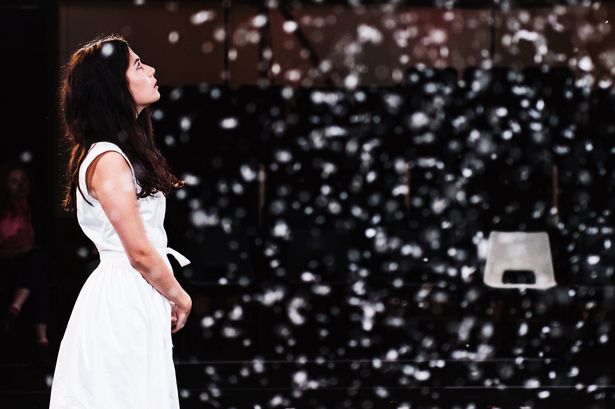
Frankcom’s directing, however, is consistent and intelligent. She realises that this play is about community and celebrating (the brevity of ?) life; and this doesn’t stop in the theatre, but continues in the auditorium too where each evening a community choir serenades patrons with a repertoire that includes the hymn sung several times over in the play itself, Blessed Be The Ties That Bind.

Youssef Kerkour, despite his stature, is a very gentle character, and his demeanour – as well as his New Hampshire accent and lumberjack style checked shirt – fit perfectly. Easy to watch and understand. However, his performance is somewhat eclipsed by the stunning and superbly simple and naturalistic acting style of Norah Lopez Holden as Emily. In a play which requires a certain approach to the acting in order for it to work, Holden hits the nail firmly and squarely on the head, balancing her every emotion to perfection. 

It is a large cast play, 15 characters in total, and these are augmented further by Frankcom using members of both the Royal Exchange Young Company and The Royal Exchange Company Of Elders, so the stage need never be bare and this somehow negates the idea of adding audience members to the throng. However, the main protagonists in the play are well cast, and Patrick Elue works excellently opposite Holden as a wide-eyed innocent turning into a more mature farmer widower, with Nicholas Khan pitching his role as Emily’s doctor father with aplomb.

The production as a whole does work, but on leaving I had the feeling that it could have worked better. Just don’t ask me how or why. However, that is just my own reaction to the production and the curtain call was warmly received, so do go along and judge it for yourselves. It’s a rarely performed piece of classic 20th century literature, waiting and ready for you to take whatever you can from it.

Our Town is at The Royal Exchange Theatre, Manchester until 14th October.

Review: Oh What A Lovely War at Oldham Coliseum

Guest review by Aleks Anders

Starting in 2014, and no doubt continuing right up until the end of 2018, Britain has been commemorating the centenary of World War 1. The Great War, The War To End All Wars. I have seen some extremely moving tributes both theatrical and musical, and now The Coliseum Theatre in Oldham opens its Autumn season with something which is a little of both, Oh What A Lovely War. A pioneering and daring work in its time, Joan Littlewood and her Theatre Workshop in London’s Stratford East came up with a dark satire which parodies the war and those in charge of it, commenting on its futility and political motivations through sharp humour and song.

Photo credit: Joel Chester Fildes

If this doesn’t sound too hard to imagine and a little lame, then remember this was premiered in 1963 when the constraints of theatre were much more rigid than today, and also that at that time, it was less than 20 years since the end of World War 2, with both The Cold War and The Vietnam War still continuing.

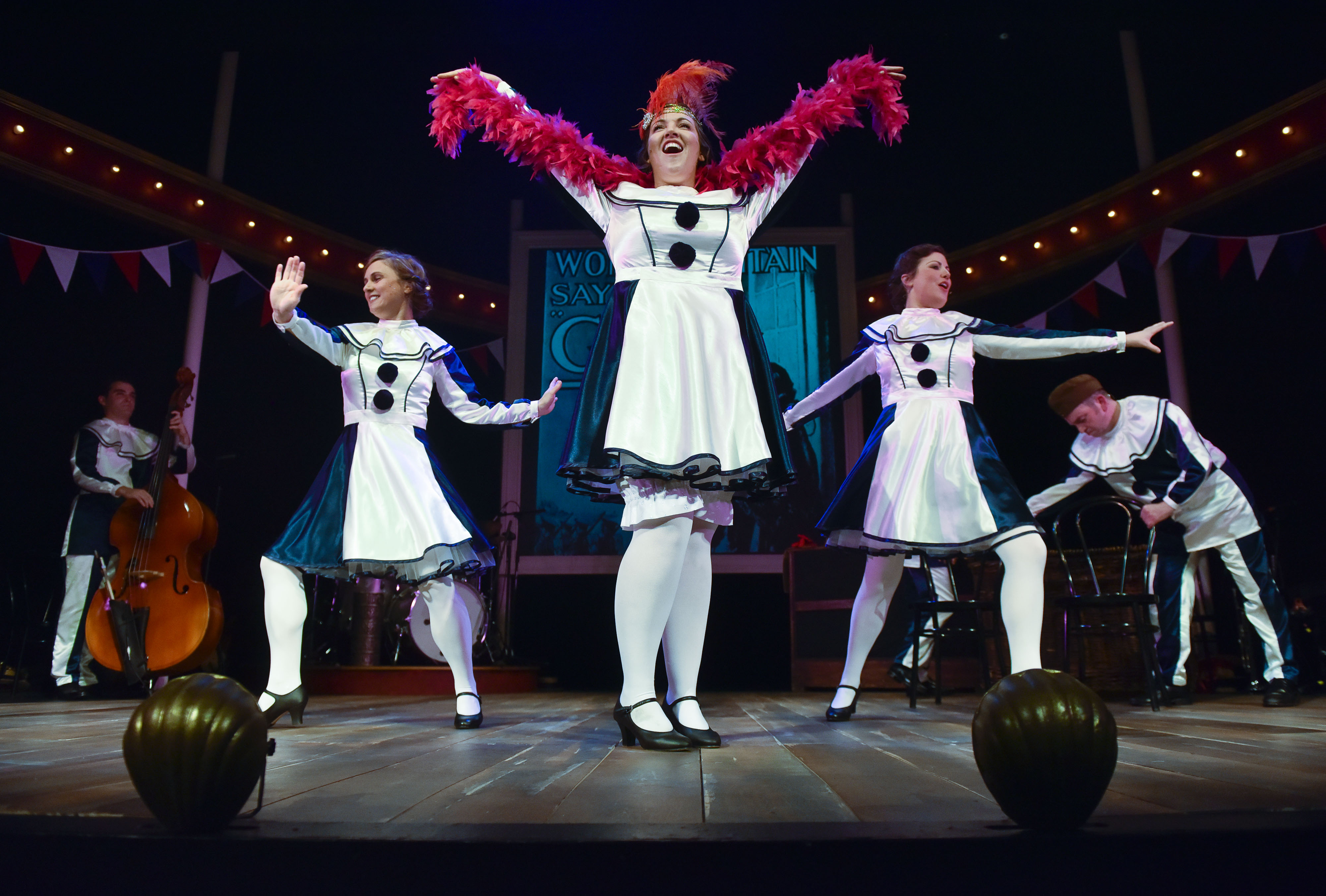
Littlewood uses the songs of the period to great effect, interspersing them throughout with little vignettes as the cast of ten dressed in costumes reminiscent of the old Music Hall Pierrettes take on multifarious characters ranging from civilian, military and political persons from Britain, France, Germany, Belgium, Russian etc, presenting “the ever popular, ‘War Games'”.

To aid us all in this, since this is a history lesson on four years of fighting on a scale never before encountered, there is a large screen in the centre of the stage upon which helpful photographs, documents, maps and information – all historically accurate – are displayed. In fact, Foxton has designed a simple and yet superb set. A circular ‘stage’ around which the performers and their props and instruments wait in Brechtian fashion, with a false gallery and prosc arch, bunting, the royal Coat Of Arms, and footlights. Just what one would have expected to find at the theatre at the end of a pier in those days.

There are ten performers in all; but don’t ask me to tell you how many characters they play between them! However, their character changes are swift and clever, with the simple addition of a hat or scarf, or perhaps even just an umbrella. They are also multi-talented as indeed they all must also sing, dance and play at least one musical instrument, as they were also the show’s band, “The Merry Roosters”. And so, piano, bass, clarinet, trombone, drum kit, and goodness knows what else were played by those members not actually involved in the acting of each scenelet.

I must say right now that under normal circumstances I am absolutely no fan of actor-musicians; and I still think I would have enjoyed the show more had they been separate, but it certainly didn’t bother me anywhere near as much as I thought it would, and for a show of this particular style, and the lovely Brechtian directing by the Coliseum’s Artistic Director Kevin Shaw, it was apt and fitted well. I do feel though that some of the songs would have benefited from a fuller sound vocally; although the harmonies were lovely, they were a little sparse.

Photo credit: Joel Chester Fildes

In fact Shaw has brought out the best from both his cast and the show in this. It could do with being a little pacier; I felt especially the first half dragged ever so slightly (perhaps because the audience didn’t really “get it”) but hopefully given a few more runs for it to “bed-in” the pace will naturally quicken anyway. Beverley Norris-Edmunds should also be commended here too for her lovely choreography. Stylistically perfect and worked excellently.

It is almost impossible to single out certain cast members from others in a show such as this, a true ensemble piece in every regard, but I cannot leave this review without mentioning them, as they are all excellent. They are Isobel Bates, Matt Connor, Richard J. Fletcher, Jeffrey Harmer, Barbara Hockaday, Anthony Hunt, Thom Petty, Lauryn Redding, Reece Richardson, and David Westbrook. My favourite number from the evening though simply has to be the lovely acapella rendering of When This Lousy War Is Over.

Oh What A Lovely War may not prove to be everyone’s cup of tea (but I guess the same can be said of any piece of theatre); however, I do believe that the Coliseum have got another hit show on their hands with this one. Poignant, relevant, and also very funny, true to the spirit and concept of the original production. Well done chaps!

Oh What A Lovely War is at the Oldham Coliseum until 30th September.

Review: Hairspray at the Orchard Theatre

If you want a show that’s guaranteed to entertain, you need look no further than Hairspray. Flying the flag for anyone who’s ever felt they don’t quite fit in, it’s the story of an American teenager with a heart of gold, who refuses to believe she can’t live her dreams just because she doesn’t look like all the pretty girls on TV. Dancing her way into the nation’s hearts, Tracy Turnblad inadvertently becomes the leader of a civil rights movement, campaigning for racial integration – because the alternative simply doesn’t make sense to her.

Photo credit: Darren Bell

In a weird way, it’s almost depressing that we still need shows like Hairspray. It would be great if we could sit back and enjoy the feel-good story, safe in the smug knowledge that these are yesterday’s problems. Unfortunately, as recent events have demonstrated, the two big issues addressed by the show – body shaming and racism – are still just as topical today as they were in the 60s (when the story’s set) or the 80s (when it was written).

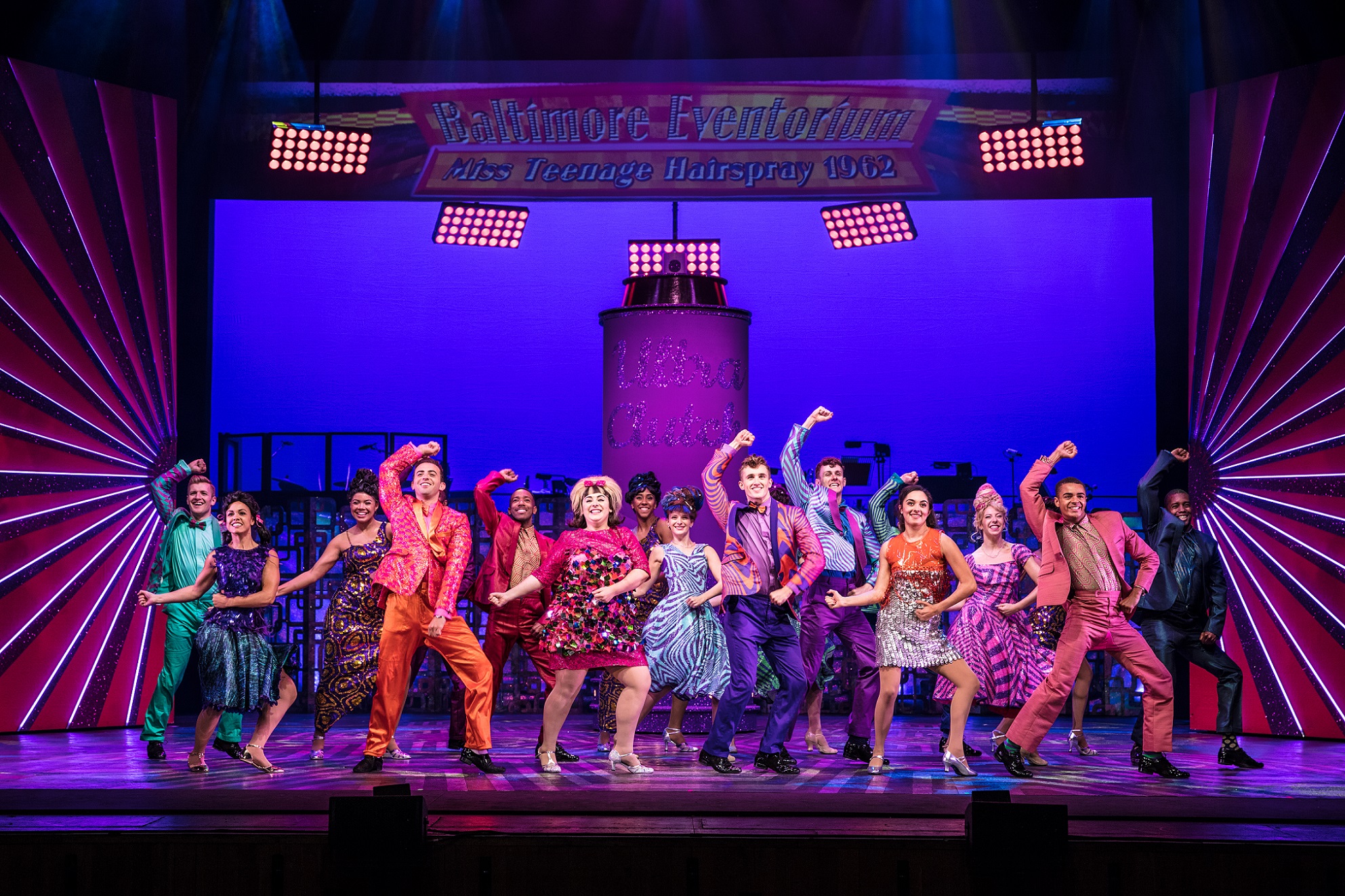
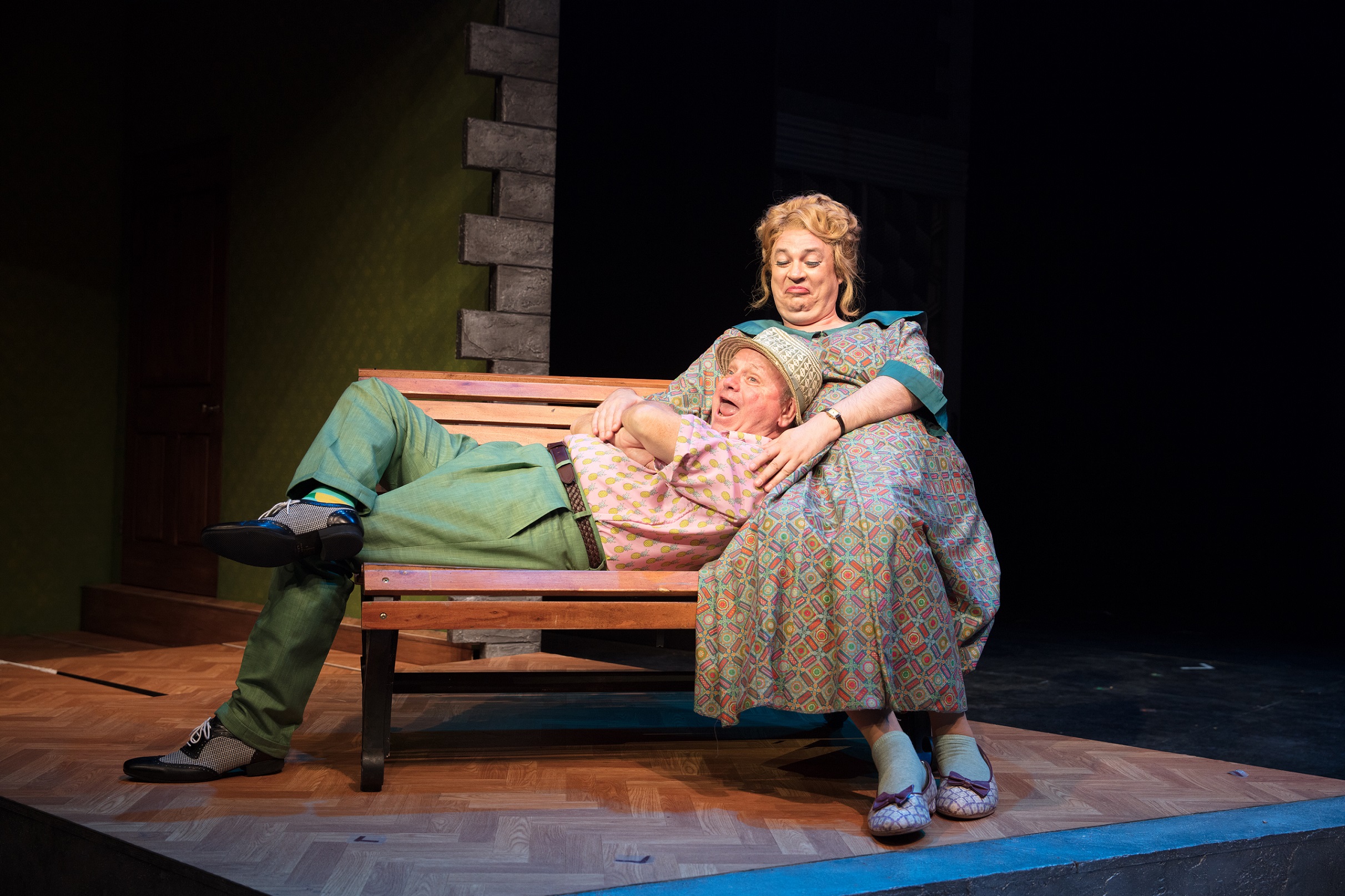
Perhaps that’s why two of this production’s most memorable moments both come from Motormouth Maybelle – Act 1 finale Big, Blonde and Beautiful, and the electrifying I Know Where I’ve Been. Then again, it could just be because Brenda Edwards, who plays Maybelle, is vocally incredible. Either way, her solos certainly stand out in a musical that’s full of show-stopping moments – among them the sweet comedy duet between Matt Rixon and Norman Pace; it’s a number known for improvisation and innuendos, and this partnership don’t disappoint. And let’s not forget the fabulous finale, which wraps everything up in a neat, glittery bow, and does so with such energy and joy that you can easily put aside how utterly unrealistic it all is.

Newcomer Rebecca Mendoza, making her professional debut as Tracy, proves herself not only a talented singer and dancer but also a gifted comedian; her adoration of Link (a suitably charming Edward Chitticks) is particularly fun to watch. At the other extreme is the villain of the piece, unashamedly racist TV producer Velma, who’s played with great relish by Gina Murray; it’s only a shame we don’t get to hear more of her amazing vocals.

Photo credit: Darren Bell

As well as a great cast who are all worthy of mention, Hairspray also boasts a toe-tapping 60s-inspired score by Marc Shaiman and Scott Wittman, brilliant choreography from Drew McOnie and dazzling set and costume design by Takis (not to mention impressively huge hair). The whole show is a riot of colour and vivacity, with plenty to enjoy for younger audience members but a healthy scattering of naughty jokes for the grownups too.

And at the heart of all this fun and froth is that serious message, summed up so succinctly by Tracy herself: “I just think it’s stupid we can’t all dance together.” It might sound like a massive simplification of a huge and complex problem – and it’s true that the show doesn’t exactly offer an in-depth debate of the issues – but in a world that increasingly feels like it’s going backwards, every little helps.

Hairspray is at the Orchard Theatre until 9th September.

Review: A Murder is Announced at the Orchard Theatre

Guest review by Sarah Gaimster

Last night I was lucky enough to be invited to review the Middle Theatre Company Ltd’s latest production of Agatha Christie’s A Murder is Announced on its opening night of a five-night run at the wonderful Orchard Theatre in Dartford.

While young Agatha Christie’s husband was away fighting in the First World War, she worked in the dispensary of the University College Hospital, London, where surrounded by poisons the idea of writing her first detective story was conceived. Her elder sister Madge was an avid supporter of the idea, so Agatha rose to the challenge, and the rest as they say is history.

Mrs Christie was appointed Dame of the British Empire in 1971 to honour her many literary works. Known as The Queen of Crime, Dame Agatha penned thirteen novels in the  Miss Marple series. A Murder is Announced is a firm favourite amongst fans of the series.

As Act One of A Murder is Announced opens, the audience are invited into Letitia Blacklock’s drawing room at Little Paddocks, her typically Victorian home in Chipping Cleghorn.

Within minutes of the opening the audience are gripped by the storytelling (adapted for stage by Leslie Darbon) when Dora Bunner, the delightfully dizzy and slightly senile Bunny reads an article from the local paper which reads:

“A murder is announced and will take place on Friday October the twenty-ninth, at Little Paddocks – at six thirty p.m. Friends please accept this, the only intimation.”

The residents are thrown into an excitable turmoil, not sure whether to be thrilled by the excitement in this unexpected event for a sleepy country village or scared by the threat to them. Is it a practical joker taking things a step too far, or is the threat real and the residents should be in fear of their lives…?

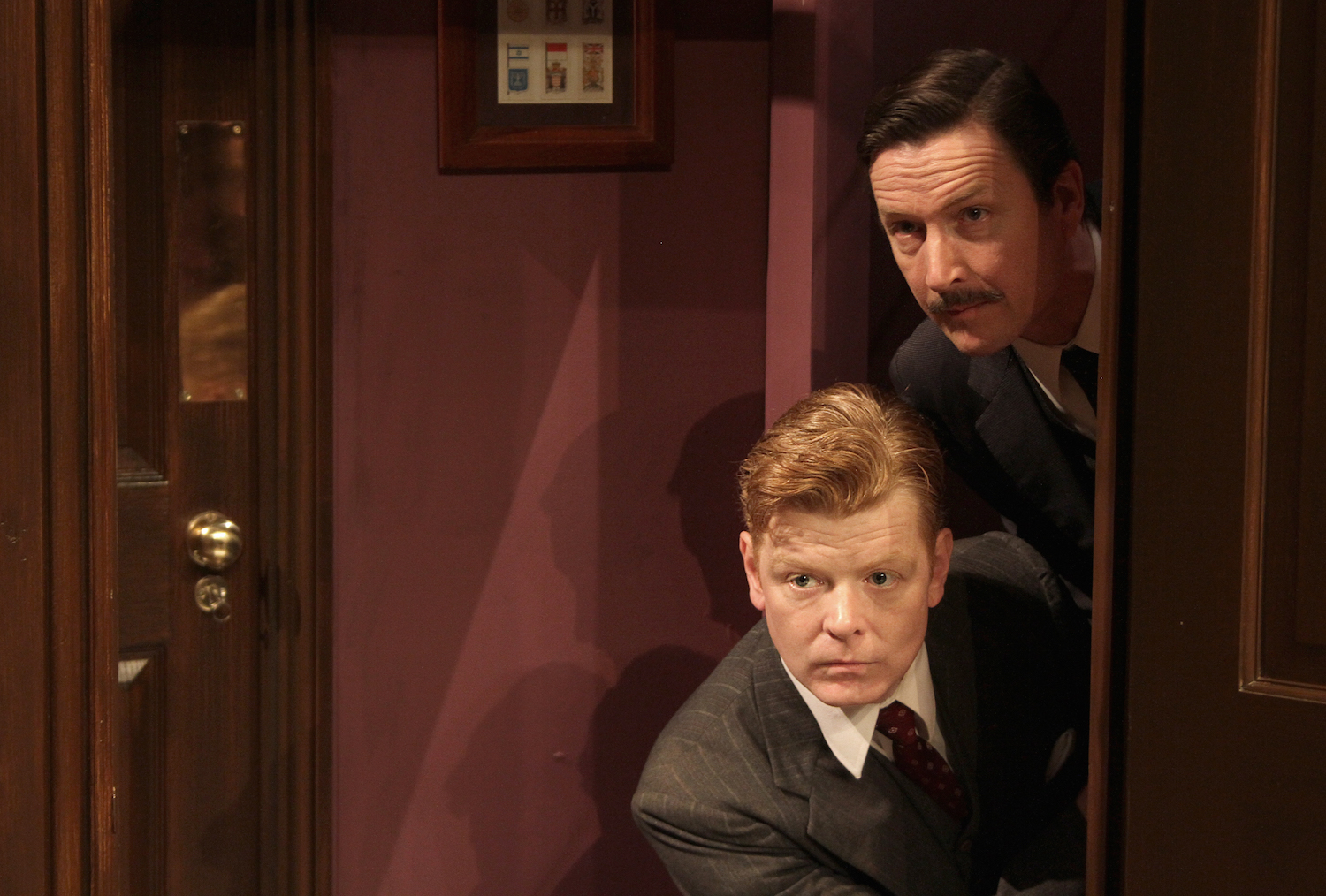
Not wanting to spoil the surprise and give the plot away, I’ll just say that the second half of the investigation into the running order of events at Little Paddocks after 6.30pm on that evening is methodically unraveled by Inspector Craddock, along with Sergeant Mellors.

Local resident – and in Inspector Craddock’s view the interfering – Miss Marple (Louise Jameson) decides to get involved and make her own discoveries about the order of events.

It is a small cast of just twelve, but you’ll be thrilled with the star studded line up from Janet Dibley (Fat Friends and Eastenders) as Letitia Blacklock, Louise Jameson (Bergerac and Tenko) as Miss Marple, Tom Butcher (The Bill and Emmerdale) as Inspector Craddock and Dean Smith (Waterloo Road and Last Tango in Halifax) as Edmund Swettenham, to name just a few that you’ll recognise.

There are comic interludes when the wonderful Hungarian housemaid Mitzi (Lydia Piechowiak) takes to the stage, which lighten the audience’s mood amongst the more serious elements of the story.

A Murder is Announced plays at the Orchard from 15th to 19th August. Grab your ticket while you still can to find out whodunnit!

Review: Little Shop of Horrors (Summer Youth Project) at the Orchard Theatre

For a second year running, the Dartford Summer Youth Project has selected a show that’s new to me. Following last year’s brilliant Bugsy Malone, this summer they’re back with Little Shop of Horrors, the classic horror comedy about a man-eating plant by Howard Ashman and Alan Menken, in a production that brings together a community cast of young Dartfordians aged between 9 and 19. The story follows shop boy Seymour, who finds himself in possession of a “strange and interesting” plant that makes him rich and famous – but at what cost…?

The show might be considered a bit gory for kids (it does, after all, involve an abusive relationship, murder, dismemberment and a psychotic dentist) and it had to be sanitised a little for this production. But the horror is all very tongue-in-cheek, and the jokes are pitched so that a lot of the humour can be appreciated by adults whilst sailing over younger heads. There’s also a valuable lesson for all ages to be taken from this cautionary tale about the dangers of putting personal gain ahead of moral values.

I have two main conclusions from this evening’s opening night performance. First, I’ll be keeping a much closer eye on my plants from now on. Second, director Sean Hollands and the rest of the SYP team have pulled off another triumph. After just two weeks of rehearsal, Little Shop of Horrors is slick, professional and features several young performers who could easily give seasoned stars a serious run for their money.

This is particularly true of the principal leads – Ethan Oswald, Olivia Hallett, Luke Walden and Mikey Stevens – who all look and sound like they’ve been on stage for years. Each of them has at least one big musical number, and absolutely nails it, with my personal highlights Mikey Stevens’ hilariously deranged Dentist! and Olivia Hallett and Ethan Oswald’s gorgeous duet, Suddenly Seymour. There’s also some brilliant voice acting from Thomas Bassett, the voice of Audrey II, who succeeds in giving us the shivers without once appearing on stage, and impressive vocals from the chorus of glamorous Ronettes.

The principals lead a huge company of over 100 children, all of whom get to be involved throughout the show as they pop up frequently in aisles and on balconies performing dance routines choreographed by Mel Simpson. This sometimes messes with the audience’s view of the stage a bit – but it’s hard to mind that too much when the children are obviously having such an amazing time.

And that’s the genius of the Summer Youth Project. Yes, this is a fantastic production that showcases some outstanding young talent, but more importantly it’s giving each and every one of the children on stage an experience they’ll never forget – the chance to be part of a production led by a professional creative team, performing for a huge audience of friends, family and strangers in a proper theatre. But it’s not just a treat for the kids; their enthusiasm and delight is infectious, and you don’t have to be a parent or even know anyone involved to feel proud of what they’ve all achieved, or to appreciate the hard work they’ve put in. This is something that’s easy to take for granted when watching a professional company for whom it’s just another day at work, and sometimes we need a reminder of why we go to the theatre in the first place: to be entertained. And on that score, Little Shop of Horrors more than delivers.

Little Shop of Horrors continues at the Orchard Theatre until Saturday 12th August.