Interview: Caroline Byrne, Blocked

Playwright Caroline Byrne returns to the Brighton Fringe this month with her new play, Blocked, which uses comedy to challenge society’s unspoken rules against talking about infertility. “A famous stand-up’s successful routine – sending up love, marriage and babies – falls apart as she melts down. It’s fast paced and delivered as a stand up routine throughout.”

Caroline explains that Blocked was inspired by her own experience of failed fertility treatment: “There’s a taboo around discussing infertility that society imposes on you and you get crap advice from people. I wanted to explore this and use dark humour to engage the audience, so that’s why I made the character a comedian.”

The show’s performed by Laura Curnick, and reunites Caroline with acclaimed director Scott Le Crass, following a previous collaboration at the Brighton Fringe 2015. “Scott directed my play In A Better Place, which was set in a hotel room, in the rock n roll themed Hotel Pelirocco,” she explains. “He is extremely creative and also very tactful and calm, so I was relieved when he agreed to direct Blocked because traditionally writers aren’t allowed in rehearsal – so you have to trust your director completely or you’d go mad. Scott has been nominated for many awards, and recently had a West End Transfer with Sid, a fabulous show.”

Blocked promises something of a mixed experience for Brighton audiences: “I want them to laugh out loud at the stand up, and then slap them in the face with the final dramatic act,” says Caroline. “You should come and see it because it’s a provocative standup routine within a piece of theatre. Two genres for the price of one!”

As the Brighton Fringe gets underway for another year, Caroline has plenty to look forward to. “I can’t wait to watch Laura Curnick perform the show for the first time!” she says. “But I’ll also be catching up with other theatre buddies and seeing their shows. In particular I’m looking forward to Nick Myles’ Trouble with Men, three great shorts. Also Goddess by Serena Haywood and Purged starring Orla Sanders.”

After Brighton, Caroline has several exciting projects lined up with her company Pure Fluke Theatre. “We write daring, comic roles for women over 35,” she explains. “I’ve just finished a new sitcom about working in fringe, with my co-writer Rachel Goth. The material writes itself. I’m also planning to tour my farce How To Make Money From Art in Ireland.”

Catch Blocked at Duke Box from 18th-24th May.
Review: Pygmalion at the Nuffield Theatre

Guest review by Edward Learman

Playing at the Nuffield Theatre last night I had the opportunity to see the latest reinterpretation of George Bernard Shaw’s classic Pygmalion, a co-production performed by Southampton University’s own Nuffield Theatre company and the two touring companies Headlong and West Yorkshire Playhouse.

I knew little about Shaw’s play, except that both he and HG Wells (The Time Machine) had at one time written propaganda romanticising the Russian Revolution and Stalin’s disastrous five-year plans. The title sounded Greek or Roman, and I’d remembered reading that it was an interpretation of the ancient myth, but this could just have easily been on the sleeve notes for My Fair Lady (1964). Interestingly, Pygmalion’s themes can be charted in such films as Titanic (1997), Pretty Woman (1990), She’s All That (1999), and probably a countless number of books and films across the world, making it a truly universal story about love, self-discovery and freedom.


The German term ‘Bildungsroman’ is often used to describe the fairy-tale journey of a hero from poverty to enlightenment; the forming of the ‘true self’ which they are destined to become. Having not seen Shaw’s original version and only familiar with its pop-culture references, I had incorrectly assumed that the play was a romantic Cinderella-tale similar to Oscar Wilde’s comedy of manners, An Ideal Husband and The Importance of Being Earnest, neither of which I’d seen either.

Just 30 seconds into the first act, it was immediately apparent that Sam Pritchard and company had little interest in making the show about either manners or love. This was not a British romance like Four Weddings and a Funeral or Bridget Jones, but then perhaps Shaw’s original never was; without a doubt it did not contain lines like, “Are you going to walk?” / “Of course not, I’m going to get a f***ing taxi.”

The first scene that introduces the pauper Eliza Doolittle (Natalie Gavin) to her sponsor and nemesis Henry Higgins (Alex Beckett) shows the main cast standing on a street, sheltering from the rain, but reading their lines in dubbed recordings using different dialects and voices. A visual projection onto the set’s background shows the text of each individual line as it’s mouthed by the actors. This is jarring for the audience, hearing the same character speak their lines like ventriloquists, but makes it so that the projected subtitles is the only way of following the conversation.

The programme contains a short interview between one of the show’s creators Caitriona Shoobridge and Dr. Bronwen Evans (from the UCL’s Speech, Hearing and Phonetic Sciences Department), in which they discuss this scene and how people often change their accents, and what this means culturally. Perhaps this device undermines the purpose of the scene, which starts as a banal conversation about the bad weather, but ends with Henry and cast humiliating Eliza as she tries to earn money selling flowers.

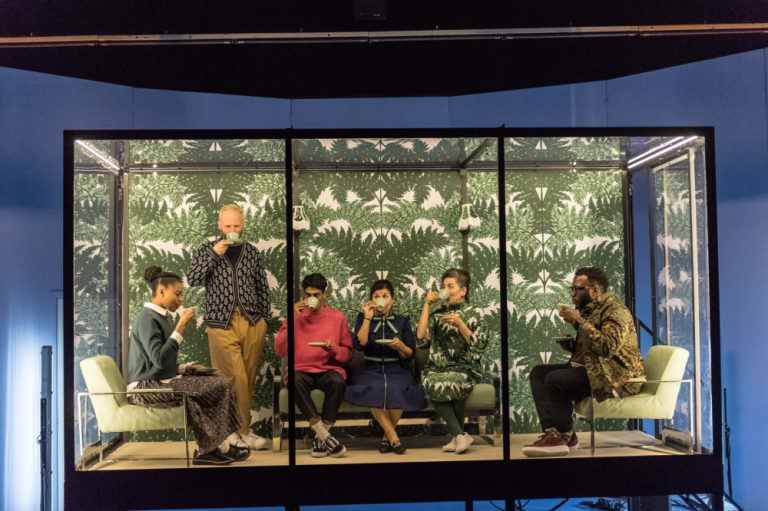
Afterwards, the scenes revert back to a formal staged drama without the subtitles. The play becomes a slapstick, sometimes musical, foray as Henry coaches the naïve Eliza in order to win his bet that he can transform her into a duchess. The stage set combines film projection and large set changes, the most striking of these being Mrs. Higgins’ dining room, which resembles a huge iguana tank, and shows her camouflaged against the tropical-green wallpaper in her matching costume.

Photo credit: Manuel Harlan

The cast give high-energy and flamboyant performances, delivering characters that go from Mighty Boosh-style slapstick to restrained moments of personal reflection. Its mixed-race cast of professional actors speak like bourgeoisie elitists, slipping in some modern phrases, to create a peculiar anachronism with Shaw’s original text. The supporting actors are versatile, especially Raphael Sowole as Colonel Pickering and Ian Burfield as Alfred Doolittle, showing their pitch-perfect timing at comic relief. The two leading actors, Alex Beckett and Natalie Gavin, whose performances require them to use different accents whilst showing the turns of the characters, are fascinating throughout.

The play is as much about bullying as it is about class prejudice. Inevitably, after being conned into a verbal contract by Henry and her father, Eliza chooses to turn her back on him when he tries to convince her that cruelty is really what class is all about.

Pygmalion is at the Nuffield Theatre until 13th May.

Interview: Nick Myles, Trouble With Men

This week sees the launch of the Brighton Fringe 2017, with a programme featuring over 970 events at 155 venues across four weeks. One of these is Trouble With Men, a trio of short plays by writer and director Nick Myles, exploring different aspects of modern male homosexuality.

Details is a provocative drama about a date that goes horribly wrong, born out of a relationship I had with a transsexual man, which opened my eyes to the variety of issues such relationships can raise,” explains Nick. “Brighton-Damascus is a love story: can Adam and Ahmed turn their online romance into real world happiness? This play was written after I read an article about the plight of LGBT people in the Middle East and the barbaric treatment they can be subjected to. It really distressed and angered me, but ironically the play I wrote in response is a very tender love story.

“And Three Men and Some Baggage is a fast-paced comedy about stereotypes and unrequited love. It’s an excuse to get the casts of the other two plays together and have a lot of fun exploring friendship and attraction and the masks we wear when we’re afraid to be ourselves.

“I hope the plays are original and explore subjects that don’t get much attention. The gay community, specifically, can be very superficial and cliquey, and it would be good for us to confront our prejudices and try to be more inclusive. For instance, even with the rising profile of transgender people there’s still an assumption that a course of hormones and a bit of surgery are all it takes to correct gender misalignment, but it’s not that simple – some trans people don’t even aspire to complete physical transformation. Going to bed with a man who has no penis makes you realise the range of different and unreported experiences there are out there.”

The three plays are performed by William McGeough, Freddie Wintrip and Reece Mahdi. “I’ve been working with William for nearly four years now,” says Nick. “He’s a tremendously versatile actor – so far he’s played ten characters for me, including two women, a murderer and a torture victim. Freddie and Reece are both fairly recent drama school graduates, but you’d never know it from watching them. They have absolutely gorgeous chemistry in Brighton-Damascus, and it was a joy to see them rise to the challenge of playing two completely different characters in Baggage.”

In addition to shining a light on previously unexplored topics, Trouble With Men has an underlying message – and challenge – for its audience. “The last line of the show is ‘What can I do?’, and I’d like audiences to leave Trouble with Men pondering that question,” says Nick. “Not just in the context of the final play, but of the show overall. I’m a fiercely compassionate writer, and I aspire to make work that challenges preconceptions, provokes debate and potentially leaves the world a better place, pretentious as that sounds. The jokes are just gravy, really.”

With less than three weeks to go, the team are excited about bringing the show to Brighton. What are they most looking forward to? “Hopefully large, enthusiastic audiences!” says Nick. “But as an Edinburgh veteran I know the competition for bums-on-seats at festivals is intense. I’ll be doing everything I can to make the show a success, but I hope to have time to relax and enjoy Brighton, which is one of my favourite towns at any time of year. I’ll be seeing shows, eating ice-cream, propping up bars, and quite possibly taking a dip in the sea.”

One of the shows Nick’s particularly looking forward to is Blocked by Caroline Byrne, at Sweet Dukebox from 18th-24th May. “It’s a one-woman show directed by the excellent Scott Le Crass about a stand-up comedian who comes to grief because of her struggle with infertility. I played a very small part in the show’s development, and I can’t wait to see the final result – it’s a terrific and very heart-felt script.”

Trouble with Men is at Warren Studio 2 on 17th-19th May, and at the King’s Head Theatre from 15th-19th August.

Review: Made in Dagenham at the Orchard Theatre

Made in Dagenham is based on the true story of the Ford sewing machinists’ strike of 1968, which became key to the passing of the Equal Pay Act two years later. Not surprisingly given the subject matter, it’s a feel-good show with some rousing musical numbers and a finale that simultaneously reminds us how far we’ve come and unashamedly commands us to get on our feet and face up to the challenges still ahead.

The Dartford Amateur Operatic and Dramatic Society (DAODS) are one of the first amateur groups in the South East to get the rights to perform Made in Dagenham, which closed in the West End in 2015 after a well-received but relatively short run starring Gemma Arterton. And they’ve proved themselves more than worthy of the honour by producing another excellent show, with director Alex Campbell making her Orchard directorial debut in swinging 60s style.

Photo credit: Rob Hooker

The story follows Rita O’Grady (Stephanie Trott), a Ford machinist who finds herself the unwitting leader of the strike after a dispute over pay scales turns into something much bigger. Facing off against the male-dominated unions, the might of Ford – represented by one very unpleasant American – and the disapproval of her husband Eddie (Alex Freeman), Rita and her girls take their struggle all the way to the top, rubbing shoulders with prime minister Harold Wilson (John Woodley) and Employment Secretary Barbara Castle (Julia Bull) on their way to winning over the TUC conference with an impassioned plea for equality.

Let’s be clear about one thing: this is not a serious or, I suspect, hugely accurate depiction of the events surrounding the strike. Nor is it particularly balanced – the opening number says it all: “If you want something done, ask a busy woman… cos you’re wasting your time asking a man.” Later, when he forgets their 10th wedding anniversary, Eddie offers as an explanation: “I’m just a man with a foolish brain.” The show at times tiptoes very close to the line between cheering for women and putting down men, but is always good humoured enough to pull it back at the last minute.

Leading lady Stephanie Trott is an experienced musical theatre performer, and it shows; she’s perfectly at ease and totally genuine both as the bubbly wife, mother and friend, and as the feisty activist – we could easily have been watching her on a West End stage. Alex Freeman, a DAODS veteran of over 10 years, offers great support as husband Eddie, really coming into his own in Act 2 with a heartfelt rendition of The Letter. And there are great – if surreal – comic performances from John Woodley as Harold Wilson, unflatteringly portrayed as a sort of man-child who’s terrified of women (and indeed any kind of responsibility) and Alex Tyrrell, who’s brilliantly bitchy as the cowboy American boss flown in to put down the revolt. Most importantly for a show that’s about solidarity, the whole cast has great chemistry and the big ensemble numbers are real highlights in an already brilliant show.

From the moment the curtain rises, there’s no doubt what era we’re in; the set and costumes are right on the money and transport us instantly to the swinging 60s. My only minor gripe about the production is that there are occasional sound issues; in the factory scenes the background chatter becomes slightly overpowering, and a few of the lyrics get lost when the band’s in full swing.

Made in Dagenham is a slightly bonkers little show in many ways, but that’s not necessarily a bad thing. The show has some catchy tunes and a cheeky, self-deprecating sense of humour, and it makes us realise how lucky we are to have had battles like this fought for us long before we were even born, even as we understand there’s still work to do. Best of all: the show may have been made in Dagenham – but DAODS was made in Dartford, and they’ve done us proud.

Made in Dagenham is at the Orchard Theatre until 29th April.

Interview: Daniel Foxsmith, BLUSH

In April 2015, legislation was passed that made revenge pornography – sharing a private sexual photo or film of someone without their consent – a criminal act. This became the catalyst for BLUSH from Snuff Box Theatre, which tells five stories about image-based sexual abuse, and went on to an award-winning run in Edinburgh. Next month the play will transfer to Soho Theatre, before embarking on a national tour.

Photo Credit: The Other Richard

“It’s a bit of a bloody rollercoaster!” says Daniel Foxsmith, who appears in BLUSH alongside writer Charlotte Josephine. “It’s a blisteringly beautiful look at how we behave online, the rules we have or haven’t made for ourselves on there, a look at gender, our modern attitude to sex, promiscuity, sex education, the shame associated with sex and how our understanding of ourselves is shaping technology now.”

Described as “a slap in the face and a call to arms”, BLUSH fearlessly tackles a difficult subject, and encourages its audience to do the same. “We need to look at all of the above with both eyes wide open,” says Daniel, “so if we can get audiences to confront some ‘digital gremlins’ that are now firmly part of our online culture that’d be great. Beyond that, hopefully they’re engaged, entertained and there’s space for reflection and empathy after the show.”

BLUSH is the third play from Charlotte Josephine, who’s co-founder of Snuff Box Theatre along with Daniel and Bryony Shanahan. The show’s been in development since 2015: “After a lot of research by Charlotte Josephine, the piece, as far as I’m aware, found its current form early on in December 2015 after some research and development at Camden People’s Theatre, where Bryony Shanahan floated the idea of the five voices being played by two performers,” explains Daniel.

“It’s grown again from there; with director Edward Stambollouian making his deft mark on it on its way to Edinburgh last summer. I think now, post-Edinburgh, the show’s current form is a robust and direct piece of storytelling, which has been reflected in some lovely thoughts from reviewers and – most importantly – audiences alike, with Charlotte winning a Stage Award for Acting Excellence whilst sweating away in the depths of Underbelly!”

Daniel believes that research is the key to BLUSH‘s success. “I think the amount carried out before, during and beyond the writing of the show makes the content well thought-out and crucially well balanced. This isn’t a two-dimensional ear bashing for a particular section of society. Also Ed’s fine touch and James’s design have created a beautifully intense and sparse atmosphere for the stories to unfold.”

Photo credit: The Other Richard

Though the play was inspired by the concept of revenge porn, the true focus of the work is shame, which allows the show to speak to a much broader audience. “I’d say the show speaks to wider themes,” says Daniel. “It’s not just about digital sexual abuse. All of the things I mentioned in summing up the show are universal themes that I’d hazard to say everyone has brushed up against in one way or another at some point.”

After its run at Soho, BLUSH goes on tour throughout the summer around the UK. “I think touring outside of London is really important, but it feels especially relevant for BLUSH, because it can be harder to escape the digital pillory that online shaming can sometimes become in communities in smaller towns and cities.”

Daniel, Charlotte and Bryony founded Snuff Box in 2011 after graduating, inspired by one simple goal: “We wanted to work!” says Daniel. “The three of us trained as performers on the East 15 CT course, and had stories to tell by the end of it. No-one was waiting for us to tell them, so forming Snuff Box was a way for us to get our work made. With the addition of Jake Orr driving us on as producer, the team is aiming to keep telling stories that are full of heart and grit, in ways that provoke today’s audience.”

BLUSH is at Soho Theatre from 16th May-3rd June, then on tour until 24th June.