Review: Odd Man Out at The Hope Theatre

The two shows that make up Odd Man Out – Dominic Grace’s Rabbitskin and Lesley Ross’ Diary of a Welshcake – weren’t written to be performed together. Nor are they similar in plot, character or even performance style. But what unites these powerful monologues is the themes of love, loss and isolation explored by their two protagonists: Joe, a sensitive book lover struggling to live up to the expectations of his father and four older brothers; and Ralph, a gay Welshman on a journey of self-discovery and unexpected romance in Hong Kong.

The first character to take the stage is Rabbitskin‘s Joe, who quickly wins our hearts with his shy smile, childlike innocence and obvious affection for both his family and his favourite books. His is a story that can only be told by dipping into others, and Grace’s script skilfully weaves episodes from Joe’s life together with the yarns spun by his father. Like both Joe and his dad, Luke Adamson proves himself a masterful and thoroughly engaging storyteller, who slips effortlessly between characters – one moment a wide-eyed seven-year-old Joe, the next his Irish father telling the legendary tale of Cu Chulainn, the next his bullying brother Cal. He even manages to make something as mundane as the washing up sound utterly magical.
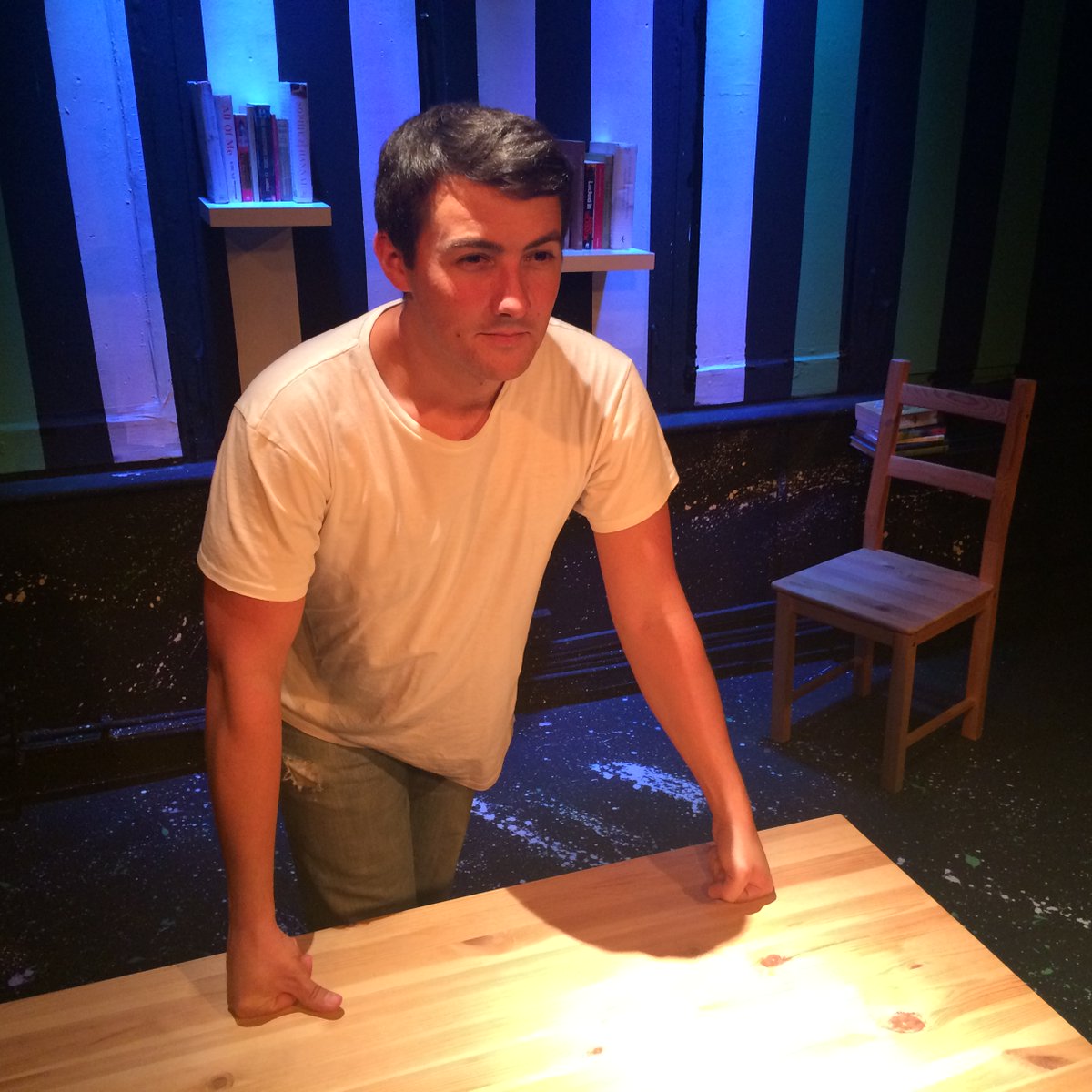
Photo credit: Luke Adamson

But stories will only protect you from real life for so long – and as sympathetic as Joe undoubtedly is, there’s a darker side to this character that refuses to stay hidden behind his defensive wall of fantasy. As the story begins to come together, and Joe’s placid demeanour cracks with increasing frequency, we know something is coming… yet the end of the story, when we arrive there, still shocks with its sudden brutality.

Gregory Ashton’s Ralph – also known as Tom – in Diary of a Welshcake is a somewhat different character; while still very likeable (and not just because he begins by handing out food) he doesn’t have Joe’s innocence, or feel quite so much a victim of his circumstances – perhaps because he ultimately acknowledges his own guilt over how the story of his Hong Kong adventure ends. Despite this, his is a much more openly comic tale, with a lot of the humour stemming from cultural differences, and particularly the absolute inability of characters from outside the UK to understand the difference between England and Wales.
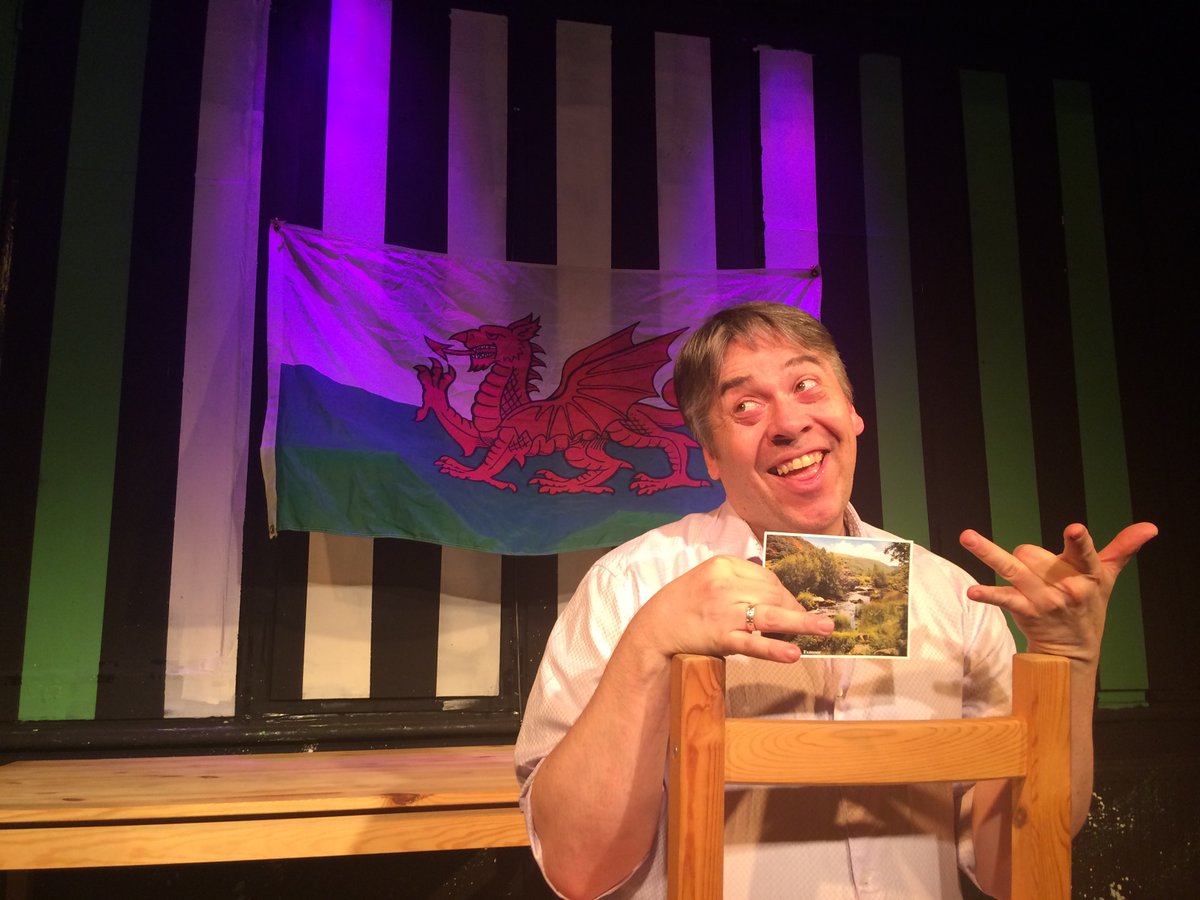
Photo credit: Gregory Ashton

These other characters – male and female – allow Ashton to demonstrate his versatility as a performer; Ralph’s “predominantly heterosexual” American flatmate Matthew is a particular highlight, and there’s even a bit of (unfortunately inaccurate) Chinese in there at one point. Ashton’s been performing the show for over ten years, and it shows; his delivery falls somewhere between stand-up and theatre, so much so that the show begins to feel like it could actually be a true autobiographical account. The easy rapport that quickly develops between actor and audience is taken full advantage of later in the show as we’re invited to help recreate a dream of Ralph’s, a bizarre but very funny moment that deliberately steers us off course in the build-up to a shocking revelation.

Each of these stories could – and does – stand alone as a skilful portrayal of a man who doesn’t quite know who he is or where he belongs. Put together, they make for an evening that’s simultaneously laugh-out-loud funny and quietly heartbreaking, featuring two engrossing solo performances. If nothing else, come for the free food; you won’t regret it.


Can’t see the map on iPhone? Try turning your phone to landscape and that should sort it. I don’t know why but I’m working on it… 😉

Review: A Different Way Home at Canal Cafe Theatre

They say there are two sides to every story. That’s certainly the case in Jimmie Chinn’s A Different Way Home, in which two members of the same family each share their viewpoint on a feud that’s kept brother and sister apart for years. While each believes they’re in the right, the play ultimately reveals that had they only talked to instead of about each other, life could have worked out very differently. Though its structure and staging are relatively simple, the play is a cleverly composed lesson in the dangers of taking character narration at face value, poignantly performed by Steven Mann and Sarah-Jane Vincent of the Unusual Theatre Company.


Set in 1986, the play’s presented as two monologues. The first of these comes from Leslie, who stayed in the family home to take care of his elderly mother while his three siblings moved away. Two of them started a new life on the other side of the world – yet for some reason Leslie’s particular wrath is reserved for Maureen, the youngest, who married a Jewish man and moved just around the corner. His moving, meandering account of the day his mother died is peppered with detours down memory lane, but returns again and again to vicious recriminations against his sister for her rejection of their family.

Fade to black; Leslie’s gone and in his place is Maureen. At first glance, it seems his depiction of her was accurate, as she turns up her nose at the state of the old house and shares juicy gossip about her childhood friends, who still live next door. But as she turns to the subject of her brother, it becomes clear he isn’t exactly perfect either, and that Maureen’s decision to distance herself from the rest of the family may not have been as one-sided as we’ve been led to believe. Ultimately, as she fills in the gaps left by Leslie in the family history, we realise that the pointless disagreement between these two flawed and stubborn characters hinges almost entirely on a simple failure to communicate.

The influence of Jimmie Chinn’s literary hero Alan Bennett is obvious in the play’s direct, conversational style (though it’s never completely clear who Leslie’s addressing; his obvious loneliness seems to suggest a casual visitor is unlikely) and northern setting. Originally written as a short radio play, the plot is driven by script and character – the only props in Val Collins’ production being a battered armchair and a hankie – and therefore demands two compelling performances in order to hold the audience’s attention throughout. Steven Mann is particularly strong as the grief-stricken Leslie; even when he’s saying nothing at all, we can see the pain of his mother’s loss etched on his face. Both he and Sarah-Jane Vincent have a very natural, chatty delivery that works well in a small space, the only downside to this being that those furthest from the stage may have to strain to hear some of the more confessional moments.

A Different Way Home is a poignant and at times quietly humorous study of grief, isolation and family relationships – a story that will speak to us all in some way, and may well make you want to get straight on the phone to your loved ones, if only to say hi.


Can’t see the map on iPhone? Try turning your phone to landscape and that should sort it. I don’t know why but I’m working on it… 😉

Interview: Dave Spencer and Ron Elisha, Window

“It’s a dramatic exploration of the nature of intimacy. What constitutes a relationship? How great is the distance between two people before they no longer matter to one another? Does it indeed take two to tango?”

Window is a new play by four-time Australian Writers’ Guild Award winner Ron Elisha, opening at the Bread and Roses on 29th August in a co-production from The So & So Arts Club and Another Soup.

“The two characters, Grace and Jimmy, appear to be living a normal life, and then suddenly, without warning, their lives are turned upside down – but not in the way you’d expect,” director Dave Spencer explains. “Ron has written a wonderful treatment of the trials of suffering with pre- and post-natal depression, and the possibility that it can become a form of psychosis.”

The play’s very loosely based on a true story Ron heard on a podcast: “I’ve made significant changes in order to render the story as a drama rather than narrative – including significant changes in the narrative itself – but the whole notion of the space between people has always fascinated me, and this scenario struck me as the ideal vehicle through which to explore the various facets of the issue.

“If you’re interested in human relationships, meaning, and notions of moral accountability, then this is the play for you. The play is a fine balance between humour and the whiff of tragedy, and will send audiences out thinking. And talking. Lots to talk about.”

Window tackles the insipid social media addiction of the modern age, the narcissism inherent in our everyday lives, in that we can no longer look at ourselves without looking at others,” says Dave. “We see our own reflection in the window that is supposed to show us the world. What is private and public has become so blurred that we no longer have any idea who we are. This is such an important issue in today’s society, where everything is played out behind a screen, be it on the telly, in the cinema, or from behind a computer. More and more, our lives are not our own, and it’s so important that we don’t lose the importance of real human connection and intimacy, and that’s what this play demonstrates and challenges so well – it’s about the need for connection when there really is none and cannot be.”

It’s not the first time Dave and Ron have worked together, and they’re both thrilled to be teaming up again on Window. “Dave’s a young director with a very clear vision, not only for the sort of work that interests him, but also for the means through which to express it best,” says Ron. “His choices are unerring, and he makes it all seem so effortless – though I’m sure it’s not. He has a great understanding of and feeling for human relationships – frightening for someone of his relatively tender years! – and makes it all happen with a minimum of fuss. I’d work with him again in a heartbeat. In fact, we will be working on a return season of The Soul Of Wittgenstein early in 2018, as well as other projects in the future.”

Dave’s equally effusive in his praise for Ron and the rest of the team: “I just think Ron is an incredible writer – he is so sensitive to the audience and the director, and really, the plays direct themselves. Although I do hope that I’ve had some part in putting it together…

“I’ve known our actors Idgie Beau and Charles Warner since university, and they have both since completed degrees at drama school, RADA and Oxford respectively. They are phenomenal actors and also theatre makers in general. They have such great chemistry as well, which, given the subject matter, is vitally important!

“I’m also so pleased to be working with Sam Pope on the trailer, as he has done a few of our trailers in the past; and Jo Turner, who is a long time collaborator, has come back to compose a wonderful track ‘Beyond Our Walls’, which is available to buy online, and is featured in both the teaser and the full trailers. And finally, it’s so exciting to have Clancy Flynn back as my go-to lighting designer. We share a real working language and she just lights things absolutely beautifully. I cannot wait to see what she does with the text!”

As well as Window, both Ron and Dave have plenty of other projects to keep them busy. “Personally, I’m always working,” says Ron. “Right now, I’m working on a play – Left Bank Waltz – about a journalist trying to get an interview with a famous actress. It was inspired by the famous Esquire article entitled ‘Sinatra has a Cold’, a brilliant long form piece born of the journalist’s inability to get to talk to the great man himself. It’s about the nature of identity and, in a strange, tangential way, is almost a modern reworking of Citizen Kane. I’m very excited about it.”

Dave’s Artistic Director of Another Soup, which was formed in 2010 when he was at university in Durham. “We were a small group of students who wanted to put on shows that were a little out of the ordinary, and so we did just that, utilising non-traditional spaces. We did two sell-out promenade covered market performances of a new musical version of Sweeney Todd, a dance-theatre piece based on Virginia Woolf’s The Waves, and a puppetry piece based on The Jungle Book, among Edinburgh Fringe productions and others. Then we moved to London and have continued to work with each other since, at the King’s Head and The Hope Theatres.

“And my full-time job is as Co-Producer at The So & So Arts Club, which is a 1,300-strong members organisation, bringing together artists from nine countries over paid work. And apart from that, as Ron mentioned, we are remounting Wittgenstein, and there are some other things that are very exciting in the offing. But in the meantime, I hope people will come and see Window, which is going to be hugely exciting.”

Book now for Window at the Bread and Roses from 29th August-16th September. You can also support the production’s Kickstarter campaign, which closes on Friday 4th August.

Interview: Jodi Burgess, SECRETS

“We all lie,” says Jodi Burgess, founder of Secret Hour Theatre, who bring their show SECRETS to the Lion and Unicorn on 8th August. “We all try and protect ourselves. We all have more than one persona. Each of the four short plays in SECRETS responds to this behaviour. They explore why we keep secrets, their consequences, and whether our lives would really be better for telling the truth. Perhaps keeping a secret is sometimes the best option.”

SECRETS will showcase four unique pieces of new writing by emerging writers. “The pieces, consisting of two monologues and two duologues, are interwoven to create a seamless performance,” explains Jodi. “Each piece will reveal an important secret; shedding light on how secrets can excite, damage, challenge, surprise and change lives.

“The stories include a challenging black comedy about gender and the sexualisation of the female body; a grisly tale motivated by love; an edgy comedy exploring the personal life of a politician; and a heart-warming journey of a daughter’s self-discovery and acceptance.

“We hope SECRETS will be relatable, challenging and surprising. It’s also a chance to see and support the work of talented and generous writers, directors and actors.”

The show’s four writers are Gregory Skulnick, Ben Francis, Megan Fellows and Alexis Boddy. “They all met the theme SECRETS with a particularly imaginative response and, most importantly, their work felt like it needed to be told,” says Jodi. “They also stood out for their distinctive voices and for taking risks in their work. The reveal of the secret is perfectly judged in all pieces, maintaining intrigue throughout.”

Jodi’s directing one of the four – Alexis Boddy’s Mote in Your Eye – as part of an all-female directing team. “Our directors were primarily chosen for their talented approach and for being well-matched to the piece,” she says. “However, we also recognise gender inequality in the arts and we’re proud to encourage and support female talent.”

SECRETS can be seen for one night only as part of the Camden Fringe 2017, and the company are proud and excited to be involved. “We’re particularly looking forward to seeing as many of this year’s shows as we can. The festival provides such a diverse and positive experience of performance in all its forms.”

Secret Hour Theatre initially started as a solitary idea. Jodi explains, “I wanted to create a company that brings writers, actors and directors together to put new voices on stage. So I leapt into making it happen. Since the initial idea, I have been lucky enough to find and collaborate with artists who have put their faith in the concept and believed in the show.

“Our aims are to make work that is new, unusual and brave. We are particularly interested in stories that are unexplored on stage and from underrepresented voices. New writing is responsive, unique and has limitless potential. It often reflects what we are experiencing now and, as these experiences are ephemeral both on and off stage, new work will never stop needing to be explored, performed and felt in new ways. Supporting this work can only encourage new writers to continue to create it.”

Book now for SECRETS at the Lion and Unicorn Theatre on 8th August, and keep up to date with Secret Hour Theatre on Twitter @secrethrtheatre.

Interview: Henry Moss, Quadruple Threat

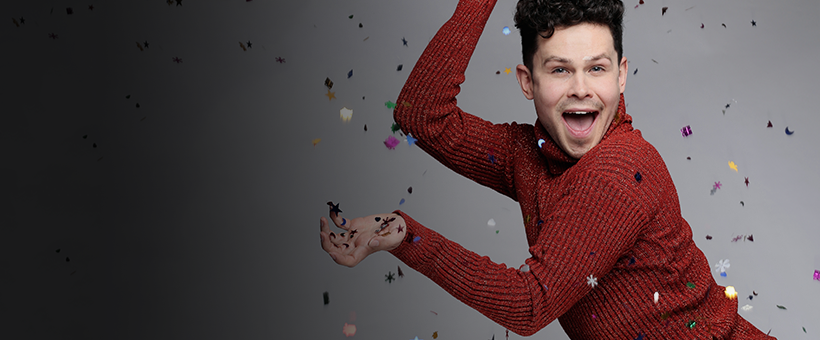
Following a sell-out run at the Sydney Fringe Festival, Australian musical theatre performer Henry Moss returns to Islington’s Hen and Chickens next weekend with his one-man show Quadruple Threat. Londoners have two opportunities left to see the show described in a rave five-star review from LondonTheatre1 as a “delightful and delectable exploration of the cut-throat and ever-unforgiving entertainment industry”.

In the show, Henry – who also writes and directs – plays Sir Harry Ledgerman, a musical theatre star and national treasure, who after a public mental breakdown is desperate to revamp his career. 

Photo credit: Seann Miley Moore

Quadruple Threat may be the campest 45 minutes of your life,” says Henry, whose influences include Graham Norton and Australian comedian Chris Lilley, of the TV series Summer Heights High. “I don’t stop to take a breath. I play egomaniac Harry Ledgerman – the struggling artist we all know, who aims to promote his tell-all celebrity memoir Quadruple Threat by hosting a series of motivational workshops – as well as his obnoxious guest speakers, LA bombshell Brandi Straussberg and quintessential Aussie bloke Bruce McDingy, who each claim they have the secret to success. I also morph into Oprah Winfrey, Hugh Jackman, Graham Norton and Dame Judi Dench.”

The show features dozens of musical theatre hits, all performed by Henry, accompanied by renowned cabaret pianist Sarah Bodalbhai. “I saw Sarah play at a hip hop gig last October,” says Henry. “I contacted her straight away and we met to discuss the show. Sarah is an incredible and versatile pianist who effortlessly improvises and segues from song to song. I am so lucky to have her accompany me. We get on like a house on fire, and the audience loves the battered and long-lasting relationship between Harry and Sarah.”

So is Quadruple Threat just a show for musical theatre fans? “Of course not,” says Henry. “It’s for any one who loves satire, has had their own series of knock backs and is intrigued by the madness that is showbiz.

“Musical theatre fans will recognise hits packed into the cabaret, but there are many pop hits from Stevie Wonder, Britney Spears, Ray Charles and Edith Piaf to name a few – that the audience recognise, roll their eyes and get the irony as I burst into these show stoppers.

“My favourite is probably my 1996 Judi Dench rendition of Send In the Clowns – it comes to Harry in the show as he feels he has ‘mis-timed his life’. There’s a hilarious tension between the tragedy of the music contrasted to Harry being so ridiculous and neurotic.”

As for Henry’s top tip for making it in showbiz? “I’ll let you know when I get there… In the mean time – a great fake tan and a whole lot of hairspray.”

Catch Quadruple Threat at the Hen and Chickens on 5th and 6th August at 3pm.