Interview: Palindrome Productions, Watching Glory Die

“Our major and abiding goal is giving voice to the dispossessed – those written out of history. Live performance has the ability to wake the dead and let them speak,” explains Lesley Ferris, director and co-founder of British-American company Palindrome Productions. “It’s always a highlight for us to witness the astonishment of audience members at seeing a living history about which they knew little if anything: the history of the British actress and suffrage, for instance, or the British history behind Palestine. Both of these still impact us today.”

The company’s latest offering, Watching Glory Die by Judith Thompson, was inspired by the true story of 19-year-old Canadian inmate Ashley Smith, who choked herself to death while her prison guards, on suicide watch, stood by and did nothing. Opening at Cockpit Theatre on 19th July, the play sees three women – prison inmate Glory, her mother and her guard – portrayed by a single performer, Victoria Fox.

Photo credit: Palindrome Productions

Both Lesley and dramaturg Penny Farfan – Professor of Drama at the University of Calgary and past editor of Theatre Journal – have long admired the work of Judith Thompson, a leading Canadian playwright, and seized the opportunity to work together on Watching Glory Die. “Thompson is a unique voice in Canadian theatre, renowned for her distinctive combination of poetic power and shocking brutality, as exemplified in Watching Glory Die,” says Penny. “She’s helped to shape modern Canadian theatre by staging aspects of society not typically seen on stage. In doing so, her work has found an international, as well as national, audience.

“Palindrome has a commitment to women playwrights, marginalized voices, and social justice. With its three female characters and its exploration of the tragic failure of the correctional system to serve the needs of one of its most vulnerable inmates, Thompson’s play is a perfect match for Palindrome. And the production offers a wonderful opportunity for London audiences to see a recent play by an important contemporary playwright.”

Palindrome’s co-founder Lesley Ferris has a long-standing passion for women’s writing: “Women have historically been marginalized and in some cases removed from history.  When I first began to study women playwrights, after I finished my degrees, I was horrified that no teacher or professor ever talked about or rarely included women’s work in their courses. Aphra Behn was a 17th century British playwright and the second most produced following the Restoration. She wrote amazing comedies that had feminist themes, and she was the first woman in Britain to write roles that women would actually perform. After her death her plays were still produced but by the time of the Victorian era she was quietly removed from sight – a woman who wrote comedies! Strong vibrant roles for women! Get rid of her!!

“History informs the present, so discovering Aphra made me think abut the present – and theatre is the art form of the present tense, so I’m committed to producing women writers and encouraging others to do so. In the USA a campaign for more women playwrights began a few years back: 50/50 in 2020 – 50% of plays produced by women by 2020, which is the centenary of the vote for women in the USA.  Scholars and theatre artists are tracking this, and there may be recently a bit of improvement but there’s still a long way to go.”

WFG_870x470

Why should audiences come and see Watching Glory Die? “Multiple reasons!” says Lesley. “The play addresses an aspect of our culture – incarceration of women – that has become more extreme and problematic in the 21st century. But it’s also an opportunity to see Judith Thompson’s work, and how she imagines a solo work that takes in three distinct roles. By making this a solo work instead of a three-hander, Thompson points out the links to be made between women.”

Penny adds one more reason: “Ashley Smith was Canadian, but the issues that Thompson’s play raises transcend national borders. As Thompson has said, ‘There are Ashleys all over the world.’”

Catch the UK premiere of Watching Glory Die from 19th-23rd July at Cockpit Theatre.

Review: Cargo at Arcola Theatre

We’re all used to hearing about refugees by now. A bit too used to it, actually; we hear the word so often these days that it’s begun to lose all meaning. It’s a sad but undeniable fact that the sight of terrified people risking everything to flee their homes has become ordinary, everyday… and with the click of a remote, even the most compassionate among us have the power to change the channel and dismiss the pictures from our minds. It’s something that happens to other people, from countries far away, so it’s easy to distance ourselves from the situation.

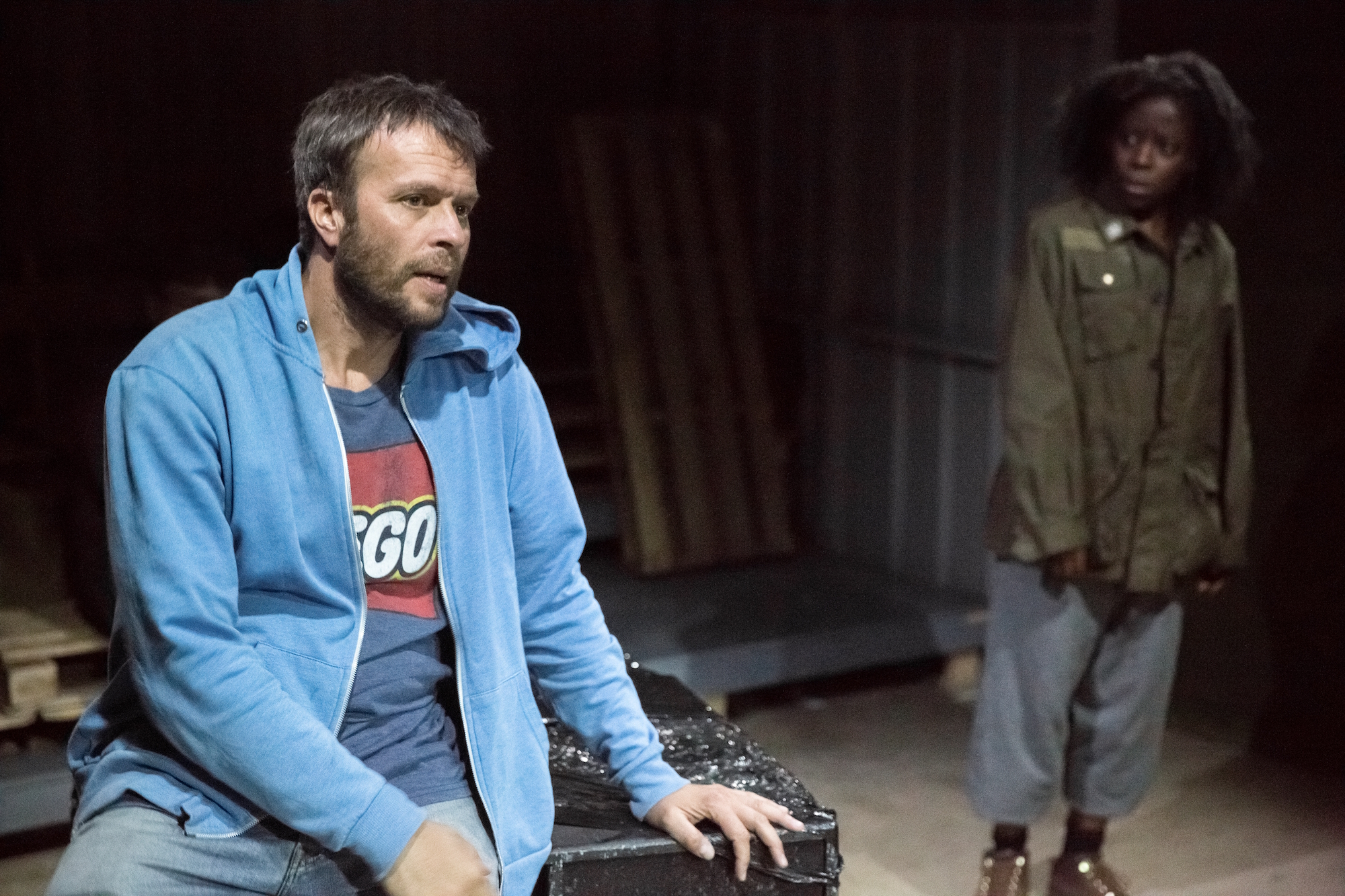
Tess Berry-Hart’s Cargo offers its audience no such luxury. For 80 gruelling minutes, we’re trapped in the dark, claustrophobic belly of a ship with four terrified refugees: Iz (Jack Gouldbourne) and his big sister Joey (Milly Thomas), Sarah (Debbie Korley) and Kayffe (John Schwab). We don’t – at least initially – know where they’ve come from, or what’s led them to leave behind everything they know and love and embark on such a dangerous journey. All we know is that they’re headed for Europe, the promised land where a golden future awaits them… if they can only get there.

Photo credit: Mark Douet

Director David Mercatali and designer Max Dorey pull no punches in their efforts to give us an authentic experience. Seated on wooden crates and plunged more than once into prolonged and total darkness, we’re kept in a state of constant, deliberate discomfort, and spared nothing; even the loo bucket is only inches from the audience (and yes, it does get used – more than once). As the journey unfolds in real time, the four characters form – and just as quickly break – alliances, swap stories, and try to decide who they can trust. And gradually, a truth begins to emerge that suddenly puts a very different complexion on our understanding of what – and who – a ‘refugee’ is.

In the tiny, cramped space, we’re treated to four exquisite performances from Cargo’s actors. Each of these characters has lived through horrors we can’t even imagine, and it’s affected them all in different ways. John Schwab is excellent as Kayffe, a mysterious American who constantly rewrites his own history until we can no longer tell truth from lies, and Debbie Korley gives a haunting performance as the fragile Sarah – even as she makes plans for a new life in Scandinavia, she can’t quite leave behind the things she’s had to do to get this far. In contrast, Jack Gouldbourne is almost puppy-like as Iz, full of innocent and heart-breaking optimism about the future, while Milly Thomas’ Joey is hardened and cautious, forced to take on the role of mother to her little brother, knowing deep down that she won’t always be able to keep him safe.

Photo credit: Mark Douet

Don’t expect an easy ride with Cargo; it’s almost unbearably tense from the moment you step inside the dingy, cramped space, and it forces its audience to confront two very uncomfortable truths: first, this is happening right now to unimaginable numbers of people, and will continue whether or not we turn off the TV. And second, it might not be happening to us – but that doesn’t mean it never could.

Devastating and unsettling it may be, but this timely and compelling piece of theatre is nonetheless essential viewing.


Can’t see the map on iPhone? Try turning your phone to landscape and that should sort it. I don’t know why but I’m working on it… 😉

Review: I’m Getting My Act Together and Taking It on the Road at Jermyn Street Theatre

The announcement that I’m Getting My Act Together and Taking It on the Road – which for ease of typing, let’s shorten to Getting My Act Together – was to be revived caused a fair bit of excitement in London musical theatre circles. Written by Gretchen Cryer and Nancy Ford, the show gained something of a cult following during its three-year run off-Broadway from 1978, and now a new generation gets to see why, thanks to Matthew Gould’s irresistible production at the intimate Jermyn Street Theatre.

The wordy title, it turns out, is actually a concise summary of the plot. Pop star Heather Jones is marking her 39th birthday with the opening night of a new act, but much to her manager Joe’s horror, her music’s taken a new direction while he’s been away. Leaving behind the banal pop songs that launched her career (and got her to 89 in the charts), Heather’s decided to stop hiding and reveal herself to her audience as the strong, independent woman she really is.

Photo credit: Richard Lakos

Unfortunately Joe, a well-meaning misogynist, doesn’t know how to sell – or indeed, even talk to – a strong, independent woman like Heather. The ensuing battle of wits is a very personal and angry one, and it soon becomes clear it’s not the new act Heather needs her friend to accept, but the new her (or rather, the her she’s always been but is only now able to show). Along the way, the show opens up a discussion about relationships and gender equality – and though Edward Iliffe’s cosy nightclub set and colourful costumes leave us in no doubt we’re in the 1970s, it’s a discussion that’s nonetheless just as (if not more) relevant today.

Though Getting My Act Together can at times lean a little towards the heavy side, particularly in the dialogue, this is balanced out by some fabulous musical numbers, which range from the uplifting anthem Natural High to the heart-breaking ballad Lonely Lady, and flawless performances from every member of the talented cast. Landi Oshinowo is a joy to watch as Heather; not only are her vocals stunning, but she brings a twinkle and charm to the part that soften the anger in her words. This is not just a bitter divorcee having a rant about men, but a woman who’s proud to have finally discovered who she is and longs to share that knowledge with her old friend (incidentally, Old Friend is another of the musical numbers, and it’s beautiful). The fact that Heather also has a feisty streak only makes her more attractive and enjoyable to watch.

Photo credit: Richard Lakos

Oshinowo receives excellent support – both emotionally and vocally – from Rosanna Hyland and Kristen Gaetz, as her back-up singers and friends Alice and Cheryl. Along with the other members of the band (Alice Offley, David Gibbons, Rich Craig and musical director Nick Barstow), the two singers radiate an infectious joy and enthusiasm for the music, its message and Heather herself. Meanwhile, Nicolas Colicos cuts a lonely figure as Joe, the only character on stage not fully in support of Heather’s new direction. It would be really easy to see him as the enemy, but Colicos’ performance is warm, funny and at times vulnerable enough that it’s hard to dislike him, even at his most outrageously sexist.

Though the subject matter of Getting My Act Together may not be everyone’s cup of tea, there’s no doubt this is a great production; an energetic cast, pitch perfect performances and the irresistible score are more than enough reason to overlook a few outdated and uninspired passages of dialogue. It seems this is another revival that was well worth waiting for.


Can’t see the map on iPhone? Try turning your phone to landscape and that should sort it. I don’t know why but I’m working on it… 😉

Review: Brontë at Upstairs at the Gatehouse

Start a conversation about English literature with just about anyone, and it probably won’t be too long before you arrive at the Brontë sisters. Best known as the authors of Jane Eyre, Wuthering Heights and The Tenant of Wildfell Hall, Charlotte, Emily and Anne are part of our national heritage, and yet most of us know far more about the lives of their characters than we do about the authors themselves. Polly Teale’s 2005 play Brontë aims to correct the balance, allowing us a glimpse into the remote rural life of the three sisters, and the complex family relationships that inspired the classic creations we know so well.

Photo credit: Robert Piwko

And it turns out there’s more than enough material here for a story all of its own. The personal and professional rivalry between Charlotte and Emily (in keeping with history, poor Anne doesn’t really get much of a look-in, and is relegated to the role of peacekeeper); the declining fortunes and eventual disgrace of their brother Branwell; the struggle to succeed as writers in a man’s world, and the sisters’ very different motivations for writing in the first place… There’s a lot to cover, and the play does so in a series of short scenes, jumping backwards and forwards in time from childhood to adulthood, and returning to somewhere in between. Each of these scenes is introduced by a change of lighting (effectively managed by Adam Taylor) and a burst of recorded string music, wherein lies my only real complaint about Tower Theatre’s production – after countless scene changes, the music does start to grate just a little bit.

That small gripe aside, the production, directed by Simona Hughes, is of the highest quality. The cast give compelling performances, in particular Joanna Nevin as the sensitive, publicity-shy Emily, and Tania Haq, who becomes more and more dishevelled as she brings to life two iconic characters – Cathy from Wuthering Heights and Bertha from Jane Eyre. The two male members of the cast also take on multiple roles with skill, and it’s here we begin to see the parallels between fiction and reality woven into Teale’s script, as the girls’ father (Martin South), whose love and approval Charlotte craves, morphs into Mr Rochester and her adored tutor Constantin Héger, while the increasingly abusive Branwell (Paul Willcocks) turns before our eyes into Heathcliff and the drunkard Arthur Huntingdon.

Photo credit: Robert Piwko

What’s most impressive about the production, though, is the way it recreates the isolation of the Brontës’ home on the moors. With the exception of the local curate, Arthur Bell Nicholls, we never see anyone from outside the family enter the house… and nor do we leave it until very late in the play (and then only briefly). Colin Guthrie’s sound design brings the countryside to life around us, as rain pours, birds cry and wind blows. And as the sisters repeat the same tasks, day in day out – folding laundry, baking bread and caring for their elderly father, all whilst knowing that the world expects nothing more of them because they’re only women – we get a sense of the stifling atmosphere that led them to find their escape through writing.

Brontë is a fascinating true life story that puts a human face on three literary legends, and makes you want to go back and read all the novels again to look for clues you might have missed the first time. Part documentary, part drama, it touches on gender issues, family relationships and the human need to be known and admired, to leave our mark on the world even long after we’re gone.

Much like the Brontë sisters’ famous novels, it’s not a particularly cheerful tale – but then as we all know, that doesn’t necessarily prevent a story from becoming a classic.


Can’t see the map on iPhone? Try turning your phone to landscape and that should sort it. I don’t know why but I’m working on it… 😉

Review: Screwed at Theatre503

For a lot of people, 30 is the milestone age when we start to think about our ‘life plan’: to consider who we are, who we want to be, and how we’re going to get there. But what if you don’t have a life plan, and you don’t even know where you’ll end up tomorrow, let alone in five years’ time?

Kathryn O’Reilly’s debut play, Screwed, introduces us to Charlene and Luce, two friends in their early 30s whose only goal is to lurch from one drunken night out to the next, filling the hours in between at their mind-numbingly boring factory job and popping caffeine pills to get through the day. Shrugging off the attempts of friends and family to set them straight, the two girls stumble down the path to self-destruction – but then one night things go too far, putting their dysfunctional friendship to the test, and changing several lives forever.

Photo credit: Sophie Mutevelian

Samantha Robinson and Eloise Joseph are a perfect team as eternal teenagers Charlene and Luce. O’Reilly’s produced a choppy, off-beat script that allows the friends to fall into a familiar routine and bounce off each other in a way that’s both funny and oddly touching; you get the feeling they’ve had the same conversation many times before, and know each other back to front. And yet there’s a bitchiness underlying almost all their banter that establishes the power balance early on in the play: the brash, confident Luce (Eloise Joseph) calls the shots, while vulnerable, self-loathing Charlene (Samantha Robinson) falls in line, often at the expense of her own happiness. Consequently the friendship becomes both uncomfortable and frustrating to watch, as we not only see both girls wasting the potential they undoubtedly possess, but also find ourselves willing Charlene to break free of Luce’s damaging influence.

If the girls are often difficult for us to like, the other two characters in the play fall at the opposite end of the spectrum; in fact, if anything, they’re a bit too good. The girls’ work colleague – and Charlene’s love interest – Paulo (Stephen Myott-Meadows) is endlessly patient and idealistic, while Luce’s trans parent, Doris (Derek Elroy), is a shining example of someone who saw what they wanted from life and made it happen, against the odds and whilst single-handedly raising a difficult and ungrateful daughter. Both the male characters are admirable and likeable enough, but next to the complexities of the central characters, they do feel just a little one-dimensional.

Photo credit: Sophie Mutevelian

Sarah Meadows’ production is slick and energetic, and leaves plenty to the audience’s imagination. Much like a drunken night out, some of the most significant events are blacked out, and we (and others) are forced to rely on the girls’ memories – which are unreliable at best, downright dishonest at worst – to piece the story together. The set, designed by Catherine Morgan, is simple yet multifunctional, adapting easily to become everything from factory to hospital, nightclub to kebab van. The concealed mirrors are a nice touch too, allowing for an increasing amount of self-examination from the characters as the play goes on… though whether it does anyone any good is questionable.

Screwed is a hard-hitting play, and not always that enjoyable to watch, though it certainly has its moments. Underneath the bawdy humour lies a cautionary tale about wasted opportunities – in love, work, and life in general – and the party culture that, much like Luce and Charlene’s friendship, does far more harm than good. Kathryn O’Reilly’s decision to explore this social trend with a focus on female characters is refreshing, if a little bit depressing, and while the play doesn’t offer a lot in the way of answers, it certainly paints a vivid picture.


Can’t see the map on iPhone? Try turning your phone to landscape and that should sort it. I don’t know why but I’m working on it… 😉