Review: This is Living at Trafalgar Studios

This is Living began life in 2012 as a seven-minute piece about a woman saying goodbye to her husband after her death. Now developed into a full-length play, Liam Borrett’s debut is a powerful, harrowing story that leaves its audience feeling emotionally battered and yet at the same time, oddly uplifted.

Michael (Michael Socha) and Alice (Tamla Kari) are a normal couple, who’ve been together for six years and have a three-year-old daughter. There’s just one problem: hours before the opening scene of the play, Alice drowned in a tragic accident. This, it turns out, is just as difficult for her to comprehend as it is for her bereaved and shell-shocked husband, and as time ticks down to the morning of her funeral, the two struggle together to make sense of what’s happened and to say their goodbyes.

Photo credit: Alex Harvey-Brown

In case that all sounds a bit too grim (and at times it really is; there are moments when the pain coming off the stage is so intense it’s almost physical), we’re also taken on a journey back in time through a series of flashbacks – effectively signposted by Jackie Shemesh’s lighting design – to significant moments in Michael and Alice’s relationship. And though some of these are scarcely less traumatic, others offer some much-needed light relief for both the audience and the actors.

It’s in these moments that we truly get to know and like the characters, whose very different personalities somehow make them a perfect pair. And yet even as we’re laughing at the awkwardness of the couple’s first date, we have a constant reminder of what’s coming up later in the story, thanks to Sarah Beaton’s set: a shallow black pool of water and mud in which both Michael and Alice grow increasingly wet and dishevelled.

Liam Borrett’s script seamlessly weaves past and present together, switching without warning from comedy to tragedy and back again, and demanding from its actors a vast and versatile emotional range. Fortunately, both Michael Socha – making an impressive West End debut – and Tamla Kari are more than up to the challenge, and utterly convincing in both grief and joy. Kari in particular shines, especially in the moments she’s alone on stage and wordlessly demonstrating her pain; the closing moments of Act 1 are among the most powerful in the whole play.
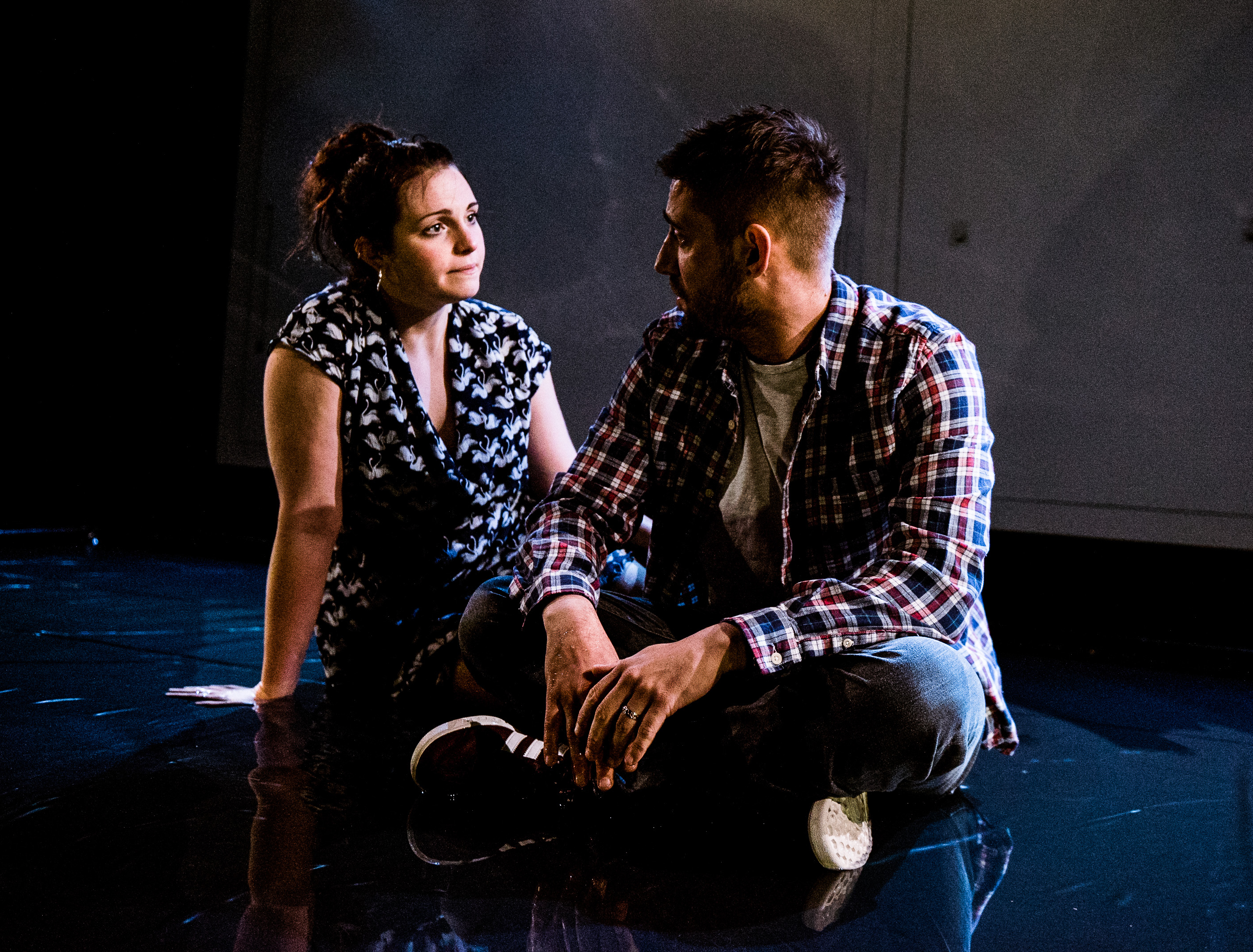
Photo credit: Alex Harvey-Brown

In addition to being an emotional rollercoaster, This is Living is also a gripping tale that keeps us guessing right to the end. Not only must we wait to find out exactly what happened to Alice, but there are hints throughout that all may not be quite as it seems, and the end of Act 1 only throws up more questions. This leaves Act 2 with a lot of work to do, but any fears we might leave unsatisfied prove unfounded. The final scene feels oddly tacked on, suddenly revealing a bit of the set we’ve never seen before – but it finishes the play off perfectly, simultaneously clearing up any remaining questions and introducing a faint note of hope to what might otherwise have been a pretty traumatic evening.

This is Living is a powerful debut from Liam Borrett, sensitively exploring a topic nobody really wants to think about. Emotionally bruising it may be, but it’s also a compelling and beautiful love story, which draws us in and keeps us gripped throughout.


Can’t see the map on iPhone? Try turning your phone to landscape and that should sort it. I don’t know why but I’m working on it… 😉

Review: Anna Karenina at Jack Studio Theatre

If, like me, you’ve often thought about reading Tolstoy but been put off just by looking at the list of characters, let alone the number of pages, help is at hand. In their first non-Shakespeare production, Arrows & Traps have pulled off the astonishing achievement of compressing a 1,000-page novel into a little under three hours, with a cast of just eight, whilst still remaining faithful to the plot.

Anna, the respected wife of provincial governor Karenin (Adam Elliott), abandons her duty and reputation when she’s swept into a passionate affair with the dashing Count Vronsky (Will Mytum). Meanwhile landowner Levin has money and power, and the freedom to do anything he likes, but is desperately in love with Kitty (Pippa Caddick), the woman he believes will give his life purpose. Anna and Levin’s lives fit together to make a whole, with each possessing what the other longs for, and Helen Edmundson’s adaptation, directed by Ross McGregor, highlights this synergy beautifully. The stories unfold in parallel, and though Anna and Levin have never met, from the outset each becomes the voice of reason for the other, the one they confide in and from whom they seek help and comfort. Their dialogue also serves a second, more practical purpose, filling in the gaps with regard to setting and context, so that each time one asks the other, ‘Where are you now?’ it’s as much for our benefit as theirs.

Anna Karenina

As a result, the production needs little in the way of set or props, and the story is carried almost wholly by the fantastic cast. Most of them take on multiple roles, but keep them perfectly distinct, so we always know who we’re looking at, and even the comparatively minor roles are memorable (I particularly enjoyed Hannah Wilder’s giggling, superficial Princess Betsy). The two leads, Ellie Jacob and David Paisley, each capture to perfection the essence of their character: Anna’s charm and quick wit, which enchant everyone she meets, have a similar effect on the audience, while Levin wins our sympathy as a good, honest man radiating quiet desperation at the lack of direction in his life.

A third plot thread involves Anna’s adulterous brother Stiva (Spencer Lee Osborne) and his long-suffering wife Dolly, who’s played by Cornelia Baumann in a truly heartbreaking performance. Of all the stories, Dolly’s is perhaps the most devastating, as she lets Anna convince her to remain in her unfaithful marriage, and consequently ends up feeling she’s never really lived at all.

What’s particularly impressive about Arrows & Traps’ production is the way it somehow manages to be both intimate and epic, getting right to the heart of the characters but also capturing the scale of the novel. There are a few moments – the ballroom, the races, and in particular Anna and Vronsky in the snow – that feel almost cinematic, which is quite an achievement on such a tiny little stage.

Anna Karenina

Anna Karenina has a bit of everything – romance, tragedy (by the way, the death scenes are brilliantly done, and in one case almost a bit too convincing), drama, social commentary, and even a few moments of comedy to lighten the mood. With 1,000 pages of text to condense down, it’s no surprise that this is an intense and gripping production – but one that I’d happily go and see again tomorrow.

It’s even made me consider reading the novel. Well, maybe…


Can’t see the map on iPhone? Try turning your phone to landscape and that should sort it. I don’t know why but I’m working on it… 😉