Review: Twelfth Night at Upstairs at the Gatehouse

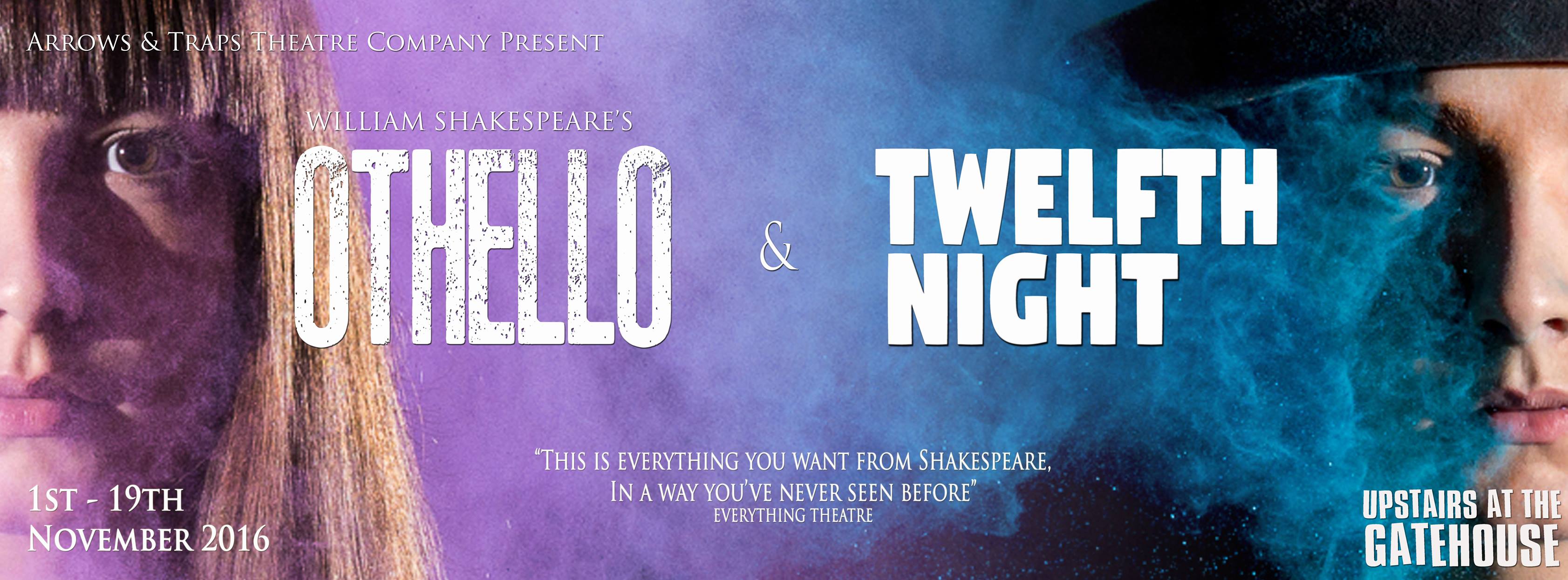
Anyone who reads this blog or follows me on Twitter will probably have noticed I’m a fully signed-up and completely unapologetic Arrows and Traps fangirl. So it should come as no surprise that I’ve been more than a little excited about their repertory season at the Gatehouse, which sees the same cast performing Twelfth Night and Othello on alternate evenings.

It’s hard to imagine two more different plays – one a comedy about romantic mix-ups and mischievous pranks; the other a dark story of betrayal, jealousy and murder. But in taking them on as a pair, the Arrows have put together a perfect showcase of everything that makes them so unique and fascinating to watch, while simultaneously demonstrating their impressive versatility. If you want to know what this company’s all about, don’t try and decide which show to see; just book for both.
14241489_1177136242368195_1963664209071337871_o

That said, the two productions can and do stand entirely independently of each other, in style, tone, even use of the space – so it seems only fair to review them as such. This review will focus on Twelfth Night – check out the other to read more about Othello.

Arguably one of Shakespeare’s most convoluted plots, Twelfth Night sees a young woman, Viola (Pippa Caddick), fall in love with her master, Orsino (Pearce Sampson) – but he’s in love with Olivia (Cornelia Baumann), who in turn has fallen for Viola, now disguised as a boy called Cesario. Oh, and then Viola’s twin brother Sebastian (Alex Stevens) shows up, pursued by his friend Antonio (Spencer Lee Osborne), to cause further confusion…
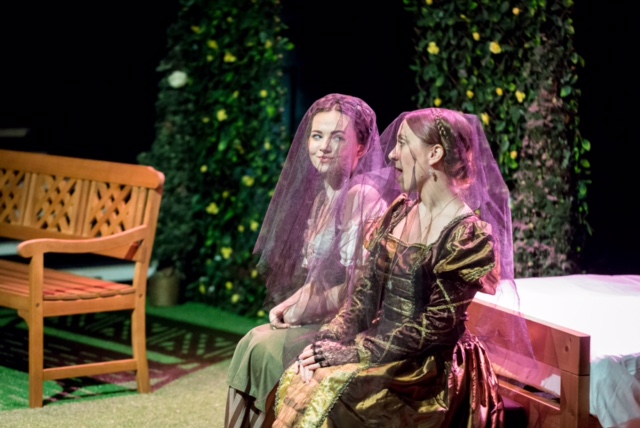
Photo credit: The Ocular Creative

Meanwhile, there’s a secondary plot involving a prank played on Olivia’s stuck-up steward Malvolio (Adam Elliott), by her maid Maria (Elle Banstead-Salim) and drunken cousin Sir Toby Belch (Tom Telford), with help from his friend Sir Andrew Aguecheek (David Grace) and the fool Feste (Lloyd Warbey). Get all that?

If it sounds a bit chaotic, that’s because it is – and this production even throws a couple of previously unexplored love triangles into the mix to complicate matters further. As a result, the play ends up as a study of unrequited love in all its forms, and brings a little more balance to the finale, which, as so often with Shakespeare’s comedies, can feel a bit too neat and tidy. Some of the characters will ultimately be satisfied, but just as many will leave disappointed, and if we’re left with a few loose ends – well, that’s the way life is sometimes.

Director Ross McGregor has assembled an impressive cast featuring several familiar Arrows faces. A larger than life story calls for similarly over the top performances, which include Elle Banstead-Salim’s over-excited and giggly Maria and David Grace’s lovably ridiculous Sir Andrew. Cornelia Baumann’s Olivia is rather more, ahem, erotically charged than we’re used to seeing, while Adam Elliott’s poker-faced turn as Malvolio brings the house down, particularly once he gets his yellow stockings out…
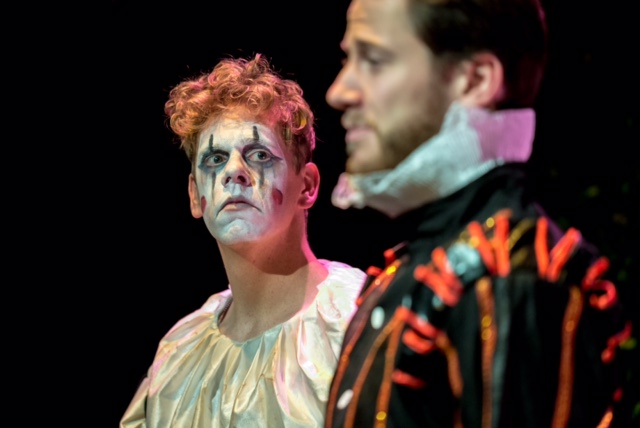
Photo credit: The Ocular Creative

But it’s not all high comedy, and there are some beautifully understated moments too – most notably from Lloyd Warbey, whose sad clown Feste, so busy entertaining others that he’s unable to speak of his own sorrow, opens his heart to us instead through song. Pascal Magdinier’s arrangement of contemporary music fits much more naturally than you might expect within the Shakespearean text, and features the likes of The Police and The Proclaimers (yes, really – and it works).

I’ve seen some versions of Twelfth Night that take quite a dark turn, particularly in the treatment of Malvolio, so that we end up feeling somehow complicit in his downfall by laughing. That’s not the case here; though there are undoubtedly some more melancholy moments, the audience is never made to feel uncomfortable. Instead we can sit back, relax and watch love, laughter and music combine in an original and thoroughly entertaining production.


Can’t see the map on iPhone? Try turning your phone to landscape and that should sort it. I don’t know why but I’m working on it… 😉

Interview: Arrows & Traps, Twelfth Night and Othello

Over the past three years, Arrows & Traps have become well known for their unique adaptations of Shakespeare and other classic works – most recently Macbeth and Anna Karenina. But the company’s latest project is their most ambitious to date, as they prepare to perform Twelfth Night and Othello in repertory at Highgate’s Upstairs at the Gatehouse this November.

14241489_1177136242368195_1963664209071337871_o

The decision to take on two plays simultaneously stemmed from director Ross McGregor’s interest in exploring the duality in Shakespeare’s work. “Shakespeare’s comedies are not just simply throwaway funny things that end in orgiastic shotgun weddings. His tragedies are not just gloomy tear-stained stab fests. Iago, the antagonist in Othello, is darkly funny whilst he does unspeakable things to innocent people, and the comic treatment of Malvolio in Twelfth Night descends into dark cruelty and manipulation. The blending of light and dark seemed to be interesting to explore.

“But it was also a practical decision. If I was asking audiences to come back and see a second show, I wanted to provide a varied menu. Twelfth Night is an unrelenting carnival fun fair of laughter, love and lyricism – and it’s also a full blown musical – whereas Othello is a psychological thriller, set in a hyper-sexualised, racist and cut-throat world of politics and militia. So I thought people would enjoy seeing the same ten people navigate the different worlds and present two sides of the same coin: the birth and demise of love.”

Of course, performing two plays at once brings with it new challenges: “I’m currently running a sweepstake on which of the cast comes onstage in the wrong costume and says the wrong opening line,” says Ross. “It does impose more time constraints on us; we have to work faster, move on quicker, correct and evaluate with more brevity, there’s less room to devise and experiment. Choices are still being made, options are still being explored, but there is now a much more pressing sense of the need for producing work each day and drawing a line under it.

“The line-learning element doesn’t seem to be too much of an issue; I’ve structured the castings so that each actor has a main role in one of the shows, and a supporting part in the other, so no-one is drowning under a tidal wave of iambic pentameter. We use the same set for both, so I suppose that might challenge us to create different stage pictures across the two shows, but with the material being so different, and the characters each actor plays being so contrasting, I haven’t noticed any repetition. In fact, there’s some nice echoes in there across the shows, for instance the bed that Pearce Sampson (Orsino) woos Pippa Caddick (Viola) in is the same one where he (now as Iago) contrives her death (as Desdemona). So I’m enjoying that aspect of it.”

img_20161001_145552_processed
Anna Karenina

Unusually, the cast for the two plays features only two new faces: “We usually have more, but this project seemed to represent the culmination of the last three years, so I wanted to show that in the casting. We have David Grace, playing the lusciously adorable and insipid Sir Andrew in Twelfth Night, and then the lovesick puppet Rodorigo in Othello, an altogether darker and more tragic role. I’ve been a fan of David for about two years, so it’s an honour to finally get to work with him. He brings an energy and dedication to his work, he’s one of the most specific actors I’ve ever heard in terms of his delivery and responses to the text; he’s flourishing as an Arrow and it’s a pleasure to support.

“Then we have Lloyd Warbey playing Feste in Twelfth Night – the lady’s fool and her “corrupter of words”, and Lodovico in Othello. You may be familiar with Lloyd from his work on Art Attack on the Disney Channel, and he’s worked all over the country, so it’s a privilege to have him involved. For Feste, you need a showman, an entertainer and a comedian, and yet there’s a melancholic sadness to him; he’s broken, lonely and jaded, and it’s great to see Lloyd switch in and out, hear him spin the language with a cheeky grin on his face.

“The other eight members of the cast are my core members, the people I would trust with any script, and the people that without them there would be no Arrows & Traps. There’s no greater gift for a director than having a cast like this. They’re a pleasure to see every day, and the amount of effort and energy they put into both shows is humbling.”

As always, the Arrows are keen to delve into the text and find something fresh and original: “I think the main element of Twelfth Night that feels new to me is the darker and melancholic elements. I’ve seen quite a lot of productions of the play that focus on the comedy but ignore the other elements. Shakespeare first staged Twelfth Night on the anniversary of the baptism of his own twin children, one of whom had drowned several years before. I think this was deliberate. On one of the days of the year where he perhaps thought of his son the most, Shakespeare put on a play where two twins find each other again after both nearly drowning. There’s a wish-fulfilment, a consoling father fantasy in that which is heartbreakingly sad. Twelfth Night to me is a dreamscape where your wildest dreams can come true, where gender and sexuality are fluid and transient, where chaos flies with majestic abandon.

“In terms of Othello, I wanted to examine what it means to be a Moor in modern times. So often, we take the word “Moor” to simply refer to someone’s race, to be black or North African, but it originally referred to their faith – that they were Muslim. We’re staging this in November, during the month where Donald Trump may or may not become leader of the most powerful nation in the world – a man who’s built a campaign on fear-mongering against Muslims, a man who campaigns for power on the promise that he will exclude, interrogate and remove people of a particular religion. Othello seems timely to me in that regard.

“I also wanted especially to show Desdemona in a better light. So often she’s portrayed as this weak, blonde willowy girl who meekly accepts her own murder, but to me she’s incredibly strong-willed and independent. She goes against her father for the man she loves, she rejects prejudice and society’s expectations of her and is unwilling to let it oppress or minimise her. She’s seduced by stories of battle and violence, tales of the unexpected and grotesque, which to me shows that this is an adventurous, outspoken, and vivacious young woman, and I wanted to show a Desdemona like that, which is something I’d never seen before.”

Macbeth
Macbeth

And now for the big question – to see just one play, or both? “I’ve directed the two shows to be able to stand on their own two feet independently of each other, but there’s something exciting about seeing both,” Ross suggests. “There are also five days in the run where you can see both in the same day, which would be something of a marathon, but since the Gatehouse is above a pub, you can have dinner in-between, have a drink and make a day of it.

“But if you could only see one of them, you have a choice between a clown-filled chaotic musical of love and passion and confusion, or a darkly thrilling study of the breakdown of a relationship in a violent and brutal society. They’re two hours each, so we’re not talking about a four-hour snore fest, but two fast-paced, visceral rollercoasters. Of course, the producer in me would like to add that if you book for both you get £2 off your second ticket…”

Book now for Twelfth Night and Othello from 1st-19th November.

Review: How To Win Against History at Ovalhouse

I watched How To Win Against History after a very long day at work, hardly any sleep and okay, maybe a couple of glasses of wine. Perhaps that’s why looking back at this fast, frenetic and frankly quite bonkers little musical brings with it a slightly surreal, dream-like feeling – although I suspect had I been wide awake and stone cold sober it wouldn’t be much different.

Seiriol Davies’ show tells the little-known story of Henry Cyril Paget, the 5th Marquis of Anglesey, a cross-dressing aristocrat from the 1800s who blew his family’s fortune on an unsuccessful theatrical career, and died at the young age of 29 in Monte Carlo of an unspecified “lung thing”. His outraged family then erased all trace of him from history.

Photo credit: Rah Petherbridge

This tragic story makes for a surprisingly hilarious musical, directed by Alex Swift and performed by a cast of three: writer and composer Seiriol Davies as Henry, musical director Dylan Townley as The Band, and Matthew Blake as Mr Alexander Keith (and everyone else). These three are a dream team, bouncing off each other brilliantly and working in perfect harmony throughout to bring this bizarre story to life.

In the hottest week of the year so far, all three performers nonetheless give it their absolute all. The tiny stage brims with energy and an infectious enthusiasm that never lets up; this show is full on fabulous from start to finish. And though it’s only an hour long, it packs in a lot – so much so, in fact, that it becomes hard to keep up. Fortunately, as instructed by the actors themselves, we have the option to go away and Google anything we might have missed, and I’m willing to bet a significant proportion of the audience did just that.

Davies’ Henry is an ethereal being, so delicate that at times his voice barely rises above a whisper. He’s instantly appealing despite his many flaws, full of wide-eyed innocence and seemingly blissfully unaware that he might not be winning at life (“apparently,” he explains at one point, appearing genuinely surprised, “I treated Lilian [his wife] rather badly”). He’s joined by loyal friend and supporter Mr Alexander Keith – just one of many roles played by the multitalented Matthew Blake (another is Lilian, in case you were wondering) – and his band, played by the eccentrically wonderful Dylan Townley on piano.

Photo credit: Rah Petherbridge

The show acknowledges and addresses its audience, encouraging participation (at one point we found ourselves singing in German) with a witty script that includes several current political and cultural references; the Daily Mail joke went down particularly well. In keeping with its central character, the humour occasionally steers very close to the line – a couple of jokes drew audible groans from the audience – but never slips across it completely, and remains good, (almost) clean fun. The final message seems a bit muddled: on the one hand, Henry feels that he’s “sort of won” by being himself and living life his way, despite opposition and indifference from those around him; on the other, he also counts it as a win to convince the Daily Mail that he’s “normal” and enjoys wearing tweed.

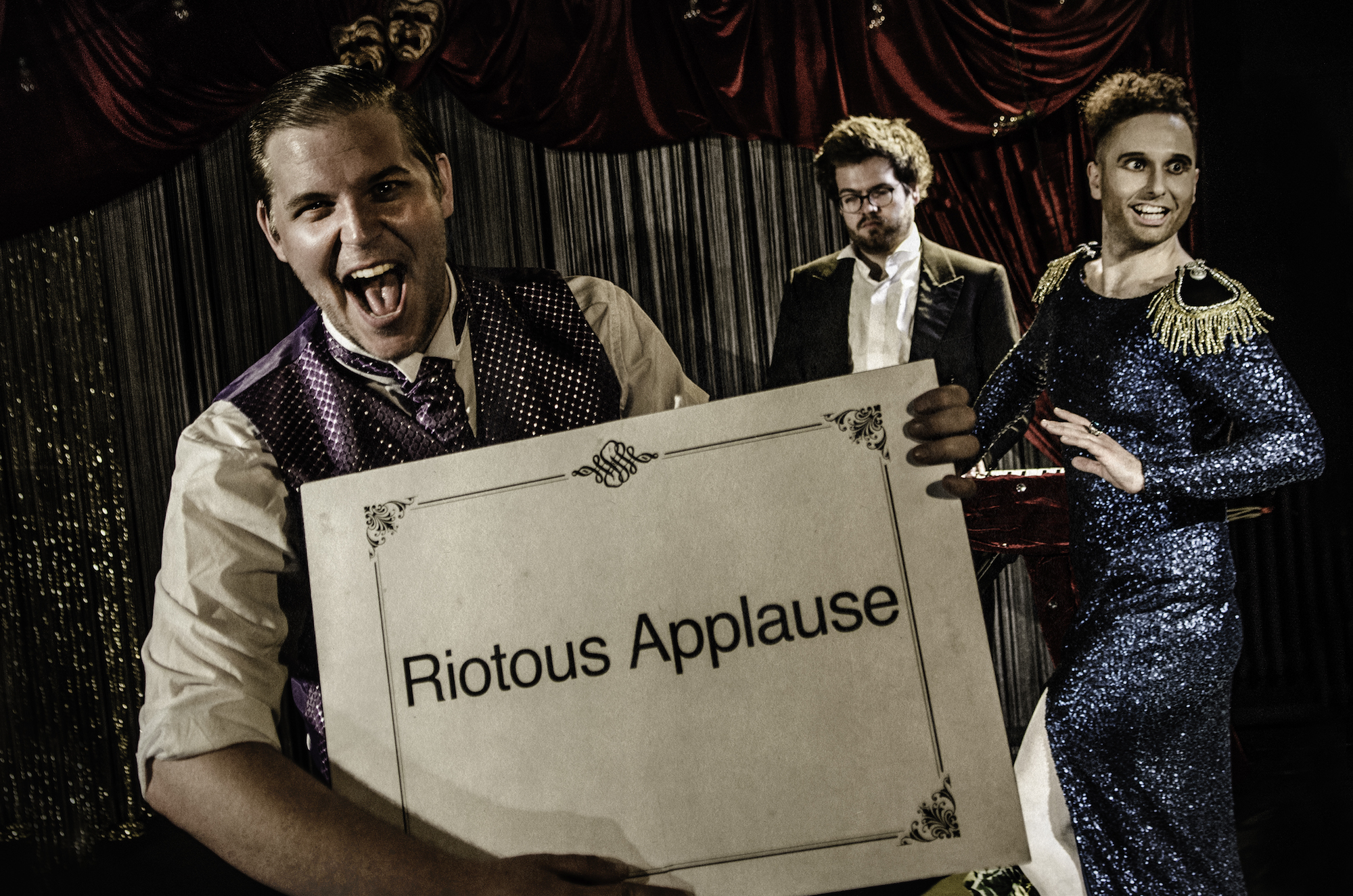
How To Win Against History is undoubtedly an odd show (even without a glass of wine in your hand) – but like its hero, it’s also fabulous and fierce. And it does things its own way, no matter what anyone thinks, with a cast of three who seem to be having easily as much fun as the audience. Riotous applause is a fitting end to such an entertaining and brilliantly performed show.


Can’t see the map on iPhone? Try turning your phone to landscape and that should sort it. I don’t know why but I’m working on it… 😉

Interview: Les Femmes Ridicule, In The Gut

Les Femmes Ridicule are Alice Robinson, Siobhan McKiernan and Margot Courtemanche, who together aim to create highly entertaining, moving and fresh work that directly engages with their audience. Following recent performances at the Brighton Festival, the trio are about to bring their show In The Gut to London for a short tour.

“In The Gut broaches the subjects of pregnancy, childbirth and parenthood; tackling tragic themes, such as miscarriage and infertility, with a thoughtful and comedic approach,” explains director Alice Robinson. “The audience will be introduced to different scenarios that offer alternative perspectives and approaches to the subjects – from the ridiculous and strange, to the dramatic and poignant.

“The show came about as an off shoot of another project that failed, which we’re really glad about! The three of us found we had so much to say on the topic of fertility and potential motherhood, and that we shared a slightly dark and silly sense of humour.”

In The Gut, Les Femmes Ridicules

In The Gut is Les Femmes Ridicules’ first show as a trio, and they’ve enjoyed working together. “It’s been really good! We’ve devised the show from our collective imaginations and passions, and that’s always a big process. As devisers our process is ongoing as we meet our audiences and continue to respond to them. We’ve laughed a lot in rehearsals and been really honest throughout, which is essential.”

The company hope to raise awareness for miscarriages in all relationships and are delighted to have the support of the Miscarriage Association and the Maternal Mental Health Alliance. “They really helped us in the research stage and opened our eyes to the impact of miscarriage on men, women and their families. We have been handing out Miscarriage Association leaflets at the shows and hope to promote the incredible services that they offer.

“In the Gut is direct in its staging of the fears around pregnancy. It doesn’t take sides, or preach, it’s unafraid of looking ugly, of moving its audiences and of playing with them.”

The RADA-trained trio’s creative process starts with simple improvisation. “I just shout things – ideas, thoughts, questions – at the other two and they plough on, adapting to what’s said in their own way. We all feed off each other’s ideas and we ended up with something we could never imagine on our own. Everything starts with a hunch, a question or something really silly like trying to outdo each other with a mime of the worst birth possible… and off we go!

“We think comedy is a brilliant way to open up a discussion, to heal and to set us free! There is humour in everything and releasing or acknowledging that is more interesting than ignoring it. Our audiences have taken the show really well, in that they have responded differently and personally. They have laughed and been moved. We’ve had midwives, parents, grandparents, people who don’t want children, young adults, people who do and people who can’t. There’s something for everyone, and everyone has an opinion on the subject matter, which is a great start.”

In The Gut is at the London Clown Festival on 12th June, the Blue Elephant Theatre from 14th-18th June, and the RADA Festival at John Gielgud Theatre on 25th and 29th June.

Review: Titanic at Charing Cross Theatre

There are a few events in history that we all just sort of know about, without necessarily remembering how or why. Henry VIII and his wives would be one; the World Wars, obviously… and the sinking of the Titanic is another. It’s an event so legendary, and so much a part of our national history, that sometimes we forget the sheer scale of the tragedy that claimed 1,517 lives in the early hours of April 15th, 1912.

This probably wasn’t helped by James Cameron’s blockbuster movie – which happened to coincide with my teenage years, so I make no apology for the fact I saw it five times at the cinema. As much as we all cried when she let go (admit it), the film went so overboard – sorry – on the special effects that as Celine Dion sang us out, the story of the Titanic still felt like just that: a story.

Photo credit: Scott Rylander

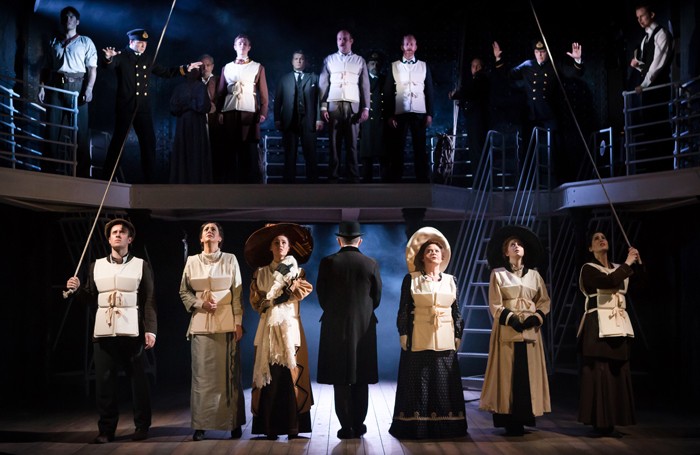
Maury Yeston and Peter Stone’s Tony award-winning musical, which was first performed on Broadway in 1997, approaches telling the story in a similar way to the movie it preceded. Act 1 (pre-iceberg) is considerably longer than Act 2, setting the scene and introducing us to the lives, loves, hopes and fears of a cross-section of the people aboard the ship: passengers – from first, second and third class, and all based on real people – and crew, from Barrett the stoker all the way up to Captain Smith. But with no Jack and Rose to hog the limelight, and despite the need to keep over twenty characters straight in our heads, we care about the fate of every single one. There’s also a lovely touch at the end of the show, which ensures we leave thinking not just about the people on stage, but about everyone who perished in those icy Atlantic waters.

Of course no portrayal of the Titanic would be complete without an element of social commentary; the theme of class runs throughout the show, without ever lecturing (because, let’s be honest, it doesn’t really need to). Heartbreakingly, it’s the third class passengers who are most likeable, and have the most to look forward to, yet we know from the start it’ll be they who are more likely to perish, simply because of where they come from.

Photo credit: Scott Rylander

It’s quite a feat to not only recreate on stage a ship with over 2,000 people on board, but then to sink it too. And yet somehow, despite the relatively intimate setting and with surprisingly little in the way of special effects, Thom Southerland’s production feels like an epic. Partly this is down to the incredible cast, who rotate through a multitude of roles, costumes and accents, giving the sensation there are hundreds of them instead of a couple of dozen. And it’s partly a result of David Woodhead’s multi-level and constantly moving set, which brings us right on board the Titanic, so that we feel the same awe as the passengers and crew on their first sighting.

But it’s mostly due to Maury Yeston’s music, with new arrangements by Ian Weinberger and directed by Joanna Cichonska, which is nothing short of exquisite. The show is a true ensemble piece, and while the solo numbers are fantastic, it’s when the cast and orchestra all come together – whether in hope as the ship sets sail, panic as it begins to sink, or grief as loved ones are separated – that the music quite literally soars, filling every inch of the space with its stunning harmonies.

Unlike its ill-fated subject, Titanic looks set to repeat the resounding triumph of its 2013 run at Southwark Playhouse. It’s a show that deserves a larger stage and a much wider audience. I know I’m gushing, but that’s how much I loved it – and I’m a grown-up now (or so they tell me), so I can’t even put my reaction down to a teenage crush on Leonardo DiCaprio.

Thank you so much to boxoffice.co.uk for the opportunity to review this show.