Interview: Sleeping Trees, Scrooge and the Seven Dwarves

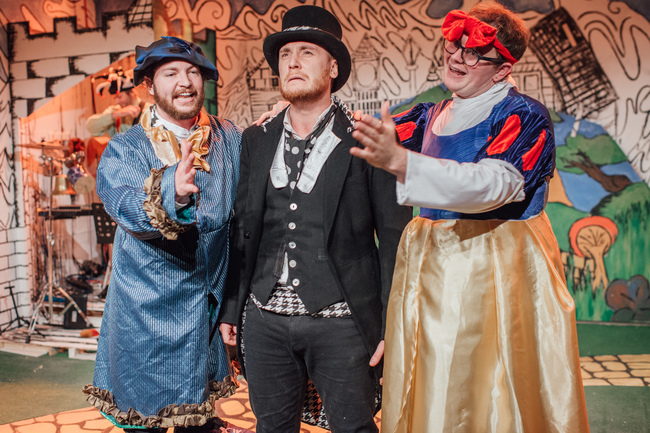
Sleeping Trees are “comthreedians” Joshua George Smith, John Woodburn and James Dunnell-Smith. Known for their surreal, physical and fast-paced comedy, the guys’ 2016 pantomime, Scrooge and the Seven Dwarves, is currently going down a storm with audiences of all ages at Battersea’s Theatre503 (check out my rave review to find out more).

Photo credit: David Monteith-Hodge

“This show does to Scrooge what Pop Stars: The Rivals did to Nadine Coyle,” is the Sleeping Trees’ concise and typically unpredictable summary of their panto. After the Wicked Witch steals all the Christmas spirit, Santa’s forced to turn to an unlikely hero, Ebenezer Scrooge, to save the day. Needless to say, he doesn’t exactly co-operate willingly… can an unexpected journey to Fairytale Land change his mind?

The show is a unique and hilarious mashup of several classic stories – so where did the idea come from? The guys explain: “We’ve always enjoyed playing with well-known pieces of literature. We’d wanted to adapt Dickens’ A Christmas Carol for ages, and when the opportunity came along to write another Christmas show we thought there’s no time like the [insert joke about ghost of Christmas Past] present [insert joke about Christmas future].

“It began with just a title that we thought sounded funny, and then we ran with it. Once we had a rough script – which was about 150 pages too long – we started the editing process. We have an absolutely brilliant team that helped us get it to the show it is today. Ben Hales came in first with the music and composition of all the songs and lyrics etc. Then the excellent director, Simon Evans, came on board as we continuously read from start to finish, cutting, changing and shaping as we went. All the while our costume and set designer Zahra Mansouri would be a fly on the wall and each day come in with ideas and examples that were simply mind blowing. Finally our stage, lighting and production management team brought it all to life.”

All the characters in the story are played by Josh, John and James, which unsurprisingly makes for a fast-paced and fairly chaotic two hours. “We have 18 ‘main characters’ that we visit throughout the show, plus an array – or rather an onslaught – of about 30 other pantomime and fairytale characters that make an appearance for one-off jokes or theatrical devices. It’s a lot of fun playing all of them. Tiny Tim probably wins the Sleeping Trees’ favourite – either him or a prehistoric cameo… no spoilers!”

Photo credit: David Monteith-Hodge

Let’s not forget that this is a pantomime, so audiences should be prepared to get involved in all the usual – and some not so usual – ways, much to Sleeping Trees’ glee. “Oh yes, we are thrilled with the participation we’ve created for this show. It will certainly be a unique experience for every audience member coming to see it. Nothing too stressful – just a lot, a lot of fun. After all, pantomimes remind everyone it’s Christmas, and who doesn’t like Christmas? Apart from Ebenezer, but trust us, we’re working on it!”

Sleeping Trees have now been together for seven years, and are looking forward to a bright (and busy) future. “We’ve been together since 2009, making theatrical comedy shows whilst collaborating with artists, comedians and musicians, and now have nine full length productions that we tour. It started once we got a taste of the Edinburgh fringe and have been a growing brand ever since. 

“The company aims to continue making comedy for stage and hopes to adapt our comedy for radio and television. We’re looking to begin touring internationally from 2017 onwards, with our latest trilogy of live action movies, Mafia? Western? and Sci-Fi? as well as writing a brand new Edinburgh Fringe show. We’re going to go back to our roots and write a stripped back show with just the three of us on stage. So the future is exciting for the entire team, and it will be our biggest tour to date, so we hope you can all come along and experience the journey with us. Merry Christmas folks.”

Scrooge and the Seven Dwarves is at Theatre503 until 7th January.

Review: Scrooge and the Seven Dwarves at Theatre503

I’ll be honest; I wasn’t really feeling the Christmas love when I arrived at Theatre503 last night; even being handed a glass of mulled wine and a mince pie didn’t quite do the job. Lucky then that the Sleeping Trees were more than up to the challenge of unearthing my festive spirit.

In this year’s pantomime, Scrooge and the Seven Dwarves, the comedy trio made up of Joshua George Smith, John Woodburn and James Dunnell-Smith, are determined to make good on last year’s fiasco, when they forgot to book their 30-strong cast of actors. Surely something that disastrous couldn’t possibly happen again…?

You see where this is going.

Photo credit: David Monteith-Hodge
Over the course of the next two hours, this hilarious tale brings to life a mash-up of Dickens and Disney, with Santa thrown in for good measure. Unlikely hero Ebenezer Scrooge is transported to Fairytale Land by Santa’s mother, charged with saving the day after the Wicked Witch steals all the Christmas spirit. I could tell you more – but I don’t want to ruin it, because it’s the twists and turns that make this story so fabulous; you literally never know (and it often feels entirely possible that the actors don’t either) what’s going to happen or who’s going to appear next.

I also fear I wouldn’t be able to do justice to the unique genius of Sleeping Trees’ creations, which include a depressed Mary Poppins, a gurning Wicked Witch and an overenthusiastic Broomstick, accompanied from a corner by composer and musician Ben Hales, who besides being a brilliant and versatile performer, also carries off a series of ridiculous hats (and an even more ridiculous Act 2 costume) with effortless style.

Scrooge is a family show, and although the audience last night was largely composed of grown-ups (in age, at least), I can imagine children adoring it – not least because they get to throw stuff, sing songs and join in with all the usual pantomime madness. In the intimate space at Theatre503, the banter flows easily and naturally between audience and actors, with the front row being particularly hot seats in that department…

Though the attention to detail and comic timing are second to none, like all the funniest comedy it’s not always clear what’s planned and what just sort of happens in the moment. The actors, who are clearly having a blast, seem frequently as amused as the audience, but also have the quick instincts of true comedians, enabling them to respond to whatever mayhem goes on (last night’s show, for instance, featured an incident which, if it was in fact unplanned, was the best example of falling with style I’ve ever seen).

Photo credit: David Monteith-Hodge
This is my first pantomime of the season, and while the others may enjoy bigger budgets and household names, they already have a huge standard to live up to. Face-achingly funny, with an imaginative and endearing story and songs that are far too catchy (24 hours later, I’m still singing the closing number), this is an absolute must-see that I shall be recommending repeatedly to anyone who’ll listen for the rest of the holiday season. Merry Christmas…


Can’t see the map on iPhone? Try turning your phone to landscape and that should sort it. I don’t know why but I’m working on it… 😉

Review: The Acedian Pirates at Theatre503

Jay Taylor’s debut play The Acedian Pirates was shortlisted for the inaugural Theatre503 Playwriting Award in 2014. Now, two years later, it’s come back home in dramatic, devastating style, to confront one of the oldest questions in history: why do human beings go to war?

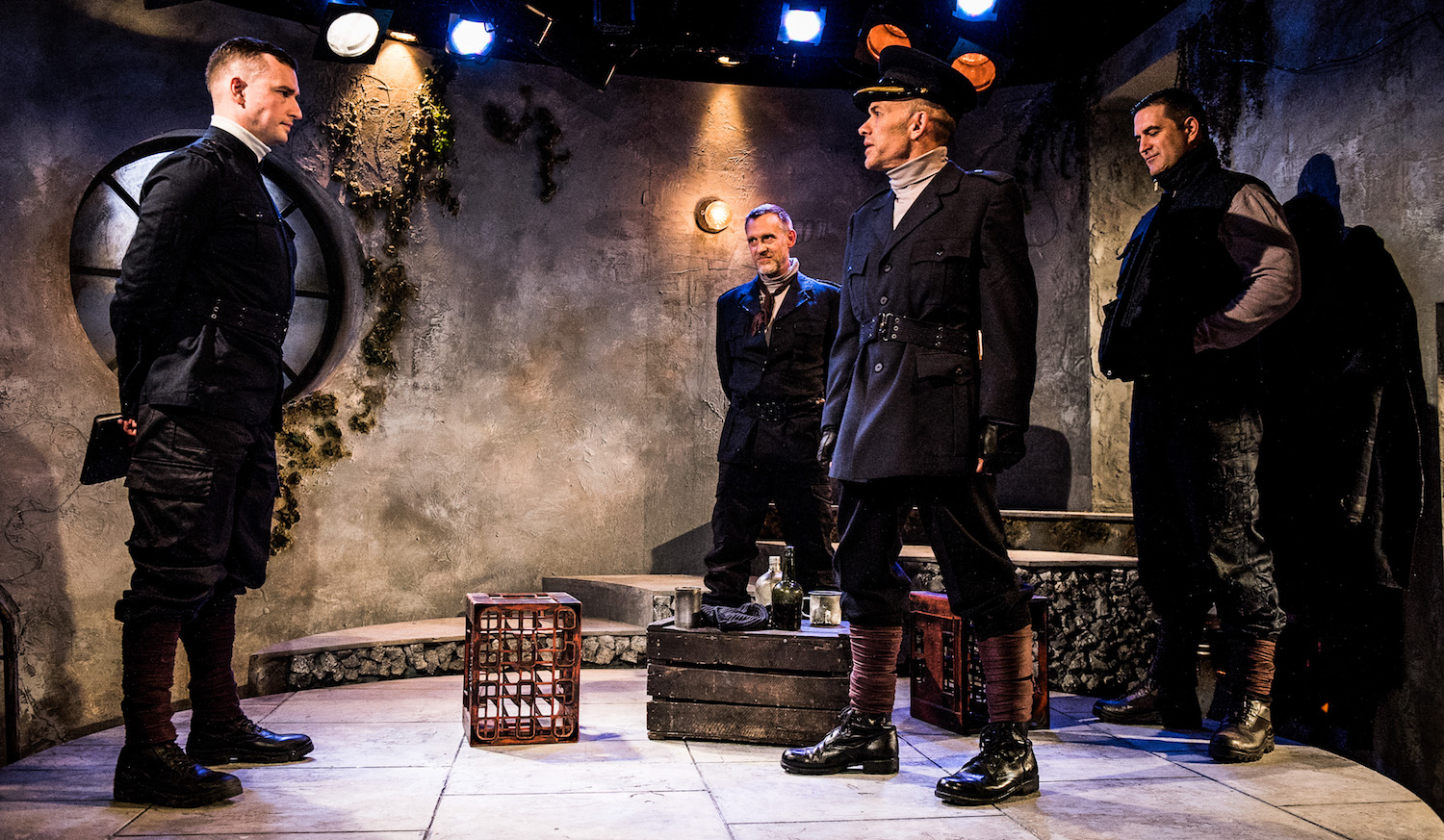
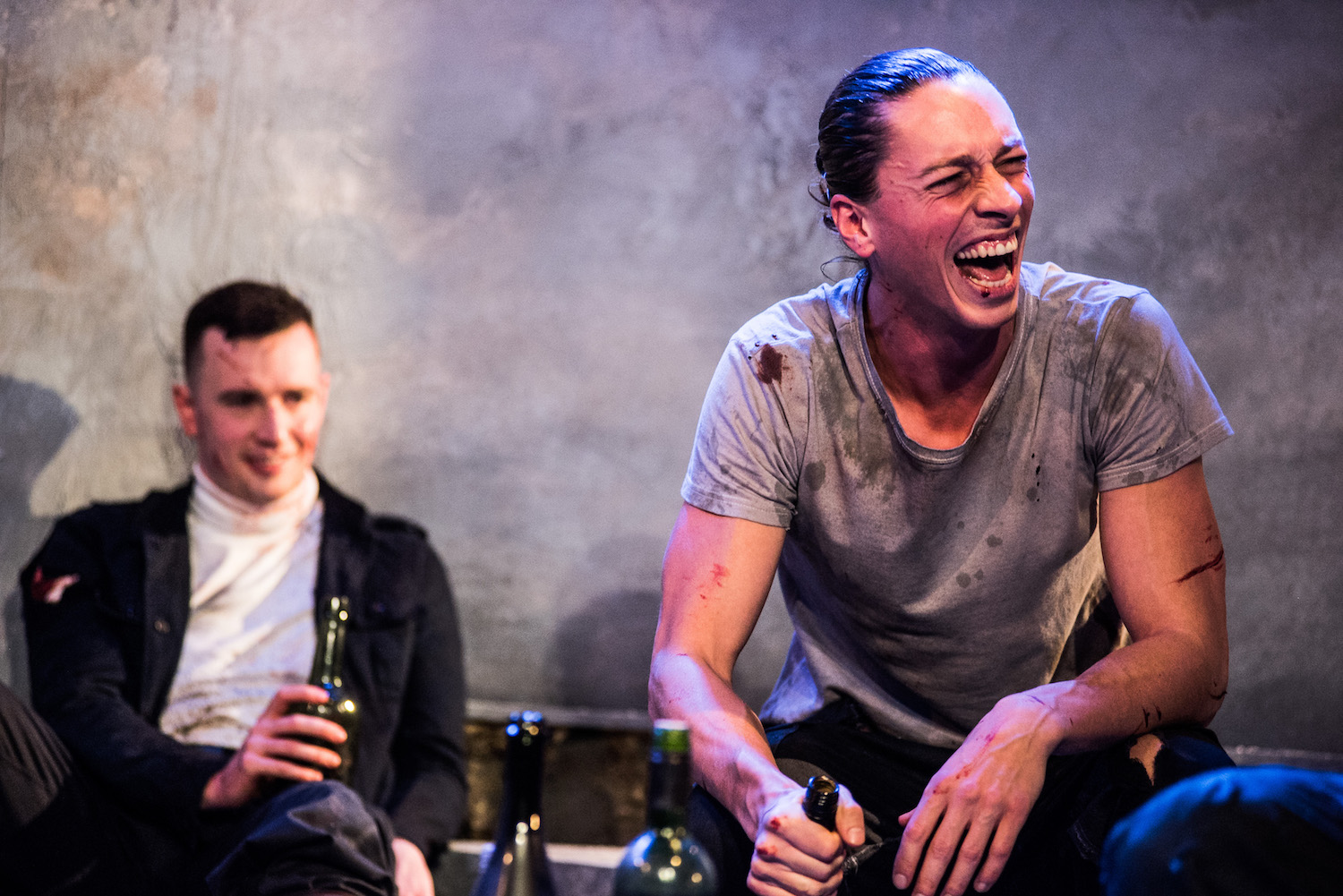
Jacob, a young man newly transferred to the Intelligence division, sits in a lighthouse with his fellow soldiers, listening to the sounds of a mysterious woman being interrogated on the floor above. We don’t know where they are; we don’t know who they’re fighting or what they’re waiting for. We don’t even know when the story’s set – it could just as easily be ancient past, present day or dystopian future. And somehow that doesn’t matter; this is, after all, just one more war in an endless series of wars, so who cares where or when it’s taking place?

Photo credit: Savannah Photographic

Besides, it’s another question that interests Jacob: why they’re at war at all. Why, he wonders, is he called a hero for killing fifteen strangers just because they wore a different uniform to him? What is it that keeps them all there, on that island, year after year? The other men answer in meaningless rote responses – that they’re there to fight, to help, to do some good – but even they seem unconvinced. In frustration, Jacob finally turns to the only other person who might be able to answer him: the woman upstairs, the one nobody’s seen but who all nonetheless firmly believe to be “everything”.

This isn’t a particularly easy play, either in its heavy subject matter or its intellectual tone; I’d recommend brushing up on your Greek mythology before leaving home. Yet despite the sophisticated vocabulary and the numerous classical references, Jay Taylor’s writing still captures the natural speech patterns of a bunch of men who’ve been cooped up together for a long time. Light-hearted banter, explosive rage and wistful nostalgia combine in a script that’s not only totally believable but also brilliantly delivered by an excellent cast.

Cavan Clarke leads the way as Jacob, skilfully managing his character’s transition from youthful arrogance to the very brink of madness. His quiet thoughtfulness is matched by that of Marc Bannerman as Bull, a man of so few words that when he does choose to speak, we listen. Meanwhile Ivan (Matthew Lloyd Davies) and Bernie (Andrew P Stephen) rarely shut up, constantly full of stories from the glorious past; whether they’re actually their own stories is neither here nor there. Rowan Polonski is the oddly charismatic commanding officer Troy, who seems quite mad but may just turn out to be the sanest of them all, while Sheena Patel is a refreshingly sharp-tongued damsel in distress.

Photo credit: Savannah Photographic

Trapped as we are within the lighthouse – beautifully imagined by designer Helen Coyston – there’s a simmering tension in Bobby Brook’s production that has little to do with the fear of physical harm. Lighting and sound effects from Cat Webb and Simon Slater give us a powerful impression of the conflict raging outside, but the real struggle is unfolding within these walls, and the only question is how and when it’ll reach its climax.

The Acedian Pirates feels particularly relevant at a moment in our history when the habit of parroting dangerous ideologies without hesitation seems to be on the rise, and those who dare to disagree are accused of being unpatriotic or disrespectful. The play doesn’t offer any answers to its central question, but perhaps that’s because there simply isn’t one to offer. Or rather there are too many; the sad fact is we’ll always find a reason to make war against each other – even if, after a while, nobody can quite remember what it was.


Can’t see the map on iPhone? Try turning your phone to landscape and that should sort it. I don’t know why but I’m working on it… 😉

Interview: Jay Taylor, The Acedian Pirates

“Funny. Surreal. Savage,” says actor-turned-writer Jay Taylor, when given three words to sum up his debut play, which was shortlisted for the inaugural Theatre503 Playwriting Award in 2014, and opens at Theatre503 on 26th October. “The Acedian Pirates is a dark comic-drama about military occupation, the moral conundrum of armed intervention and the mythology of warfare,” he adds, when allowed a few more.

jaycolour

What led Jay to choose this weighty subject for his first play? “I wanted to write something about the way people mythologise conflict and also about man’s obsession with war,” he explains. “It seemed to me that Helen of Troy was the ultimate idol and myth, so I wanted to offer a radically different perspective on the ‘face that launched a thousand ships’. This play was intended to investigate belief, propaganda and the moral dilemma of intervention; all themes that seem very relevant considering the amount of instability and conflict in the world today.

“I hope it challenges a few perceptions and attitudes towards the military: their recruitment policy, their moral responsibility and their genuine intentions when invading or occupying another territory. But this is not intended to be a condemnation of the military or a pacifist diatribe. The crux of the play is the moral dilemma of intervention; for example, what would have happened if the allies had not intervened in the Second World War in order to defeat fascism?”

After 10 years as an actor, Jay’s finding it fascinating to approach the creative process from the other side: “I’m quite used to being in an audition environment, but being on the other side of the table for our casting process was a hugely informative experience. And being in rehearsals is fantastic – the actors are able to investigate their characters with great specificity and turn them into fully realised people. Plus, they’re not letting me off the hook with regard to the characters’ desires and objectives, which forces me to rethink certain aspects of the play. It’s brilliant.

“There are many transferable skills between acting and writing. Essentially they’re both about critical thinking and determining what characters, choices and attitudes best serve the story you are trying to tell. Acting also gives you a good ear for dialogue, as well as a desire to make every character as dynamic as possible. I’ve played plenty of characters that are purely there to exposit and give information to the protagonist. That sort of writing is lazy, so I try my best not to do that!”

the-acedian-pirates-lead-image-hr

Jay’s over the moon to see his work performed at Theatre503. “It’s thrilling. Theatre503 rightly has the reputation of being one of the most bold, ambitious and innovative theatres in London. For a theatre with such limited space and resources, their output is extraordinary. I’m delighted that my first play has been programmed there; I think it’s worth mentioning that I sent The Acedian Pirates direct to the theatre, through their unsolicited script submission portal. Their resident literary manager and dramaturg Steve Harper has offered invaluable support to me as a writer – this production wouldn’t be happening without him.”

The Acedian Pirates takes place in a lighthouse, with a set designed by Helen Coyston. “Helen’s been a fantastic addition to the creative team,” says Jay. “Having only seen the model box and costume design drawings, I think her design is going to be deeply atmospheric, offering a pressure cooker environment for the characters to inhabit. I’m personally looking forward to seeing how we cram six actors, a lighthouse, the moon, the sea and some pretty significant special effects all onto the diminutive stage at Theatre503! But we will and it will obviously be deeply cool and brilliant… I hope!”

Finally, what advice does Jay have for someone thinking about getting into writing, but not sure where to begin? “People often say to write what you know, but my advice is to be as bold, inventive and imaginative as you can. I love nothing more than going to the theatre and seeing something subversive, different and theatrical. I feel like our addiction to television box sets has stifled creativity and made theatrical exuberance unfashionable.

“Don’t write what someone else tells you to write or what you think might please someone. Think with your inner child; write about something that inspires you and something you really believe in.”

The Acedian Pirates is at Theatre503 from 26th October-19th November.

Review: Screwed at Theatre503

For a lot of people, 30 is the milestone age when we start to think about our ‘life plan’: to consider who we are, who we want to be, and how we’re going to get there. But what if you don’t have a life plan, and you don’t even know where you’ll end up tomorrow, let alone in five years’ time?

Kathryn O’Reilly’s debut play, Screwed, introduces us to Charlene and Luce, two friends in their early 30s whose only goal is to lurch from one drunken night out to the next, filling the hours in between at their mind-numbingly boring factory job and popping caffeine pills to get through the day. Shrugging off the attempts of friends and family to set them straight, the two girls stumble down the path to self-destruction – but then one night things go too far, putting their dysfunctional friendship to the test, and changing several lives forever.

Photo credit: Sophie Mutevelian

Samantha Robinson and Eloise Joseph are a perfect team as eternal teenagers Charlene and Luce. O’Reilly’s produced a choppy, off-beat script that allows the friends to fall into a familiar routine and bounce off each other in a way that’s both funny and oddly touching; you get the feeling they’ve had the same conversation many times before, and know each other back to front. And yet there’s a bitchiness underlying almost all their banter that establishes the power balance early on in the play: the brash, confident Luce (Eloise Joseph) calls the shots, while vulnerable, self-loathing Charlene (Samantha Robinson) falls in line, often at the expense of her own happiness. Consequently the friendship becomes both uncomfortable and frustrating to watch, as we not only see both girls wasting the potential they undoubtedly possess, but also find ourselves willing Charlene to break free of Luce’s damaging influence.

If the girls are often difficult for us to like, the other two characters in the play fall at the opposite end of the spectrum; in fact, if anything, they’re a bit too good. The girls’ work colleague – and Charlene’s love interest – Paulo (Stephen Myott-Meadows) is endlessly patient and idealistic, while Luce’s trans parent, Doris (Derek Elroy), is a shining example of someone who saw what they wanted from life and made it happen, against the odds and whilst single-handedly raising a difficult and ungrateful daughter. Both the male characters are admirable and likeable enough, but next to the complexities of the central characters, they do feel just a little one-dimensional.

Photo credit: Sophie Mutevelian

Sarah Meadows’ production is slick and energetic, and leaves plenty to the audience’s imagination. Much like a drunken night out, some of the most significant events are blacked out, and we (and others) are forced to rely on the girls’ memories – which are unreliable at best, downright dishonest at worst – to piece the story together. The set, designed by Catherine Morgan, is simple yet multifunctional, adapting easily to become everything from factory to hospital, nightclub to kebab van. The concealed mirrors are a nice touch too, allowing for an increasing amount of self-examination from the characters as the play goes on… though whether it does anyone any good is questionable.

Screwed is a hard-hitting play, and not always that enjoyable to watch, though it certainly has its moments. Underneath the bawdy humour lies a cautionary tale about wasted opportunities – in love, work, and life in general – and the party culture that, much like Luce and Charlene’s friendship, does far more harm than good. Kathryn O’Reilly’s decision to explore this social trend with a focus on female characters is refreshing, if a little bit depressing, and while the play doesn’t offer a lot in the way of answers, it certainly paints a vivid picture.


Can’t see the map on iPhone? Try turning your phone to landscape and that should sort it. I don’t know why but I’m working on it… 😉