Interview: Jemma McDonnell, Mobile

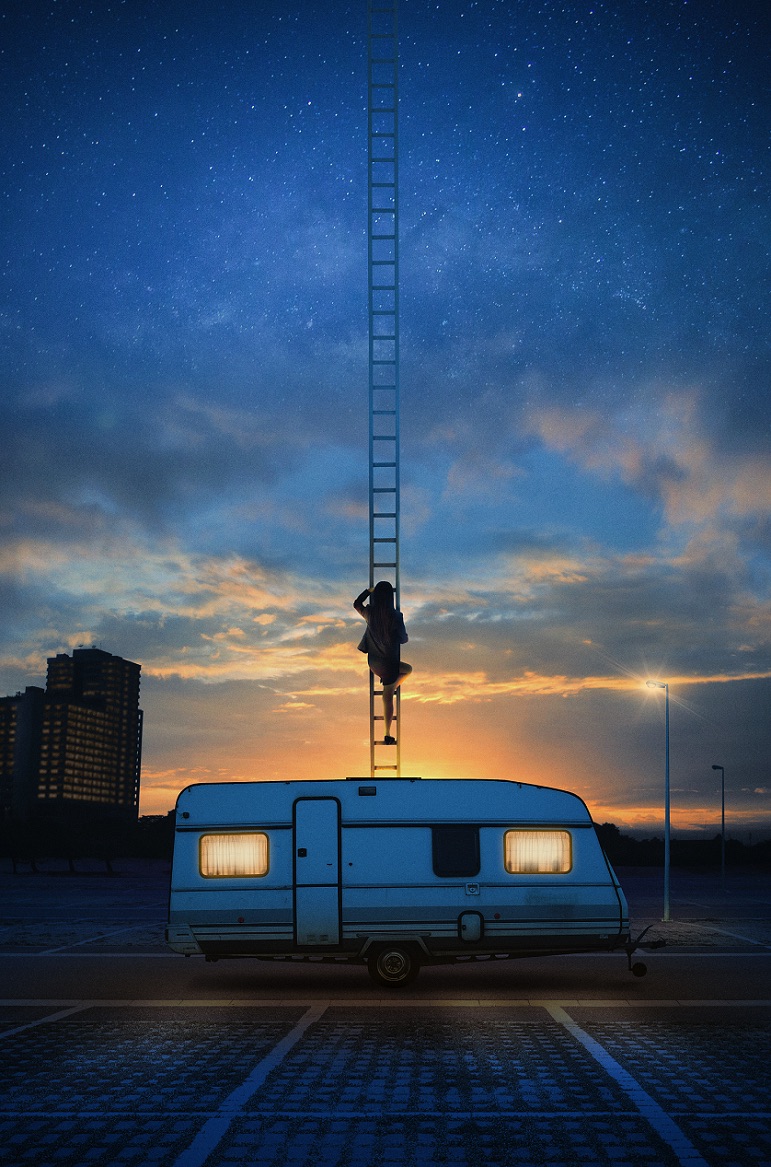
The Paper Birds are a devising theatre company with a political agenda, currently touring the country with Mobile, the second show in a trilogy about social class. Staged in a caravan for audiences of up to eight people at a time, the show is an intimate piece of verbatim theatre based on personal testimonies, and will be popping up at the seaside, on high streets, at schools, and in arts centres and theatres all over the UK until October.

“We want people to think about social class and social mobility,” says The Paper Birds’ Artistic Director, Jemma McDonnell. “Who are you and how do you experience the world? Did the start in life that your parents gave you determine who you would be? Is the society we live in one that gives everyone an equal opportunity? And if not, is this important?

“We were keen to make a trilogy about class because it is so complex in the way it shadows who we are and what we do in the world. We began by collaborating with a sociologist, Dr Sam Friedman from London School of Economics, who shared a range of verbatim interviews with us that he had undertaken as part of his research. This led us to talking to more communities and beginning to shape a show that really explored ideas around social mobility.”

Photo Credit: Richard Davenport for The Other Richard

While it’s undoubtedly a unique and fascinating choice of setting, staging a show in a caravan is not without its equally unique challenges: “The caravan is very intimate and this allowed us to use theatrical images and trickery that would not be impactful in a larger traditional theatre space,” explains Jemma. “But the caravan’s size was also its downfall, as limited space meant we had to be creative with the ways we created our characters. Luckily, we managed to come up with a few tricks!

“The show is made to be highly accessible. It can travel, it is only 40 minutes long and there is a cap on ticket prices. We want people to take a risk on the show, to be brave and step inside the caravan with us!”

And people, it seems, are happy to take that risk; having already been on tour since May, the company have found audiences very receptive to the unusual format of the show. “Overwhelmingly so,” confirms Jemma. “Audience feedback and responses have been fantastic. People love to try something different and whilst the caravan looks ordinary from the outside, it has many unexpected surprises inside that the audiences have loved.”

Photo Credit: Richard Davenport for The Other Richard

The Paper Birds are an established company aiming to inspire, educate, and make big socio-political subjects accessible. “We met whilst at Bretton Hall, Leeds University studying,” explains Jemma. “We graduated in 2003 and have been making work together since. As a company, we make political work that gives people a voice. Sometimes it is our voice, more often the shows are based on people we meet around the UK. We want to make work that has an impact socially.”

Intrigued? Catch Mobile on tour – visit thepaperbirds.com for all dates and venues.

Review: Wet Bread at the King’s Head Theatre

If you’ve found yourself constantly surprised and disappointed over the last twelve months by the results of public votes, you’re not alone; Adele, the protagonist in Tom Glover’s Wet Bread, knows exactly how you feel. A lifelong campaigner, she’s saying and doing all the right things – helping the homeless, going on fun runs, organising sit-ins against fracking (despite not knowing exactly what it is), and most importantly looking down her nose at Tories, Brexiteers, and indeed anyone who doesn’t agree with her. And if that means her relationship with her family is in tatters, she’s ditched the man of her dreams because he eats meat, and the alcoholic homeless guy staying in her flat won’t stop calling her Twinkletits – well, that’s just the price that needs to be paid for being a good person. Right?

Performed by Morag Sims, Wet Bread is simultaneously very funny and often slightly uncomfortable viewing, because while many of the scenarios are just a bit too ridiculous to be realistic, they still touch a nerve in a world where political arguments all too often become personal, and rage just as fiercely on Twitter as they do in Parliament. Adele’s not a bad person; she genuinely longs to change the world, and there’s nothing wrong with that – but in defending her own beliefs, she’s inadvertently become as intolerant and judgmental as the classic “evil Tory” she’s fighting against. Worse, she’s been so busy fighting everybody that she’s lost sight of what’s going on with the people closest to her.

The play isn’t a criticism of left-wing politics – or right-wing, either; despite Adele’s bitter diatribes against – well, everyone – there’s no suggestion that one side of the political divide is better than the other. If anything, the play’s trying to tone down our increasingly urgent need to politicise anything and everything that happens, and to point out how ridiculous both sides can be. None of which means we have to give up our principles – but maybe, Glover suggests, we should be focusing more on what unites us than on what drives us apart; to stop making everything into a battle and instead try to change the world in small, positive ways.

Sims comfortably owns the stage, skipping through an array of characters, from an enthusiastic fun run organiser (“yay, cancer!”) to Adele’s devastated and petulant niece, who’s just learnt that her birthday present is a goat – and that she doesn’t even get to keep it. Adele herself is a bit like the Bridget Jones of politics: loveable but a bit of a fool, quick to overreact and always taking things just a little too far. It’s a brilliant comedy performance, but a bittersweet finale is delivered with genuine sincerity to ensure Glover’s point is driven home.

Wet Bread is a lot of fun, but it should also make us stop and think – not about what our political views are, but rather why we have them and how we wield them. The main character may in this case be a leftie, but there’s plenty of entertainment and education in this 60-minute production for audiences of all persuasions.


Can’t see the map on iPhone? Try turning your phone to landscape and that should sort it. I don’t know why but I’m working on it… 😉

Interview: Luke Adamson and Gregory Ashton, Odd Man Out

Odd Man Out is a double bill of stories about people who don’t quite fit in, coming to The Hope Theatre later this month. Performed by The Hope’s Associate Director Luke Adamson and Off West End award nominated Gregory Ashton, these two one-man shows examine male mental health, sexuality, bullying… and elephants.

Rabbitskin is Joe’s story,” says Luke. “He’s a master storyteller like his dad and delights in the smallest of details. Inspired by his heroes, Holden Caulfield, Charles Dickens and the rest, he sets out to tell his story – but growing up as the youngest and smallest of five brothers in Leeds with only his dad to raise them wasn’t easy, and Joe struggles to keep on track.”

“And Welshcake is the story of a Welshman who travels half way across the world and falls in love in the most unlikely of ways,” continues Gregory. “He also happens to be an elephant – make of that what you will. So I guess it’s a love story but with a twist.”

Luke originally appeared in Rabbitskin in 2013, while Gregory’s been performing Diary of a Welshcake for over ten years. So why put the two together? “I guess they are both really lovely examples of adult storytelling, but more than that they connect with that basic need to understand where we fit in,” says Gregory. “When I was reading Rabbitskin certain lines and moments from Welshcake just popped out at me and I thought, ‘Ooh, yes, these will work together.’

“I think identity and fitting in are definitely strong there, but also why we define ourselves in whatever group we choose to. The main protagonists in Welshcake are from different cultures and yet neither really feels 100% part of that culture, and so they seek something in the other that is either an escape or simply a way to connect with who they are. I’m getting on a bit now, and so I have seen many people struggle with identity and the notion of ‘where do I belong’ and it is one of the things that really drives us. But what makes us human is the ability to connect with those outside of our comfort zone and in these very divisive times, that message is always one that is worth exploring.”

“Yeah, as Gregory mentioned there are certain thematic crossovers and even some lines that are shared,” adds Luke. “Together they will present an audience with a moving but hopefully uplifting evening at the theatre.

“There are definitely thematic links in that it is two people telling the story of their lives and finding out where they fit and I guess it touches as well on the broader idea of identity; what makes us who we are? Who we become? And this is universal and will touch different people in different ways.”

Luke came across Dominic Grace’s Rabbitskin quite by accident: “I was called in to audition for it at the West Yorkshire Playhouse a few years ago. As soon as I read the script I was hooked. I knew I had to do this play! It is so well written, poetic and touching and laugh out loud funny. And Joe is a dream of a character. I’m so delighted to have an opportunity to share this piece again.”

Gregory, meanwhile, has a personal connection to Diary of a Welshcake. “Well, I grew up in Hong Kong, and I definitely sound more Michael McIntyre than Michael Sheen, so the idea of telling the story of a Welshman who sounds English and ends up teaching in Hong Kong was always a no brainer for me.

“I’ve been performing versions of the show for a long time now, but having someone like Steve Marmion – who’d directed me in another one-man show, Madam Butterfly’s Child – come in and reshape the piece was a godsend, and really changed how I felt about the connection I could make with an audience, by simply just letting them into the story. I also think I have a much better understanding of where I fit in this world myself and that has changed how I play certain moments, definitely. I’ve played the piece all over the world now, so watching different cultural responses to different parts has been fascinating; it’s a constant learning curve…”

He also enjoys the audience participation element of the show: “My favourite part! I’m a great believer in what I call “Safe” participation. Nothing mortifying, nothing cruel, but just the odd moment where the audience help the action along. It is lonely up there on your own – I am sure Luke can vouch for that – so feeling the audience is actually helping you create your world is a wonderful sensation. But again, in a safe way. For example, in Madam Butterfly’s Child the audience had to be 4,000 people at the Albert Hall… as a group, no one singled out. Although “safe” for the audience doesn’t always translate to “Safe” for me: in Welshcake there is a pivotal plot moment that involves the creation of… but can’t give anything more away other than to say… I’ve only been hurt once.”

As Associate Director at The Hope, Luke has plenty of good things to say about the show’s venue. “The Hope is a family. It’s a place for people to take chances and break new ground on the Off West End scene. I’m so proud of the Equity agreement, the exciting and varied programming and the work we’ve done here over the past few years, and I was delighted that Matthew quite deservedly won Artistic Director of the year at the most recent Offies.”

Gregory’s equally complimentary: “Everyone who works at the Hope is paid. It may not be a huge amount, but everyone is paid and I think that is a huge thing, because everyone feels valued for the work that they do. There is a real team spirit, and under the leadership of Matthew Parker, that sense of commitment to a great and thriving fringe filters down beautifully: I have never been let down when I have been as an audience member, and I cannot wait to return there as a performer.”

So why should we come to see Odd Man Out? “Well, I am going to get humble here and say ‘to see Luke Adamson'”, says Gregory. “He is an exquisite young actor and I can’t wait to see him bring Rabbitskin to life. And then you can have a drink in the interval, and come and share the story of an elephant abroad.

“I hope that people go away with a sense of how huge a world can be created with just one person and a few props. Fringe is so important and proves that you can have an amazing night out for a lot less money! But more importantly, if one person leaves that theatre and plans to be kinder to the next odd man out that they meet, well I will be satisfied.”

“Haha! Bit of extra pressure there. Thanks for that!” says Luke. “I’m going to say people should come to see two gorgeously moving stories beautifully told. Hopefully people will leave feeling moved but with a smile on their faces. Like they feel richer for the experience. For me that’s when theatre is at its best.”

Book now for Odd Man Out at The Hope Theatre from 26th July-12th August.

Review: The Ladykillers at Upstairs at the Gatehouse

Based on William Rose’s 1955 movie, The Ladykillers was adapted for the stage by Graham Linehan in 2011. A hilariously over the top and extremely British slapstick comedy, the play’s staged with great exuberance at the Gatehouse by the always entertaining Tower Theatre Company.

The story behind The Ladykillers is almost as much fun as the plot itself, which apparently came to screenwriter William Rose in a dream; he woke up in the middle of the night and told his wife, then went back to sleep – while she got up and wrote it all down so that she could remind him in the morning.

Photo credit: David Sprecher

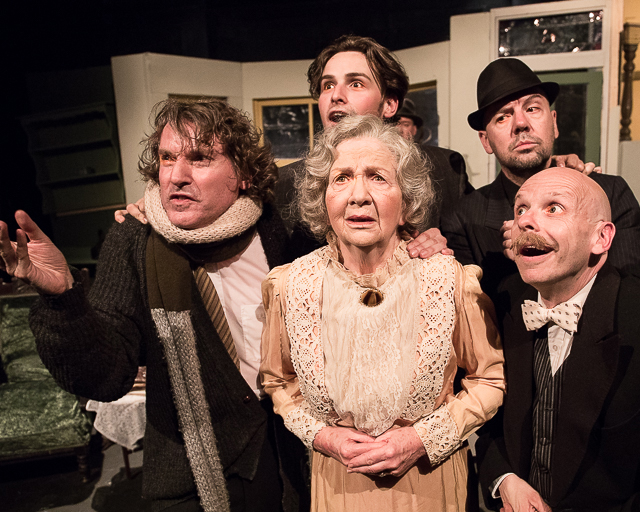
Mrs Wilberforce is a little old lady who lives alone with her ailing parrot, General Gordon. When she rents her upstairs room to what she thinks is a group of classical musicians, little does she know they’re actually robbers planning a heist at Kings Cross. This is quite surprising – partly because Mrs Wilberforce usually sees conspiracy theories everywhere, but also because the eccentric Professor Marcus and his gang are particularly inept criminals. The stage is set for chaos, and this production certainly delivers – even the set seemed to be in on the joke, with Mrs Wilberforce’s front door frequently swinging open of its own accord.

That little issue aside, the set is impressive; stretching the full length of the substantial stage area at the Gatehouse, it allows us to see simultaneously into Mrs Wilberforce’s front room, the upstairs room and even, briefly, on to the roof. Everything in the house is a bit lop-sided (Mrs W unfortunately suffers from subsidence), and its proximity to the nearby railway line presents various comic opportunities in both set design and storyline.

The cast have a lot of fun with their characters, all of whom are entirely ridiculous in their own way. Alison Liney leads the way as the clueless yet indomitable Mrs Wilberforce, while Ed Malcomson channels Basil Fawlty as the artist and criminal “mastermind” Professor Marcus, desperately trying to hold his plan together despite the best efforts of his incompetent colleagues. Dan Usztan’s nice but dim One Round is a delight, and there’s some enjoyable physical comedy from pill-popping Harry, played by Samuel Currie-Smith. Completing the gang of misfits are Alex T Hornby as Louis, a brooding Romanian hitman, and Michael Bettell as nervous wreck (and closet cross-dresser), the Major.

Photo credit: David Sprecher

Like most farces, many of the jokes – and the play’s ending – can be anticipated, but that doesn’t make them any less fun to watch. There are also a few enjoyable digs at artistic pretension and the British obsession with class and social appearances (which landed particularly well with the North London audience). The Ladykillers is perfect light-hearted evening entertainment, with a reminder that there’s a little good in the worst of men – though it may just turn out to be their downfall.


Can’t see the map on iPhone? Try turning your phone to landscape and that should sort it. I don’t know why but I’m working on it… 😉

Review: torn apart (dissolution) at The Hope Theatre

One of the warnings on the door at Bj McNeill’s torn apart (dissolution) is of full frontal nudity. What it doesn’t mention is that this doesn’t just mean physical nakedness. Yes, the first three scenes of the play each begin with a couple having enthusiastic sex, but there’s a lot more going on here. Over 90 breathless, intense minutes, the six characters in this interlocking trio of love stories are stripped bare emotionally as well as sexually, as we touch on family, politics, drug addiction, homosexuality and much more.

Photo credit: Scott Rylander

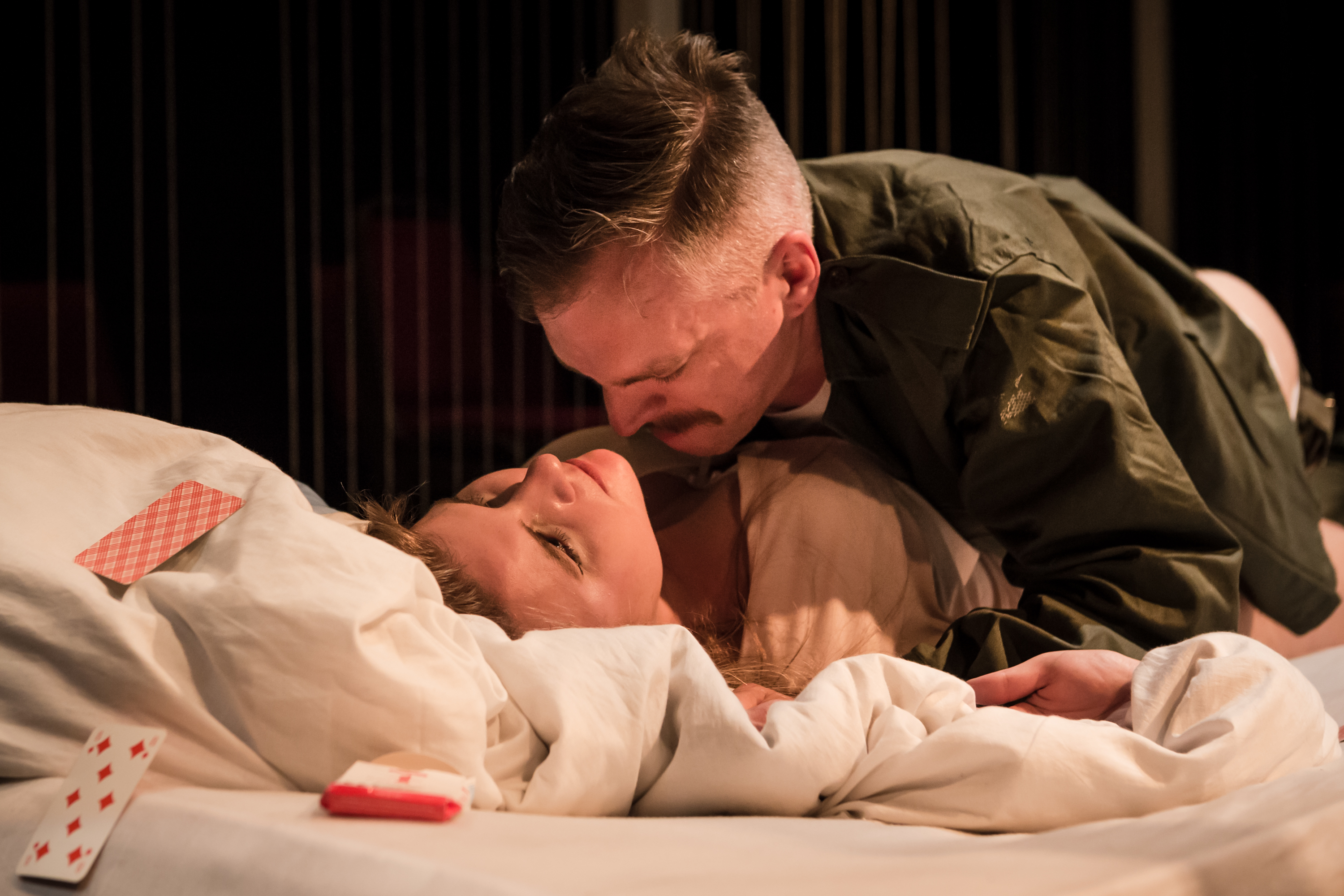
I previously saw the play at Theatre N16, where I remember being struck by the proximity of Szymon Ruszczewski’s set – a string cage that encloses the stage area – to the audience. At The Hope Theatre, if possible, we’re even closer to the action and there’s nowhere to hide as the three stories unfold mere inches away, sometimes quite literally in our faces. Alina (Nastazja Somers), a student in West Germany in the early 1980s, is locked in a passionate relationship with an American soldier (Charlie Allen) who’ll soon have to return home. Elliott (Elliott Rogers), in London in 1999, is in love with Australian backpacker Casey (Christina Baston) whose visa’s about to run out. And Holly (Sarah Hastings), now, is struggling to rationalise her decision to leave her perfect husband and embark on a relationship with Erica (Monty Leigh) – who’s dealing with problems and a past of her own.

There’s a secret that links the three couples together, which is gradually revealed piece by piece as the play goes on; seeing it for the second time it’s fascinating to see the little clues scattered along the way. But what ultimately unites them all, as the play’s title suggests, is the experience of lost love and the lasting impact this can have – and not only on those directly involved. The early scenes of carefree, passionate lovemaking soon feel like a distant memory as the clothes go on and the relationships begin to crumble. And though the three couples are indeed torn apart by circumstances beyond their control, it’s clear that, while their love is genuine, each also has (perhaps) insurmountable issues that may only be revealed in the privacy of their own bedroom.

Photo credit: Scott Rylander

The show’s main strength lies in its excellent cast, all but one of whom reprise their roles from torn apart‘s previous run in Balham. The relationships – both physical and otherwise – are totally convincing, and the actors play expertly on our emotions as they try desperately to hold on to what they have at any cost. McNeill has made a point of placing female characters at the centre of the action and allowing the female voice to come through loud and proud, particularly in Nastazja Somers’ Alina and Christina Baston’s Casey, who stand up for what they think is right rather than take the easy option, even if it means losing everything.

But McNeill also avoids falling into the trap of promoting women by relegating men to a one-dimensional role; both Charlie Allen and Elliott Rogers portray characters who are just as complex and damaged as the women they love. Sarah Hastings and Monty Leigh complete the cast as two women who come from very different backgrounds and have very different ideas about pretty much everything. They spend more time arguing than anything else, yet there’s a genuine tenderness in their relationship, and Holly’s desperate attempts to hold on to the life she’s only just discovered is particularly heartbreaking.

Fearless and uncompromising, torn apart (dissolution) is not a play that can be easily forgotten; nor is it one that everybody will agree on (and there’s enough material for several post-show discussions) – which just goes to show that when it comes to love, there are no right or wrong answers.


Can’t see the map on iPhone? Try turning your phone to landscape and that should sort it. I don’t know why but I’m working on it… 😉