Review: Testament at The Hope Theatre

Following a warm reception in Edinburgh, Chalk Line Theatre bring their show Testament to The Hope Theatre for a limited run, and one thing is instantly clear: this is not a company who believe in doing things by halves. Written and directed (with William Harrison) by Sam Edmunds, Testament comes at us like the head-on collision that begins the story, sweeping us up in a strobe-lit whirl of panic and confusion, punctuated by just the right amount of darkly comic relief.
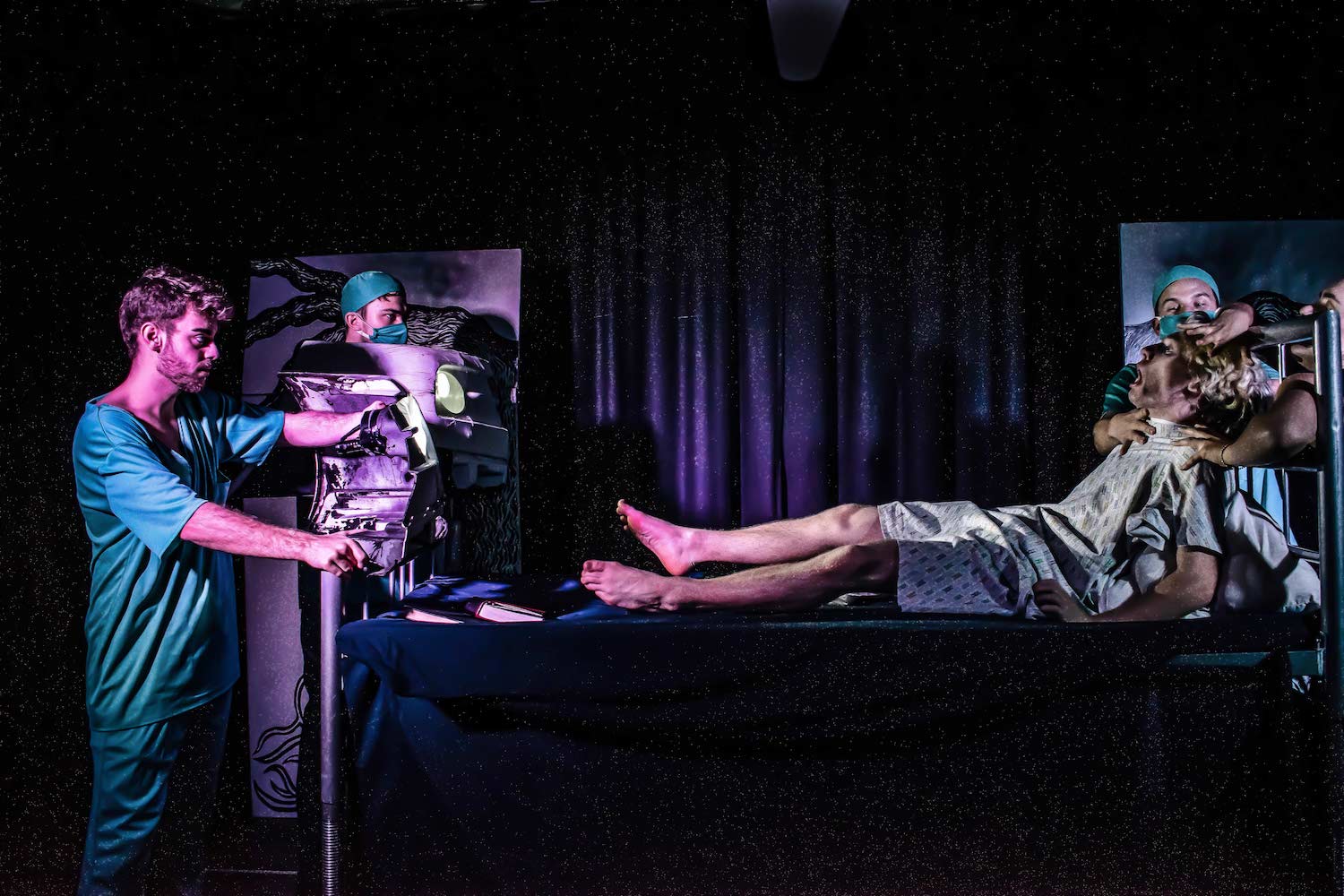
Photo credit: Tongchai O. Hansen

At the centre of it all is Max (Nick Young), who’s just woken up in hospital after jumping off a building – a suicide attempt prompted by the recent death of his girlfriend Tess (Hannah Benson) in a car accident. There’s just one problem; Max doesn’t remember that Tess is gone, and he can’t understand why his brother Chris (William Shackleton) and his doctor (Jensen Gray) are keeping her from him. As his medical condition worsens, Max has a decision to make – with a little bit of “help” from a visiting Jesus (David Angland) and Lucifer (Daniel Leadbitter) – to accept treatment for his injuries and risk losing Tess all over again, or refuse it and keep hold of her for a little longer.

As Max struggles to choose a path, remembering funny moments with Tess one minute and wrestling with sinister masked surgeons the next, we get a glimpse of the chaos inside his traumatised mind. The pre-show warning about strobe effects is not to be taken lightly; there are several scenes in which these feature prominently and for prolonged periods, intensifying the nightmarish quality of Max’s visions. These include reliving more than once the car crash that started it all, which leads to a surprising twist revelation about what really happened that night.

Set in counterpoint to these dramatic scenes are moments of stark reality, where Chris and the doctor discuss Max’s treatment. These scenes are played convincingly by Jensen Gray and William Shackleton, bringing us back to the real world and the growing urgency to take action. The obvious concern they both feel contrasts sharply with Max’s view that the medical staff are out to harm him, and once the truth about the accident is revealed, their conversations and the decision they need to make take on an interesting new direction.

Though the play deals with some difficult themes – bereavement, suicide, survivor’s guilt – there’s also plenty of humour, buckets of energy, and the faintest glimmer of light at the end of the tunnel, all of which keep Testament from becoming too traumatic even in its darkest moments. Nick Young leads a strong cast, skilfully juggling the pre-accident Max – exuberant, charismatic, a bit immature – with the fragile, tormented figure we find curled up in a hospital bed, discussing the meaning of life with biblical figures, each of whom has their own agenda.
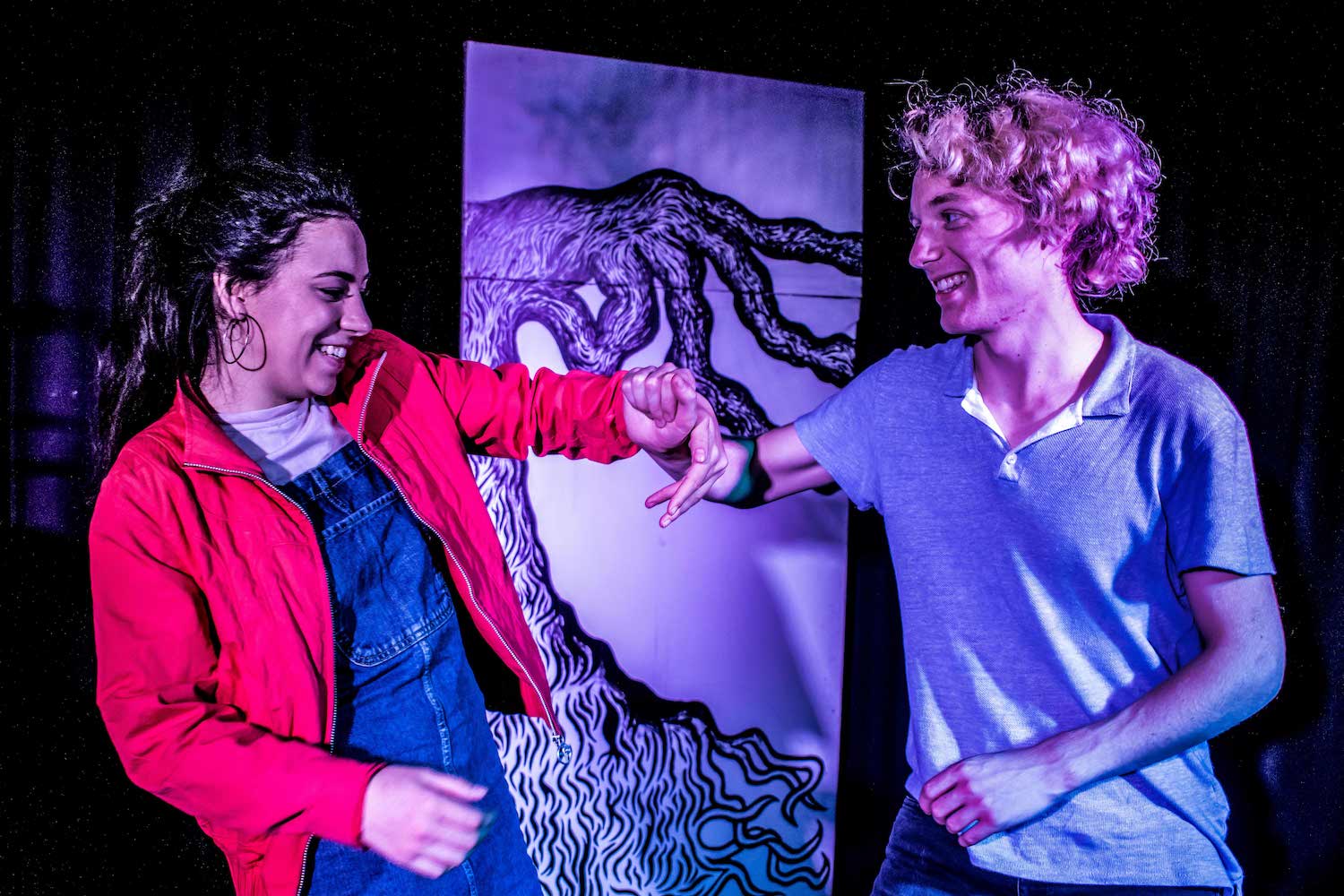
Photo credit: Tongchai O. Hansen

If the play’s conclusion feels a little flat compared with the unstoppable energy and unsettling oddness of what’s gone before, it’s a minor complaint. The themes of Testament have been written about many times before, in many different ways, so to find an approach that still feels fresh and unique is quite an achievement. This high quality production will stress you out, make you laugh and send you home with plenty to think about. With only two dates left at The Hope, grab a ticket while you have the chance.


Can’t see the map on iPhone? Try turning your phone to landscape and that should sort it. I don’t know why but I’m working on it… 😉
Review: Jericho’s Rose at The Hope Theatre

“Where do you live?” It seems like such a simple question – but the enquiry takes on new significance with each repetition in Jericho’s Rose from Althea Theatre. Written by Lilac Yosiphon, who also directs along with Mike Cole and Annie-Lunnette Deakin-Foster, it’s a moving and intriguing exploration of the true meaning of “home”, seen through the eyes of two characters. Jasmine is a writer fighting for the right to stay in London, and her grandfather, back in Tel Aviv, has been diagnosed with Alzheimer’s. For each of them, and for different reasons, answering the straightforward question “Where do you live?” becomes an increasingly difficult – and sometimes impossible – task.

Photo credit: Lidia Crisafulli

The structure of the show is based around repetition: the frustrations of having the same conversations over and over with someone who doesn’t remember; the endless meetings with doctors who can never say anything new; the constant disappointment of being rejected – again – for a visa. All that really changes in Jasmine’s life over the course of the 75-minute show is her location, as she moves from one city to the next in search of… something. Even then, in each city her experience is much the same – drinking too much, having disappointing romantic encounters in nightclubs, and ultimately ending up back in Tel Aviv with Grandpa.

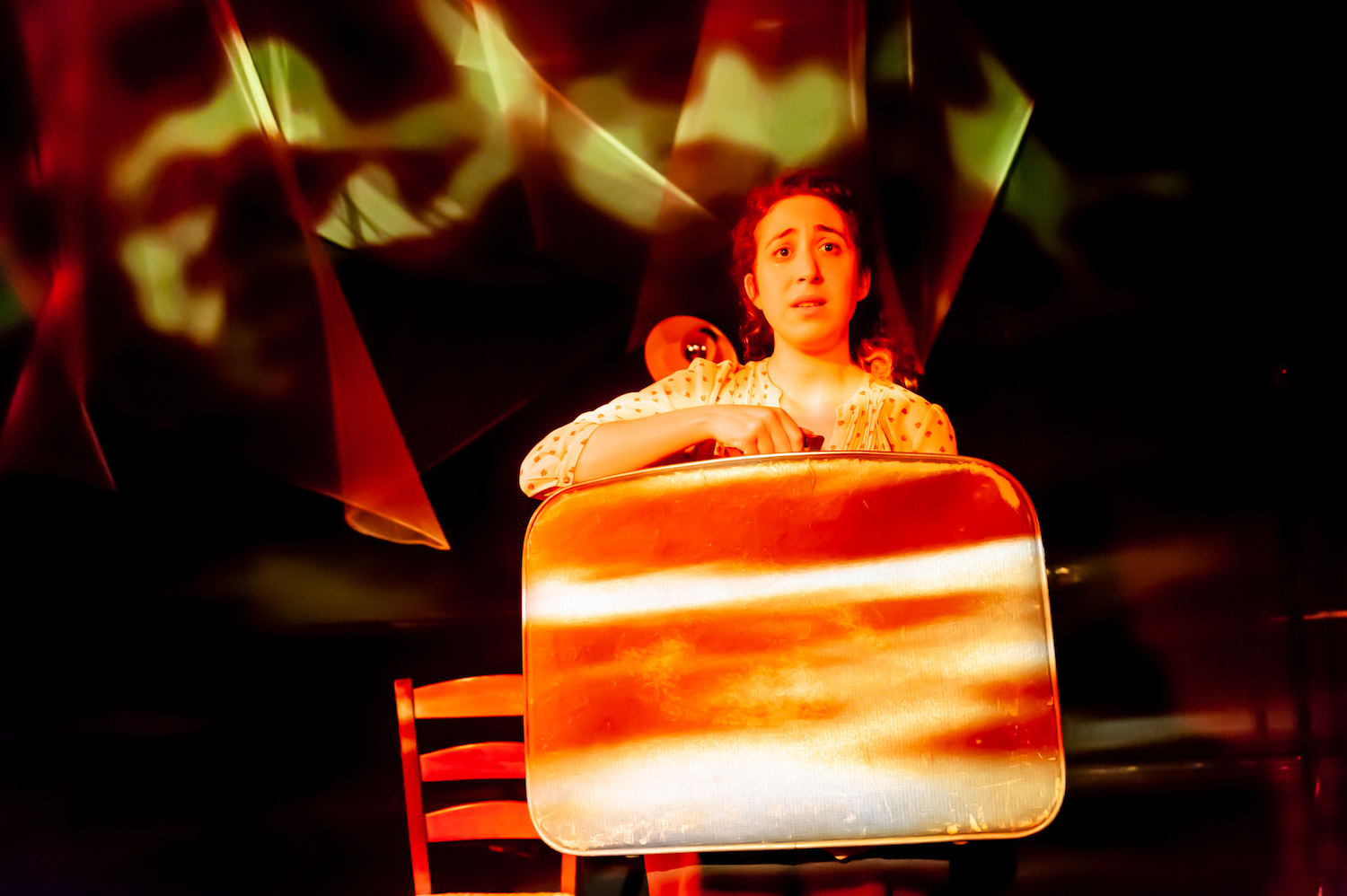
In other hands, this cyclical structure could easily teeter on the brink of tedium, and it’s credit to Lilac Yosiphon’s engaging, almost mesmerising performance as both Jasmine and Grandpa that this doesn’t happen. Slipping seamlessly from one character to the other – at times conversing with her other persona on stage, at others with her own recorded voice – she holds our attention throughout with ease.

This is fortunate, because the fragmented narrative of the piece, which hops around in time, location and style, does demand the audience’s constant focus in order to piece it all together. We’re aided in this, to some extent, by the use of music and loop pedalled sound, composed and performed live from the corner of the stage by Sam Elwin, and by Will Monks’ projections, both of which provide us with certain audiovisual signposts as we make our way through the show’s deliberately disorienting landscape.

Photo credit: Lidia Crisafulli

For those of us privileged enough to have never questioned where we belong, this unique multi-sensory production paints a powerful picture of the trauma of displacement – whether physical or emotional – through the sharing of a very personal and poignant story. The eclectic nature of the show may not be everyone’s cup of tea, but Jericho’s Rose is bold, original and invites us to consider themes we may think we understand in a whole new light.


Can’t see the map on iPhone? Try turning your phone to landscape and that should sort it. I don’t know why but I’m working on it… 😉
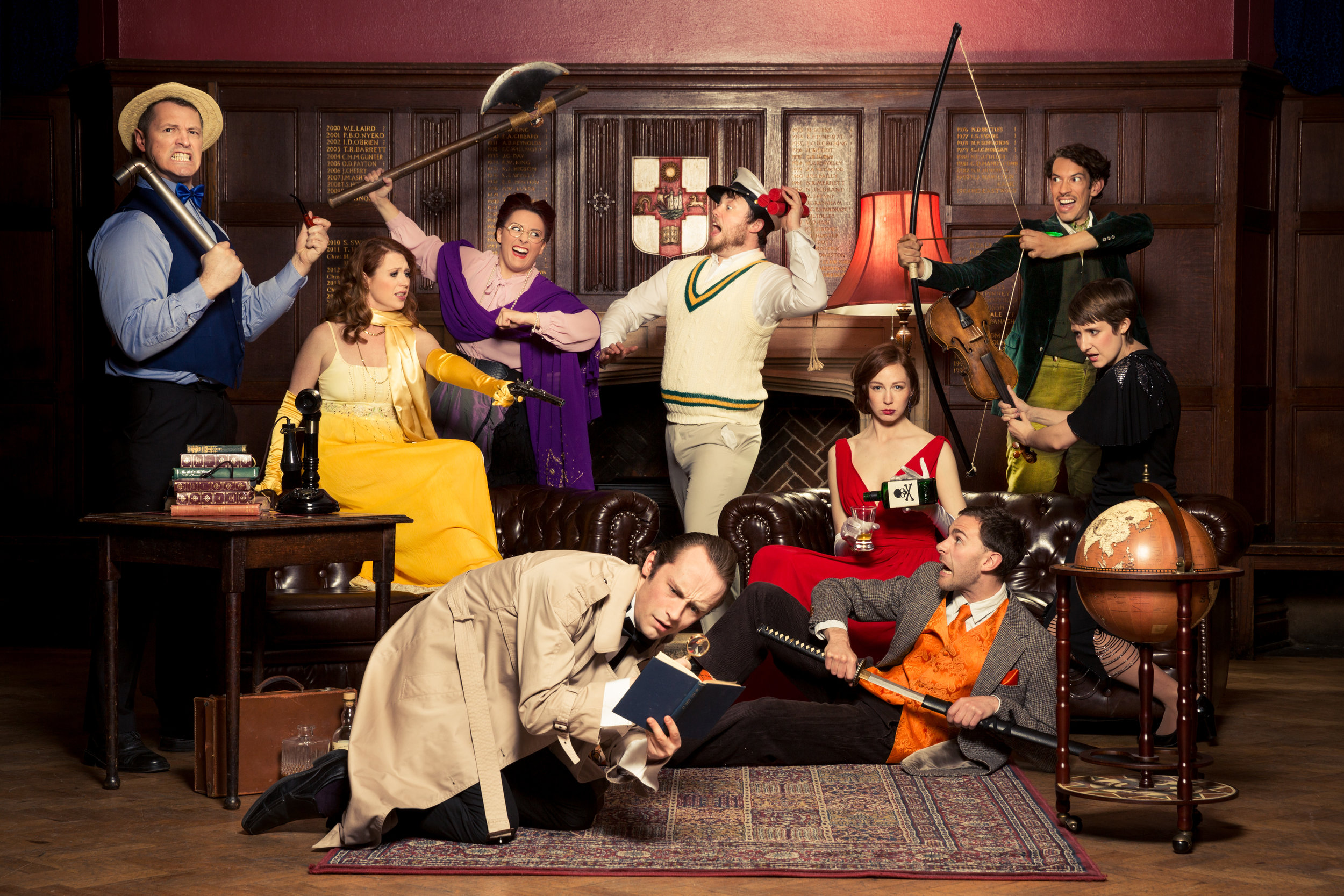
Review: Murder, She Didn’t Write at Leicester Square Theatre

It’s not often you get to start a review of a murder mystery by revealing whodunnit, but here goes: it was Scarlett, in the cattery, with a seatless unicycle (I’ll leave the gory details to your imagination). And I can tell you all this with a clear conscience because Murder, She Didn’t Write from Bristol-based improv company Degrees of Error is, by its very nature, different every time. It’s also extremely silly, slightly nonsensical and very, very funny.

Going in, the cast know as much as we do – that someone’s about to die, and that someone else dunnit. The details of where and how are provided by the audience at the start of the show, while the identities of killer and victim are surreptitiously selected by “Jerkins”, a.k.a. an unsuspecting member of the audience drafted in to play Detective Genevieve Foxcroft’s incompetent assistant. (Nothing to be alarmed about if you’re averse to a bit of audience participation – it’s a crucial but not particularly demanding role.)

Photo credit: Jamie Corbin

Equipped with the bare bones, the cast of six (on this occasion Peter Baker, Lizzy Skrzypiec, Tessa Gaukroger, Tom Bridges, Caitlin Campbell and Rachael Procter-Lane – accompanied by musical director Sara Garrard on piano) spend the next couple of hours working their magic live on stage, rapidly pulling out of the hat a convoluted tale about some clowns and a taxidermist who are, naturally, invited to celebrate a cat’s birthday. It doesn’t make a huge amount of sense, but it’s not like anybody’s there looking for a coherent plot. What we want – and what we get – is to see a talented cast of comedy actors adapting to every bizarre new twist, whilst doing their best to put each other off their stride at every possible opportunity.

Unsurprisingly, there’s no shortage of running jokes, particularly inspired at this show by the helpful audience suggestion of a cat’s birthday, which proved to be the source of exactly as much innuendo as you might imagine. We also got recurring gags about the dubious merits of being French, an extremely flimsy broom cupboard, the correct way to pronounce Bicester, and the ever-increasing age of two of the characters (who certainly didn’t look like they were in their eighties…) Some lines work better than others, but that’s to be expected and forgiven in a show of this kind; besides, the pace of the show is such that any awkward moments are quickly forgotten, and/or plunged into darkness with expert comic timing by lighting designer Alex Hoyle.

Like any ingenious magic trick, you can’t help but wonder from time to time just how they do it. But there are no smoke and mirrors here; although we have to assume some kind of framework exists before the show begins, the crowd-pleasing success of Murder, She Didn’t Write lies with the quick thinking of a clever and extraordinarily versatile cast.

And Jerkins, obviously.

Preview: Come From Away touches down in Europe

2019 looks set to be more than a little exciting in the West End, with Broadway hits Dear Evan Hansen and Waitress among the shows heading to London over the coming months. This week saw the European launch at Canada House of another American import: multi-award winning Come From Away, the story of a small town in Newfoundland that took in thousands of passengers stranded by the 9/11 terror attacks.

Written by Irene Sankoff and David Hein, Come From Away will have its European premiere at the Abbey Theatre in Dublin from 6th December to 19th January, before taking up residence at London’s Phoenix Theatre from 30th January.

On September 11th, 2001, as news broke of the terror attacks in the States, U.S. airspace was closed, leaving 7,000 people on planes with nowhere to go. Landing in Newfoundland, they were taken in by the residents of Gander, who had dropped everything to get the town ready, and worked tirelessly for five days to make their unexpected guests feel at home.

It’s hard to imagine how a musical inspired by 9/11 could be uplifting, but this heartwarming and universal story, which celebrates friendship, support and resilience in the darkest of times – not to mention the unique and infectious Newfoundland spirit – has been warmly received across North America since it was first performed in Ontario in 2013. “People around the world are hungry for stories about kindness,” said writer David Hein in a video message sent to the London launch, as he and Irene Sankoff prepared for the opening of the North American tour in Seattle. “We can’t wait to share it with the world.”

Directed by Christopher Ashley, winner of the 2017 Tony Award for Best Direction of a Musical, the European cast includes former Wicked star Rachel Tucker as Beverley Bass, the first female captain for American Airlines, who was among those stranded in Gander. Starring alongside her will be Jenna Boyd, Nathanael Campbell, Clive Carter, Mary Doherty, Robert Hands, Helen Hobson, Jonathan Andrew Hume, Harry Morrison, Emma Salvo, David Shannon and Cat Simmons.

Photo credit: Helen Maybanks

The London launch concluded with cast performances of three musical numbers from the show, and even after only two days of rehearsal guests were left in no doubt that we’re in for a treat when Come From Away touches down in Europe. Get booking now for this joyous celebration of the very best of humanity – in a world that often feels a very dark place, this is exactly the kind of story we need to be sharing, and I for one cannot wait.

Book now for Come From Away at Phoenix Theatre, London (from 30th January).

Review: The Wider Earth at the Natural History Museum

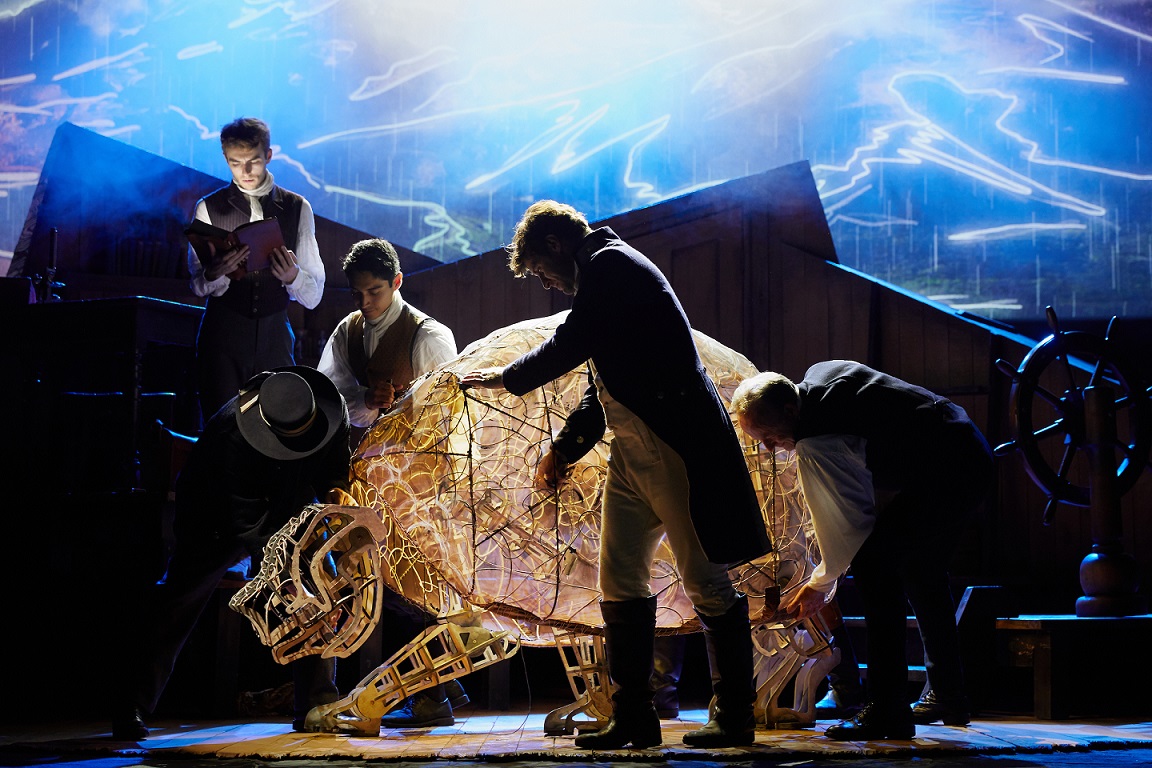
Natural history comes alive in spectacular fashion in The Wider Earth – and appropriately enough, it does so in a custom-built theatre at London’s Natural History Museum. The show tells the story of 22-year-old Charles Darwin, who joins a voyage to the Americas on the HMS Beagle and returns five years later with a new theory that will change the way we see the world forever.

The production, written and directed by Dead Puppet Society’s David Morton, is jaw-droppingly beautiful in almost every way imaginable. A huge video screen projects vibrant animations depicting Darwin’s travels, while the majority of the action takes place on a huge revolve stage that doubles as both the ship’s deck and the rugged landscapes explored by the young naturalist. A gorgeous score from co-composers Lior and Tony Buchen transports us to new lands as a host of stunning puppets bring creatures great and small to life before our eyes.

Photo credit: Mark Douet

As a spectacle, the show is undeniably a hit, but this is certainly not a case of style over substance; the play itself, performed by a talented cast of seven, is a fascinating insight into the life of a man most of us imagine only as middle-aged and beardy. Charles Darwin, played by Bradley Foster, is young, idealistic and full of curiosity about the natural world. Told by his father (Ian Houghton) that he can’t go on the voyage, he sulks and complains until his friend – and future wife – Emma Wedgwood (Melissa Vaughan) takes pity on him and asks her father to intervene on his behalf. These early scenes are clearly important to establish Darwin’s character, but do mean that the story takes a little while to really get going; fortunately, our patience is more than rewarded by what follows.

An enthusiastic Darwin initially views the Beagle’s voyage as little more than an adventure, and wants only to get to Tenerife, an island he’s heard about from his friend and professor Reverend Henslow (Andrew Bridgmont). But as his horizons expand so too does his mind (and his journal) – leading him to conclusions that go against everything he’s been taught to believe: that God created all living things exactly as they are, and always will be.

Not surprisingly, Darwin’s discoveries lead him into dangerous territory with the ship’s captain, Robert FitzRoy, who believes robustly in a preordained, God-given hierarchy of living things, with (some) humans at the top. Jack Parry-Jones captures to perfection FitzRoy’s volatile temper – particularly when challenged by Darwin on his views regarding slavery – and the vulnerability of a man whose faith and sanity are being shaken to their core, not only by his friend’s theories, but also by his own failure to civilise the “savages” of Tierra del Fuego.

Photo credit: Mark Douet

For all its brilliance, the show is not without a couple of issues. There are moments, particularly when the stage is revolving, when it becomes difficult to hear the actors over the music. In addition, audience members at ground level frequently have our view of the video projections obscured by the towering set, and occasionally have to jostle to see the land-based puppets over the heads of those in front. These frustrations, however, are surprisingly easy to dismiss in the face of such overwhelming visual wonders.

As a world-renowned centre of scientific research, the Natural History Museum could not be a better place for this remarkable story to be told. Combining entertainment with education, The Wider Earth takes us on a magical journey of discovery and adventure – who knew learning about science could be so much fun?


Can’t see the map on iPhone? Try turning your phone to landscape and that should sort it. I don’t know why but I’m working on it… 😉