Review: In Search of Applause at the Old Red Lion Theatre

Lorelei is a professional clown – or at least she would be, if she hadn’t given it all up when she met Nigel. He’s a workaholic app developer, who takes her on nice holidays but otherwise seems to have very little time for her; he’s dismissive of her views and won’t even stop working long enough to have dinner together. Now it’s two years later and she spends her days alone, going to yoga, pouring her heart out to a therapist, and flirting with the guy behind the counter at the local juice bar. But hey, at least she’s not poor any more. Right?

Photo credit: Ian Hart

Maroussia Vladi’s In Search of Applause is an intriguing one-woman show, which likens Lorelei’s romantic relationship with Nigel to her career as a performer: though she has a beautiful stage, set, costumes and props, does any of that matter if the audience isn’t paying attention? To an outsider it’s something of a no-brainer, and Lorelei has no qualms about counselling Harry, the juice bar guy, to quit his job and pursue his dream to become a musician. And yet when it comes to her own life, despite her obvious unhappiness after several disappointingly one-sided conversations with her partner, she can’t seem to apply that same advice.

Directed by Andrew Hurst, the play is made up of a series of one-sided exchanges between Lorelei and various off-stage characters. Two of these never appear at all; the third – Nigel – is represented by a hat suspended above a chair, and the sound of rapid typing each time Lorelei returns home and tries to engage with him. As we follow her repeatedly from home to therapy to the juice bar and back home again, we get a feel for the cyclical monotony and frustration of her uninspiring life.

Maroussia Vladi gives a very expressive and engaging performance as she moves around the stage, bringing vividly to life the story’s different settings and characters. Despite this, there’s a remoteness to the character of Lorelei that makes her at times difficult to relate to. She is by her own admission quite old-fashioned in her attitudes, and the play has a similar aesthetic: everything from Lorelei’s outfits to her luggage to Nigel’s hat feel like they’re from a different time to the story itself, which creates a disconnect between what we’re seeing and what we’re hearing, and makes it harder to get lost in the action. It’s a skilful piece of storytelling, but for this reason it does always feel like exactly that – a story.

Photo credit: Ian Hart

If you hear “romantic comedy” and think Richard Curtis, In Search of Applause will not be what you’re used to. What it is, however, is a quiet and reflective piece about what drives us to make the decisions we do (or not), presented with charm, creativity and gentle humour. It doesn’t necessarily go in the direction you might expect, but it’s well worth a visit if you’re in the market for a slightly offbeat take on love and relationships.

Can’t see the map on iPhone? Try turning your phone to landscape and that should sort it. I don’t know why but I’m working on it… 😉

Review: Rattled at the Old Red Lion Theatre

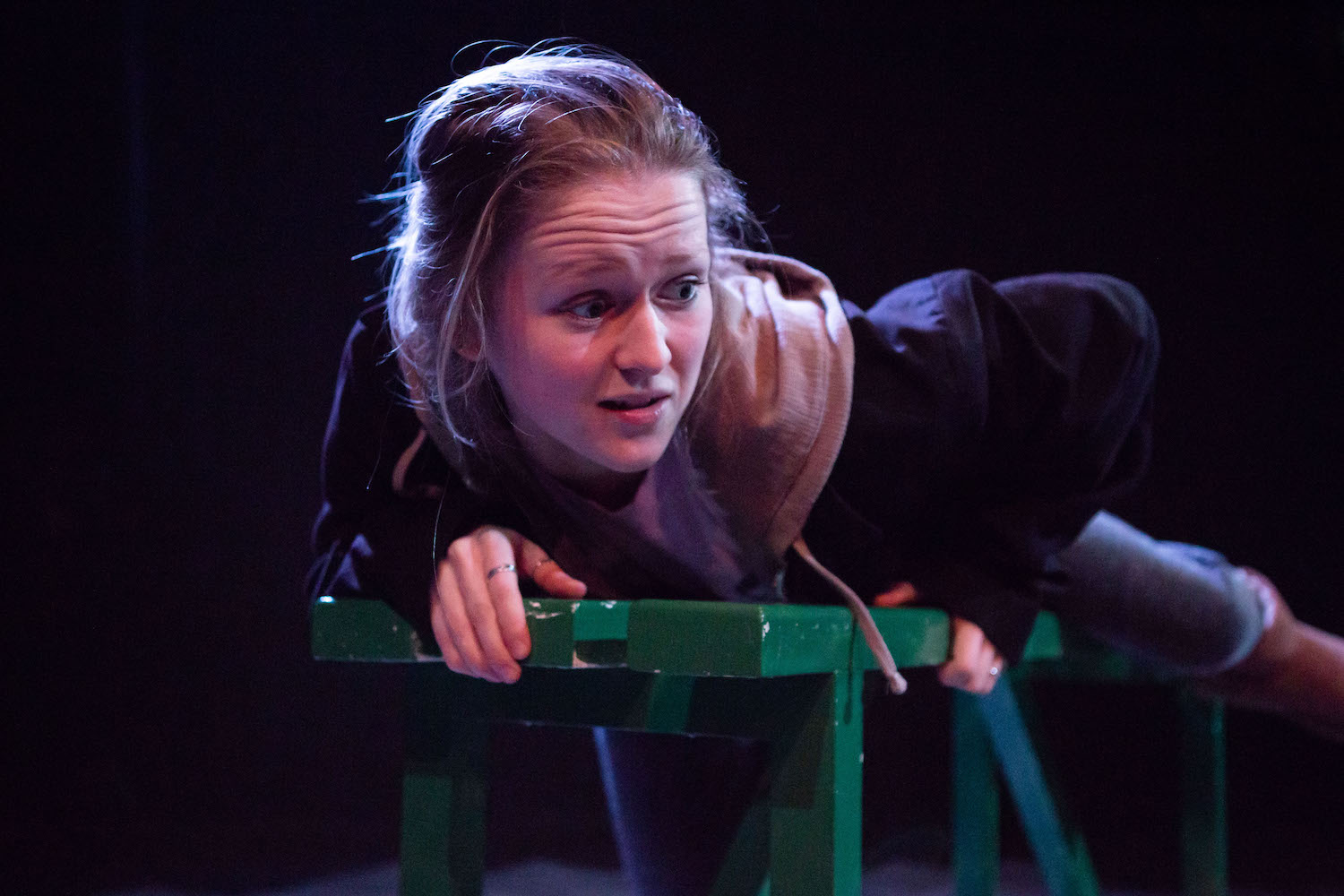
Inspired by a mother’s true account, Rachel Harper’s one-woman play Rattled is a short but punchy production tackling the sensitive topics of childhood trauma and postnatal mental health. The play is set on a lonely railway platform somewhere in southern England, where Em has just discovered a baby in a carrier. Unable to track down the child’s mother, she sits down to wait – and then, to fill the awkward silence, she begins to talk. Soon we (and baby) have heard all about her nice but dull husband Ian, their unsatisfying marriage, and her fear that she may have settled too easily and missed out on a great romance. We also learn about her childhood trauma and the abuse and neglect she suffered, and it doesn’t take long to guess the answer to Em’s repeated and increasingly desperate question: whose baby is this?

Photo credit: Ali Wright

Though it deals with some difficult issues, Rattled isn’t as hard going as it sounds; in fact it’s a surprisingly funny play, whose aim is never to wallow in the misery of mental illness but rather to advocate talking as the first step to recovery. Em is a very likeable, intelligent and witty character, and Rachel Harper is exceptional – both as a writer and an actor – in her utterly convincing portrayal of this vulnerable young woman who’s been through so much and now finds herself at breaking point. Her story unfolds very plausibly as a stream of consciousness, meandering from one memory to another and punctuated by musings on everything from Wuthering Heights to the parenting habits of orangutans. It all sounds random, unplanned – but in reality, not one word is wasted in this tightly constructed piece of writing.

This efficiency is reflected also in director Jemma Gross’ fast-moving production. Simple, effective design from Florence Hazard (set), Sherry Coenen (lighting) and Nicola Chang (sound) quickly and convincingly establishes the station setting, from the “see it, say it, sorted” announcements to the flickering lights of a passing train. Similarly, from the moment the play begins Rachel Harper’s performance leaves us in no doubt of Em’s current state of mind; every movement and gesture is loaded with meaning. She’s moving constantly, full of restless, nervous energy and unable to sit still. Each time she tells a joke, it’s accompanied by an awkward, high-pitched laugh. As the play goes on she becomes increasingly dishevelled, and even before she says a word, her emotional distress is palpable. We don’t know exactly what her intentions are at the station – though various possibilities come to mind, each more disturbing than the last – but the way she stiffens each time an announcement comes over the tannoy makes it clear that the train approaching the station is of some significance. As it gets closer, the tension both on and off stage builds as we wait to find out how Em’s story will end.

Photo credit: Ali Wright

Rattled is a gripping and poignant production that doesn’t flinch in its portrayal of mental illness, particularly affecting new mothers. But it also puts its money where its mouth is; Missmanaged Theatre have teamed up with childcare agency Bea & Co to support parents by providing a free creche at Sunday matinees, and discounts on at-home childcare for audiences attending evening shows. This is clearly a company who not only believe in making high quality theatre, but who also want to make it count – let’s hope others follow in their footsteps.

Can’t see the map on iPhone? Try turning your phone to landscape and that should sort it. I don’t know why but I’m working on it… 😉
Review: soft animals at Soho Theatre

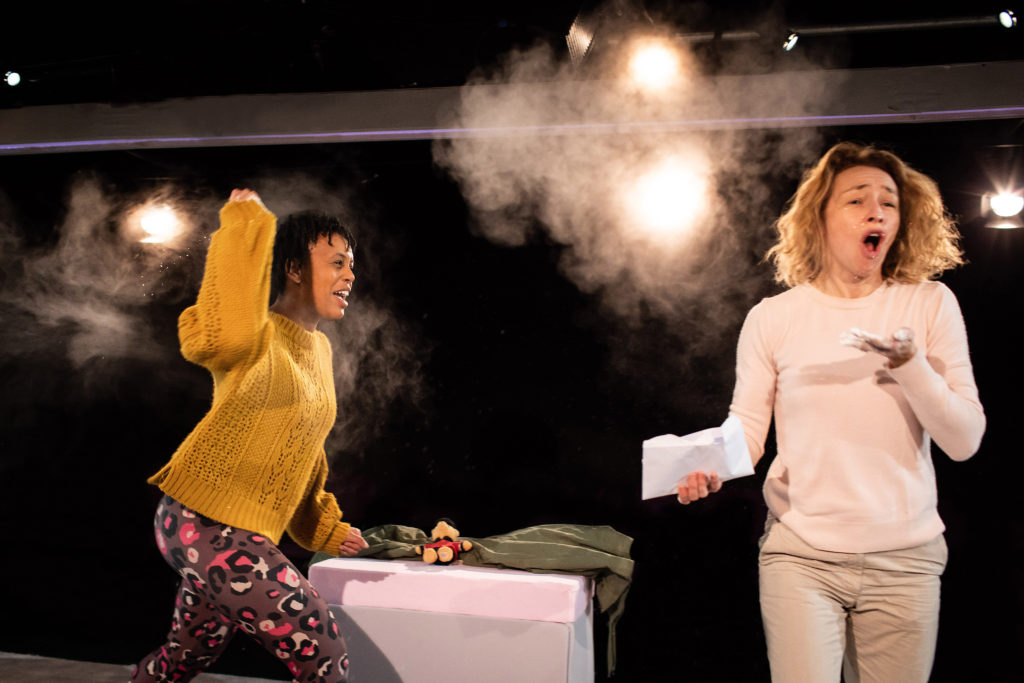
Don’t be fooled by the title of Holly Robinson’s debut play soft animals; despite the plethora of teddy bears scattered around the room, there’s nothing particularly cuddly about this hard-hitting two-hander. Directed by Lakesha Arie-Angelo, the play tackles grief and guilt through the surprising friendship of two very different women connected by a devastating tragedy: Sarah (Ellie Piercy), a well-off soon-to-be divorcee living in Fulham, and Frankie (Bianca Stephens), a black teenager from Birmingham struggling to cope with the demands of both uni and life.

Photo credit: Helen Maybanks

The tragedy is Sarah’s – the loss of a child in horrifying circumstances and subsequent nationwide condemnation of her as a mother and a woman – while Frankie’s direct involvement in the events of that day bring her to Sarah’s doorstep several months later. Over time the two become friends, though the dynamic of that friendship shifts constantly, and ultimately allows each to begin to see a way forward out of their own personal darkness.

The performances from Ellie Piercy and Bianca Stephens are perfectly pitched, the two of them bouncing off each other well as they deliver Robinson’s fast-paced, witty script. But there’s genuine tenderness between them too; if you can make it to the end of the play without at least a bit of a lump in your throat, you’re made of sterner stuff than I am. While Stephens is instantly likeable as the anxious and painfully vulnerable Frankie, Piercy’s Sarah doesn’t try too hard to win our sympathy, if anything going out of her way to make us – and the rest of the world – hate her because that’s what she thinks she deserves. It’s only by seeing her through Frankie’s eyes, behind closed doors, that we come to understand and feel for everything she’s gone through, and to question our own readiness to judge a total stranger based only on what we think we know of their crimes.

Just as the script reveals little by little the details of what happened, so too does Anna Reid’s deceptively simple set. Beginning as a single cube in the centre of the stage, it comes apart piece by piece to populate Sarah’s living room with furniture, with one final reveal towards the end reminding us forcefully of the gaping absence at the heart of the story. This is reinforced throughout by the appearance of soft toys from London’s various tourist attractions, which sit sadly around the room as a reminder that there’s nobody here to love and play with them.

Photo credit: Helen Maybanks

soft animals is an incredibly accomplished debut from Holly Robinson, tackling difficult themes with great sensitivity while also drawing us in with a compelling story. The friendship between Sarah and Frankie is unlikely but entirely believable, and each character feels authentic despite her unusual and tragic circumstances. This is a powerful piece of new writing that will break your heart – but then might just quietly put it back together again. Highly recommended.

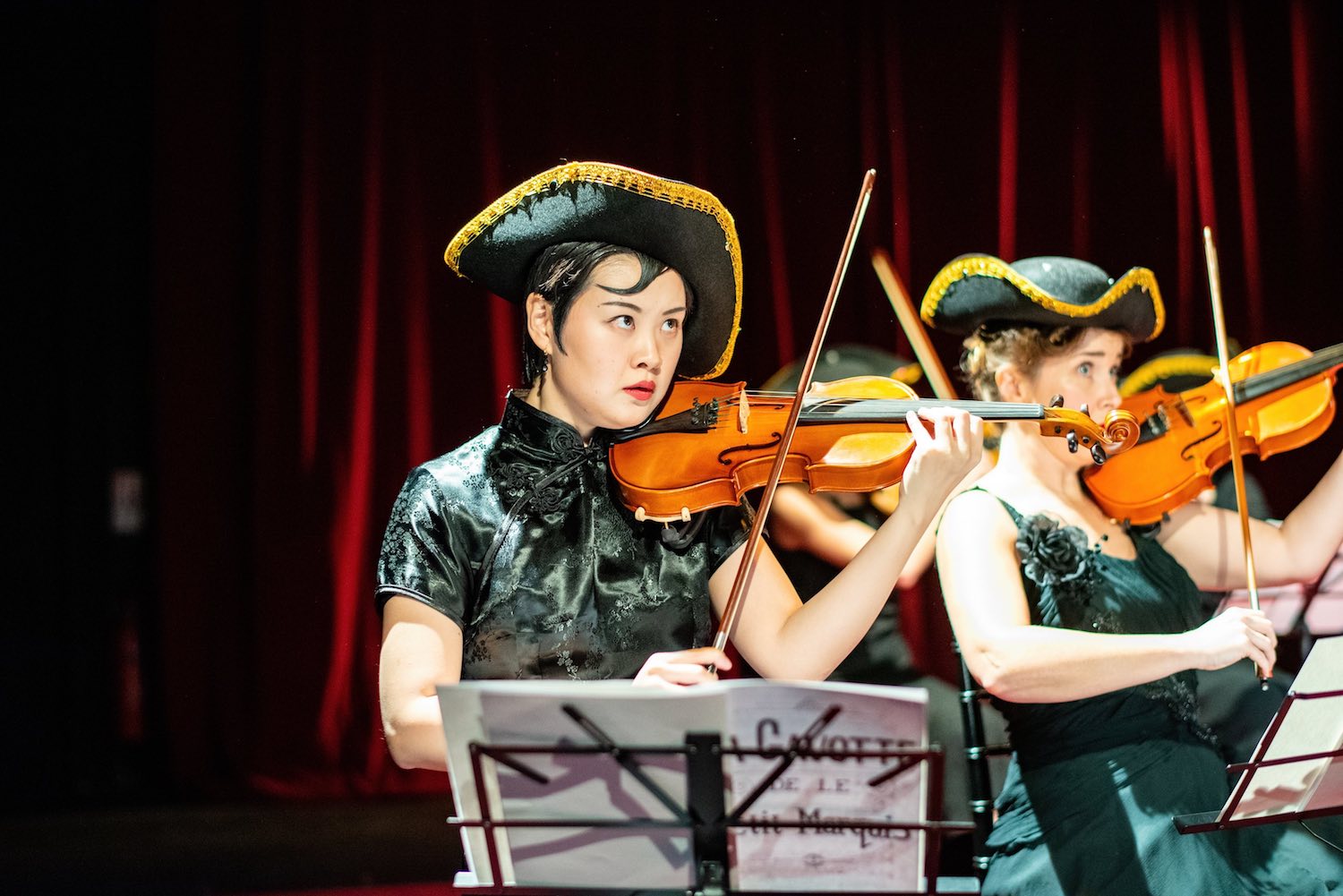
Review: The Orchestra at Omnibus Theatre

The show must go on… but at what cost? In Jean Anouilh’s The Orchestra, set just after World War II, petty in-fighting and lingering suspicions between the members of an orchestra in a small French spa town contrast sharply with their jaunty repertoire. Under the watchful eye of the manager, they must play on despite mounting tensions, uncomfortable revelations, and an unexpected climax to the evening’s entertainment.

Photo credit: Jacob Malinski

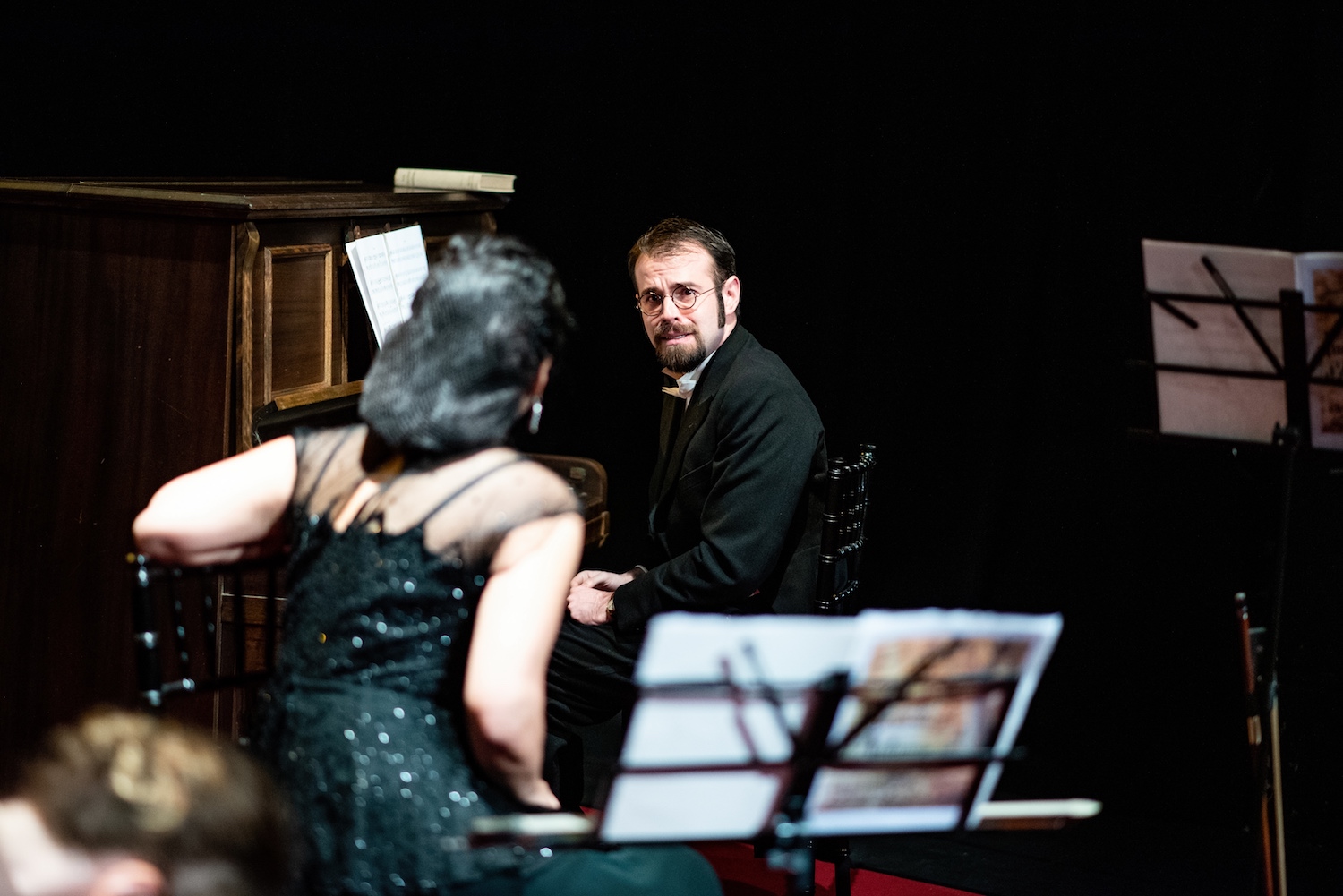
Set in real time, the 50-minute play alternates between musical interludes and the snatches of conversation in between, and sometimes during, the performances. From these we learn that leader Mme. Hortense (Amanda Osborne) and cellist Suzanne (Stefania Licari) are love rivals, fighting inexplicably over the orchestra’s meek pianist – and sole male – M. Leon (Pedro Casarin); violinists Patricia (Luna Dai) and Pamela (Sarah Waddell) clash over their very different views on sex and relationships; and flautist Leona (Jessica Hulme) is forced to sit and gasp appreciatively as Ermeline (Charlotte Laporte) talks at length about her marital problems. And all the while, the manager (Toph Enany) prowls in and out of the theatre – having also made his presence felt in the bar before the show – as a constant reminder of the pressure to paste on a smile and perform.

There’s an undercurrent of dark humour in Anouilh’s text, translated by Jeremy Sams, though it’s more of the satirical than the laugh out loud variety. Bickering and breakdowns are delivered with conviction by the internationally diverse cast, with Amanda Osborne particularly enjoyable as she tries to keep the group upbeat and focused on the task at hand. While the other characters’ conversations establish a backdrop of ongoing frustration with their own lives, the love triangle that connects Mme. Hortense with Stefania Licari’s melodramatic Suzanne and Pedro Casarin’s perpetually flustered M. Leon is more immediate and explosive, providing some drama and preventing the play from becoming too static.

Photo credit: Jacob Malinski

Unfortunately the musical scenes in Kristine Landon-Smith’s production – with the exception of the final one – don’t hold our attention in the same way, and this frequent loss of engagement means the play never quite takes off. The cast do a convincing job of miming along with the recorded soundtrack, but besides a few sideways glances and the odd bit of dialogue, there’s often not that much going on. Perhaps this is deliberate, to emphasise the divide between the players’ professional and personal demeanours; that certainly comes across very effectively. But it does mean that after a while – each piece is a good couple of minutes – the audience is left with not much to look at, the cheerful tunes we’re listening to (composed by Felix Cross) already having been dismissed by members of the orchestra themselves as little more than background music for a polite but indifferent audience.

Most of us have, at some point, had to put aside workplace squabbles and present a united front in the name of professionalism. Anouilh’s play presents a heightened version of that scenario, taking it to absurd lengths and setting it in a very particular time and place, but it remains enjoyably relatable – and this production, while not perfect, is a welcome revival.

The Orchestra is at the Omnibus Theatre until 17th February.


Can’t see the map on iPhone? Try turning your phone to landscape and that should sort it. I don’t know why but I’m working on it… 😉

Review: TARO at the Brockley Jack Studio Theatre

Last week when I reviewed Gentleman Jack, the first of two new plays that make up Arrows & Traps’ Female Firsts repertory season, I described it as “perhaps more understated than some of their previous work”. The same can certainly not be said for TARO, the second piece. In fact, Ross McGregor’s biopic of Gerda Taro feels a lot like the Arrows’ greatest hits compilation (there’s even a cameo for the snow machine from Anna Karenina), but if it’s your first time seeing them in action… well, let’s just say you’ve picked a good one – possibly even the company’s best.

Photo credit: Davor Tovarlaza @ The Ocular Creative

Born Gerta Pohorylle in 1910, Gerda Taro (Cornelia Baumann and Lucy Ioannou) was a German Jewish war photographer. Forced to leave her home by the rise of the Nazis, at the age of 23 she moved to Paris, where she met and fell in love with the Hungarian photographer Endre Friedmann (Tom Hartill). Faced with growing anti-semitic prejudice in Europe, the couple worked together under an invented alias, Robert Capa, before Gerta assumed her own professional identity and began working openly as Gerda Taro.

We hear this account from Gerda herself who, following her death in Spain at the age of just 26, looks back over her short life in an imagined conversation with her idol, Greta Garbo (Beatrice Vincent). Garbo adopts the role of director and under her guiding hand, the story of Gerda Taro comes magically to life.

And it really is a magical experience to watch it unfold. TARO is, quite simply, a meticulously choreographed masterclass in ensemble performance; a play in which every member of the cast shines individually but also forms part of a perfectly engineered and visually gorgeous whole. Movement director Matthew Parker has created some exquisite sequences, highlighted by stunningly atmospheric lighting from Ben Jacobs, and the whole piece has the feeling of both a story and a production far more epic than their intimate staging might suggest.

As in Gentleman Jack, the central character of Gerda Taro becomes a dual role, allowing the living Gerda to be observed wistfully by her ghostly counterpart. Both Lucy Ioannou and Cornelia Baumann are extraordinary, each radiating a quiet dignity in the face of tragedy and prejudice respectively. Among a host of great performances, Tom Hartill makes an incredibly charming Endre, Alex Stevens cuts a sympathetic figure as the couple’s friend and fellow photographer David “Chim” Seymour, and Beatrice Vincent oozes class and elegance as the legendary Greta Garbo.

Photo credit: Davor Tovarlaza @ The Ocular Creative

Being labelled the first female photographer to be killed in action may seem like a dubious honour, particularly since Endre Freidmann – as Robert Capa – would go on to be dubbed by some the greatest war photographer in history. But those few words sum up so much about Gerda Taro: her courage, talent, passion, determination and above all, her refusal to let a little thing like being female – or indeed Jewish – stop her succeeding at a job she loved. All those qualities shine through in this beautiful tribute, which so clearly comes from a place of deep respect and admiration. What more can I say? An incredible life honoured by a gorgeous, goosebump-inducing production – you really don’t want to miss this one.