Review: Miss Nightingale at The Vaults

Matthew Bugg’s acclaimed WW2 musical Miss Nightingale may just have found its spiritual home at The Vaults. Entering the warren of dimly lit underground tunnels, we’re handed a chocolate bar and a programme designed to look like a ration book before stepping into the auditorium, which could very easily be an air raid shelter. As trains rumble in and out of Waterloo Station above our heads, it’s not a huge stretch to imagine what we’re actually hearing is bombs falling, and it’s almost a surprise to emerge into Launcelot Street and find all the buildings intact and ourselves back in the 21st century.

Photo credit: Robert Workman
Miss Nightingale does many things all at once. It’s a touching story of forbidden love, a social commentary on gay and women’s rights, and a feel-good (and really quite naughty) musical. By rights it probably should feel like a bit of a jumble, and it’s true that some elements of the plot end up a little sketchy through sheer lack of time – yet it’s impossible not to get swept up in the charm and sheer joy of it all.

It’s 1942, and war hero Sir Frank Worthington-Blythe (Nicholas Coutu-Langmead) hires Maggie Brown (Tamar Broadbent), a feisty nurse from oop north, to perform in his new club. The two quickly grow close, but Maggie’s already in a relationship with dodgy wheeler-dealer Tom (Niall Kerrigan) – and besides, it’s her friend and songwriter George (Conor O’Kane), a Polish Jew still in mourning for both his lost family and his beloved Berlin, who’s secretly captured Frank’s heart.

Forced by the law and social expectations to keep their illicit love affair under wraps, the two men end up embroiling both themselves and Maggie in a complex tangle of broken hearts and false hopes – all the while maintaining a facade of determined jollity in order to keep up morale. This is Britain, after all, and the show must go on, whatever dramas may be unfolding behind the scenes.

And there’s no doubt Miss Nightingale‘s outrageous comedy numbers know how to lift the spirits. Laden with every innuendo you can think of – and a few that you might not – they provide welcome light relief from the intensity of Frank and George’s tempestuous love affair, and particularly from the disturbing realisation that less than 100 years ago, gay couples still risked social ruin or even prison just for the chance to be together. (And worse – there’s a moment in Act 2 when George reflects on the unfairness of being persecuted in the country he came to seeking refuge; as recent events have shown all too clearly, these words could just as easily be spoken today.)

Photo credit: Robert Workman
The whole cast of actor-musicians are clearly in their element during the rude bits (and let’s be honest, who wouldn’t get a bit of a buzz out of a song whose main lyric is, “You’ve got to get your sausage where you can”?) but Matthew Bugg’s score demands a softer side too, particularly from the show’s three main stars, all of whom impress with their powerful vocals. Though best known as a comedian, Tamar Broadbent reveals she can do serious just as successfully, while Nicholas Coutu-Langmead and Conor O’Kane maintain an ideal balance in their blossoming on-stage relationship, with Frank’s timidity and stiff upper lip perfectly countered by George’s volatility and flamboyance.

This is the fifth production of Miss Nightingale, and it’s not hard to see why the show keeps returning – it really is the best of British, in more ways than one. Yes, it’s a huge amount of fun, but there’s a more serious point to all this. We might not be at war any more, but that doesn’t mean there aren’t still battles to be fought – and in an increasingly troubled world, this show reminds us that it’s as important as ever to stand up and be counted.


Can’t see the map on iPhone? Try turning your phone to landscape and that should sort it. I don’t know why but I’m working on it… 😉

Interview: Tobias Oliver, Miss Nightingale

Since its premiere in 2011, Matthew Bugg’s Miss Nightingale has toured five times, earned numerous five-star reviews, been named one of the Guardian’s Top 50 Shows of 2016 and been voted into BritishTheatre.com’s Top 100 Greatest Musicals of All Time. And now it’s finally coming back to London, with a two-month run at The Vaults from 30th March.

Miss Nightingale is not your usual musical theatre show,” explains co-producer (with writer and composer Matthew Bugg), Tobias Oliver. “It’s set in World War Two London and challenges you to stand up for yourself, to fight for what you believe in and to resist prejudice in all forms. But it does this whilst entertaining the socks off you with a gripping narrative, tender love story and a load of absolutely brilliant songs, some of which are very, very naughty! One of my favourite reviews on our last tour said it was like, ‘Cabaret – as if written by Victoria Wood.’ I really love that description.”

It’s a long-awaited return to London for Miss Nightingale. “We’ve wanted to bring the show back to London for several years and have had a number of offers but they never felt quite right,” says Tobias. “We aren’t your typical West End show and we wanted to find the right venue. When the opportunity of transferring to The Vaults came up we jumped at it. It’s just perfect and almost feels as if it were made for Miss Nightingale, particularly as all the action in the show takes place in London. And I grew up in London and it’s where I started going to and falling in love with theatre, so performing the show here is always going to be extra special for me.”
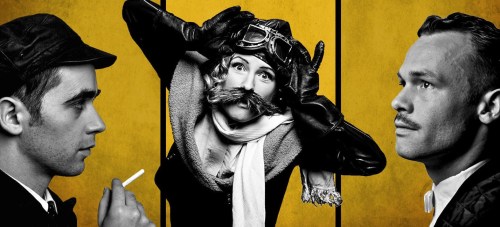
What is it that makes The Vaults an ideal venue for the show? “It’s one of the most exciting venues in the capital right now,” says Tobias. “The fact that it feels like a cross between a theatre, an illegal drinking den, a subterranean jazz club and an air-raid shelter really couldn’t be better. Miss Nightingale is set in 1942 and much of the action centres around a smoky, underground cabaret club in the heart of war-torn London. The Vaults is absolutely the perfect fit for us – and the fact that you can hear the rumble of trains and other sounds of city life sets the scene perfectly of life carrying on regardless.”

The show’s changed a lot since it was first performed six years ago: “The 2011 production was a small-scale, chamber version of the show with a cast of just three. The response was fantastic, we were the best-selling late night show at the King’s Head and the show went on to tour the UK five times. However, back in 2011 as soon as we started performing the show in front of an audience we knew there were things we wanted to change and creases to be ironed out. There’s always a missing link in making theatre until you get it in front of an audience. This is why all big-budget shows have extensive development periods, a number of workshops, lengthy previews and out-of-town runs to smooth out the glitches and fix any problems.

“So we did some fairly hefty re-writes and added several new songs before we presented the show again in a full-scale production that toured in 2013. And we’ve continued to refine the show for each new outing. I guess anyone who saw the show back in 2011 is in for a bit of a surprise when they come to watch it at The Vaults, and it will be fascinating to see their reaction.”

In addition to his co-producing responsibilities, Tobias also has a small  role in the show as well as playing double bass – and he has nothing but praise for his fellow cast members. “Our cast are seriously talented. Not only do they act, sing and dance, but they also play all the musical instruments! And there is something that is incredibly exciting about working with actor-musicians who are at the very top of their game. We spend a lot of time looking out for and casting the right people. Our two leading men, Conor O’Kane and Nicholas Coutu-Langmead have such great chemistry on-stage and it’s really beautiful watching them fall in love every night.

“We also have a couple of new cast members, including the wonderful, award-winning singer-songwriter Tamar Broadbent making her musical theatre debut as ‘Miss Nightingale’. If you’ve ever been lucky enough to see her perform her comedy shows then you know she’s a star in the making.”

Though described in one of its many rave reviews as “raucously funny”, the show also has a serious point to make. “If anything the show seems more relevant than ever in 2017 what with recent events both in the UK and overseas,” says Tobias. “We don’t know what will happen to LGBT people’s rights after Brexit because much of the protection we have gained against discrimination came from the EU. The far right is on the rise across Europe with a particularly regressive, homophobic platform. Then there’s the frankly terrifying, virulently anti-LGBT agenda of the Trump government in the United States. It’s truly frightening. Now more than ever the arts and performance – satire in particular – seem to be powerful ways to offer an alternative to these messages of hate and division.”

Finally, what’s one thing Tobias wants audiences to know before we see the show – and one word he’d like us to use to describe it afterwards? “Blimey, that’s a tricky question to end with! I want people to know that Miss Nightingale has absolutely nothing to do with Florence Nightingale – it’s set in World War Two, not the Crimean War! And I’d like them to describe the show as ‘life-affirming’. Does a hyphenated word count?”

Miss Nightingale is at The Vaults from 30th March to 20th May.

Review: dreamplay at The Vaults

What did you dream about last night? I can’t be sure, although I have a feeling at one point I was teaching some American children how to do the can-can. This is pretty standard; my dreams hardly ever make any sense, if I remember them at all. But what does tend to stay with me is how they make me feel – sometimes happy and relaxed, occasionally relieved, other times tense and panicky. (I once had a dream I was on the run, and spent the entire following day feeling uneasy and looking over my shoulder, without really knowing why.)

Anyone seeking a linear or even logical narrative in BAZ Productions’ dreamplay, based on August Strindberg’s 1901 play, will inevitably leave feeling disappointed; each time we come close to understanding what’s going on, the play veers off in an unexpected direction and brings us back to square one. And yet there’s no denying that the scenes we witness – as disjointed and downright odd as they undoubtedly are – evoke some pretty powerful emotions. Some are funny, others sad, others a bit scary (nothing quite like being suddenly plunged into darkness to get the heart racing). And I’m willing to bet if you asked the audience on the way out which moment in particular spoke to them, there’d be a lot of different answers.

Photo credit: Cesare De Giglio
At this point in a review I’d usually include a plot summary, but as we’ve already established, that’s not really relevant in this case. That said, there is the hint of a story running through the scenes: a young woman, Agnes, comes to Earth to try and discover what makes human beings sad. It’s a quest that ends in disappointment, however, and Agnes finally leaves without the enlightenment she was hoping for.

The Vaults, beneath Waterloo Station, is an atmospheric and inspired choice of venue for director Sarah Bedi’s mysterious journey into the world of dreams. As we move from each space to the next, we’re plunged into a different world: a dimly lit auditorium; a modern bedroom; vast, echoing tunnels; even the open air. And while the promenade experience is an unusual and occasionally frustrating one – just as you’re getting comfortable, up you get and move on again – it also feels necessary to create that sensation of being in a dream, where your surroundings can and do change without warning. The only scene that didn’t really work for me was the last one; with the audience all on our feet and most of the action taking place on the floor, those of us in the back struggled to see what was happening.

The cast take on a variety of roles throughout the show. Colin Hurley is convincing as an audience member plucked from his seat; it’s simultaneously a disappointment and a relief when he’s revealed to be a plant. Jade Ogugua and Jack Wilkinson shine in perhaps the closest scene to “normality”, in which a recently married couple argue about their finances, while Michelle Luther is both entertaining and slightly terrifying as a performer controlled by the cello music to which she dances. That music is provided by alternative cellist, vocalist and singer-songwriter Laura Moody, in whose hands the cello becomes not just a musical instrument but almost human, capable of menace, joy, playfulness and despair.

Photo credit: Cesare De Giglio
From a traditional perspective, dreamplay doesn’t really make any sense. It’s a series of striking images and moments that, afterwards, we may struggle to connect. As someone who likes to leave the theatre understanding what I’ve just seen, I now find myself a little frustrated at my inability to pinpoint what this play was all about. Then again, I often feel that way about my dreams (I have no idea where teaching the can-can came from, for instance, and that bothers me) – so in that respect, dreamplay is right on the money.


Can’t see the map on iPhone? Try turning your phone to landscape and that should sort it. I don’t know why but I’m working on it… 😉

Interview: BAZ Productions, dreamplay

BAZ Productions was formed in 2009 with the goal of creating work that’s “alive and limitless… courageous and more than a little bit mischievous…” And if you think that sounds intriguing, wait until you hear director Sarah Bedi’s summary of the company’s latest production, dreamplay, which comes to The Vaults in September.

dreamplay is a dreamy-journey through underground tunnels, searching for the door which hides the answer to the meaning of life, pursued by a clown, a teacher and a set of lovers…

The play’s a modern re-working of August Strindberg’s A Dream Play, written in 1901, and tells the story of a young woman who arrives on earth from ‘above’ to discover the mysteries of humanity. For the uninitiated, Sarah explains, “Strindberg’s original A Dream Play is a massive, bonkers, labyrinthine play about the meaning of life and why we suffer – or at least that’s what I think it’s about. I was chatting to a well-respected theatre academic last week, who admitted he hadn’t the faintest clue what Strindberg was getting at with A Dream Play! He couldn’t pin it down. I love it because of that. I think it’s the most honest Strindberg is in any of his writing. It’s all about human expression and suffering and feeling lost. Like a dream, it’s to be felt.”

dreamplay, BAZ Productions

Like BAZ’s previous productions, dreamplay makes innovative use of an unusual space: “We’ve always loved spaces that weren’t designed to be theatres. That had a purpose and a life before we arrived, and so are bristling with their own energy. In some ways they become another character in our team of performers. We aim to work with what the space gives us for free – it’s not always a process of layering up a design, rather brushing away at the edges of the space until we stumble upon something special. Archaeology in a sense.

“Unusual venues are also fun in terms of playing with audience expectations. There’s always lots of talk around about theatre ‘subverting’ audience expectations. However, I think we want to go further. It’s about removing expectations completely. You rock up outside a Crypt in the centre of London and you don’t know what to expect, so as an audience member you arrive empty. You find your way to an artgallery down a graffitied alley in Shoreditch and again you’re open to something new. You have to be. Because this doesn’t look like a theatre in the traditional sense, so all the usual rituals go out the window – along with all expectations and preconceptions. You can be present with us, here and now.

“The Vaults is another great space to play in – it’s still connected to Waterloo station, we are right below the platforms so every few minutes a train passes overhead and its vibrations permeate the space. It feels alive. And very dream-like: the tunnels and spaces range in size, from intimate and claustrophobic to gaping and cavernous, space leading onto space in a maze of interconnected rooms. We’re imagining it’s the giant sub-conscious of London. Alive but in the shadows, pulsing away down there and holding all our fears and dreams.”

dreamplay also features original music from alternative singer-cellist Laura Moody. “Laura started working with us a few years ago, and her work has become central to the piece. At that time, we’d been developing a very playful set of rehearsal ‘rules’ and it was fun to introduce Laura and see how ‘normal’ impro would work if you made one character cello music. So I’m sat arguing with my Mum, but my Mum is this weird set of noises Laura’s making. So Laura isn’t playing my Mum, the music is. It was instantly dream-like. Her music is not so much soundtrack as another performer in the play.”

It’s becoming increasingly clear that dreamplay isn’t your ‘traditional’ night at the theatre… starting with the seating arrangements – or lack of. “I guess an obvious difference is that the audience will be on their feet, moving through the space: rather than observing the play, you will be inside it. Narratively, though, I hope it’ll feel like we’re offering you a bunch of dots and it’s for you to join them to create whatever shape you think you see. I think it’s a show that literally cannot exist without the audience’s imagination.

“I guess what the audience take away from the piece is very open, I don’t think I’d want to dictate what that should be. I hope they feel like they’ve been inside a dream of their very own, and are left with the collection of feelings and thoughts that arise from that.”

Catch dreamplay at The Vaults from 10th September-1st October.