Interview: David Fairs and Anna Marsland, GOLEM!

“David Lynch colliding with The Godfather – and a bit of Cruel Intentions…” is David Fairs’ intriguing summary of GOLEM!’s second production. Following the success of last year’s Macbeths (check out my review for LondonTheatre1), the company are back at The Hope Theatre on 13th June with I Know You Of Old, a fresh take on Shakespeare’s Much Ado About Nothing.

I took the original text and then built a new story out of it,” explains David, who also plays Benedick in the play. “So it only has three characters, and the starting point for our play is two weeks after the actual death of Hero. We pick up the night before her funeral, when Benedick, Beatrice and Claudio all encounter each other in the chapel of rest, and the whole play takes place over about twelve hours leading up to the funeral the next morning.”
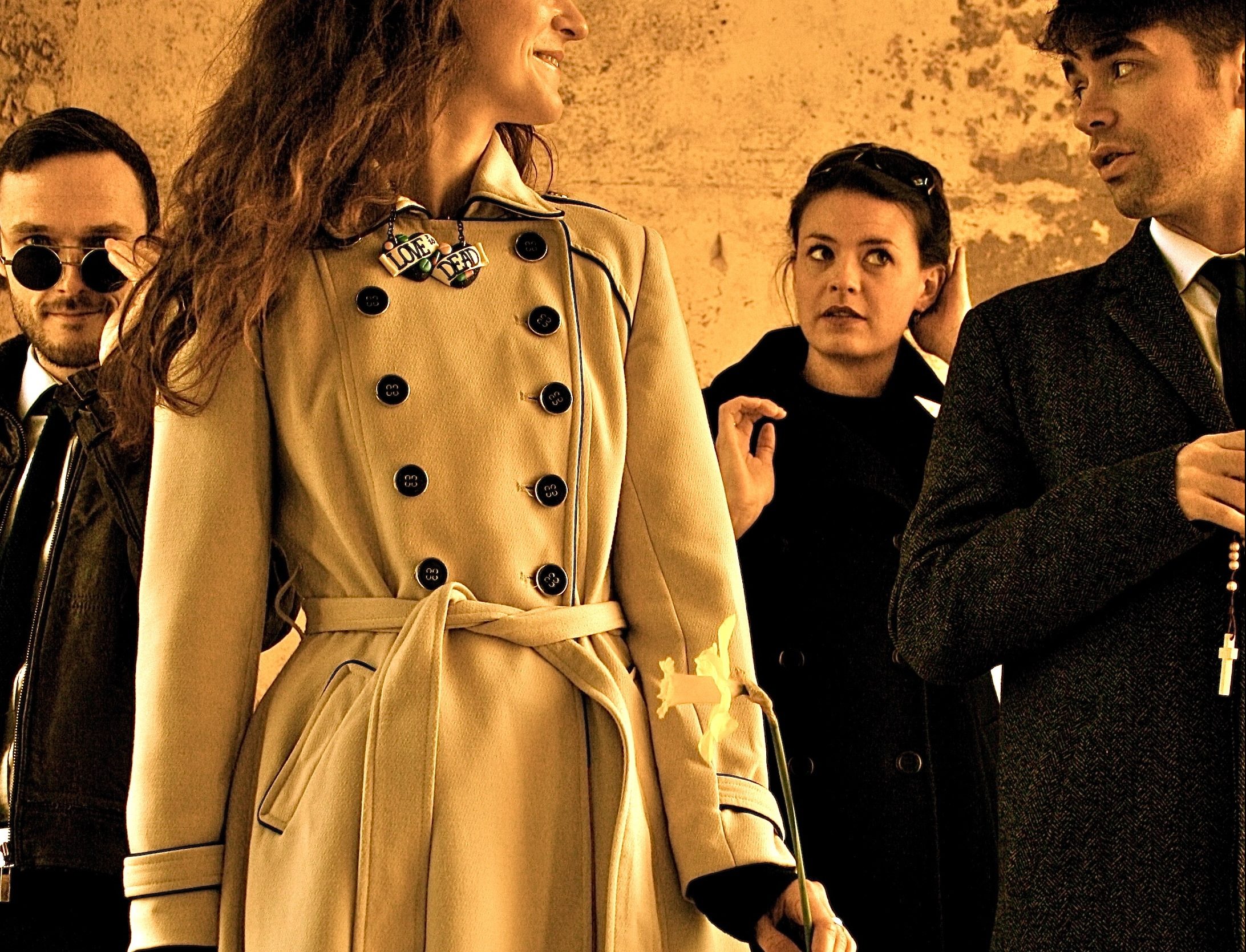
“You don’t need to be familiar with Much Ado,” adds director Anna Marsland. “Our hope is that you’re coming to see a new play in which you know someone’s died and you know these three people are connected to her, and you’re uncovering the story as the play goes on. But my hope is that anyone who does know the play gets an added extra in terms of seeing that dialogue repurposed.”

GOLEM!’s first production, Macbeths, followed the same narrative as Shakespeare’s original but placed the Macbeths’ domestic relationship at the heart of the story. “I’d always had this fascination with examining Shakespeare’s great characters as real people who are brilliant examples of the human condition,” explains David. “So I just started to think about how we might do that, and the first thing that came to mind was Lady Macbeth, and I became really fascinated with the idea of isolating those two characters and seeing what story could be told.

“Then after MacbethsI started thinking about other relationships it would be interesting to isolate and examine. Much Ado is one of my favourite plays, and I was most interested in the relationship between Beatrice and Benedick, why they behave like that – they’re very entertaining but when you actually look at them, they’re very odd. They know each other so well that they can play whatever game they want, they can tactically pick up on what the other person is doing and destroy them with it. You have to know someone incredibly well to do that, and it was interesting to me to put that relationship into a pressurised environment.

“And the other element that’s always struck me as missing is a real deep examination of the shaming of Hero – because it’s something that occurs and is then forgotten. The thing that happens to her is horrendous; she’s destroyed on her wedding day by her father and her fiancé, and yet in that final scene nobody offers her an apology.”

So this play is putting that completely at the heart of it,” says Anna. “She’s been slut-shamed, she’s been destroyed – and that has gone so far that she’s died; that pain has killed her.”

Unlike Macbeths, development for I Know You Of Old has been a collaborative process from the start, with input from both David and Anna, along with fellow company members Sarah Lambie (Beatrice) and Conor O’Kane (Claudio). “Dave and I often have very similar instincts about things,” explains Anna. “I think we are artistically very much on the same page, and I think it’s important that we trust each other a lot. But I think that trust has allowed us to make that distinction quite smooth: I trust Dave to go off and write the thing – after we had the idea, we signed the contract to go and do it at The Hope and then I said, ‘Okay you need to write it now!’

“And we were quite strict with ourselves – workshop, second draft, workshop, rehearsal draft. And once the rehearsal draft is done, that’s when Dave hands it over to me. And of course there are little tweaks but the fundamental set-up and structure are there – and I feel like we’ve tested it as a piece of writing rigorously enough that now we’re in rehearsals I’ve got Dave the actor in the room, not Dave the writer.”

“I do implicitly trust Anna with the script and the play,” agrees David. “That became so evident immediately when we were doing Macbeths in that I had the script, but as soon as I gave it Anna to direct she brought things out of it that I hadn’t even dreamed of. So it’s a really nice process – I prepare it, we have that crossover period where we’re workshopping it, and we work out that we’re on the same page and streamline it down to that shared idea, and then I’m happy to hand it over.”

I’ve not really worked on a play in the same way before, in terms of being so involved with the actors who are going to be in it,” says Anna. “And as a company it feels like we had the luxury of a lot of development time, which has taken the pressure off rehearsals because we’ve had all those conversations over the last six months between the four of us about where this piece is heading.”

And what of those people who think Shakespeare is not to be messed with? “I have no problem with this being polarising, I think that’ll be very interesting,” says David. “And I don’t think there’s any disrespect in any of it – I’m very much coming from the point of view of someone who absolutely loves Shakespeare. He is my favourite playwright, my favourite thing to act and to watch. I have a huge amount of respect for him, and it doesn’t feel like that is in conflict with what I’m doing.

“None of this is arbitrary – the structure and form of this play is very much designed to almost be an extension and a compliment to Much Ado, not a rehash of it. I think you can revere Shakespeare and the words he wrote, without considering that it’s sacrilegious to do anything to the text. I love the idea that actually what he gave us was an incredibly rich raw material that is so brilliant that we actually don’t lose the DNA in the expansion of it.

I also love what previous – and the current – artistic directors have done with Shakespeare’s work at the Globe. Going back to Rylance, I love the idea that you can take this and you can play with it – the idea is that it’s something to be enjoyed and experimented with.”

“We wanted to take it a step further this time,” adds Anna. “The idea of setting up GOLEM! was about how much we can take a text and change it some way, and one way of doing that is this re-orchestration. And it’s how far we can push that, so there we just changed the text to the story of Macbeths and reshaped it; here we’re taking the text and the characters and some of the plot, and veering off in another direction. And I don’t know what the next step would be – maybe taking the text and telling a completely different story, or even taking multiple texts.”

Anna and David first worked together at university, an experience he remembers for one very specific reason… “My overriding memory of what Anna had me do was get covered head to toe in ice cream for the final scene of the play – but we discovered ice cream doesn’t look like ice cream when you’re covered in it. So ultimately I was covered in gallons of Angel Delight, performing in a theatre that didn’t have showers, and had to leg it across the city to a friend’s room and shower, then head back for a drink!

“Once the prospect of the R&D space for Macbeths became available at the Catford upon Avon festival last March, I obviously knew that we needed a director and Anna was top of my list to approach. I knew that she’d worked at the RSC and the Globe, and that she was London-based at the moment because she was – and still is – Resident Director on Curious Incident in the West End.”

“So it was quite a chance reunion in a way,” says Anna. “I love working on Shakespeare and I also really love prioritising those female stories in Shakespeare. So interests-wise and working-wise, it was just a happy collision really.”

And what’s next for GOLEM! after I Know You Of Old? “Our hope is that what we’ll end up with is two nice companion pieces – two adapted Shakespeare plays: one tragedy that’s become a love story and one comedy that now has a much darker heart,” says Anna. “And the idea is maybe to tour them as a double bill or a pairing that could be on alternate nights. We’re kind of hoping we might take them up to Edinburgh next year.”

“And another idea once we’ve finished this run, the next thing I’d be interested in looking at is a direct sequel to Macbeths, picking up and seeing where all of the characters might have ended up,” suggests David. “And potentially with this one forming a story and a script out of multiple plays, out of the whole canon, and seeing what story I can build.”

Book now for I Know You Of Old at The Hope Theatre from 13th June to 1st July.

Review: Brimstone and Treacle at The Hope Theatre

Dennis Potter’s Brimstone and Treacle was originally written for the BBC, but banned from transmission for several years because of its controversial content. 40 years later, Matthew Parker’s revival proves the play has lost none of its power to shock and disturb. Trying to reconcile everything that goes on keeps making my head hurt – and not just because of Rachael Ryan’s spectacular 70s wallpaper (though that certainly doesn’t help the situation).

It all seems quite straightforward to begin with. Tom and Amy Bates are a middle-aged couple caring for their daughter Pattie after a hit and run two years ago left her brain damaged and helpless. Just as they’re reaching breaking point, a mysterious young man turns up on the doorstep claiming to know their daughter, and offering his help. Martin Taylor seems like the answer to their prayers, but despite Amy’s raptures, it’s clear from the start that he is not a good guy – an impression cemented when he commits an unspeakable act against the vulnerable Pattie while her mum’s out getting her hair done.

But then. Then it all gets very interesting (if headache-inducing) as events take an unexpected turn and suddenly we don’t know whose side we’re on any more. The lines between good and evil begin to blur, and the play evolves into a powerful and incredibly relevant debate on issues of immigration, national identity and what it really means to “take our country back” – before spiralling to a shocking but strangely satisfying conclusion.

Photo credit: lhphotoshots

Matthew Parker has assembled a small but perfectly formed cast, who handle the difficult material with sensitivity and skill. As the beaten down Amy, Stephanie Beattie’s weariness and desperation are palpable, and it’s easy to see why she so readily falls for Martin’s slick patter. Paul Clayton gives a nicely understated performance as her husband Tom, whose only way of dealing with his grief is being impatient with his wife and hankering for the way things used to be.

Olivia Beardsley has fewest lines but arguably the toughest role as Pattie; in a meticulously observed physical performance, she communicates everything she can’t say verbally through her eyes and movement. And at the centre of it all is Fergus Leathem, genuinely quite terrifying as the psychopathic Martin, with a fixed grin but empty eyes, and a discomfiting habit of turning mid-conversation to address his private thoughts to the audience. His emotionless (not to mention tuneless) rendition of You Are My Sunshine is the stuff of horror movies; I don’t think I’ll ever be able to listen to the song again without a small shudder of revulsion.

Photo credit: lhphotoshots

Potter’s play deals with difficult themes in a darkly humorous way, provoking nervous and slightly guilty laughter at unexpected moments. But at the same time, spooky sound and light effects from Philip Matejtschuk and Tom Kitney keep us on edge and remind us not to get too comfortable – we are, after all, in the presence of pure evil.

It’s safe to say Brimstone and Treacle may not be everyone’s cup of tea; it’s incredibly intense, really messes with your head and may be best avoided by the easily offended or those of a nervous disposition. But it’s also a gripping production, beautifully performed, and even four decades after the play was written, fascinatingly – and uncomfortably – relevant. Above all, it reminds us that while evil may be closer to home than we realise, good will always win in the end – though maybe not in quite the way we expect.


Can’t see the map on iPhone? Try turning your phone to landscape and that should sort it. I don’t know why but I’m working on it… 😉

Review: Threads at The Hope Theatre

On the surface, David Lane’s Threads appears to be a standard break-up drama. Five years after she left him, Charlie (Samuel Lawrence) has finally managed to track down Vic (Katharine Davenport) and convinced her to come and visit him at their old flat. Vic’s moved on – new home, new job, new relationship – while Charlie’s struggling; he hasn’t left the flat for several years, but we’re about to discover that’s the least of his worries.

Photo credit: Lidia Crisafulli

Because there’s much more to Threads than meets the eye, and Lane waits just the right amount of time for us to relax before casually taking the story in a new and decidedly unsettling direction. It turns out Charlie’s not just feeling a bit low; his life has quite literally stopped moving forward (I’ll leave it there for fear of spoilers). And Vic isn’t doing all that well herself – for all her protestations of “resolve”, the wall she’s consciously built around Charlie in her memory is crumbling before our eyes, as is the image she projects to the world of her perfect new life. At the centre of the play is the metaphor of threads that connect us to each other, and the impossibility of simply severing those cords and walking away when a relationship comes to an end.

Like the story, Jo Jones’ set takes the mundane setting of Charlie’s flat, complete with the sort of things you’d expect – armchair, kitchen, window – but adds a touch of Frankenstein-esque gothic weirdness to keep us on our toes. The dingy room gives off the vibe of a mad scientist’s workshop, and electric cables hang from the walls and ceiling and creep across the furniture, occasionally glowing with a crackling energy as the couple’s simmering, unresolved passion threatens to boil over. (I kept half expecting them to come to life and start moving on their own, but was very glad they didn’t; that way nightmares lie.)

That same energy also radiates from the actors, neither of whom seem able to keep still as they restlessly cover every inch of the space. Samuel Lawrence is jittery and anxious from the start, stammering and raising his voice in frustration at his inability to make Vic believe what he’s going through. Katharine Davenport, on the other hand, starts out cool, calm and collected – but there’s a rising tension as her defences begin to fall, and the explosion when it comes is unexpectedly fierce. The two initially appear to have little in common, yet there are shared moments of tenderness as they reflect on a memory or private joke, and it’s in these moments that we can appreciate what they once had together.

Photo credit: Lidia Crisafulli

Director Pamela Schermann keeps up the intensity throughout, aided by light and sound design from Rachel Sampley and James Scriven, which are effective but not intrusive and allow our focus to remain on the human drama unfolding just inches away. The intimate Hope Theatre lends itself perfectly to this play, drawing us right inside the living room and holding us there just as it does Vic. By the end of the 70 minutes we’re left feeling exposed, and drained by the emotion of seeing laid bare an experience most of us will have gone through in some way during our lives, but may not have been able to articulate.

Threads is a highly original and unpredictable piece of theatre that grabs hold of you and doesn’t let go. It deals in metaphors without trying to be too clever, and remains a gripping human drama – whilst also providing plenty of food for thought for the train home.


Can’t see the map on iPhone? Try turning your phone to landscape and that should sort it. I don’t know why but I’m working on it… 😉

Interview: Matthew Parker, Brimstone and Treacle

The Hope Theatre in Islington has been quietly building a reputation for excellence over the last couple of years, collecting rave reviews and countless award nominations, including one for Fringe Theatre of the Year at The Stage Awards. Much of this success must be attributed to the theatre’s artistic director Matthew Parker, who came on board in late 2014 and was recently named Best Artistic Director at the Off West End Awards.

Next month The Hope kicks off its 2017 in-house season with a 40th anniversary revival of Dennis Potter’s controversial Brimstone and Treacle, directed by Matthew and starring Olivia Beardsley, Stephanie Beattie, Fergus Leathem and Paul Clayton. Originally written as a BBC Play for Today in 1976, it was banned for its disturbing content, and wasn’t performed until the following year at the Sheffield Crucible. A film version starring Sting followed in 1982, but it wasn’t until 1987 that the BBC finally allowed the play to be transmitted.

Brimstone and Treacle is about a young man who thinks he’s the devil, and visits a middle class, middle aged couple who are caring for their vulnerable daughter,” explains Matthew, who admits he’s been longing to tackle this particular play for years. “It’s darkly funny, frightening and shocking, a controversial masterpiece about good and evil, identity, religion and what it means to be British. Who wouldn’t want to tackle a one act play that explores all of those monumental themes? Plus, and crucially for me and the Hope, it is a gender balanced cast – two women and two men – with roles for two actors over 50.”

40 years after it was written, Potter’s play remains just as relevant in 2017 – though that’s hardly something to celebrate. “It’s about racism, the horror that lies behind the twitching floral curtains of middle England homes,” says Matthew. “It attacks what it means to be British and the lengths people will go to inside their own heads to ‘reclaim their country’. Coming off the back of 2016’s Brexit vote it really couldn’t be more timely if it tried! It’s the 40th anniversary this year and I am always fascinated to look at these 20th century classics with a 21st century audience and ask ourselves, ‘What has changed?’ It’s scary to see just how little matters have actually changed in terms of attitudes to race, gender and religious tolerance.”

The play contains scenes that were deemed too offensive to be shown in the 1970s, but does it still have the same shock value today? Matthew believes it does: “In a word, yes. It contains scenes of sexual violence against someone in a vulnerable position and it really doesn’t shy away from showing evil, both in a physical and mental way. It’s very important to me that our production is not exploitative with the scenes of sexual violence. But nor should it be sugar-coated. We are dealing with pure evil here. The darkness of humanity. The piece examines the nature of good and evil, and asks whether miracles can occur from an act of evil – from the visitation of the devil rather than an angel.

“And it is funny – and the fact that it is funny as well as violent is shocking in itself. Even at our first read through some of the team were laughing away whilst some others were staring at them in horror, thinking ‘how can you be laughing at that?’ As a director, work that creates different reactions within audiences has always attracted me.”

Matthew’s delighted with his cast for the show. “Well, they’re bloody brilliant. Stephanie Beattie was in my production of Steel Magnolias last year and blew everyone away with her astonishingly heartbreaking performance as M’Lynn. Joining her as her on stage hubby is Paul Clayton, an actor with an amazing career spanning TV (Peep Show, Him and Her, Coronation Street) and theatre including RSC, Chichester, Royal Exchange, West End. They are joined by two graduates of Drama Studio London: Fergus Leathem, who last year appeared in Game of Thrones, and Olivia Beardsley joins us less than a year from graduating and I’m super-excited to get to work with her at this early stage of her career. She’s definitely one to watch!”

As disturbing as the play undoubtedly is, there is some good news. “I’d like our audiences to take away the comfort that good will always triumph over evil,” says Matthew. “And knowing that The Hope takes risks with its programming, and that you can see theatre here that is bold, theatrical and stunningly performed.”

So what makes The Hope different from other fringe theatres? “Little room – BIG ideas. Small space – HUGE ambition. Minimal money – MASSIVE passion,” summarises Matthew. “And every piece is theatrical. It’s not kitchen sink dramas. It’s not really naturalism. Everything has a little sprinkle of magical theatricality.”

Not surprisingly, when it comes to choosing which productions go into a season at The Hope, Matthew and his team operate a careful, thorough selection process: “I have a brilliant team of people who read all the plays that get submitted. If they like them then I read them, then I meet with the company and chat though the unique way in which we collaborate with people at The Hope. Not everyone is the right ‘fit’ and I won’t just take anyone or any show.

“It’s super important to me that everything that takes place in that lovely little space is brilliant. I take risks but I take them on people who enter into the collaboration with honesty, and with joy and passion. It really is fantastic to see that this approach has paid off with a Stage Award nomination as Fringe Theatre of the Year and my recent success at the Off West End Awards as Best Artistic Director 2016.”

Catch Brimstone and Treacle at The Hope Theatre from 2nd-20th May – and why not check the theatre’s website to see what else is coming up?

Review: Kicked in the Sh*tter at the Hope Theatre

The title of Leon Fleming’s new play could hardly be more appropriate, because watching it actually does feel like being kicked, if not in the sh*tter then somewhere equally painful. Fearless and brutal, the play forces us to confront two of our society’s most common and damaging assumptions – that anyone on benefits must be a work-shy scrounger, and that anyone who suffers with depression must be a malingerer – and establishes an unsurprising but often-forgotten link between poverty and mental health issues.

Photo credit: Ashley Carter

We first meet the two unnamed siblings, Her and Him, as kids – planning their futures with an optimism that becomes increasingly heartbreaking as we flash forward to how things have actually turned out. She’s now a single mother of two, while he’s struggling with depression and living in squalor. Neither has a job – he because he doesn’t feel able to work; she because someone needs to stay home and take care of their sick mum – and both ultimately find themselves at the mercy of a system that deals in check boxes and endless forms, rather than the many shades of grey that make up real human lives. Which is not to say Kicked in the Sh*tter is necessarily a political play – Fleming’s careful to make clear that the health and social care professionals are doing their best within a flawed system, and that’s as far as the criticism goes. This is a story about people, not politics.

In keeping with this, director Scott Le Crass (who previously collaborated with Fleming on the critically acclaimed Sid) keeps things simple. The set, designed by Justin Williams and Jonny Rust, is made up of large boxes that resemble dark concrete, and are manoeuvred into position by the actors to become a bed, sofa, table… Consequently, our focus remains on the characters, and particularly on the powerful performances given by Helen Budge and James Clay. In a series of short, punchy scenes that jump around in time and space, they show us the despair of a mother unable to provide tea for her kids, and the helplessness of a young man fighting not only his illness but also the assumptions of those who think he’s faking.

Between the two we see genuine affection, but also a constant battle as to who’s got it worse, resulting in a downward spiral from which there seems to be only one escape. As Scott Le Crass points out in his programme notes, this is not poverty porn; there’s no abuse of the system here, no smoking, drinking or fancy phones at the taxpayer’s expense – just two people genuinely struggling to survive against ever-increasing odds.

Photo credit: Ashley Carter

At the heart of the 75-minute play is a raw, honest account of mental illness, and the sobering realisation that it can strike anyone, anywhere, at any time – even those who think they’re holding it all together. But it’s not all doom and gloom. There’s actually a lot of humour in the play, a hopeful message that desperate times may reveal us to be capable of much more than we thought, along with an encouragement to share our struggles with those closest to us, rather than battling on alone.

It’s not necessary to read the programme notes from Leon Fleming and Scott Le Crass to understand this is a passion project; there’s an intensity to the writing and production that grabs you by the throat and doesn’t let go. And for those of us who are able to put dinner on the table every night, it’s a wake-up call – a reminder of just how fortunate we are, but also of how unfairly we sometimes judge those who most need our help.


Can’t see the map on iPhone? Try turning your phone to landscape and that should sort it. I don’t know why but I’m working on it… 😉