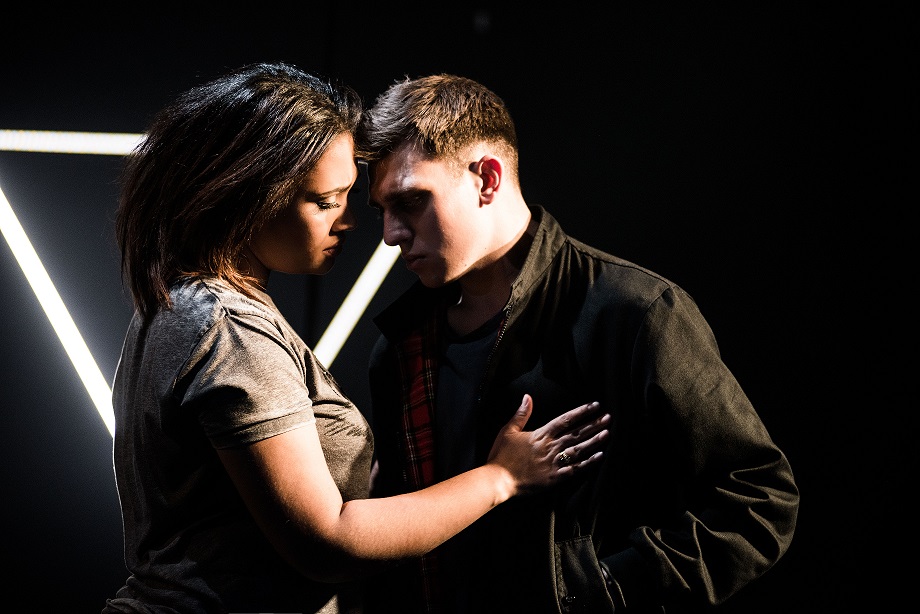
Review: La Ronde at The Bunker Theatre

Max Gill’s adaptation of La Ronde by Arthur Schnitzler launches the second season at The Bunker, and it’s already causing quite a stir. Partly this is down to the star cast, but it’s fair to say the major draw of this production is its unique and fascinating format.

Four actors – Lauren Samuels, Amanda Wilkin, Alex Vlahos and Leemore Marrett Jr – play between them ten gender-neutral characters. There are ten scenes, each featuring two of the actors. But who appears in which scene is entirely down to fate, and decided by the slow, deadly spin of a roulette wheel. Altogether, there are over 3,000 possible different versions of the show, so it’s no surprise that it cries out for multiple viewings. Fortunately, it’s also entertaining enough to ensure that wouldn’t be a chore.

Photo credit: Ray Burmiston
The use of a roulette wheel is appropriate, because La Ronde is a risky enterprise in more ways than one. Firstly, there’s the danger that one of the actors might find themselves repeatedly out of the loop; I saw very little of Amanda Wilkin until the comparatively short final two scenes, which she appeared in by default. (On the other hand, the mounting suspense of waiting to see if she would finally get her moment meant we never got bored of watching the wheel spin every few minutes.)

The format is also incredibly demanding for the actors, who have to learn every part and really think on their feet – but this outstanding cast have more than risen to the challenge. Every individual performance is confident and believable, as are the relationships between the different pairings, regardless of gender combination.

The overarching theme of the play is sex, and there’s some form of sexual encounter in every scene, whether consummated or not (which prompts the interesting question, what even counts as a sexual encounter; where do we draw the line?). Some are illicit, many unsatisfying, others quite poignant… And all of them are unseen, because the stage is plunged into darkness at the critical moment – an interesting choice that suggests the deed itself may not be quite as critical as what leads up to it, or what happens afterwards.

The script is necessarily gender-neutral, which creates a few awkward moments and rather excessive use of the characters’ (unisex) names, but on the whole flows more naturally than I expected. The different combinations of male and female force us to examine our own expectations about gender roles within sexual relationships and society as a whole. Questions of power, vulnerability, even career stereotypes (why should a female bus driver or a male cleaner be any more unusual than the opposite?) are all eloquently addressed, without labouring the point; the scenarios are unfolded before us and we’re left to consider our own response.

Photo credit: Ray Burmiston
The modern setting and individual scenes are the work of writer/director Max Gill, inspired by stories he collected over several months from Londoners – snippets of which we hear during the transitions between scenes. But the structure of the play comes from Schnitzler, and is just as enthralling. Each character appears in only two consecutive scenes, with the first actor selected by the wheel returning at the play’s conclusion to close the circle. So within this big loop are lots of little ones, all linked both directly to their neighbours, and also indirectly, with events and characters referenced from earlier scenes. (Weirdly, the pattern reminded me a bit of that magic roundabout in Hemel Hempstead – which is not something I ever thought I’d write in a theatre review, and is honestly a lot more flattering than it sounds.)

The biggest disappointment of La Ronde, for me, is that I probably won’t have time to see it again and compare last night’s version with another – and so in a way, I feel like I can only half appreciate how clever the show is. But that’s really a compliment; this is an original and endlessly fascinating idea, brilliantly executed by both cast and creatives. It’s not without its risks… but I’d say this particular spin of the wheel is a winner.

Additional note on 7th March:

As it happens, I did get a chance to see La Ronde again, a few days ago, and it was just as interesting as I suspected it would be. With the exception of one scene, every pairing was different to the last time, and in one case involved the same people but in opposite roles. And though the script was familiar, the different combinations – not only of gender but of personality and style, too – made it into a brand new story. Some scenes were funnier than before; others much more emotional. Some characters were more likeable; others harder to relate to. And though the sexual encounters were the same in location and circumstance, the responses to them were different – not because, for instance, it was between a man and a woman instead of two men, but because it was between two unique human beings.

There’s something slightly addictive about La Ronde; having been twice I now want to go again (and again). It’s a show of – almost – infinite possibilities, and one that you sense will remain constantly fresh and exciting, for audience and actors alike.


Can’t see the map on iPhone? Try turning your phone to landscape and that should sort it. I don’t know why but I’m working on it… 😉

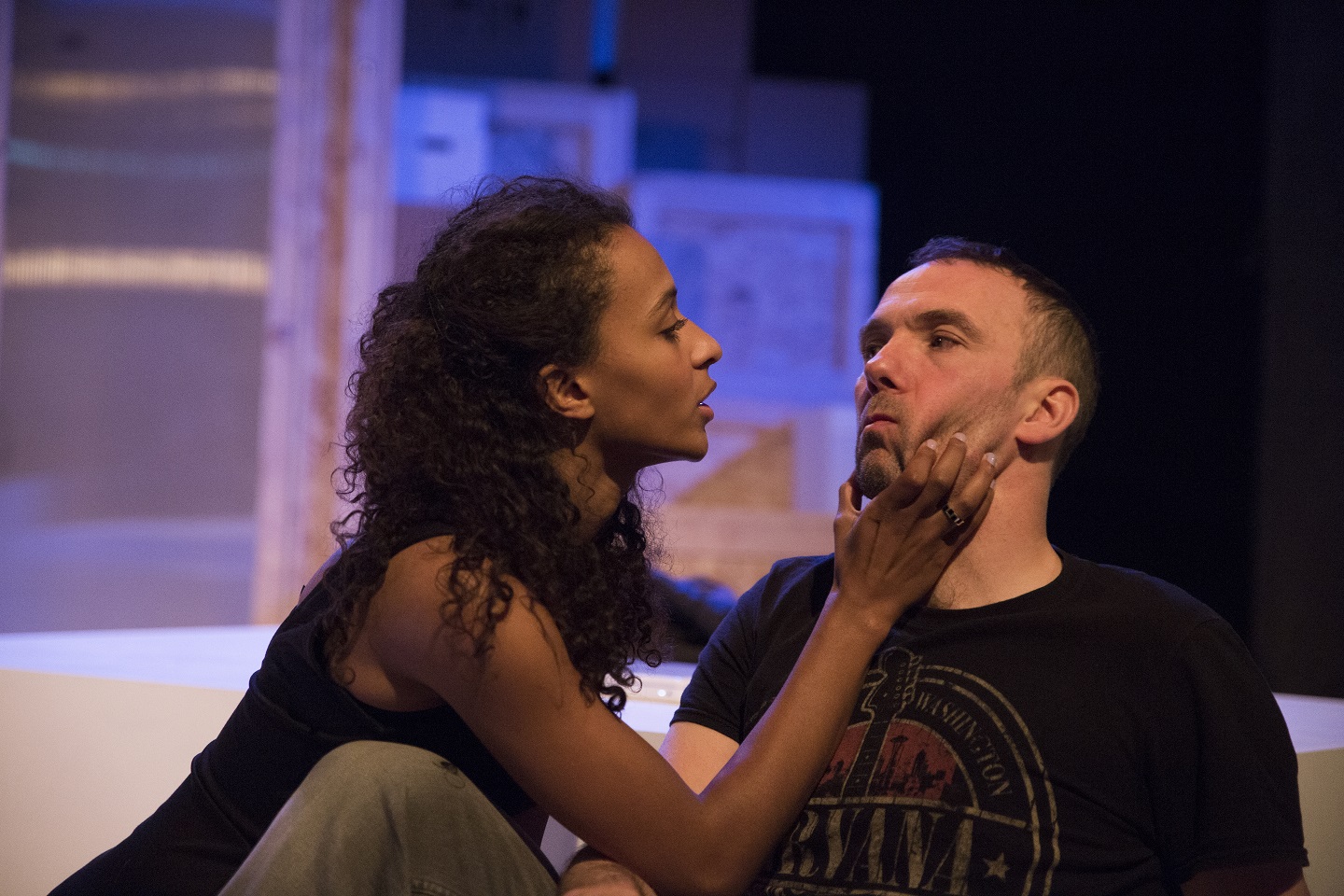
Review: Abigail at The Bunker

The Bunker’s first season concludes with Fiona Doyle’s two-hander, Abigail. Although why it’s called Abigail is an intriguing question, since the two characters in the play remain nameless throughout. It’s a dark tale about a dysfunctional, abusive relationship – but in a welcome challenge to convention, here it’s the man who’s the victim, struggling to find his way back to who he was before they met.

It all starts well: after meeting in the snow outside Berlin Airport, the couple embark on a whirlwind romance. He’s quite a bit older than her, but their attraction is instant and intense. By the time their one-year anniversary rolls around, though, it’s all fallen apart. He says he wants to leave; she has other ideas. Doyle’s script hops back and forth in time, filling in the story of their relationship as their final showdown unfolds in the present.

Photo credit: Anton Belmonté for 176 Flamingo Lane

Tia Bannon and Mark Rose give compelling performances as the unhappy couple, dealing skilfully with the many changes in mood as time skips back and forth. Bannon has a bright smile that appears at inappropriate moments and which never quite reaches her eyes. And there’s an eerie, almost robotic calm about her throughout, which makes her violent outbursts all the more shocking. Rose, meanwhile, is the very image of a broken man, and handles the physical side of the role well; I’ll say no more for fear of spoilers, but suffice to say that at times his performance is uncomfortably convincing.

Max Dorey’s set, made up of boxes stacked in a huge pile, allows director Joshua McTaggart the chance to get creative with the staging; the two actors cover almost every inch of the space as they climb all over it, producing props and costumes that are concealed within the set, and which gradually end up scattered around the stage as the couple’s anniversary evening unravels.

So what’s there is good – but the problem is it feels like there’s quite a bit missing from the story. There’s nothing wrong with plot gaps in a play; having everything handed to you on a plate removes any need for interpretation or discussion afterwards. But at just 60 minutes, this play has more gaps than most – and leaves us with a lot of questions but not enough info to try and answer them.

Photo credit: Anton Belmonté for 176 Flamingo Lane

There’s an attempt in the script to explore the psychology of the abuser, but without sufficient detail for us to really understand her motivations. Some conversations seem like they’re about to reveal an important clue – but then the scene changes and we’re left (quite literally) in the dark.

As for the abused, we know next to nothing about him; he keeps insisting he’s not himself in this relationship, but apart from the scene in which the couple first meet, we get very few insights into who he really is outside it; she spends a lot of time reminiscing about her early life, but he never gets that opportunity. No attempt is made to explain why he’s stayed in a relationship that he says himself was only good for the first couple of months, nor what’s prompted him to finally take action now. It’s not often we get to see a depiction of abuse that’s this way around, so it feels like we’ve missed out on a rare opportunity to hear the point of view of a male victim.

I’ll say it again: what’s there is good. This is an excellent production, with strong performances, of a play that just feels a little bit too short. With a bit of work, this could be a really powerful piece of theatre, shedding light on an issue that currently doesn’t get enough attention. As it is now, it’s an enjoyably dark drama, but it doesn’t make the lasting impression that it probably should.


Can’t see the map on iPhone? Try turning your phone to landscape and that should sort it. I don’t know why but I’m working on it… 😉

Review: Muted at the Bunker

Tucked away in a converted underground car park a few minutes from London Bridge is The Bunker, London’s newest (and quite possibly coolest) off-West End theatre. Its inaugural season continues with Muted, a new British musical that’s been several years in the making.

Written by Sarah Henley, with music and lyrics by Tim Prottey-Jones and Tori Allen-Martin, Muted is the story of Michael (David Leopold), a promising young musician rendered mute by the death of his mother (Helen Hobson) in a hit and run accident. Now cared for by his reluctant uncle (Mark Hawkins), he hasn’t seen any of his old friends for years – until his ex-girlfriend Lauren (Tori Allen-Martin), now in a relationship with his best friend Jake (Jos Slovick), comes to visit… and it becomes clear Michael isn’t the only one struggling to say what’s on his mind.

Photo credit: Savannah Photographic

The show was initially called After the Turn, but Muted feels like a more appropriate title – not only because of the subject matter but because it accurately sums up the musical itself. There are no big show-stopping song and dance numbers here; Muted is a quiet, reflective piece about the different ways we cope with loss, and the music is similarly gentle in tone, allowing the characters – most notably teenage Michael (Edd Campbell Bird), who speaks for his older self – to express what they can’t say in any other way. It’s music that makes an impression without needing to be catchy or toe-tapping, and left me wanting to listen to it all over again.

The story too is a bit of a slow-burner, with Act 1 focusing very much on establishing the back story, relationships and motivations of the characters, before the pace picks up in Act 2 and events begin to spiral out of control. The finale is undeniably beautiful, although it feels rather abrupt – everything falls suddenly into place in a conclusion that’s a bit too neat, especially after such a lengthy build-up.

In a uniformly strong cast, David Leopold is perfect as the damaged Michael. Unable to make a sound, he speaks volumes with his face and body language, expressing his vulnerability and frustration with a twitchy intensity and haunted gaze. His relationship with teenage Michael, played by Edd Campbell Bird, is particularly moving; radiating energy and assurance, the younger man acts simultaneously as a friend and a constant reminder of everything he’s lost. Equally flawless is Tori Allen-Martin as Lauren, who unlike Michael, talks too much – but beneath the chatter lies a young woman who’s just as fragile as her ex-boyfriend, and it’s not at all clear by the end of the story who needs whose help more.

Photo credit: Savannah Photographic

Jamie Jackson’s production is quite abstract, leaving much open to interpretation. The set, designed by Sarah Beaton, is simple and stark: a square walkway surrounding a shallow pool of water, at the centre of which sits the island representing Michael’s bedroom. (There’s also a swing hanging from the ceiling, which gets a lot of use throughout the show, although its significance is never totally clear.) And many of the songs are accompanied by gestures from the actors that fall somewhere between interpretive dance and a kind of sign language, stripping the story back to its core emotions and producing some of the most visually striking moments in the whole show.

Muted is a powerful new musical that appeals to every emotion; it’s at times desperately sad, at others laugh out loud funny, and concludes on a note of cautious optimism. Though the show’s not yet perfect, it certainly has the potential to be – and even now, there’s no doubt it’s been well worth waiting for.


Can’t see the map on iPhone? Try turning your phone to landscape and that should sort it. I don’t know why but I’m working on it… 😉