Review: FCUK’D at The Bunker Theatre

There’s a particularly poignant moment in Niall Ransome’s FCUK’D, in which two frightened boys huddle together under a railway bridge in the freezing cold, while above them commuters are absorbed in their phones and Christmas revellers make their merry way home, all of them oblivious to the children who need their help just yards away.

While this image has plenty to say about our society and way of life, it’s also a pretty good metaphor for the show itself. While other theatres opt for the crowd-pleasing spectacle of panto, not far away The Bunker is quietly doing something very different to mark the festive season – reminding us along the way that not everyone is celebrating just because it’s Christmas. FCUK’D is a simple, understated yet incredibly hard-hitting one-man show about seventeen-year-old Boy and his little brother Matty. Having been abandoned by their father and neglected by their mother, Boy lives every day in terror of Matty – the person he cares about more than anyone else in the world – being taken away. And he’s willing to do anything, even go on the run, to prevent that from happening.

Photo credit: Andreas Lambis

However touching Boy’s motivation, when it inevitably happens the two brothers’ flight always seems like a doomed enterprise. Boy is, by his own admission, rash and immature; he has no idea what he’s doing and is clearly as terrified as his confused little brother. Driven by desperation and fear, the pair have no money, shelter or transport and are forced to take increasingly extreme measures to survive in the freezing December temperatures. Their devotion to each other is such that we want them to make it, and yet we have to acknowledge their situation is unsustainable, and to question if this really is the way to give Matty his best chance – even if the alternative is a system that isn’t doing enough to help young people in trouble until it’s too late.

Will Mytum gives an utterly compelling solo performance as both Boy and Matty (he even has a convincing play-fight with himself at one point). Delivering Niall Ransome’s rhyming verse in a way that highlights the poetry but still sounds completely natural, Mytum has all the swagger and false confidence of any teenager, but with a haunted expression that reveals the self-loathing and insecurity lurking not far beneath the surface. Then, all of a sudden, it’s like a switch is thrown as he transforms into Matty and we see all the fear and doubt fall away. Matty is adorable – innocent, inquisitive, and with such absolute faith in his big brother that he’ll follow him anywhere, no matter what it might cost.
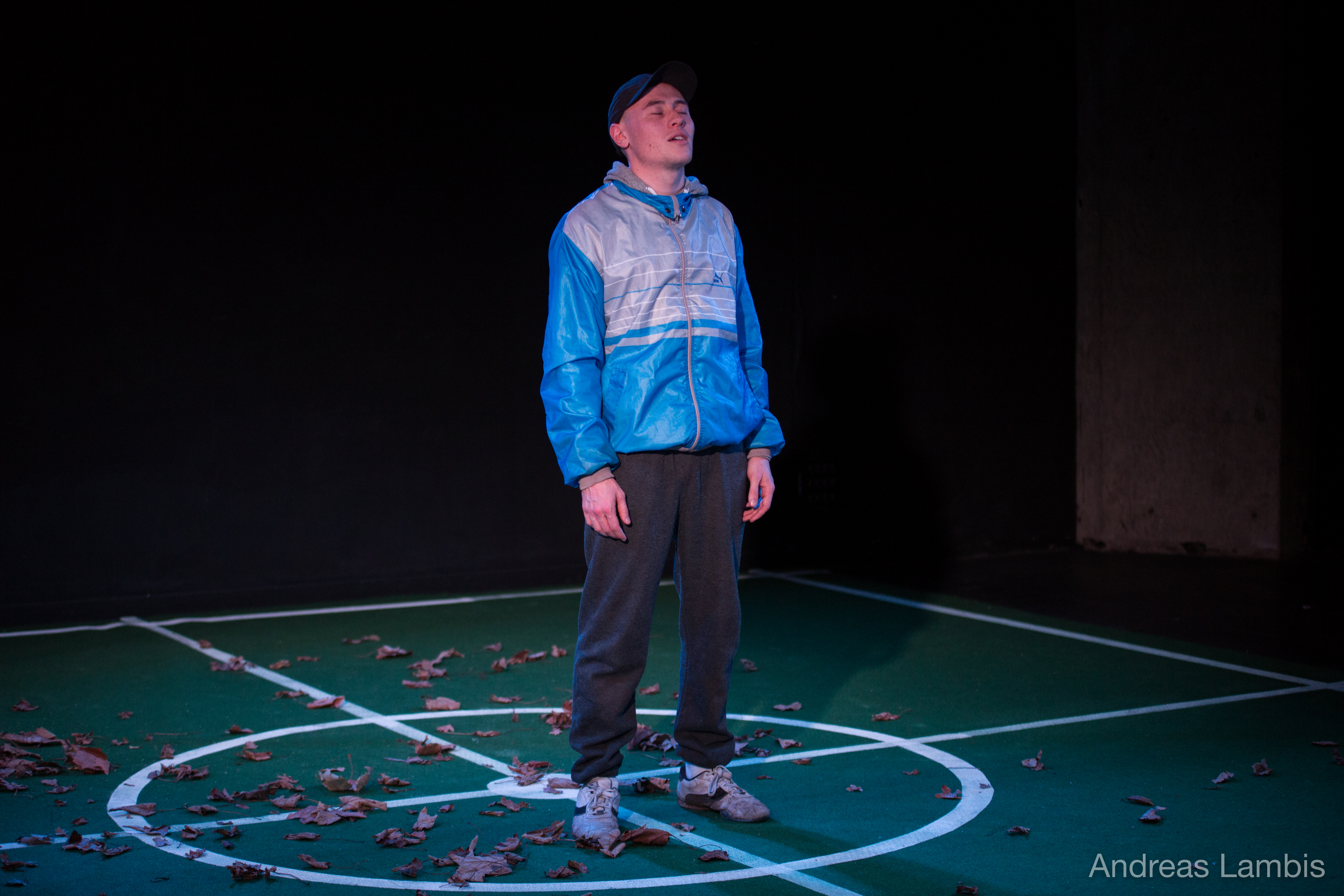
Photo credit: Andreas Lambis

The rest of the production, which is also directed by Niall Ransome, is similarly understated, with effects that – unlike in many festive shows – support the central performance without trying to be the main focus. Peter Wilson’s ominous score helps to build the tension, while the set by Grace Venning captures the harsh urban environment of Boy and Matty’s world. And Jess Bernberg’s brilliantly effective lighting combines with Ransome’s words to show us things we can’t see, like the flickering orange of a flame, or the blue lights of an approaching police car.

FCUK’D is not your typical Christmas show, but that’s not a bad thing; pantos are always good festive fun, but they’re also about as far from the real world as it’s possible to get. At this time of year perhaps more than any other, when we can get so absorbed by shopping, wrapping, cooking and partying, a shot of reality – however sobering – might be just what’s needed.


Can’t see the map on iPhone? Try turning your phone to landscape and that should sort it. I don’t know why but I’m working on it… 😉

Review: Eyes Closed, Ears Covered at The Bunker

In Alex Gwyther’s thriller Eyes Closed, Ears Covered, two teenage boys bunk off school and go on an adventure to Brighton. It’s obvious from the start that the two friends have a complex and potentially unhealthy relationship – and when something terrible happens on the beach, it falls to two frustrated police officers to try and make sense of the day’s events.

Much like the officers, the audience must piece together the clues to work out the real story behind Aaron and Seb’s day trip – and when the final piece of the jigsaw slots into place moments before the play ends, the truth turns out to be as shocking as it is satisfying. I love a well-written thriller that really keeps you guessing, and this play definitely falls into that category.

Photo credit: Anton Belmonté of 176 Flamingo Lane

Many of the characters in Derek Anderson’s production feature only as Big Brother-esque voiceovers, which means all our attention is focused on the story’s three leads. Danny-Boy Hatchard takes control in the first act as Aaron, who’s the mastermind behind the adventure. Outgoing and often very funny, he can also be unpredictable and aggressive when things don’t go his way… and he wields a disturbing amount of power over the naive and socially awkward Seb.

Act 2 abandons the police station and is carried by the excellent Joe Idris-Roberts, who takes us back in time to explore the tender relationship between ten-year-old Seb and his mother Lily, played by Phoebe Thomas. As well as answering a lot of the questions posed by Act 1, this part of the play also leads us into increasingly dark territory (there’s very little laughter to be heard after the interval), touching on themes of domestic violence and mental health as it paves the way for the story’s dramatic conclusion.

A simple set proves no obstacle to the storytelling, with some impeccably timed movement (directed by Jonnie Riordan) helping to build a picture of the characters’ surroundings, and Norvydas Genys’ lighting design keeping the action moving between locations, as well as back and forth in time. There’s also a great moment at the beginning of Act 2, when Lily replaces a photo of herself, appearing on stage as if by magic.

Photo credit: Anton Belmonté of 176 Flamingo Lane

There’s just one niggle for me about the play, namely the decision to set it in the 1980s. This isn’t particularly borne out by the story (I remember just one popular culture reference to Tom Selleck as a relevant movie star), and putting 30 years between the events of the play and its audience suggests they have no relevance today – when in fact the opposite is true.

That said, this is without doubt a compelling and well executed piece of theatre, which grabs our attention from the start and never loses its intensity. With three brilliant performances and a dramatic twist ending, this dark thriller is well worth a visit.


Can’t see the map on iPhone? Try turning your phone to landscape and that should sort it. I don’t know why but I’m working on it… 😉

Interview: Michelle Payne, The Staff Room

They’re teaching our children, but are they teaching the right things…?

Michelle Payne’s The Staff Room started life as a 15-minute piece, written for an Actor Awareness scratch night. Now a one-act play, the show is all set for its first Edinburgh preview tomorrow at The Bunker, followed by a second at Barons Court Theatre on Saturday, before heading to the Fringe.

The Staff Room follows three young teachers on their breaks through an academic year,” Michelle explains. “You can expect to see a slice of life; an insight into what our teachers get up to in state schools.”

The play was inspired by Michelle’s own experience as a freelance dance teacher. “I was working in a lot of different schools for a really long time, so I sat in a lot of staff rooms,” she says. “I found the dynamics really interesting, and often very comical. I wanted to praise our hard working, state school teachers and give them an up to date voice in the theatre!”

While the play is a must for anyone who’s ever wondered what goes on behind the staffroom door (which, let’s be honest, is all of us when we were at school), Michelle hopes it’ll also be enjoyed by those within the profession: “Definitely teachers! And I also hope it appeals to young, working class people. Hopefully it’ll make our audiences laugh, and provoke discussion about political topics.”

Joining The Staff Room‘s all female creative team are cast members Faye Derham, Hilary Murnane and Craig Webb – who audiences might recognise from a recent high-profile TV appearance. Michelle explains, “Craig, who plays our Geography teacher Hugo, was a finalist singing with Neon Panda on Gary Barlow’s Let it Shine on BBC One. Which was very exciting for us – seeing him on the telly!”

The Actor Awareness campaign, founded by Tom Stocks, has played a key role in the play’s development. “I wrote the first draft of the play especially for an Actor Awareness health themed scratch night,” says Michelle. “This was chosen and performed at Theatre N16 last year. From this we were offered a full show at N16 if I could extend the play to one act for the summer. So Actor Awareness definitely supplied me with that initial opportunity!”

Following the show’s two London previews, Michelle and the team will be heading north for a run at Edinburgh’s theSpace @ Surgeons Hall from 21st-26th August. “I’ve visited the Fringe every year for the past six years and have supported friends’ shows, so I’m glad it’s finally my turn to have a show up there!” she says. “We’re looking forward to getting some feedback and hopefully making people laugh.”

Catch The Staff Room at The Bunker on 18th July, Barons Court Theatre on 22nd July or in Edinburgh at theSpace @ Surgeons Hall, 21st-26th August.

Review: The Enchanted at The Bunker

If you had to think of a word to describe death row, what would it be? Dark, perhaps. Hopeless. Desperate. Whatever word first comes to mind, probably one of the last would be enchanted. Yet this is how Pharmacy Theatre’s haunting play begins, as a death row inmate describes his surroundings in language so poetic and beautiful it seems impossible he could be talking about a prison where men and women who are despised and forgotten by society go to die.

Photo credit: Dina T

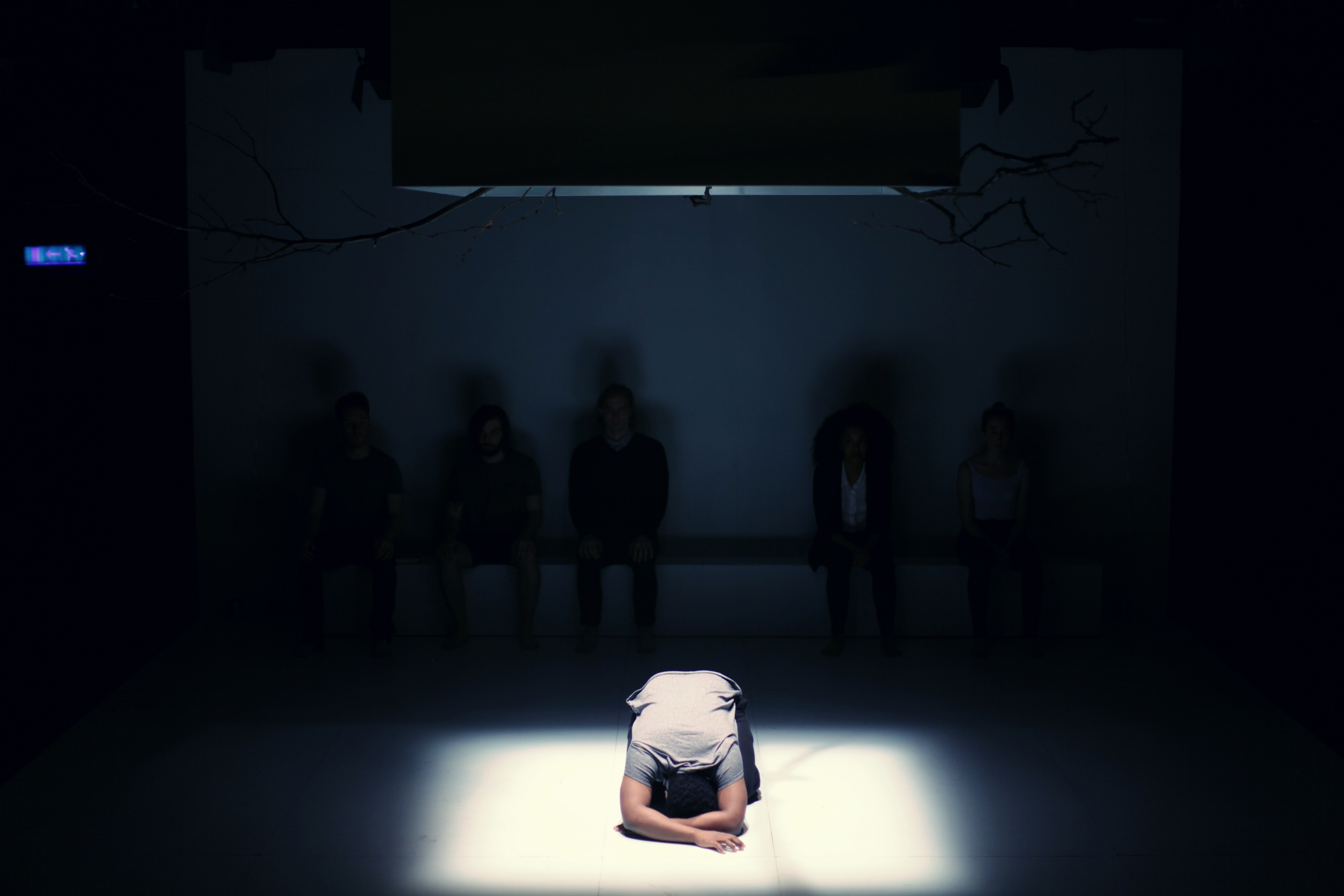
This is just one example from the play of how hope and redemption can be found in even the darkest of places… or people. The Enchanted – both the play and Rene Denfeld’s novel on which it’s based – tackles head on the assumptions we in the free world make daily about death row: everyone there is evil; they feel no love or remorse; they deserve to be where they are, and can have nothing to offer the world but more pain. It does this without making excuses or painting an unrealistically rosy picture: the two prisoners in the play are guilty men who’ve done terrible things, the full details of which – thankfully – we never learn. What’s more important is not what they’ve done, but why; at the play’s heart is a desperate need to understand, and as the actors scrawl words and images on the walls and floor in chalk, the set begins to resemble a big mind map trying to make sense of a huge and complex problem.

Condensing the multiple complex strands of the novel into 90 minutes, Joanna and Connie Treves’ skilful adaptation is narrated by Arden, a prisoner whose crimes are so terrible that nobody – not even other killers – ever speaks of them. In a spellbinding performance, Corey Montague-Sholay plays this character with an intense vulnerability that’s at odds with his role as murderer; every movement, gesture and facial expression, his childlike love of books and his poetic use of language to escape the confines of his world cry out to us that this is not an evil man, but rather one who’s been broken by life.

Perhaps more in keeping with our imagined idea of a death row inmate is York (Hunter Bishop), the man in the cell next door. Unpredictable, unstable and unkempt, all restless energy and crazy eyes, he’s done the unthinkable: given up on his appeals and decided he wants to die. The only person now standing between him and execution is The Lady (Jade Ogugua), an investigator who’s become a symbol of hope for everyone on the row. As she delves into York’s past, she uncovers a horrific tale of abuse and neglect – hauntingly portrayed by puppets, as if in a therapist’s office – that explains how he ended up a killer. But can she convince him to live – and is that even her ultimate goal, or does she have some other motivation for her tireless efforts to get inside the mind of a murderer?

Photo credit: Dina T

What comes across so well in the performance, movement (directed by Emily Orme) and language of all the actors is a deep sadness and sense of collective responsibility – not just from those who’ve committed crimes, but also from those around them, who failed to hear or react to their cries for help as they set off down the dark path that ends on death row. While in no way diminishing the responsibility of the individual for their own actions, the play makes it clear that society must take some of the blame; otherwise how can we ever hope to stop such crimes from happening?

Just as in life, there are no easy answers or neat endings in this dark and gripping tale – to suggest there are would be overly simplistic. The Enchanted isn’t a political drama but an urgent human one, shining a light on a world most of us can’t even imagine, and forcing us to confront and accept the flawed and forgotten humanity of those within it, before they run out of time.


Can’t see the map on iPhone? Try turning your phone to landscape and that should sort it. I don’t know why but I’m working on it… 😉
Review: This Is Not Culturally Significant at The Bunker

Rightly or wrongly, there’s one thing most people will know going into Adam Scott-Rowley’s one-man show, This Is Not Culturally Significant – so let’s get it out the way first. Yes, he’s naked. No, it’s not weird. Uncomfortably explicit on occasion, yes; the first couple of minutes are unforgiving and throw us entirely in the deep end. It definitely won’t be everyone’s cup of tea. But surprisingly quickly the nudity not only stops being an issue; it starts to feel like a necessary part of the performance.

Photo credit: Bessell McNamee

To make sense of that, let’s go back a bit. This Is Not Culturally Significant, we learn in the programme, began life as a series of caricatures that grew and developed, and ultimately began to link together. There’s an American porn star and her lonely father, an abusive husband and his timid wife, a homeless Scottish woman, a bitter theatre producer who’s being ousted in favour of Andrew Lloyd Webber… and several others, all of whom challenge us and each other simply by being themselves in a world that doesn’t quite know what to do with them.

And every one of those characters is played by Adam Scott-Rowley in an astonishing virtuoso performance that sees him transforming from one persona to the next, sometimes abruptly, sometimes slowly. These changes become more frequent as the show goes on and his characters increasingly jostle for centre stage. Posture, personality, voice and accent are always absolutely distinct; it’s clear he knows each of the characters intimately, and his embodiment of them is so skilful that by the end of the 50 minutes we feel we’re starting to know them too.

And so back to the nudity, which was initially introduced as a way to add vulnerability to the characters, but ends up serving a far more practical purpose: with no need for costume changes, the shifts are not only easier and quicker but a lot more effective; it would have been difficult to believe in a bag lady dressed in the same clothes as a posh racist or a spiritualist lecturer, and pausing to change would interrupt the flow. Seeing someone so entirely exposed – in every sense – also gives the show an extra intensity, and ironically it ends up being the one naked guy in the room who’s most at ease.

Photo credit: Bessell McNamee

It’s not only the nakedness that keeps us on edge; this is a show you experience rather than enjoy, and the abruptness of the character changes, flashing lights, loud noises, and one exquisitely awkward moment where it’s not clear if audience participation is required (I still don’t know, if I’m honest), all contribute to ensure we never get too comfortable. Yet there are moments of dark humour too, with much of the laughter fuelled as much by surprise or recognition as by amusement.

I can honestly say This Is Not Culturally Significant is unlike any show I’ve seen before – but I can just as honestly say that’s not only because it’s performed nude. If everyone goes in knowing that one thing, let’s hope they come out talking about Adam Scott-Rowley’s extraordinary performance, and acknowledging that the nudity enhances something that’s already pretty special – with or without clothes.


Can’t see the map on iPhone? Try turning your phone to landscape and that should sort it. I don’t know why but I’m working on it… 😉