Interview: Nathan Ellis, No One Is Coming to Save You

Kicking off on 11th June, Breaking Out is a festival of world premiere shows by emerging theatre companies, chosen from over 45 different projects by the artistic team at The Bunker Theatre. One of those shows is No One Is Coming to Save You from This Noise, a new theatre company that try to find contemporary languages for political action. An experimental duologue about one night in the lives of two people in their early twenties, No One Is Coming to Save You explores youth loneliness, power and powerlessness, and the hope for something better.

“Pretty much every day a new article will come out online about how young people are really unhappy and disappointed with the world and their lives, and that didn’t seem to be being reflected in the work we were seeing onstage, which either ignores young people altogether or is extremely interested in their sex lives,” explains writer Nathan Ellis. “We wanted to be more reflective and talk about how it really feels to be young, and how that feeling that something better is coming is maybe masking a sneaking suspicion that it isn’t.

“We really want to accurately reflect what it feels like to be young right now in both the content and the form of the play. The form of the show has been ambitiously experimental from the beginning. The two performers tell the story of two people, but as the story progresses, the lines between themselves and their stories start to blur. It’s exploring the feeling of being not-quite-in-the-world that seems particularly salient to contemporary experience. If you like Caryl Churchill or Chris Thorpe – plays that demand you think and feel – then you’ll like this.”

Nathan started writing No One Is Coming to Save You in 2016 at a residency in Oxford. “It’s almost unrecognisable from that point, but it’s essentially got the same DNA as that play,” he says. “Since then the company have had a year’s worth of workshops and scratch performances and sharings to bring it to where it is now, and have been really generously supported by Arts Council England. A lot of the play has been collaborative, with lots of discussion with people within and outside the company about its themes – everyone in the company is under 25 – and experiences from their own lives.”

No One Is Coming to Save You is the first production from This Noise, who focus on making theatre by, with, and for young people: “We are made up of a group of interdisciplinary makers across writing, design, and performance and have been Arts Council East funded since 2018,” says Nathan. “We basically think theatre is a great space to talk about how complicated it is to be alive right now, without resorting to simple answers or platitudes. If you’re looking for a formally experimental show that explores how it really feels to be young today – about youth loneliness, mental health, and the terrors of a world not working, then give No One Is Coming to Save You a go.

“Although it deals with serious issues in a complex, challenging way, the play is actually very hopeful. Without spoiling the ending, it’s got a real belief behind it that communal experiences – like sharing space and sharing a story – can really make us feel more connected to each other. Hopefully it will challenge people with a new form and maybe make them smile a bit too. There are some funny bits – promise!”

With a little over two weeks until their first performance as part of Breaking Out, Nathan and the team are looking forward to bringing their work to The Bunker. “This Noise are unbelievably excited about Breaking Out. It’s so exciting to be part of such a vibrant season of other work by emerging companies. Particularly as a company exploring how it feels to be young, it will be so great to see where their work has taken them and to see the pieces in conversation with each other. We’ve been in love with the Bunker since it opened and always wanted to perform the show there. It already has such a history of supporting complicated, experimental work that would otherwise not get a platform in London. It’s such a versatile space and one that has a real atmosphere and engaged audience, who we think will really appreciate the challenge of a show like No One Is Coming to Save You.”

Review: Grotty at the Bunker Theatre

As tours go, this one is not for the faint-hearted. Izzy Tennyson’s aptly named Grotty provides a rare opportunity to explore East London’s lesbian scene, but avoids any temptation to romanticise; this trip is not an advertisement, but a warts and all depiction of a community rarely seen on stage.

Our guide is 22-year-old Rigby, played by Tennyson, who’s relatively new to this world herself and experiencing something of a baptism of fire. As the play begins, she’s in a relationship with Toad (Rebekah Hinds), who’s older, more experienced and in possession of a significant amount of baggage. This includes ex-lover Natty (Anita-Joy Uwajeh), a persistent and unwelcome presence in Rigby’s life, and former fiancée Witch (Grace Chilton), an outcast whose dark sexual proclivities are the stuff of legend. Almost inevitably, it’s not long before Rigby and Witch’s paths cross, marking a new stage in Rigby’s emotional and sexual education, and establishing a complex triangular situation that is, to use her own word, more than a little grotty.

Photo credit: The Other Richard

Rigby herself is a fascinating creation: a twitchy, awkward figure who’s unafraid when addressing the audience to offer a sharp-tongued critique of both lesbian culture and the various personalities she meets within it, but often falls silent when joined by other characters who “outrank” her. Despite the community’s marginalised status both in society as a whole and within LGBTQ circles, there’s very little sense of unity or mutual support among its members, apart from when mocking outsiders who pretend to be gay because they think it makes them look cool. Instead Tennyson paints a picture of a claustrophobic, hierarchical world where everyone knows everybody else’s business – a sensation emphasised by Hannah Hauer-King’s direction, which places Rigby at the centre while the other characters observe her in silence from each side of the stage.

While the messy situation between Rigby, Toad and Witch forms the core of the narrative, the five-strong cast actually plays a total of nine characters between them, including straight friend Kate; a potential new love interest, Elliot, whose appeal seems to lie largely in the opportunity for Rigby to take the lead for once; and Dr Alexandra, whose analysis concludes that her patient is “suicidal, but not suicidal enough” to warrant treatment. There’s also a brief appearance from Clare Gollop as Rigby’s mother, in a late twist that sheds an interesting new light on all that’s gone before. We learn little about any of these women, who in many ways are more caricature than fully developed characters, but they do allow us a further insight into Rigby’s character, her mental health, and the ways in which she adapts her personality and manner to each new interaction in her quest to belong.

Photo credit: The Other Richard

There are some aspects of the play that don’t completely work: many of Rigby’s monologues are delivered so quickly that it’s hard to keep up or fully appreciate the savage humour of Tennyson’s writing, and the plot ends abruptly just as it reaches an interesting potential turning point (perhaps a sequel in the making?). That said, a look around at audience reactions is enough to confirm that Grotty does what it sets out to do: bring an often overlooked subculture into the spotlight in a way that’s both educational and inclusive.

Can’t see the map on iPhone? Try turning your phone to landscape and that should sort it. I don’t know why but I’m working on it… 😉

Interview: Peter Imms, Section 2

“People need to see something about this topic, and to talk about it – as long as you chat about it in the bar afterwards, that’s great.”

Section 2 is a new play by London-based playwright Peter Imms, which addresses the sensitive subject of mental health. It’s been developed in collaboration with Paper Creatures, an emerging theatre company founded last year by Jon Tozzi and Nathan Coenen, and will open in June as part of the Bunker Theatre’s Breaking Out season.

The play follows the story of Cam, who was sectioned 28 days ago, as he faces the review that will decide if he’s well enough to go home. “The play looks at the coping mechanisms that everybody has to find within themselves – not just Cam but everybody around him,” explains Peter. “It’s a really intimate and intense piece that clings on to the desperation that people feel when they’re thrown into a situation as drastic as this.

“It’s a subject that I didn’t really know about until half a year ago, and I think generally it’s something that people don’t know much about – there’s not many source materials for what sectioning is and the effects it has on people. I did a bit of research and found that it does happen to a lot of people, but there’s not really a conversation about it. So this play is a nice way to have that conversation, but also it’s just a good, gritty intense drama about four characters, all trapped in the same situation and trying to achieve the same thing from different angles.”

Peter was inspired to write the play by an unexpected personal experience: “Someone I knew was sectioned, and it shocked me because it’s one of those things that you think is never going to happen to you. So it came from visiting them and reading about other people’s stories – I guess I’m interested by things I don’t understand, so I did a lot of work into what it actually is and the technicalities of it. We also got in touch with Mind, the mental health charity, who have been amazing with information and feedback. They put us in touch with a lot of other people who’ve been sectioned, and then from that point the stories just began to form. So Section 2 has come from a place of interest, intrigue, lack of understanding and passion.”

The play began life as an idea and ten pages submitted in response to a call-out by Paper Creatures, who were looking for a new project following the success of their critically acclaimed debut production, Flood. “Paper Creatures are so good as a company because they’re not like anybody else – they’re all about collaboration and creativity,” says Peter. “When I went to them with the idea for Section 2, they liked what it had to offer in terms of potential, and from there we developed it together. We got the director Georgie Staight on board really early, and it’s been a constant soundboard with everybody involved. We’ve had R&Ds – we went away to Wittering together, which was romantic and lovely – just to explore it and play with it. It’s my favourite way of working; it’s been so nice to be in the room with people at the top of their creative game, to develop the play and test things out.”

That development process has seen the play go through some significant changes from its initial draft. “Between the first and second draft, the play basically completely changed,” Peter explains. “The first draft had this huge twist, but when we had a reading of it we all agreed that although it was great and very tense, it didn’t give us anything other than ‘it’s a twist’. So I went away and essentially re-wrote the whole play, still in keeping with exactly the same themes but I changed the structure of it a lot. It’s been hugely fun and explorative; they’re all so giving and so, so good, and for me it was a treat just to see them rip it all apart and put it back together again.”

As for Paper Creatures, Peter has no doubt they’re the perfect company to tell Cam’s story. “They’re advocates for new writing – I’ve never met anyone else who genuinely cares so much about new writers,” he says. “They go and see new work, they’re growing new artists all the time – and not just writing, they’re constantly looking to connect with new set designers, new lighting designers, whatever. They’re just so passionate about ‘new’, and they want to be pioneers of new work – so for me that’s fantastic because that’s what I am.

“But also the sensitivity that they bring to a subject like sectioning and mental health in general is absolutely priceless; they have a perfect balance of creative desire and the will to push everyone in the company to be the best, but also to honour the story that we’re trying to tell, and I think they marry the two really well.”

Section 2 will be performed as part of the Bunker’s Breaking Out season, which sees six companies perform in rep over four weeks. “The Breaking Out season is a great way for emerging companies to get on stage,” says Peter. “I hope it’s going to have a familial feel, especially for us as we’re always sharing the same night with the same company (This Noise), so I’d like to think we’re going to get to know them and it’ll be quite a community.

“Before I even knew it was a possibility I felt the Bunker would be perfect for Section 2; it’s got this gritty, intimate, almost – in a good way – dirty feel. The audience are encroaching on the show, and it’s like a fly on the wall situation. When I found out that we’d got it, I was delighted and now I can’t see it anywhere else. And the Bunker have been great in terms of help with marketing and outreach. For example we’re having some post-show talks involving the creative team, Mind, and people who’ve been affected by sectioning, so the theatre have offered us the time for that and helped us set it up.”

Originally from the Midlands, Peter moved to London when he was 18 to go to drama school. “I think a lot of playwrights either get into it from acting or from writing in some other form,” he says. “I was the acting route – I went to East 15 for a year, which was absolutely invaluable in terms of knowledge of the business and how stuff works. With that move to London I really discovered theatre, it was like a blast of everything that was new, so going to drama school for that reason alone was so integral.

“From that I realised I liked the production side a little bit more, so I started to work with screen, writing and directing short films, and that led into just writing those films, and that led into theatre, because I found I was more suited to the dialogue base of theatre than the visual base of screen. So it was just a slow transition until I found what I was right for and more comfortable with. Now it’s been three years that I’ve been solely writing plays and honing my craft – everything’s slow with writing, but I feel like I’m getting there.”

His top tip to other aspiring playwrights is to see as much theatre as possible: “See stuff you love, see stuff you hate, see stuff you’re indifferent about, see stuff you hate and find stuff in it that you like. I try and go to the theatre a lot; I just think it’s really important creatively. In terms of new writing, I love the Royal Court, and the Bush is a favourite for me at the minute, I saw Misty there a couple of weeks ago and it was incredible. In terms of smaller venues, I’ve seen some great things at Theatre 503, and I’m really close to the Orange Tree and haven’t seen anything I’ve not loved there, so that’s one that stands out.

“If I’ve got a bit of a block and something I’m working on isn’t really flowing, sometimes I’ll see something at the theatre and it’ll just change something in me – even if you just see something you love, it’ll inspire your writing. I think that’s the most important thing. And in London there’s so much here, especially in fringe theatre. That’s all I spend my money on, to be honest – that and beer! – but I wouldn’t change it.”

Review: Devil With The Blue Dress at The Bunker Theatre

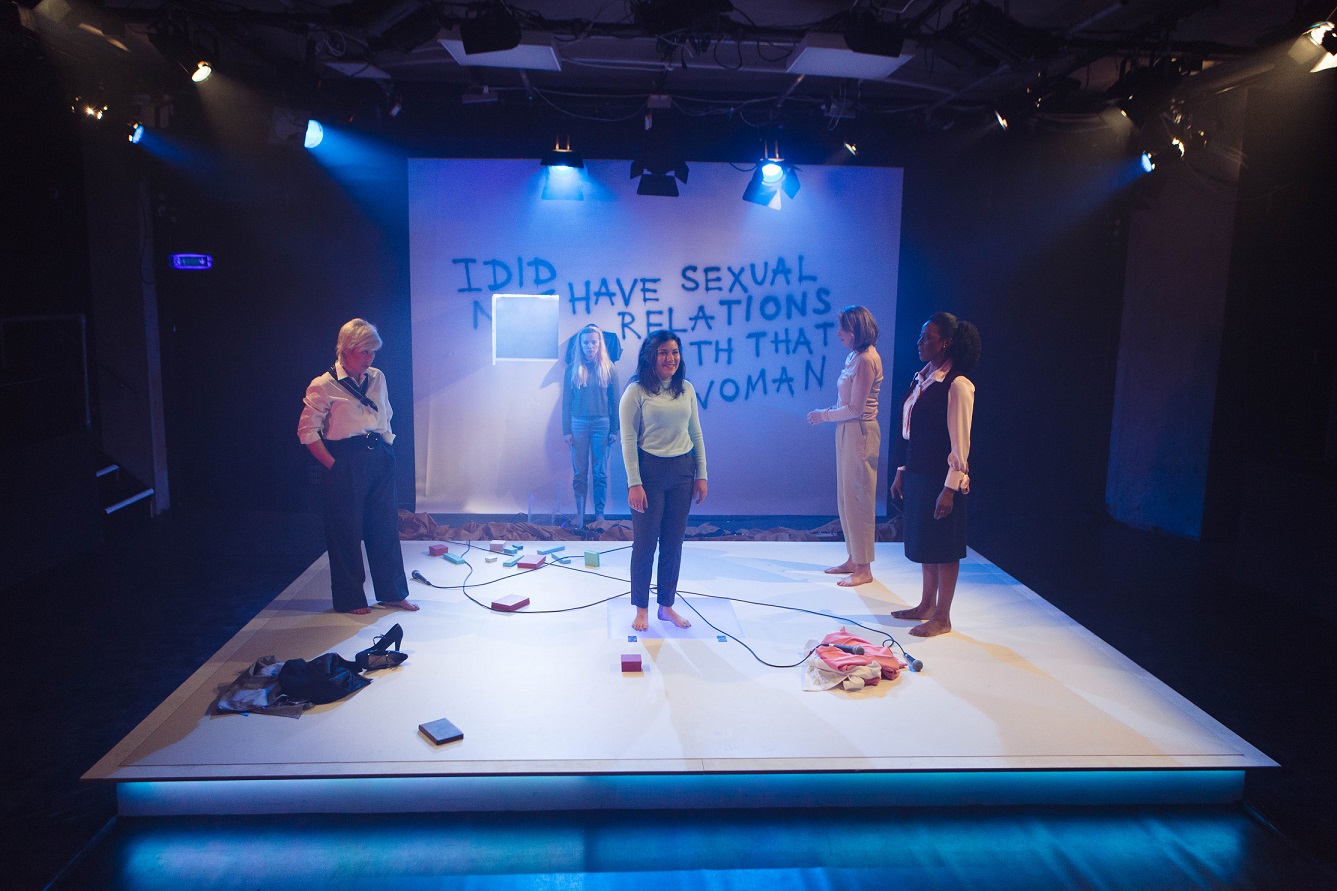
In Kevin Armento’s Devil With The Blue Dress, Hillary Clinton refers to her husband’s affair with Monica Lewinsky as the second worst thing ever to happen to her. It’s a great line, which unsurprisingly earns a big laugh, but it’s also a very telling comment. Hillary Rodham Clinton – lawyer, author, politician, mother, grandmother, the first woman to be nominated for president by a major political party in U.S. history – is still known above all by people across the world, and within her own nation, for two main events: that time her husband cheated on her with a 22-year-old intern, and that time she was beaten in the presidential election by a man with zero political experience, qualifications or intelligence.

Photo credit: Helen Murray

Devil With The Blue Dress examines the circumstances of the former, while reflecting on the impact it may or may not have had on the latter. Most of us above a certain age will remember, however vaguely, what’s become known as “the Monica Lewinsky scandal”; Armento’s script fills in the political and personal details, from the perspective of both Hillary (Flora Montgomery) and Monica (Daniella Isaacs), as well as the Clintons’ daughter Chelsea (Kristy Philipps), Bill’s devoted secretary Betty (Dawn Hope) and Monica’s friend and confidante, Linda (Emma Handy).

Joshua McTaggart’s production begins in an orderly fashion, with Flora Montgomery’s meticulously controlled Hillary presenting each of the characters in “her play” as they emerge from behind a curtain at the back of the stage. Then Monica, played by Daniella Isaacs, crashes the party, at which point the narrative takes a very different direction. She wants to tell her side of the story, and does so with colour and emotion; in fact she’s the total opposite of Hillary, and if we met her out of context, we’d probably quite like her. It’s a sympathetic view of a woman who’s rarely seen in such a positive light: young and in love, she’s manipulated by those around her and pays for it by becoming the face and name of a global scandal.

By Act 2, the curtain’s down, the truth is out and the gloves – or rather heels – are well and truly off, as little by little the five women turn on each other. And if there’s one key player noticeably missing from the all-female line-up, Bill Clinton still makes his voice heard, both through the sterling work of saxophonist Tashomi Balfour and through the women themselves, with the “supporting cast” of Chelsea, Linda and Betty each taking turns to speak his words. Meanwhile Hillary and Monica face off in a battle over who’s been most wronged by the other, neither apparently giving a moment’s thought to the idea that the President might bear some responsibility for their misery. And it’s that very point that makes this play about a 20-year-old scandal so relevant right now in 2018, with the #metoo movement continuing to gain momentum, even as Donald Trump – a man who literally believes he can do anything he wants to women because he’s famous – sits smugly in the White House.

Photo credit: Helen Murray

Though a little knowledge of U.S. political history might help, particularly at the start of the play, Armento’s writing is clear enough that anyone with the sketchiest knowledge of what happened in 1998 – and 2016 – can easily keep up with the chain of events. The conflict between the women makes for compelling viewing, but what really sets the stage for an interesting debate is the underlying question of why that conflict is even happening, and what damage it’s inflicting on both the individuals involved and the perceptions of those watching. I’ve never questioned why it’s known as the Monica Lewinsky scandal and not the Bill Clinton scandal – but I am now, and I don’t think I’m the only one.

Can’t see the map on iPhone? Try turning your phone to landscape and that should sort it. I don’t know why but I’m working on it… 😉

Review: Ken at The Bunker Theatre

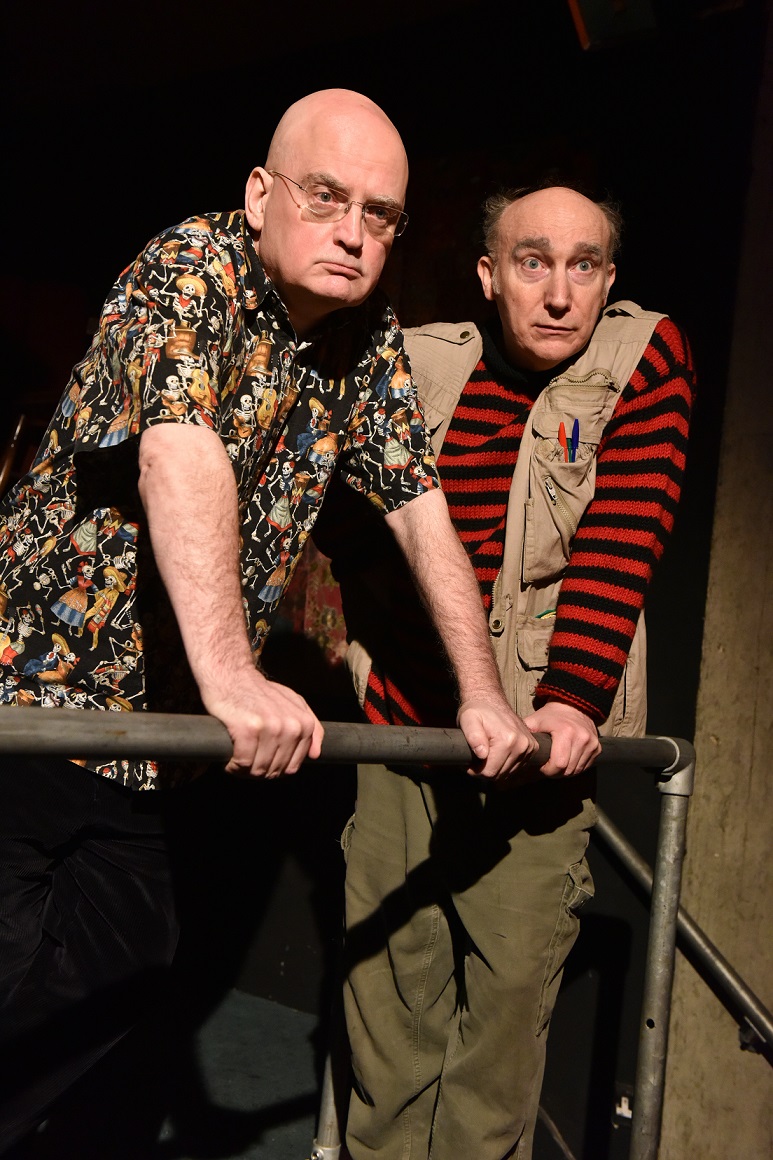
Ken Campbell was a writer, actor, director and legendary prankster, who had a profound influence on the careers of some of Britain’s best-loved entertainers – among them Terry Johnson and Jeremy Stockwell, whose two-man show marks the tenth anniversary of their friend’s death.

The Ken experience begins with Tim Shortall’s set; stepping inside The Bunker is like going back in time to the 1970s. There’s plush pink carpet everywhere you look, a smell of incense hanging in the air, and a random assortment of audience seating choices, from cushions to bar stools.

The format of the show, directed by Lisa Spirling, is equally unusual, and sees Johnson (in the programme named as The Writer but in reality speaking as himself) presenting from a lectern for the majority of its 90-minute duration. Meanwhile Jeremy Stockwell roams the theatre as Ken, spending more time among the audience than he does on stage (though that doesn’t mean he isn’t participating in the show – far from it). Both men appear throughout to be enjoying themselves immensely, not least when the script – deliberately or not, it’s impossible to tell – goes out the window.

Photo credit: Robert Day

Ken is difficult to put into any particular box; I can best describe it as a hybrid of part theatre, part stand-up, part eulogy, and it’s this last that leaves the deepest impression. Among other anecdotes, we learn how Ken and Terry met in a chance encounter, witness their collaboration on a notorious 24-hour production at the Edinburgh Fringe, and hear about a later, equally infamous, attempt to stage The Hitchhikers’ Guide to the Galaxy – an attempt that marked the end of Terry Johnson’s acting career (until now, at least).

Johnson is open and honest about his tempestuous relationship with Campbell and his own journey of self-discovery as a result of their friendship. Despite all the ups and downs, there’s an obvious affection there as he looks back with a wry smile on their madcap adventures, and the play closes with a poignant reflection on Campbell’s funeral and the legacy he left behind.

Jeremy Stockwell’s performance, in contrast to Johnson’s quiet dignity, is brash, unembarrassed, and not afraid to improvise. Even for those of us not familiar with the real Ken, there’s such conviction in his portrayal that it’s easy to believe we’re in the presence of the man himself, though he slips just as easily into other impressions, from Irish actor John Joyce to theatre director Trevor Nunn. His performance is exciting to watch because – like Campbell – he’s entirely unpredictable and we never quite know what he might say or do next.

Photo credit: Robert Day

Ken is a moving, warm tribute to an unforgettable character. There’s no doubting the sincerity of the performance or the sentiments expressed, but the show stops short of becoming maudlin; as Johnson points out, Ken – who reminded his friends from beyond the grave that “funeral” is an anagram of “real fun” – would have hated that. Like all the best memorials, this is a joyful and more than a little bonkers celebration of a unique life and personality, and through it Ken lives on.

Can’t see the map on iPhone? Try turning your phone to landscape and that should sort it. I don’t know why but I’m working on it… 😉<<<<<<
;