Review: Pickle Jar at Soho Theatre

When you’re at school, you tend to assume your teachers are fully functioning adults who have life all figured out. Then a few years pass, you reach the age they were when they taught you, and you’re startled to realise that perhaps they weren’t quite as together as you thought.

In Maddie Rice’s one-woman play Pickle Jar, Miss is a young English teacher struggling to find her footing both in and out of the classroom. Away from work, she’s just been dumped and can’t stop obsessing over how bad her life is compared to everyone else’s. At work, her approach to teaching is to try and be friends with her teenage pupils, who fascinate her with their apparent confidence and worldliness – it often seems her attempts to connect with them are as much for her own comfort and support as they are for her students’ benefit.

Photo credit: Ali Wright

Maddie Rice, who previously starred in the touring production of Fleabag, was encouraged by that show’s creator, Phoebe Waller-Bridge, to write something that made her laugh or cry. Pickle Jar ticks both boxes. Directed by Katie Pesskin, the first half of the show is straight-up, laugh-out-loud comedy, as Miss reflects on everything from her meagre Instagram follower count, to the night her ex broke up with her (shortly after advising her to get tested for chlamydia), to her fumbling attempts – egged on by best friend Mairead – at flirtation with Mr Ellis, the much-fancied food tech teacher.

And then, about halfway through, the story takes a dark turn, and just keeps getting darker as one twist follows another, ultimately catching us off guard with some very uncomfortable, and topical, questions around consent and victim blaming. The humour is still present, but the laughs become far less frequent, and the overwhelming emotion we feel as the show comes to an end is much closer to anger than amusement. Even in the #metoo era, the fact that a female character feels she has to shoulder any of the responsibility for a man’s actions shows how very far we still have to go.

One thing that’s immediately clear is that Maddie Rice is an exceptional performer, bringing an extensive cast of characters, a complex back-and-forth timeline, and a number of different locations to life without ever missing a beat. Colleagues, friends, students, strangers: they’re all here, and all perfectly distinct from each other. Miss in particular is a well-drawn, realistically flawed character who most of the show’s target audience – women in their 20s and 30s – can identify with to some extent (whether we’re willing to admit it or not). The half hour that we spend getting to know her, laughing with – and at – her, never feels like wasted time, even though it delays the show getting to its actual point.

Photo credit: Ali Wright

There’s so much to enjoy about Pickle Jar, a very funny and brilliantly acted hour of theatre that will no doubt resonate with teachers, women and indeed anyone still trying to figure out how this whole adulting thing works (which, let’s be honest, is most of us). But behind the laughter, the play does have a point to make – and it’s a point that needs to be heard and acted on, however uncomfortable that might be.

Can’t see the map on iPhone? Try turning your phone to landscape and that should sort it. I don’t know why but I’m working on it… 😉
Review: Sacrifice at Soho Theatre

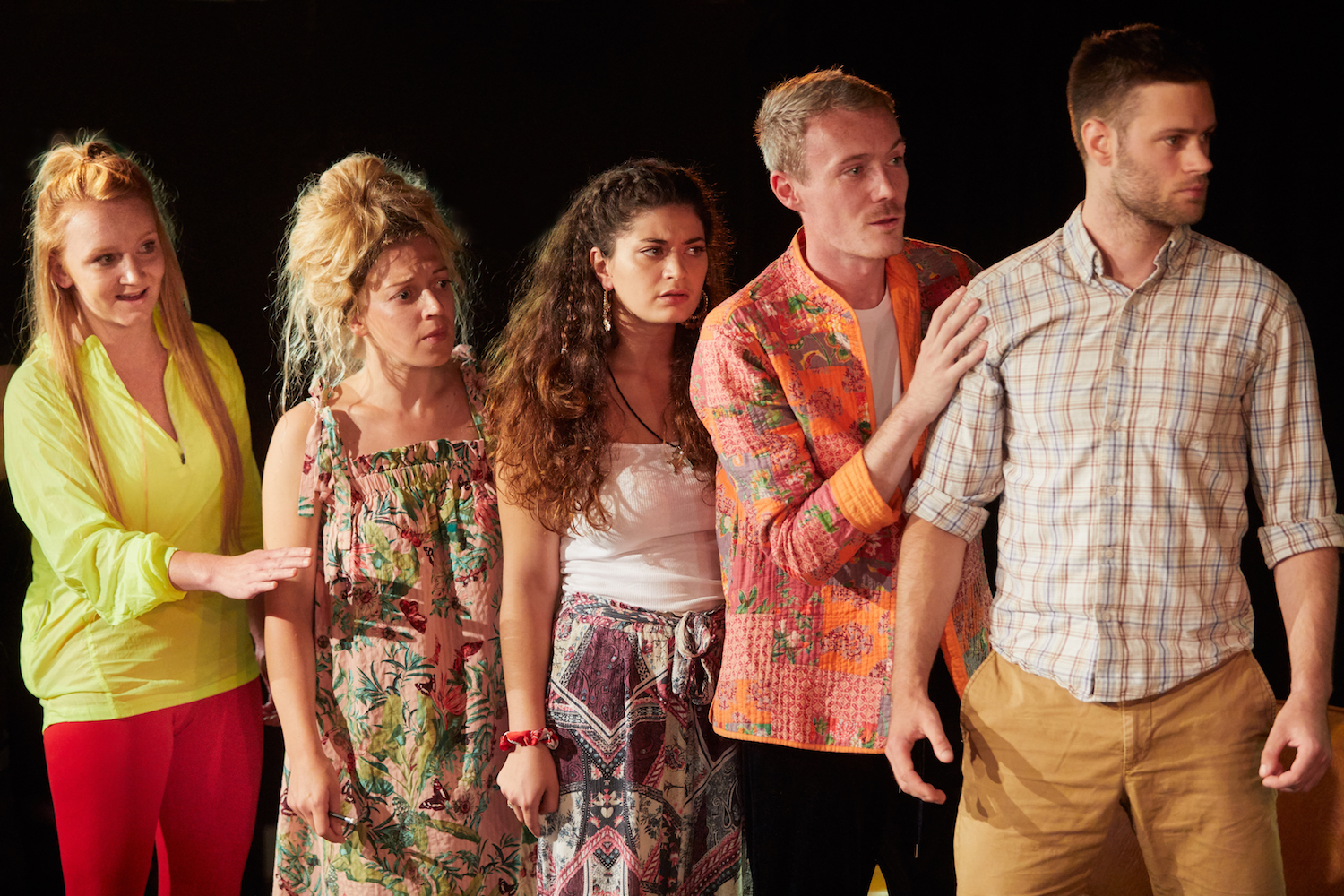
What would you be prepared to give up in order to live your dreams? In Andrew Muir’s Sacrifice, seven drama school graduates have followed their dream to London, only to find that the streets are paved in anything but gold. And when they wake one morning to find a strange man followed them home last night, they’re forced to face up to some harsh truths, both about their chosen profession and about themselves.

Sacrifice at Soho Theatre
Photo credit: Mark Douet

This is not a random choice of topic for the Ardent8, a year-long scheme established by Andrew Muir and Mark Sands to provide emerging actors from outside the M25 with opportunities they might otherwise never be able to afford. And you get the sense that the cast of recent graduates understand all too well what their characters – who are all, with one exception, named after them – are going through, both as actors and as young people. (“I’m 24,” says Nathan incredulously, when Sam, the stranger, asks him if he owns his own home. That, it seems, is answer enough.)

A funny, fast-moving script sees multiple conversations – about poverty, racism, turning vegan, family dramas and much more – criss-crossing over each other as each of the seven roommates fixates on his or her own issues. Witty one-liners aside, the unwelcome presence of Sam as the “outsider” who’s not afraid to ask awkward questions, brings to the fore the fact that perhaps these friends don’t actually have a lot in common besides their choice of career. It’s possible, in fact, that they don’t even know or like each other that much – but they continue to stick together, out of financial necessity and a shared conviction that the phone is always about to ring with someone’s big break.

The cast (Sophie Coulter, Angela Crispim, Clare Hawkins, Henry Holmes, Nathan Linsdell, Jamie Parker, Garry Skimins and Sam Weston) work well as an ensemble to deliver an hour of theatre that’s both entertaining and relatable for a millennial audience – whether or not we’re trying to break into the acting profession. Their struggles are not only financial; along the way, like most of us, they also suffer crises of confidence, and of identity, and ultimately end up wondering if the career they’ve studied so hard for is ever going to be worth all the effort. There’s also an extra twist of intrigue to the play in Sam’s story, and our need to understand what motivates him to act as he does: he might not face the daily struggle for survival that the others do, but does that really mean he’s happy?

Sacrifice at Soho Theatre
Photo credit: Mark Douet

The Ardent8 began as an idea to open doors that might otherwise have remained forever closed. In Sacrifice, eight talented young actors prove they more than deserve to take their place on the London stage. Funny and challenging, the play makes us consider what’s really important, and the price we’re willing to pay – both financial and otherwise – to get our hands on it.

Can’t see the map on iPhone? Try turning your phone to landscape and that should sort it. I don’t know why but I’m working on it… 😉

Review: Flesh and Bone at Soho Theatre

Written by Unpolished Theatre’s Elliot Warren, who also performs and directs alongside co-founder Olivia Brady, Flesh and Bone is a funny, gritty and sharply topical portrayal of everyday life on a working-class estate in East London.

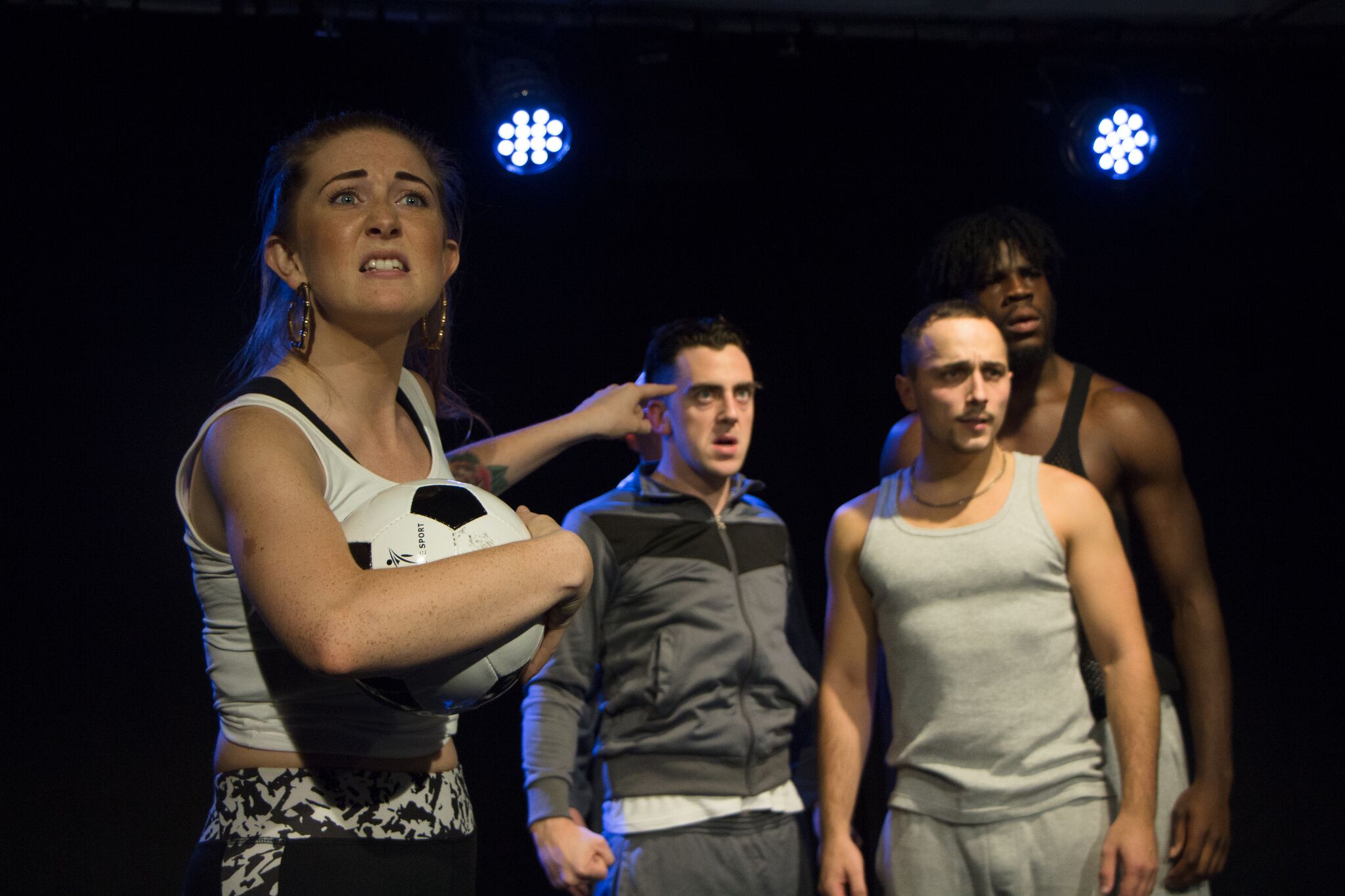
Tel (Warren) lives with his brother Reiss (Michael Jinks), his girlfriend Kel (Brady) and her grandad (Nick T Frost) in a rat-infested apartment block that’s just been scheduled for demolition. With money scarce, wannabe singer Kelly puts her vocal talents to profitable use by getting a job on a sex chatline, and Reiss works behind the bar in a Soho club, where he makes a startling – and not entirely welcome – discovery about his sexuality. Meanwhile Grandad’s mourning the loss of the good old days, and Tel, whose rage issues mean he can’t hold down a job, ends up robbing the local corner shop with downstairs neighbour and local drug dealer Jamal (Alessandro Babalola) in an attempt to raise some extra cash.

Flesh and Bone at Soho Theatre
Photo credit: Owen Baker

They’re a motley crew, as evidenced in an opening scene that sees them all caught up in a violent brawl over a plate of scampi at the local pub. But while the play is, on the surface, a comedy that revels in its characters’ larger than life personalities, its message is more complex than we might first assume. As each of the five steps into the spotlight to tell their story, we get a glimpse beyond the stereotype and begin to appreciate their daily struggle to be seen, heard and understood, not just by the rest of society but within their own community. Each of the five characters hides a secret from their peers, held back from revealing the truth by a fear of judgment – and yet despite these internal fractures, in moments of crisis they’re able to put their differences aside and come together to defend their way of life against outside threats.

The company’s name is very quickly revealed to be a misnomer, as the play’s first rate cast are anything but unpolished. Everything about the performance is so slick and assured that even the script’s infusion of Shakespearean verse with a 21st century Cockney flavour feels completely natural, and combined with the intricately choreographed physicality of the ensemble scenes, holds our unwavering attention for the play’s full 80 minutes. The audience is an acknowledged and important part of the production, which draws us into the world of the characters with its humour and honesty, but never quite lets us forget that we’re only there as observers – so while Tel, Kel and friends may pour out their hearts to us, they’re also not afraid to issue a challenge if they feel they’re not being taken seriously. We’re on their turf, and they make sure we know it.

Flesh and Bone at Soho Theatre
Photo credit: Owen Baker

Inspired by Elliot Warren’s own East End heritage, Flesh and Bone is an affectionate, entertaining and unapologetically irreverent tribute to a community that’s much more than a caricature, and has plenty to say for itself if only anybody would listen. But it also tackles universal themes – homosexuality, bereavement, misogyny and more – that will strike a chord with audiences from any background. If this is the debut production from Unpolished Theatre, then I can’t wait to see what they do next.

Can’t see the map on iPhone? Try turning your phone to landscape and that should sort it. I don’t know why but I’m working on it… 😉
Review: Dust at Soho Theatre

It’s said the beginning is a very good place to start – but Milly Thomas’ award-winning Dust does things a little differently, and starts at the end. Well, sort of.

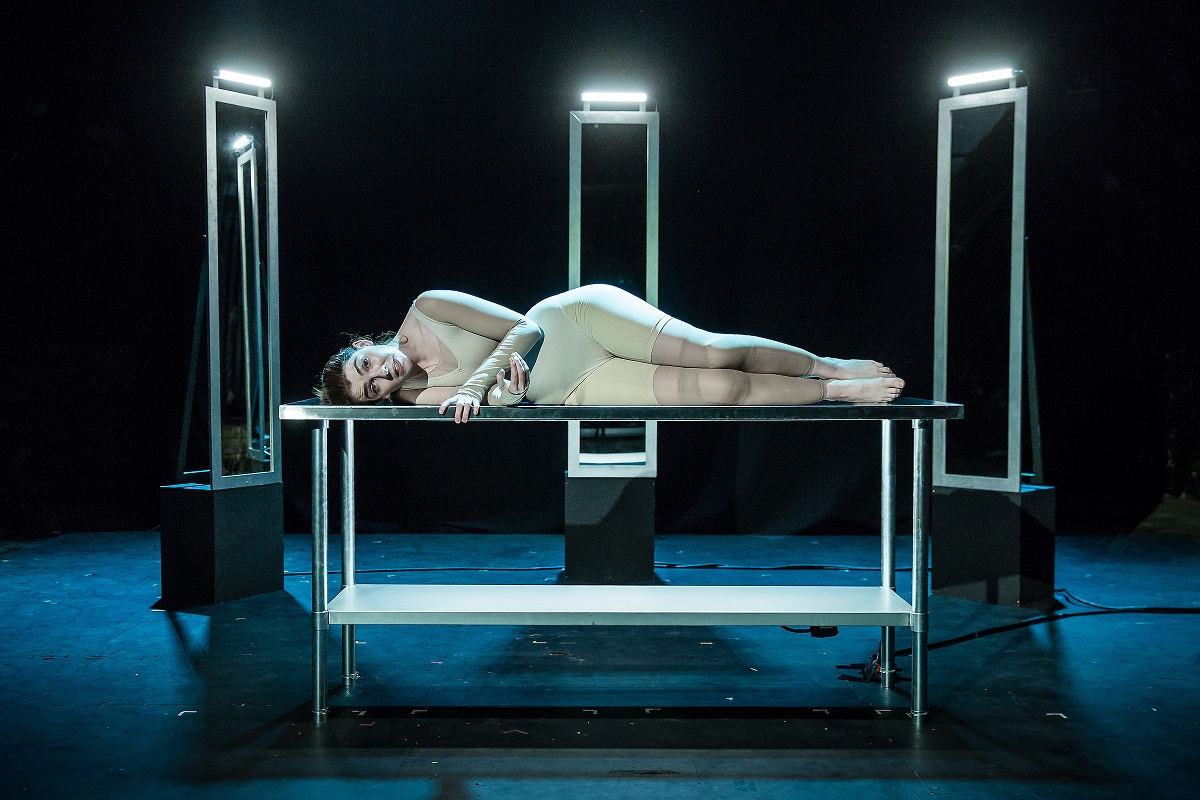
After years of living with depression, Alice has just committed suicide – and wakes to find herself looking down at her own corpse on a morgue table. Initially, she’s fascinated by her new perspective and the freedom being dead gives her to go anywhere, see anything. But as she watches her loved ones grieve, and makes a few unwanted discoveries, it begins to dawn on her what she’s done – to them and to herself.

Photo credit: The Other Richard

It rather goes without saying that Dust is not an easy show to watch, but almost immediately it’s obvious that it is a vitally important one. Alice’s death was supposed to be an escape, but instead it becomes a perfect metaphor for the depression that drove her to kill herself: trapped in a world where she can’t talk to anyone, she’s forced to watch the people she loves go on with their lives, while she remains stuck.

Dust also makes the important point that depression doesn’t necessarily mean being miserable all the time. The show itself is surprisingly funny for a story about suicide, thanks largely to Alice’s own frank, unapologetic sense of humour, though much of the comedy comes with a sting in the tail. Alice’s posh aunt, for instance, who bursts into the house uninvited and takes over everything, is hilarious to watch, but also expresses some unforgivable – but sadly not as shocking as they should be – views about her niece’s life and death.

There’s also a great scene that takes us rapidly through a year in the life of Alice – a year in which she went to parties, gave her best friend makeup advice, had sex with her boyfriend – which serves as a powerful reminder that just because someone seems to be having a good time, that doesn’t necessarily mean they’re not privately suffering. I don’t think it’s an exaggeration to say that this is probably one of the best and most enlightening portrayals of depression I’ve ever seen on stage.

Photo credit: The Other Richard

It’s not just the writing, either; Milly Thomas’ performance, directed by Sara Joyce, is equally outstanding. Her Alice is witty and loyal and attractive, so that even without knowing her, we’re sad she’s dead – but she’s also selfish and bitchy and foul-mouthed and real enough to ensure that her story never feels overly simplistic (despite a passing reference to it, this is not Ghost). Her bewilderment and anguish as she looks back on her decision is almost physically painful to watch. At the same time, Thomas brings each of the characters and settings around her to life so vividly that it’s easy to forget you’re watching a solo show, on a set populated only by a few mirrors and a morgue table. It’s an inspired and inspiring performance, which leaves you shaken and moved, but also entertained and educated about this huge and complex issue.

Dust‘s run at Soho Theatre is sold out – and for good reason – but if you can beg, borrow or steal* a ticket I’d absolutely recommend it. Don’t expect an easy hour; this is a show about suicide and depression, after all, and one that doesn’t hold back on the details, either. But it also makes an eloquent contribution to the conversation about mental health, and that alone makes it a must-see piece of theatre.

*Don’t really steal, obviously.

Can’t see the map on iPhone? Try turning your phone to landscape and that should sort it. I don’t know why but I’m working on it… 😉
Review: BLUSH at Soho Theatre

We’ve all felt that flush of shame when someone tags us in a terrible photo on Facebook, or we’ve tweeted something and instantly wished we could take it back. But what if it was far worse than an embarrassing selfie or misjudged comment? Sharing isn’t always caring, as we’re about to discover in Charlotte Josephine’s BLUSH, an intense, exhausting and impassioned two-hander.

Directed by Ed Stambollouian, BLUSH delves into the world of social media, with all its practical, social and psychological side effects. We now live in a world where anything we do at any time can be made public, whether by our choice or not. At the same time that world provides sufficient anonymity for people to behave in a way they almost certainly wouldn’t in real life: make vile comments on a video of a teenager that her boyfriend posted as a joke; make public naked selfies that a young woman sent privately through a dating app (and then use them to blackmail her into sending more); make rape threats against a girl on Twitter because she turned down the advances of a man they don’t even know.

Photo Credit: The Other Richard

These are some of the stories told by the three women and two men played by Charlotte Josephine and Daniel Foxsmith in BLUSH; at first in an orderly fashion, taking it in turns to step up and tell their story, the show becomes increasingly frantic and chaotic as it builds to a climax, leaving both actors out of breath and dripping with sweat, and the audience feeling we’ve gone through it all with them.

The script is descriptive and at times verging on poetic (opening with a particularly graphic picture involving 30,000 pairs of eyeballs) without ever feeling forced or inauthentic. And the set is literally that – a film set, surrounded by lights and cameras, with a circular red carpet at the centre that could be interpreted in several ways: the “stage” of a TED speaker trying to reach out to an audience; the record button on a camera; the embarrassed blush of the show’s title; or maybe just a big stop sign.

The presence of a male and female voice means we also get to explore the fascinating and distressing gender imbalance at play. A young male professional on a high-profile business trip gets drunk and tweets about a girl who turned him down, unleashing a torrent of hatred – against her. In response he gets a slap on the wrist and is whisked back home on the next flight. Simultaneously, a young woman whose boyfriend has ghosted her posts explicit images and videos of him on the Internet – but the instant backlash is against her, not him.

Photo Credit: The Other Richard

The play makes no attempt to justify this behaviour on either side, or to suggest answers (though there is a pointed comment at one stage about the ineffectiveness of the law on revenge porn); instead it focuses on making us aware of the dangers lurking and the countless ways both we and those around us can be affected by our widespread need for validation. Importantly, though, BLUSH doesn’t indulge in victim blaming; quite the opposite – it goes out of its way to be clear that the fault lies squarely with those who feel the need to take advantage of others’ vulnerability.

Hard-hitting, complex and hugely topical, at a little over an hour BLUSH feels both mercifully short and not long enough – and certainly makes you think twice about reaching for your phone the moment it’s over.


Can’t see the map on iPhone? Try turning your phone to landscape and that should sort it. I don’t know why but I’m working on it… 😉