Review: Twelfth Night at Upstairs at the Gatehouse

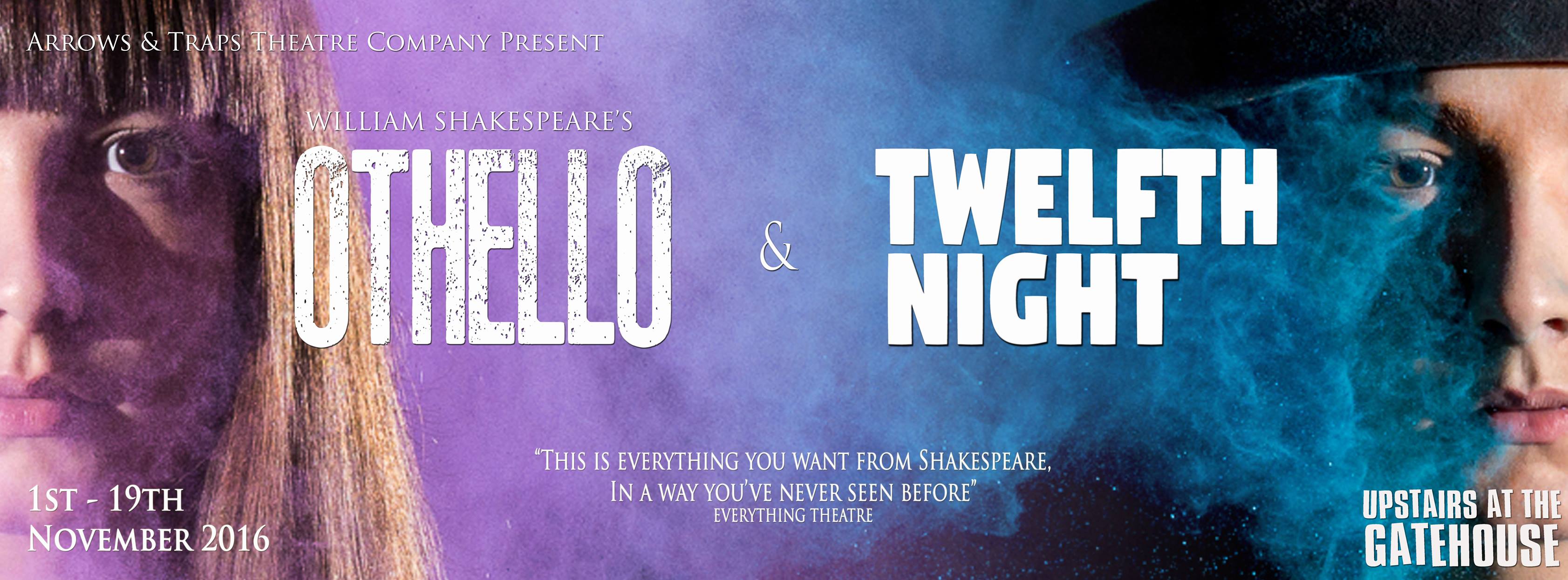
Anyone who reads this blog or follows me on Twitter will probably have noticed I’m a fully signed-up and completely unapologetic Arrows and Traps fangirl. So it should come as no surprise that I’ve been more than a little excited about their repertory season at the Gatehouse, which sees the same cast performing Twelfth Night and Othello on alternate evenings.

It’s hard to imagine two more different plays – one a comedy about romantic mix-ups and mischievous pranks; the other a dark story of betrayal, jealousy and murder. But in taking them on as a pair, the Arrows have put together a perfect showcase of everything that makes them so unique and fascinating to watch, while simultaneously demonstrating their impressive versatility. If you want to know what this company’s all about, don’t try and decide which show to see; just book for both.
14241489_1177136242368195_1963664209071337871_o

That said, the two productions can and do stand entirely independently of each other, in style, tone, even use of the space – so it seems only fair to review them as such. This review will focus on Twelfth Night – check out the other to read more about Othello.

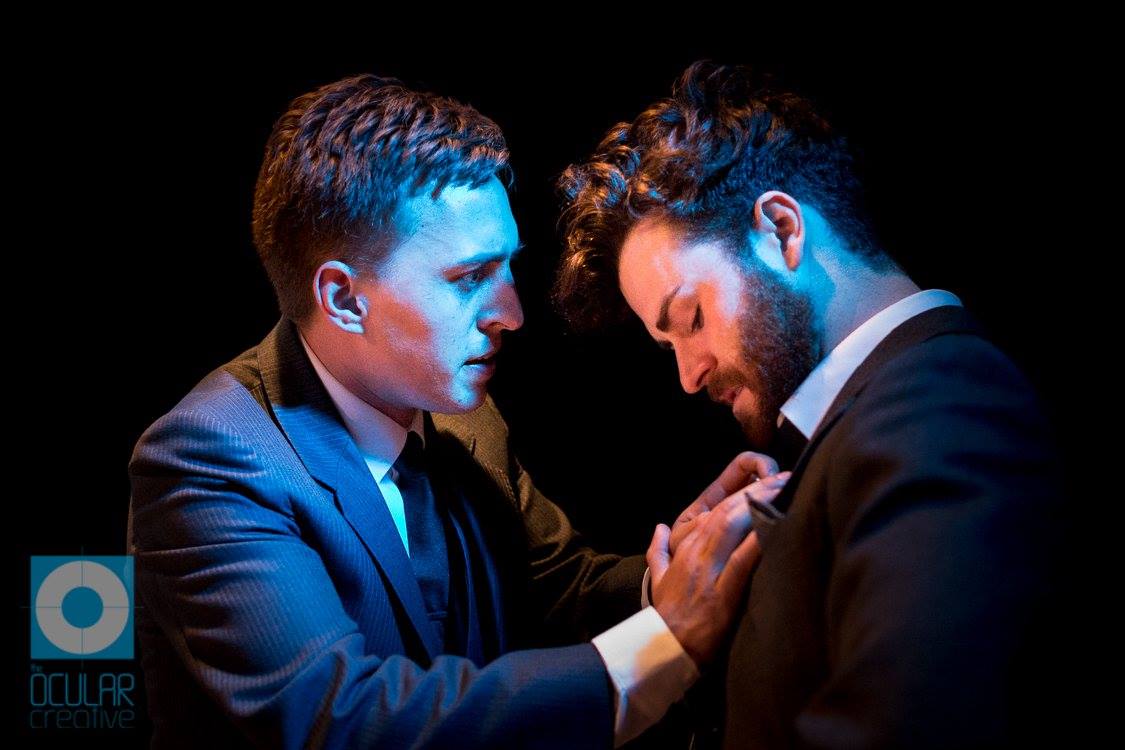
Arguably one of Shakespeare’s most convoluted plots, Twelfth Night sees a young woman, Viola (Pippa Caddick), fall in love with her master, Orsino (Pearce Sampson) – but he’s in love with Olivia (Cornelia Baumann), who in turn has fallen for Viola, now disguised as a boy called Cesario. Oh, and then Viola’s twin brother Sebastian (Alex Stevens) shows up, pursued by his friend Antonio (Spencer Lee Osborne), to cause further confusion…
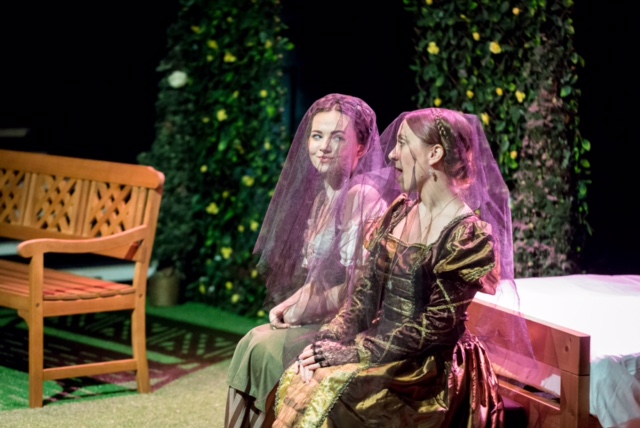
Photo credit: The Ocular Creative

Meanwhile, there’s a secondary plot involving a prank played on Olivia’s stuck-up steward Malvolio (Adam Elliott), by her maid Maria (Elle Banstead-Salim) and drunken cousin Sir Toby Belch (Tom Telford), with help from his friend Sir Andrew Aguecheek (David Grace) and the fool Feste (Lloyd Warbey). Get all that?

If it sounds a bit chaotic, that’s because it is – and this production even throws a couple of previously unexplored love triangles into the mix to complicate matters further. As a result, the play ends up as a study of unrequited love in all its forms, and brings a little more balance to the finale, which, as so often with Shakespeare’s comedies, can feel a bit too neat and tidy. Some of the characters will ultimately be satisfied, but just as many will leave disappointed, and if we’re left with a few loose ends – well, that’s the way life is sometimes.

Director Ross McGregor has assembled an impressive cast featuring several familiar Arrows faces. A larger than life story calls for similarly over the top performances, which include Elle Banstead-Salim’s over-excited and giggly Maria and David Grace’s lovably ridiculous Sir Andrew. Cornelia Baumann’s Olivia is rather more, ahem, erotically charged than we’re used to seeing, while Adam Elliott’s poker-faced turn as Malvolio brings the house down, particularly once he gets his yellow stockings out…
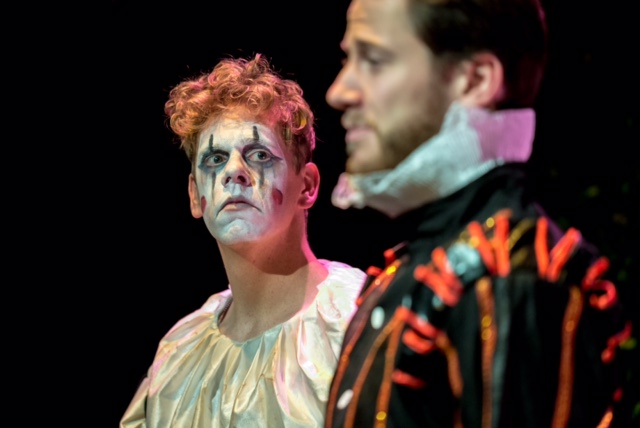
Photo credit: The Ocular Creative

But it’s not all high comedy, and there are some beautifully understated moments too – most notably from Lloyd Warbey, whose sad clown Feste, so busy entertaining others that he’s unable to speak of his own sorrow, opens his heart to us instead through song. Pascal Magdinier’s arrangement of contemporary music fits much more naturally than you might expect within the Shakespearean text, and features the likes of The Police and The Proclaimers (yes, really – and it works).

I’ve seen some versions of Twelfth Night that take quite a dark turn, particularly in the treatment of Malvolio, so that we end up feeling somehow complicit in his downfall by laughing. That’s not the case here; though there are undoubtedly some more melancholy moments, the audience is never made to feel uncomfortable. Instead we can sit back, relax and watch love, laughter and music combine in an original and thoroughly entertaining production.


Can’t see the map on iPhone? Try turning your phone to landscape and that should sort it. I don’t know why but I’m working on it… 😉

Interview: Arrows & Traps, Twelfth Night and Othello

Over the past three years, Arrows & Traps have become well known for their unique adaptations of Shakespeare and other classic works – most recently Macbeth and Anna Karenina. But the company’s latest project is their most ambitious to date, as they prepare to perform Twelfth Night and Othello in repertory at Highgate’s Upstairs at the Gatehouse this November.

14241489_1177136242368195_1963664209071337871_o

The decision to take on two plays simultaneously stemmed from director Ross McGregor’s interest in exploring the duality in Shakespeare’s work. “Shakespeare’s comedies are not just simply throwaway funny things that end in orgiastic shotgun weddings. His tragedies are not just gloomy tear-stained stab fests. Iago, the antagonist in Othello, is darkly funny whilst he does unspeakable things to innocent people, and the comic treatment of Malvolio in Twelfth Night descends into dark cruelty and manipulation. The blending of light and dark seemed to be interesting to explore.

“But it was also a practical decision. If I was asking audiences to come back and see a second show, I wanted to provide a varied menu. Twelfth Night is an unrelenting carnival fun fair of laughter, love and lyricism – and it’s also a full blown musical – whereas Othello is a psychological thriller, set in a hyper-sexualised, racist and cut-throat world of politics and militia. So I thought people would enjoy seeing the same ten people navigate the different worlds and present two sides of the same coin: the birth and demise of love.”

Of course, performing two plays at once brings with it new challenges: “I’m currently running a sweepstake on which of the cast comes onstage in the wrong costume and says the wrong opening line,” says Ross. “It does impose more time constraints on us; we have to work faster, move on quicker, correct and evaluate with more brevity, there’s less room to devise and experiment. Choices are still being made, options are still being explored, but there is now a much more pressing sense of the need for producing work each day and drawing a line under it.

“The line-learning element doesn’t seem to be too much of an issue; I’ve structured the castings so that each actor has a main role in one of the shows, and a supporting part in the other, so no-one is drowning under a tidal wave of iambic pentameter. We use the same set for both, so I suppose that might challenge us to create different stage pictures across the two shows, but with the material being so different, and the characters each actor plays being so contrasting, I haven’t noticed any repetition. In fact, there’s some nice echoes in there across the shows, for instance the bed that Pearce Sampson (Orsino) woos Pippa Caddick (Viola) in is the same one where he (now as Iago) contrives her death (as Desdemona). So I’m enjoying that aspect of it.”

img_20161001_145552_processed
Anna Karenina

Unusually, the cast for the two plays features only two new faces: “We usually have more, but this project seemed to represent the culmination of the last three years, so I wanted to show that in the casting. We have David Grace, playing the lusciously adorable and insipid Sir Andrew in Twelfth Night, and then the lovesick puppet Rodorigo in Othello, an altogether darker and more tragic role. I’ve been a fan of David for about two years, so it’s an honour to finally get to work with him. He brings an energy and dedication to his work, he’s one of the most specific actors I’ve ever heard in terms of his delivery and responses to the text; he’s flourishing as an Arrow and it’s a pleasure to support.

“Then we have Lloyd Warbey playing Feste in Twelfth Night – the lady’s fool and her “corrupter of words”, and Lodovico in Othello. You may be familiar with Lloyd from his work on Art Attack on the Disney Channel, and he’s worked all over the country, so it’s a privilege to have him involved. For Feste, you need a showman, an entertainer and a comedian, and yet there’s a melancholic sadness to him; he’s broken, lonely and jaded, and it’s great to see Lloyd switch in and out, hear him spin the language with a cheeky grin on his face.

“The other eight members of the cast are my core members, the people I would trust with any script, and the people that without them there would be no Arrows & Traps. There’s no greater gift for a director than having a cast like this. They’re a pleasure to see every day, and the amount of effort and energy they put into both shows is humbling.”

As always, the Arrows are keen to delve into the text and find something fresh and original: “I think the main element of Twelfth Night that feels new to me is the darker and melancholic elements. I’ve seen quite a lot of productions of the play that focus on the comedy but ignore the other elements. Shakespeare first staged Twelfth Night on the anniversary of the baptism of his own twin children, one of whom had drowned several years before. I think this was deliberate. On one of the days of the year where he perhaps thought of his son the most, Shakespeare put on a play where two twins find each other again after both nearly drowning. There’s a wish-fulfilment, a consoling father fantasy in that which is heartbreakingly sad. Twelfth Night to me is a dreamscape where your wildest dreams can come true, where gender and sexuality are fluid and transient, where chaos flies with majestic abandon.

“In terms of Othello, I wanted to examine what it means to be a Moor in modern times. So often, we take the word “Moor” to simply refer to someone’s race, to be black or North African, but it originally referred to their faith – that they were Muslim. We’re staging this in November, during the month where Donald Trump may or may not become leader of the most powerful nation in the world – a man who’s built a campaign on fear-mongering against Muslims, a man who campaigns for power on the promise that he will exclude, interrogate and remove people of a particular religion. Othello seems timely to me in that regard.

“I also wanted especially to show Desdemona in a better light. So often she’s portrayed as this weak, blonde willowy girl who meekly accepts her own murder, but to me she’s incredibly strong-willed and independent. She goes against her father for the man she loves, she rejects prejudice and society’s expectations of her and is unwilling to let it oppress or minimise her. She’s seduced by stories of battle and violence, tales of the unexpected and grotesque, which to me shows that this is an adventurous, outspoken, and vivacious young woman, and I wanted to show a Desdemona like that, which is something I’d never seen before.”

Macbeth
Macbeth

And now for the big question – to see just one play, or both? “I’ve directed the two shows to be able to stand on their own two feet independently of each other, but there’s something exciting about seeing both,” Ross suggests. “There are also five days in the run where you can see both in the same day, which would be something of a marathon, but since the Gatehouse is above a pub, you can have dinner in-between, have a drink and make a day of it.

“But if you could only see one of them, you have a choice between a clown-filled chaotic musical of love and passion and confusion, or a darkly thrilling study of the breakdown of a relationship in a violent and brutal society. They’re two hours each, so we’re not talking about a four-hour snore fest, but two fast-paced, visceral rollercoasters. Of course, the producer in me would like to add that if you book for both you get £2 off your second ticket…”

Book now for Twelfth Night and Othello from 1st-19th November.

Review: Shakespeare Tonight at Theatro Technis

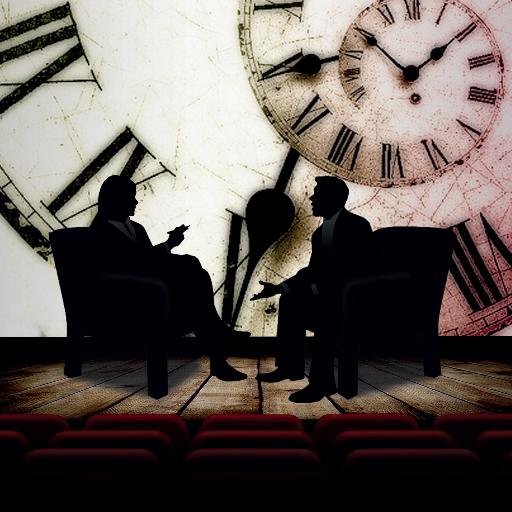
Shakespeare Tonight imagines what would happen if the Bard lived in the era of social media and TV chat shows. And indeed, the man himself is about to appear on one of these shows for the very first time. In a coup for producer Rebekah, one of the most famous men on the planet will be talking live in the studio to bubbly host Martina Fleur about his latest play, Hamlet, which has just opened to mixed reviews.

In a twist, though, Shakespeare won’t be the only guest on the show; he’ll be joined by arch rival Sir Francis Bacon, who – unlike William – is no stranger to the TV cameras. As the flamboyant, smirking Bacon makes himself at home on Martina’s sofa, and Shakespeare does his best to look cool and collected, the stage is set for a spectacular showdown between two great literary minds.

Shakespeare Tonight

There’s lots to enjoy about Shakespeare Tonight; the script, by Paul Wilson and Tim Ferguson is witty, wordy and packed with so many references it almost warrants a return visit to try and catch them all. The only downside to this is that anyone not interested in Shakespeare may get a bit lost (but then again, it’s unlikely they’d go and see a play called Shakespeare Tonight, so moving on…).

The addition of modern culture into the mix is also good fun, tweets from the audience presented with cheeky and irreverent charm by Martina’s warm up and social media guy, the Duke, played by an extremely likeable Paul Obertelli. Francesca Mepham, in contrast, is decidedly unlikeable in her brief but memorable appearance as the sneering bully Rebekah, who’s happy to exploit both host and guests to bring in the viewers and secure a second series. And Kaara Benstead impresses in an even more fleeting yet highly significant role, bringing the show to an emotional end as Shakespeare’s estranged wife, Anne Hathaway.

The main bulk of the show is carried by Priscilla Fere as Martina, Garry Voss as Bacon and Peter Revel-Walsh as Shakespeare, and while there’s clearly no shortage of talent on stage, unfortunately their scenes also expose some flaws in the production. Issues with acoustics mean that much of the script gets lost as actors turn away from the audience, while a few fluffed lines lead to awkward silences that interrupt the flow of the conversation and leave everyone – on stage and off – feeling a bit tense and anxious.

Part of the problem is a lack of context; though I’m not usually an advocate of canned laughter, the studio setting could perhaps benefit from some sound effects to remind us where we are and how the spectators in the room are reacting. (It seems unlikely, for instance, that Jeremy Kyle’s audience would remain silent when one guest is threatening another with a dagger.) It is made clear from the outset that we’re supposed to be the studio audience – but aside from a few occasions when the Duke invites us to applaud, we’re given little indication of what’s expected of us or how involved we’re supposed to get.

This show clearly has a lot of potential, and will I’m sure deliver on its early promise as its week-long run at Theatro Technis continues, and later in the month when it travels to Edinburgh. With an experienced director in David Parry and an undoubtedly talented cast, the problems encountered last night are all very fixable, and shouldn’t detract from what is still an enjoyable evening.


Can’t see the map on iPhone? Try turning your phone to landscape and that should sort it. I don’t know why but I’m working on it… 😉
Review: Macbeth at New Wimbledon Studio

Macbeth: the story of a man driven by personal ambition to destroy his friend and leader, and seize the crown for himself. Sweeping aside anyone who gets in his way, he ultimately leads his nation into civil war…

There could not have been a more pertinent day to see Arrows & Traps’ production of Macbeth at New Wimbledon Studio. Macbeth isn’t an easy watch at the best of times, but the events of the previous 24 hours lent last night’s performance an extra intensity that nobody could have foreseen, and took Ross McGregor’s adaptation from pretty dark to full-blown horror. (A brief addition to the script referencing the shock EU referendum result met with a split second of laughter, until we all remembered it was based in reality, and not actually very funny.)

Photo credit: Davor Tovarlaza

The irony of Shakespeare’s play is that Macbeth isn’t a totally bad guy (though not a particularly nice one either, obviously) but rather someone who allows himself to be led onto a dark path and discovers too late there’s no way back. As Macbeth and his wife, David Paisley and Cornelia Baumann are genuinely frightening – he’s full of violence and rage, while she’s cold and calculating, and together they spin a web of lies and commit crimes that are increasingly bloody and shocking. And yet the revulsion we feel is not without more than a hint of sympathy; both characters ultimately break under the weight of their guilt, and their passionate relationship of the opening scenes disintegrates into one of tension, fear and suspicion. It’s in these moments of vulnerability that Paisley and Baumann are at their most compelling; the pain they feel is palpable and devastating to witness.

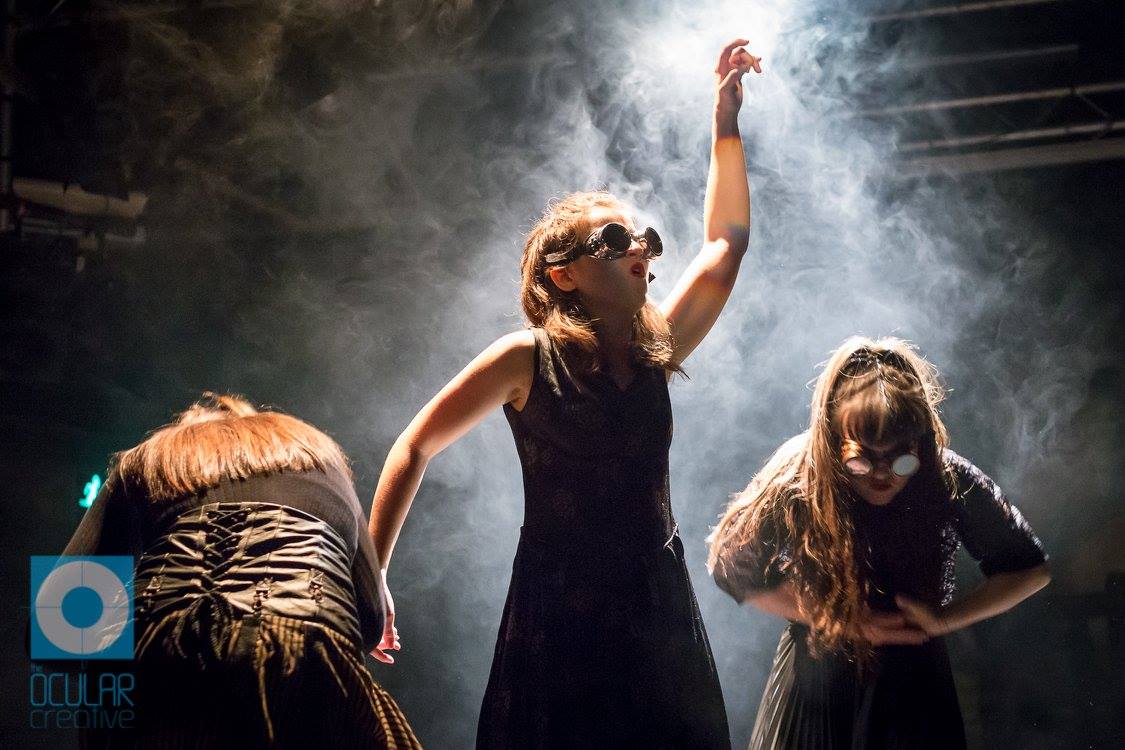
It’s not just the Macbeths that are out to scare us, though; McGregor wanted his Macbeth to be one that’s all about fear, and he’s got his wish. The three witches, played by Elle Banstead-Salim, Olivia Stott and Monique Williams, are part-demon, part-seductress, and their regular appearances on stage throughout the play remind us who’s really in control of events. There’s no shortage of blood and gore from the start, and a few jumpy moments just to keep us on the edge of our seats. And then there’s Banquo’s ghost…

Photo credit: Davor Tovarlaza

In the kind of original twist that we’ve come to expect from Arrows & Traps, in this production almost all Macbeth’s victims are female – most notably Duncan (Jean Apps) and Banquo (Becky Black) – as are his hired assassins. Seeing this violence both from and against women is a shock to the audience, hammering home the depths to which Macbeth is driven in his thirst for power. And it puts a fresh perspective on the relationships in the play – both Duncan and Banquo are loving mothers who share tender moments with their sons, while we’re also led to wonder about the exact nature of Macbeth’s friendship with Banquo as the play begins.

Like the company’s previous production, Anna Karenina, the show’s a visual feast; there’s smoke and blood galore, and some intense physical scenes from fight director Alex Payne. The climactic scene of Macbeth’s death is particularly stunning, with choreography, movement and music coming together to turn a moment of violence into something quite beautiful from which it’s impossible to look away.

The set is simple – just a table at the centre of the stage – and without the need for elaborate set changes, the production moves along at a rapid pace. The overlapping of some moments is particularly effective, as is the use of freeze frame during the dinner scene, contrasting Macbeth’s dark intentions with the merriment of his guests. And music is used to great effect to add drama, giving the play a very cinematic feel that seems to extend far beyond the theatre’s small stage.

Photo credit: Davor Tovarlaza

This is the third Arrows & Traps production I’ve seen, and each time I’m surprised and delighted by their unique, inventive take on classic works. Their Macbeth is a political and supernatural thriller that’s as gripping as any episode of Game of Thrones (the body count is about the same, too), and reminds us once again of Shakespeare’s continuing relevance 500 years after his death. As depressing as that relevance may occasionally be.


Can’t see the map on iPhone? Try turning your phone to landscape and that should sort it. I don’t know why but I’m working on it… 😉

Interview: Ross McGregor, Arrows & Traps

Earlier this year, they took on Tolstoy, condensing the epic novel Anna Karenina into a gripping three hours, and somehow making the story manageable without losing any of its complexity or intensity. And for their sixth production, Arrows & Traps are returning to their Shakespearean roots with Macbeth, which runs from 14th June to 9th July at New Wimbledon Studio, and opens the company’s ‘Broken Crown’ season.

Arrows and Traps, Macbeth

The Macbeth cast reunites actors who’ve worked on previous productions – among them David Paisley and Cornelia Baumann (Anna Karenina), Jean Apps (The Taming of the Shrew) and Alex Stevens (Titus Andronicus) – and introduces several new members of the company. Director Ross McGregor welcomes this mix of old and new faces:

“We’re one of the few operating rep companies in the fringe, in that we have a base of returning actors that we use in every show. It’s delightful to have actors from last year’s Taming Of The Shrew, Titus Andronicus, and this year’s Anna Karenina coming back to work on Macbeth alongside our new blood. This is great for me as a director as it builds a shorthand in rehearsal, but it also gives actors just starting out in their careers a home to come back to hone their craft on some classic drama. They know that there’s always a place for them in Arrows & Traps, and for me there’s no greater honour or compliment than when an actor asks to work with you again. This may seem like a cliché, but six shows in, it does feel like a little theatre family.”

In addition, the cast will work once again with Offie-nominated Movement Director Will Pinchin, who’s been a member of the creative team on all of Arrows & Traps’ previous productions. “It’s an honour to have Will back for a sixth time, working with the witches and ghosts for the show; he’s producing some incredible work in rehearsal. I’ve known Will for almost seven years, and I’d never consider directing a show without him now. We work well as a pair, he sees things I don’t, and I can structure his creative mania – there’s very little wasted time in rehearsal because each of us has a good sense of what the other wants to do. He’s also a new father, so the fact that he can still devote time to the company when he should be fast asleep is a testament to his generosity.”

Photo credit: Beth Gibbs

Following on from last year’s gender-reversed Taming of the Shrew, this version of Macbeth is a gender equal production – in fact, in an intriguing twist, McGregor’s cast includes more women than men. “Macbeth is normally a bit of a sausage fest in terms of casting, so it’s great to be able to offer so many roles to female actors. Both Duncan and Banquo have been made into female roles, and we’re loving the new opportunities and relationship impacts that these changes are making. For example, in our version, Banquo is a mother. Lady Macbeth has lost her child. How does that impact the relationship between the two women? Is there more of a connection between Banquo and Macbeth than just friends? Exactly who is jealous of whom?

“Duncan also has been opened up in so many interesting ways. She has that Margaret Thatcher feel to her: a bold, brave women in a cabinet of men who want her dead. Plus the thought of murdering Duncan is made even more harrowing if it’s an elderly woman in her bed. I was watching rehearsal a few days ago and was struck by the fact that the murder of Banquo is almost an entirely female staged spectacle of combat, and it’s a refreshing thing to be staging, even in an age when we’ve seen it all. I personally think it’s been a boys’ club for long enough. Give a girl a dagger.”

So what can audiences expect from this new version of a well known play? “Arrows & Traps has always been about making commercial entertainment that doesn’t lose its intelligence. I want to make shows that sell (name a theatre director that doesn’t), plays that people will have heard of, but that don’t lose their intellect or beauty for the sake of making it easier or shorter.

“I’m always struck by a common response I hear from people when asked if they go to the theatre. So many people say “I should. I should go more.” Like it’s the dentist. Like watching Hamlet is the theatrical equivalent of a root canal. Why is intelligent classic theatre seen as a dry duty for most people? It shouldn’t be. If Shakespeare had to compete with bear baiters and prostitutes and merchants all selling their wares in the theatre, his lines had to grab their attention. They had to fly. It’s our company goal to make commercial theatre that is as intelligent as it is entertaining. It’s got to be a live event. It’s got to be exciting. And if it’s Shakespeare and it’s done well, you’ve got to understand what they’re all saying. My hope is that Macbeth strikes this balance – both serving the beautiful text as well as being a rollercoaster ride.

Photo credit: Beth Gibbs

“I also wanted to make a genuinely frightening production of the play, because for me it’s all about fear. A standard GCSE answer is that Macbeth is all about ambition, and whilst that’s true, the word ‘fear’ is mentioned more times in Macbeth than any other play in the canon. It’s the story of a man who literally unleashes fear into the world. It’s a story where people believe in ghosts and witches and damnation and spirits. This is not our world, this isn’t reality, it’s a different playing space, a place where Freddy Krueger, Michael Myers and Norman Bates live. A place where things go bump in the night, and all our worst nightmares come and sit down beside us whilst we’re having dinner.

“Olivier said that if you don’t believe in witches then there’s no point in doing Macbeth – and I think he’s right. I think you have to create a world where witches can feasibly exist and take the audience on a journey into the belly of the beast. It feels like a horror film to me. Full of jumps and bumps and frights and somewhere in the midst of the darkness is a cautionary tale about the dangers of desire. But then again, and this is the genius of Shakespeare, Macbeth is also about a couple on the verge of breakdown, and the lengths that two people will go to in order to save their marriage. So there’s a lot to love about the text, and everyone is operating in a shade of grey. I didn’t want there to be villains or clear cut baddies. I think in many ways the Macbeths are more likeable than the ‘heroes’ of the story, Macduff and Malcolm, even though they do despicable things. It’s really the great-great-great grandfather of House Of Cards.”

Book now to see Macbeth at New Wimbledon Studio from 14th June to 9th July.