Review: La Cage Aux Folles at the Orchard Theatre

There are some shows that just make you feel good about life. La Cage Aux Folles is one such show. Setting the stage for more recent hits like Priscilla Queen of the Desert and Kinky Boots, Jerry Herman and Harvey Fierstein’s award-winning musical is a feel-good extravaganza that looks stunning, sounds fabulous and features a sensational starring performance from John Partridge.

Based in St Tropez, La Cage Aux Folles is the story of nightclub owner Georges (Adrian Zmed) and his partner Albin (John Partridge), the popular star of the club’s drag act. But then Georges’ son Jean-Michele (Dougie Carter) announces his engagement to the daughter of an infamous right wing politician, and hilarious chaos ensues as the couple attempt to tone down their flamboyant lifestyle and “act normal”.
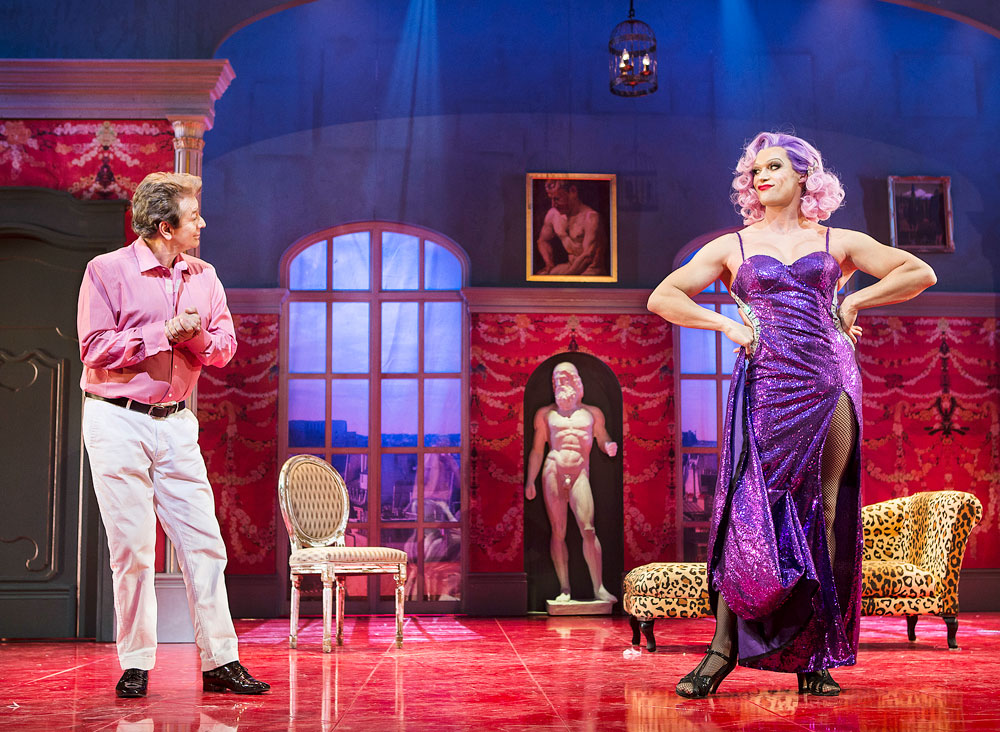
Photo credit: Pamela Raith Photography

Act 1 in director Martin Connor’s production acts largely as an opportunity to set the scene and show off Albin’s jaw-dropping array of glittering gowns; “it’s like Black Friday at Primark back there,” he confides after yet another lightning-fast costume change. Perhaps inevitably given this frenetic backstage activity, parts of the first act – particularly during the title number – start to feel a bit like they’re only there to fill time while we wait for the next big reveal. Having said that, it does give us plenty of time to admire Gary McCann’s drop dead gorgeous set, and features one of the highlights of the evening as the distraught Albin, having learned he’s to be excluded from the meeting with Jean-Michele’s new in-laws, brings the house and curtain down with a heart-felt performance of I Am What I Am.

This, by the way, was the only song I knew from the show beforehand, but it turns out to be part of a fabulous, catchy score that’s hard to get out of your head, even 24 hours later. Song on the Sand, With You on My Arm and The Best of Times are just a few of the tunes that get the feet tapping and simultaneously pull on the heart-strings.

After the interval, there’s more action and fewer costume changes, so the comedy can begin in earnest as we head towards a somewhat predictable but still heart-warming conclusion; I’m not ashamed to admit I welled up at one point, and spontaneously cheered at another. As light-hearted as the show is, it still has an important message about accepting others and ourselves, and Dindon the homophobic politician (Paul F. Monaghan) unfortunately feels just as real in 2017 as he was when the musical was written in the 1980s.

Photo credit: Pamela Raith Photography

As Albin, John Partridge is exquisite – and not just in appearance, though he does look amazing in every outfit he puts on. Vocally, emotionally, comically, he pitches his performance exactly right, and his relationship with Adrian Zmed as Georges is both believable and touching. But while, much like his character, Partridge is undoubtedly the star of the show, the rest of the cast are by no means in his shadow. Zmed is easily likeable and a natural comedian, Marti Webb (literally) steals the limelight during her all too rare appearances as restaurant owner Jacqueline, and Samson Ajewole is particularly fun as the sassy maid/butler Jacob.

La Cage Aux Folles may not be one of the best known musicals for British audiences, but that deserves to change. A treat for the eyes, ears and heart, this dazzling production of a hugely entertaining and uplifting show is well worth a visit. If it doesn’t brighten your day, then I really don’t know what will.

La Cage Aux Folles is at the Orchard Theatre until 13th May.

Review: Care at the Courtyard Theatre

Guest review by Lucrezia Pollice

Funny, but is it?
It’s all lovely and nice to have children but what are the stories not told?

Care was first performed at the Royal Court Upstairs, with its first revival by the Angus Mackay Foundation at the Courtyard Theatre in Shoreditch. Set in a young couple’s living room, the play looks very intimately at the narratives of Terry and Cheryl, who seem to be dealing with something. It is this something that drives the narrative. An it – a she – something or someone hidden centre stage in a cupboard, which forces spectators to engage.

Terry, played by Marc Benga, is very charismatic and seems at first to be unaffected by the whole situation. Karen Mann’s Cheryl instead is distressed from the start. She is suffering from some pain of her own, trying to get attention from Terry and a love which is not given back. The TV glares throughout the scene as we watch their daily life over the course of a long weekend. The story is simple, but interesting; it gives actors more responsibility to deliver the script.

Throughout the performance, their friends David (Leo Shirley) and Cathy (Jaana Tamra) come round to the house. The relationships between the couples are strong, and create a comical scene in which Terry and Cheryl are in distress but cannot find the courage to tell Cathy and David to leave. The Polish stereotype of Cathy’s character is overly rude and sexual, and her lack of social understanding of the situation is made comical by the hilarious body language during the scene of her husband, who seems to have given up on her.

From what seems like a normal domestic, it escalates into what instead looks like an abusive relationship. Who is abusing who is unclear though. It begins as a physically abusive relationship from Terry’s part, to then shift to a loving relationship, to then seem like it is her who is abusing him. Slightly confusing, perhaps on purpose, who in the relationship was causing troubles. Terry seems to be innocent; he makes all the jokes and seems to be stuck in a house and situation he doesn’t want to be in. Or is Cheryl right in saying that he doesn’t respect her?

The playwright Roy Mitchell was a member of the National and Birmingham Youth Theatres, trained as an actor at the Manchester Polytechnic School of Theatre, and more recently has been participating in the creation of BBC1’s New Tricks drama. He touches upon very difficult topics in this play, making the audience work to understand the motifs behind the characters’ actions by not giving much away until the end.

Perhaps the simple narrative at times needs a bit more tension as this is lacking. Conveying a constant distress creates a slightly lamenting voice, which becomes uncomfortable after a while, and accents are slippery at times. The intentions between the two main characters are slightly unclear, and the grief of a baby’s loss is not conveyed as deeply as it could be in moments of despair. However, overall the performances are believable, and it was really lovely to engage with an ethnically diverse cast with such a powerful taboo topic which is death.

My favourite moment must be when Terry and Cheryl come back drunk from the pub and start watching a horror on TV. It is amazing to see how something so simple can be made into something so entertaining. The performance is overall touching upon very delicate topics, but is presented also with light moments of comedy and an obscurity as to what is happening, which might intrigue spectators.


Can’t see the map on iPhone? Try turning your phone to landscape and that should sort it. I don’t know why but I’m working on it… 😉

Review: Brimstone and Treacle at The Hope Theatre

Dennis Potter’s Brimstone and Treacle was originally written for the BBC, but banned from transmission for several years because of its controversial content. 40 years later, Matthew Parker’s revival proves the play has lost none of its power to shock and disturb. Trying to reconcile everything that goes on keeps making my head hurt – and not just because of Rachael Ryan’s spectacular 70s wallpaper (though that certainly doesn’t help the situation).

It all seems quite straightforward to begin with. Tom and Amy Bates are a middle-aged couple caring for their daughter Pattie after a hit and run two years ago left her brain damaged and helpless. Just as they’re reaching breaking point, a mysterious young man turns up on the doorstep claiming to know their daughter, and offering his help. Martin Taylor seems like the answer to their prayers, but despite Amy’s raptures, it’s clear from the start that he is not a good guy – an impression cemented when he commits an unspeakable act against the vulnerable Pattie while her mum’s out getting her hair done.

But then. Then it all gets very interesting (if headache-inducing) as events take an unexpected turn and suddenly we don’t know whose side we’re on any more. The lines between good and evil begin to blur, and the play evolves into a powerful and incredibly relevant debate on issues of immigration, national identity and what it really means to “take our country back” – before spiralling to a shocking but strangely satisfying conclusion.

Photo credit: lhphotoshots

Matthew Parker has assembled a small but perfectly formed cast, who handle the difficult material with sensitivity and skill. As the beaten down Amy, Stephanie Beattie’s weariness and desperation are palpable, and it’s easy to see why she so readily falls for Martin’s slick patter. Paul Clayton gives a nicely understated performance as her husband Tom, whose only way of dealing with his grief is being impatient with his wife and hankering for the way things used to be.

Olivia Beardsley has fewest lines but arguably the toughest role as Pattie; in a meticulously observed physical performance, she communicates everything she can’t say verbally through her eyes and movement. And at the centre of it all is Fergus Leathem, genuinely quite terrifying as the psychopathic Martin, with a fixed grin but empty eyes, and a discomfiting habit of turning mid-conversation to address his private thoughts to the audience. His emotionless (not to mention tuneless) rendition of You Are My Sunshine is the stuff of horror movies; I don’t think I’ll ever be able to listen to the song again without a small shudder of revulsion.

Photo credit: lhphotoshots

Potter’s play deals with difficult themes in a darkly humorous way, provoking nervous and slightly guilty laughter at unexpected moments. But at the same time, spooky sound and light effects from Philip Matejtschuk and Tom Kitney keep us on edge and remind us not to get too comfortable – we are, after all, in the presence of pure evil.

It’s safe to say Brimstone and Treacle may not be everyone’s cup of tea; it’s incredibly intense, really messes with your head and may be best avoided by the easily offended or those of a nervous disposition. But it’s also a gripping production, beautifully performed, and even four decades after the play was written, fascinatingly – and uncomfortably – relevant. Above all, it reminds us that while evil may be closer to home than we realise, good will always win in the end – though maybe not in quite the way we expect.


Can’t see the map on iPhone? Try turning your phone to landscape and that should sort it. I don’t know why but I’m working on it… 😉

Review: Becoming Mohammed at The Pleasance

Becoming Mohammed by Claudia Marinaro packs an unexpected punch. On the surface a relatively straightforward family drama, on another, deeper level, it forces us to question our own assumptions and what’s led us to form these opinions in the first place.

The story’s based on director Annemiek van Elst’s real-life family experience, and sees Sarah (Philippa Carson) return home after living abroad for two years, looking forward to indulging in a bit of nostalgia with her brother Thomas (Jack Hammett). But when she learns he’s become a Muslim in her absence, a horrified Sarah does all she can to talk him out of it, assuming he’s been brainwashed by new best friend Musa (Jonah Fazel) and his sister – now Thomas’ fiancée – Aminah (Nadia Lamin).

Photo credit: And Many Others

With time and understanding, Sarah and Thomas set out on the road to resolving their family drama. But there’s a bigger conflict brewing, as an enthusiastic Thomas attempts to bridge the gap between Muslims and non-Muslims within the local community, not realising he’s fighting a losing battle against the ignorance and fear that’s become such a natural part of our society we barely notice it any more. Musa and Aminah, on the other hand, exude a weary resignation to the prejudice against them and it’s perhaps this that hits hardest – the fact that an entire section of society feels there’s no point standing up for themselves because nothing will ever change.

In trying to shed a little light on what Islam is really all about, Marinaro has been careful to create well-rounded characters and a realistic portrayal of Muslim culture. So Aminah can’t be alone with Thomas without a chaperone until they’re married, and won’t let Sarah wear heels to visit the mosque because they “make you walk a certain way” – but all three Muslim characters also frequently swear like troopers and listen to the likes of Beyonce and Coolio. It’s interesting too to see Aminah go from shy bride-to-be in Act 1 to by far the strongest personality in Act 2, with Nadia Lamin revelling in her character’s transformation and delivering some brilliant one-liners as she figuratively bangs everyone else’s heads together. In direct contrast, Jonah Fazel’s Musa shifts from being a bit of a joker early on to take a more confrontational position when he sees his position as spokesman for the Muslim community threatened by his own protege.

Photo credit: And Many Others

While there’s a surprising amount of humour in the play (yet another assumption shattered – why should we be surprised that a play about Islam is funny?), there are also some really touching scenes between Jack Hammett and Philippa Carson as the estranged siblings. Sarah’s visit has been prompted by Thomas’ plans to sell their family home; they’re surrounded throughout by plastic boxes filled with childhood memories. It soon becomes clear that Sarah’s main concern isn’t really that her brother’s being radicalised; it’s a basic human fear of losing him to a world that she doesn’t understand. The problem is, he’s so excited about his new life that he’s blind to her vulnerability – and so the distance between them grows ever greater.

Becoming Mohammed may be based on one family’s story, but it’s representative of many more. The play shows how far we still have to go, not only in our understanding of Muslim culture, but in breaking down the stereotypes associated with it. Only by challenging the idea of “us and them” can society – and we as individuals – move forward together.


Can’t see the map on iPhone? Try turning your phone to landscape and that should sort it. I don’t know why but I’m working on it… 😉

Review: All Our Children, Jermyn Street Theatre

It was never going to be an easy play to watch. Stephen Unwin makes his debut as a playwright with All Our Children, a chilling expose of the brutal programme that saw Nazi Germany send thousands of disabled children to their deaths, ostensibly to ease the financial burden on the state. Over the course of one day, we see the situation through the eyes of five characters, each with a different perspective – and leave disturbed and shaken by the horrors human beings are capable of inflicting on each other.

The subject matter sounds grim, and it is – not for what we see but rather what we don’t. There are no children in the play; we never leave the comfortable office of Dr Victor Franz (Colin Tierney), chief paediatrician at a children’s clinic near Cologne. But we come to know them, through the pain of a mother who’s lost her son, the remorse of another who’s realised the patients in the clinic are, after all, “just children”, and through the cowardly attempts of a man who once swore to do no harm to justify sending his innocent charges to be murdered.

Photo credit: Camilla Greenwell

It’s this, more than anything, that really sends a chill down the spine. Franz is an experienced and compassionate doctor; he’s often funny, has an obvious affection for his devoted maid Martha (Rebecca Johnson), and dislikes the odious SS man Eric Schmidt (Edward Franklin) who’s there to make sure he toes the line and meets his grotesque quotas. Franz could be quite a likeable guy, in fact, but for the cold, clinical way he reels off the official justifications for his actions. Unlike the fanatical Schmidt, who simply hates the clinic’s patients and everything they represent, it’s obvious from the doctor’s hangdog expression, late night drinking and constant efforts to hide the truth from Martha that he knows full well what he’s doing is wrong. The arrival of David Yelland’s Bishop von Galen (a real historical figure, whose public opposition to the programme was key to its eventual abolition) could hardly be more timely, and his dignified rage in the face of Franz’s cowardice speaks for all of us.

The play is a very personal project for Stephen Unwin, who also directs, and there’s no doubting the passion or anger behind every word – but he resists the urge to preach his views, instead presenting a sensitive and balanced debate from which ultimately it’s the compassionate voices that cry out the loudest. While the men each get their turn to argue the intellectual and moral points of the debate, the two women – both mothers – represent the emotional heart of the play, and it’s their scenes that really drive home the horror of what’s happening. Lucy Speed’s Frau Pabst breaks our hearts as she describes her son with none of the eloquence of the men but a great deal more feeling; she knows Stefan will never have a job or pay tax – but he’s her son and she can’t bring herself to share the view that his is a life not worth living. And Martha’s softly spoken realisation that the patients she used to feel so sorry for are no different to her own three “normal” children has just as much impact as the bishop’s outrage.

Photo credit: Camilla Greenwell

A few slightly artificial sound effects aside, All Our Children is an incredibly effective and thought-provoking piece of theatre, a warning from history that reminds us of our continuing duty to look out for those who need our help, particularly at a time of government cuts and growing intolerance. We may not be in Nazi Germany, and it may not be 1941 – but that doesn’t mean there aren’t still lessons to be learnt, or battles to be fought.


Can’t see the map on iPhone? Try turning your phone to landscape and that should sort it. I don’t know why but I’m working on it… 😉