Review: Moth Hunting at Cockpit Theatre

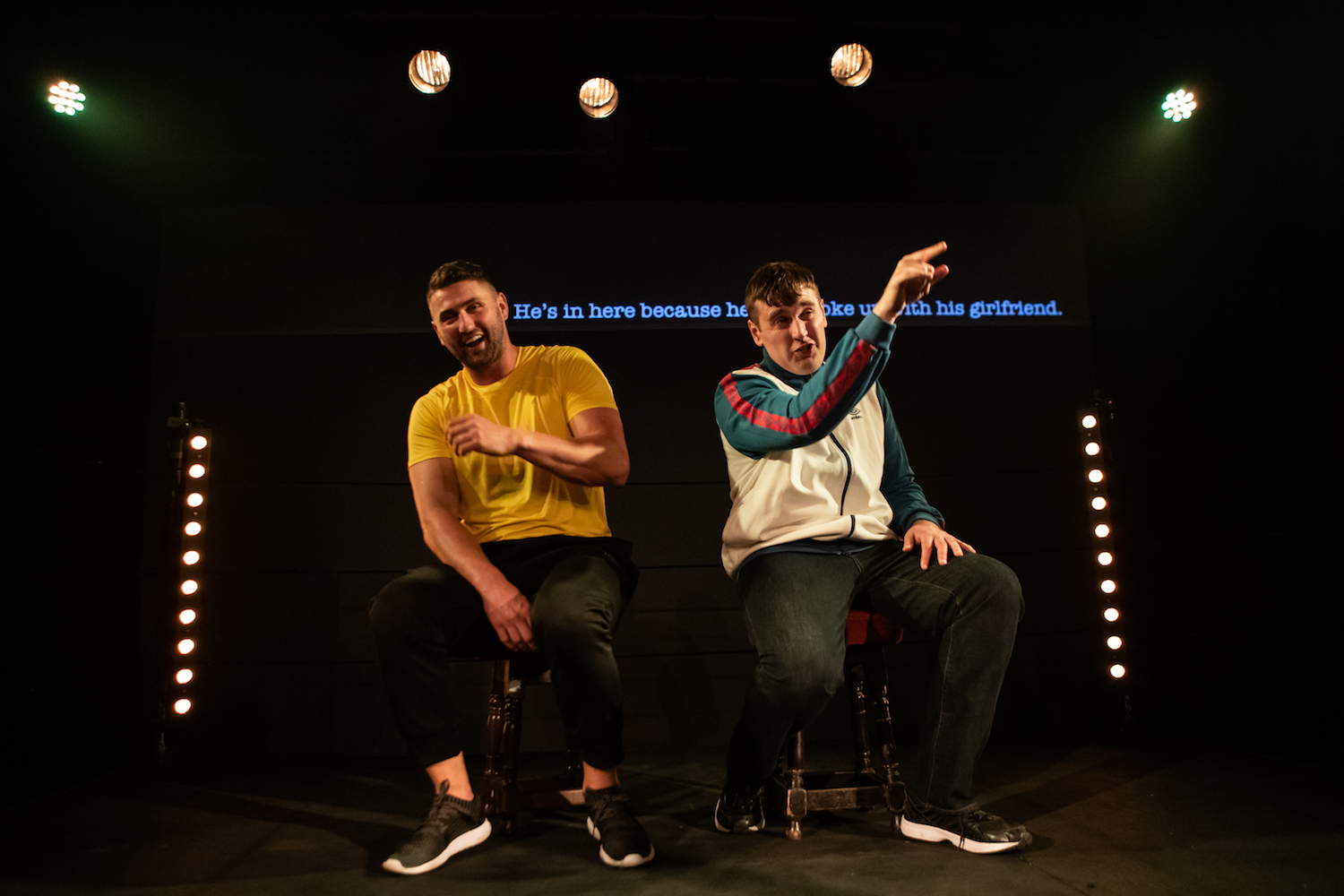
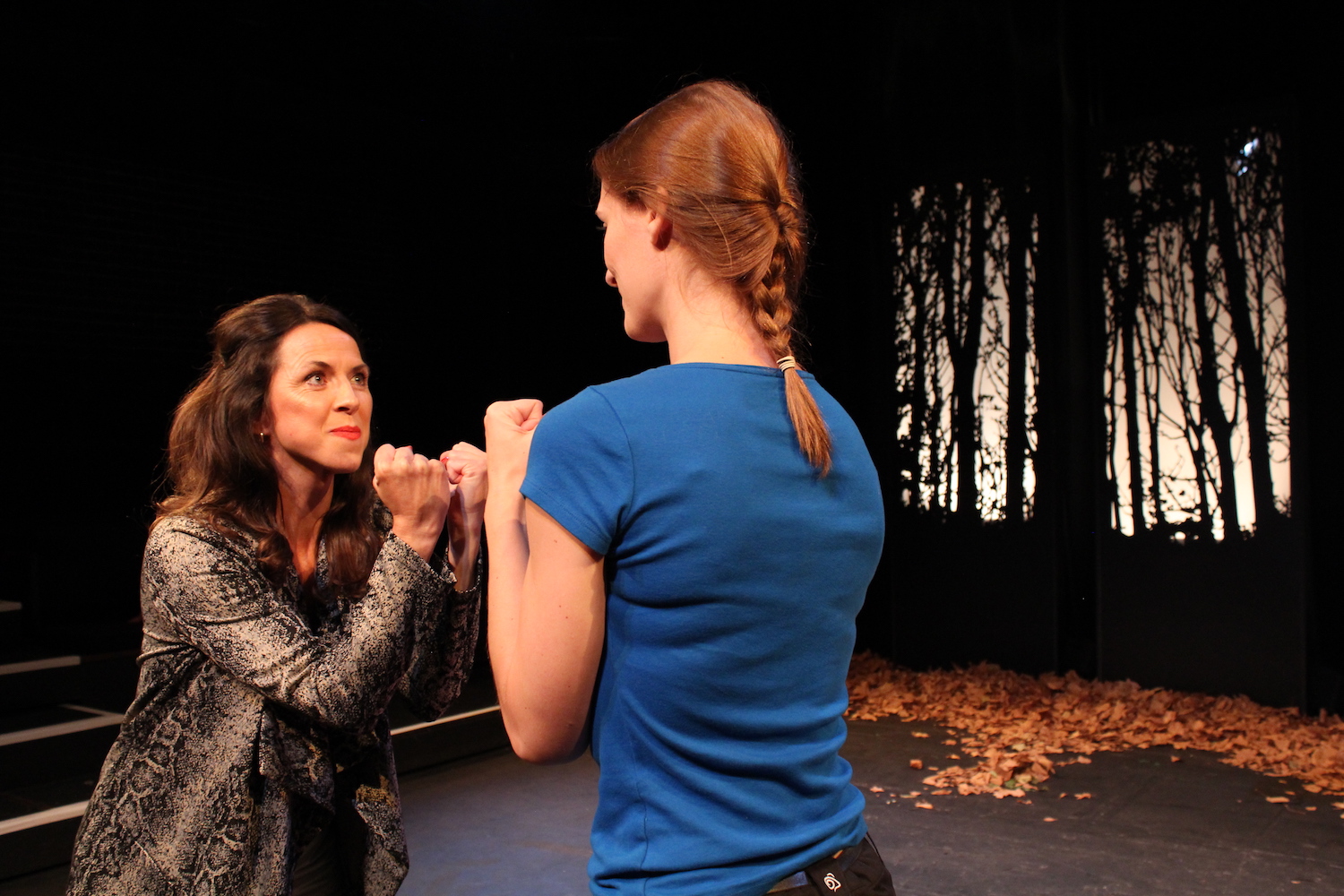
The first full-length play from writer Phil Ball, Moth Hunting is a comedy that very much sums up the expression, “You can’t choose your family.” Sisters Ann (Charlotte Baker) and Sue (Kathryn McGarr) are about as different as two women can be, and their relationship is on decidedly shaky ground – despite the best efforts of their mum Gill (Verity Richards) to smooth things over. When the three of them find themselves on a girls’ night “mothing” in the woods, tensions inevitably begin to boil over.

With Greg Spong’s attractive woodland design setting the scene, Rosie Snell’s production is a perfect fit for a drizzly autumn evening, and provides an enjoyable hour of entertainment that most of us will be able to relate to on some level. It’s also educational; who knew that moth hunting was a thing? Not that our characters have a lot of success on the mothing front – they’re generally too busy bickering to pay much attention to their surroundings, and it’s only when something bad happens that they’re forced to pull together and tentatively begin to build some bridges.

Though it’s undeniably a comedy, and largely a very successful one, the play does also delve into some more serious territory as it unpicks the family history and gets to the bottom of their troubled relationships. Bereavement, marital problems, and references to alcoholism and both physical and mental illness, are handled sensitively within the script – and although the play ends on a positive note, there’s no unrealistic suggestion that in one night the characters have managed to clear up years of resentment, or that all their problems have suddenly gone away.

The fraught relationship between the three women, with all its ups and downs, is well portrayed by Kathryn McGarr, Verity Richards and Charlotte Baker. While the differences in their personalities ensure plenty of laughs, there are moments of connection too, which makes it much easier to picture them as a family – however messed up that family might be. They’re also joined briefly, but memorably, by Gareth Turkington as Sue’s amiable husband Sid, whose arrival is as unexpected as it is entertaining.
If the play has a flaw, it’s in the way it frequently removes one character from the stage so that the other two can talk in private. While this works, it begins after a while to feel a bit contrived, particularly since the third character has a way of always reappearing just at a crucial moment in the conversation. The play’s conclusion, too, comes very suddenly, leaving several unanswered questions in its wake about the events of the evening.

Nevertheless, as a lighthearted comedy about a dysfunctional family, Moth Hunting is a great watch. It’s skilfully directed and performed and with plenty of belly laughs to be had – though I’m not sure it’ll have me running off to the woods to try moth hunting any time soon…

Moth Hunting‘s final performance at the Cockpit Theatre is tonight – you can follow @BuddingRoseProd for details of future productions.
Review: The Open at The Space

2050. Brexit is (finally) done. The environment is (predictably) a mess. And Britain’s been sold and turned into a giant golf course owned and run by “The Organisation” – a.k.a. Donald Trump, who at 100 years old may or may not still be alive, and who’s taken on such God/Voldemort-like status that nobody even says his name out loud any more. The Great British Golf Course promises citizens, or at least the ones born in Britain, the opportunity to “live, work, thrive” – but three friends are about to discover what really goes on behind closed doors…

Photo credit: Kit Dambite

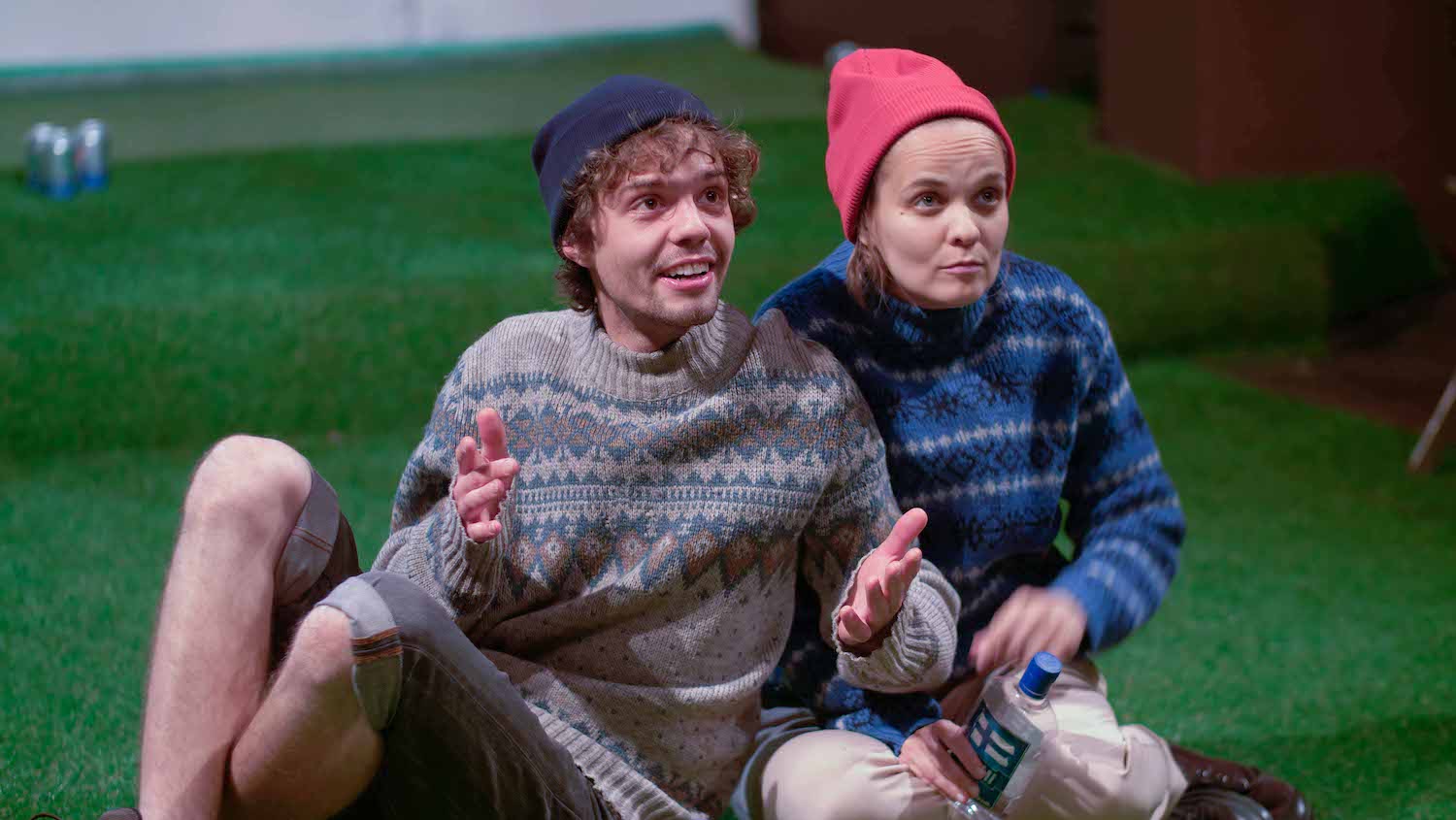
As with any dystopian drama, the central idea of Florence Bell’s The Open – the GBGC itself – sounds far-fetched, but the foundations on which it’s built aren’t all that implausible: a future in which money continues to be the source of power, social status is dictated purely by nationality, and any resistance is dismissed as “fake news” or simply made to disappear. Arthur (Priyank Morjaria) has bought into the dream 100%, particularly after bumping into one of the GBGC’s chief architects, Bella (Emma Austin). Such is his devotion to his employer that he’s even willing to consider betraying his closest friends, Estonian immigrant Jana (Heidi Niemi) and her boyfriend Patrick (Tom Blake), when they dare to question everything he thinks he knows.

Through the play’s four characters, we meet the full range of people who make up the GBGC community – and they’re all recognisable figures to a 2019 audience. Emma Austin’s Bella is self-involved, manipulative and absolutely lacking in remorse. At the other end of the scale, Heidi Niemi steps into the role of hero as straight-talking Jana, who’s willing to risk everything in defence of what’s right. She’s come back for Tom Blake’s innocent, almost childlike Patrick, who has his doubts – and certainly shows little loyalty to The Organisation – but would quite cheerfully continue to do and say nothing without his girlfriend there to push him into action. And then there’s Priyank Morjaria as Arthur, the embodiment of a good man turned bad by a combination of fear, promises and false information.

It’s a clever and intriguing premise, and executed well by a strong cast, so it’s surprising that The Open never completely takes flight; the ingredients are all there, but the play as a whole lacks balance. A complicated plot and back story mean that Act 1 has to spend a lot of time explaining how we got here, often through slightly circular conversations between the characters. The pace of the show starts to lag as a result, and even then it feels like there’s a lot we still haven’t quite pieced together. All the action then happens rather suddenly in Act 2, which feels rushed by comparison and, oddly, raises more laughs than Act 1, even though it’s only after the interval that the true horror of the GBGC is revealed.

Photo credit: Kit Dambite

Looking at the current state of the world, it’s not hard to imagine a situation like the one in The Open – the play essentially takes characters and attitudes that already exist and puts them into an extreme scenario to see what they’ll do. This has the potential to work really well, but the pace and structure of the unfolding drama needs some work in order for the play to fully capture the audience’s imagination.

The Open is at The Space until 12th October.

Review: Redemption at Drayton Arms Theatre

Faye (Grace Martin) and Jess (Molly Marr-Johnson) have been best friends since their first year at uni. They live together, party together and support each other through thick and thin. But now Faye’s got a new boyfriend, Alf (Douglas Clarke-Wood), and Jess isn’t dealing with it well. Are her misgivings just paranoia, sparked by a trauma that still haunts her from years before – or is she right to be concerned?

Redemption, which marks the writing and directorial debut of Emily Shanks, is a compelling and very well acted play about friendship, dating and the complexities that come with taking our first steps into adulthood, whether we feel ready for it or not. Touching also on issues of mental health and childhood trauma, it’s packed full of twists and turns, with the audience never quite knowing who we can trust, and concludes with an explosive climax that’s both shocking and emotional to watch.

The cast of four are excellent; the intimacy between them is very convincing, and there’s a playfulness to their physical and spoken interactions that feels totally natural. (This is all the more impressive given that Douglas Clarke-Wood only took over the pivotal role of Alf a week or so before opening night.) Grace Martin and Molly Marr-Johnson are particularly strong as the two best friends, whether they’re teasing each other mercilessly or having a serious heart-to-heart. It only takes a few minutes for the audience to become completely engaged with their relationship, which makes it all the more difficult later as we see it begin to fracture under pressure.

The play isn’t just about female friendship, though, and the bond between Alf and his own best friend Nick (Nicholas Marrast Lewis) is equally strong, though far more complex and a lot less demonstrative. And then there’s the relationship between the girls and Nick, which is different again – he’s the classic Gay Best Friend of sitcom tradition, but even this relatively conventional friendship holds a surprise or two.

The action takes place entirely in Faye and Jess’s flat, with a beautifully detailed set that feels genuinely lived in. The lighting is realistic for a cosy, lamp-lit living room, though at times – particularly in the opening scene – this can make it hard to see what’s going on. The production also feels like it needs to find its feet in terms of timing and structure – at just over 80 minutes long, the inclusion of an interval feels unnecessary and needs to be more clearly announced (it took the opening night audience very much by surprise). The play’s conclusion, though powerful, also feels slightly abrupt.

These, however, are minor details that can no doubt be worked out over the course of the run. The play itself – both the story and its characters – already makes for quality viewing, thanks to strong writing and performances across the board. An impressive debut and well worth a visit.

Redemption is at the Drayton Arms Theatre until 21st September.

Review: What Girls Are Made Of at Soho Theatre

When she was a teenager in Glenrothes, Cora Bissett wanted to be a rockstar. And then she was one, for a while, as lead singer of Scottish band Darlingheart – remember them? No, me neither, but in the early 90s they came pretty close to hitting the big time, signing a six-album deal and touring with the likes of Blur and Radiohead. But showbiz is a fickle industry, and all it took was one bad review in NME to start the reversal of the band’s fortunes that would rapidly bring the dream crashing down.

Photo credit: Mihaela Bodlovic

In What Girls Are Made Of, currently at the latter end of a world tour that’s taken it to Brazil, USA and back to Edinburgh for the second summer in a row, Cora reflects on her time as a teenage rockstar. Although it paints a vivid and entertaining picture of how unforgiving and exploitative the music industry can be, though, the show is about so much more than that. It’s a story of survival, recovery and finding a place in the world. It’s about family, love and loss. And it’s about not letting anyone tell you what you can or can’t do – especially if you’re a girl.

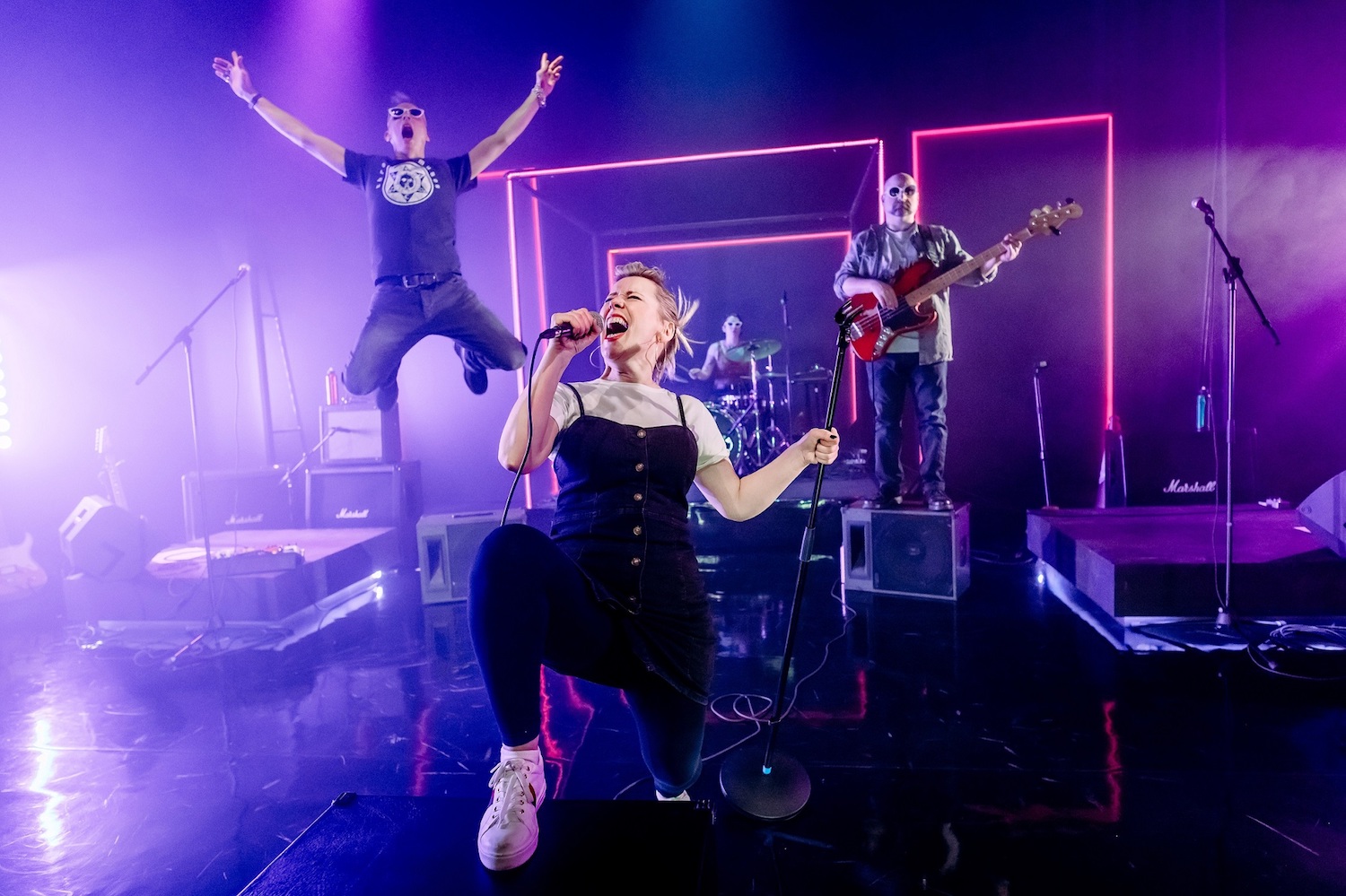
Cora herself is an engaging and charismatic storyteller; microphone in hand, she steps smoothly back into the role of front woman after 25 years. Though there’s no shortage of humour in her tale, nor is there any attempt to sugarcoat any aspect of it, and Cora’s raw honesty means that by the time we get to the business end of proceedings we’re well and truly invested. It’s these final twenty minutes or so where the show really hits home emotionally – perhaps we don’t know what it’s like to party with Blur, but we can certainly relate to the disappointment of having a childhood dream snatched away, the fear of losing a parent, or the desperate longing for a future that’s always just out of reach.

Fittingly, the show takes the format of part play, part gig, with all the appearance and atmosphere of a live music performance – it almost feels wrong for the audience to be sitting down to watch, particularly at the end. Joining Cora on stage are bandmates Emma Smith, Simon Donaldson and Harry Ward, who in addition to providing the music also frequently come close to stealing the show with their hilarious portrayals of everyone from Damon Albarn to Cora’s mum. Under Orla O’Loughlin’s slick direction, the energy of the piece never falters, and the transitions between the musical numbers and spoken word flow very naturally.

Photo credit: Mihaela Bodlovic

Besides being a great nostalgia trip for those of us who grew up listening to the indie music of the 90s, What Girls Are Made Of is a fun and uplifting show that, like any good gig, takes its audience on a journey and then sends us home on a high, confident in the knowledge that while we may not all get (or indeed want) to be rockstars, it’s more than enough to be ourselves – whatever we’re made of.

What Girls Are Made Of is at Soho Theatre until 28th September.

Review: Jade City at the Bunker Theatre

Written in response to the governmental neglect that’s left a lasting mark on the city and people of Belfast, Alice Malseed’s Jade City is a troubling two-hander exploring mental health among young working class men. Unemployed, skint, and with little to strive for or look forward to, friends Sas (Brendan Quinn) and Monty (Barry Calvert) have devised their own way to escape: The Game. Stepping out of their dull, uninspiring lives, in The Game they can be whoever and go wherever they want – fighters in the Cuban Revolution, guests at the Plaza in New York, seagulls soaring high above the city – and for a brief moment they can revel in their newfound freedom, be it financial, political or physical.

Photo credit: Ali Wright

But Sas, who at first glance appears to be the younger and less worldly of the two, has decided it’s time to grow up. He can’t stop thinking about a real-life incident that happened a while back, and he wants to stop playing and start talking – if only Monty would listen. As the story of that night comes out piece by piece, the play takes us down some dark paths, with references to depression, suicide and sexual violence, and a harrowing conclusion that’s left wide open to audience interpretation.

The interaction between Barry Calvert and Brendan Quinn is at first entertaining, then thrilling, and finally deeply uncomfortable to watch. With the action carefully contained by director Katherine Nesbitt within a boxing ring set that’s a literal representation of the guys’ surroundings and simultaneously hints at an impending conflict, the energy between them ebbs, flows, and ultimately mutates into something that feels toxic and dangerous – and not just for them.

As much as the play highlights the many barriers to opportunity faced by young Northern Irish men like Sas and Monty, it’s also something of a love letter to Belfast itself. Amidst the banter, Malseed’s script is often gloriously poetic: a celebration of the language, culture and atmosphere of a city that for so many people, even twenty years after the Good Friday Agreement, still brings to mind only unrest and division. There’s the sense of a community, albeit a dissatisfied one, in the familiar faces who hang out at the local working men’s club to drink their troubles away, and for all the characters’ escapist fantasies, it’s obvious that in reality they can’t picture themselves anywhere else.

Photo credit: Ali Wright

To ensure we don’t miss a word, captions are used throughout – and while these are certainly helpful at times for deciphering the characters’ Northern Irish accents, their inclusion feels as symbolic as it is practical: you get the sense that Sas and Monty are merely acting out a story that’s been written for them, and which for any good intentions they might have, can’t now be avoided.

The play was inspired by two shocking statistics: one third of people in Northern Ireland live on or below the bread line, and there have been more suicides in the last two decades than there were deaths during the Troubles. Behind those numbers are real people like Sas and Monty, who’ve grown up in the shadow of a period in their country’s history that they don’t even remember. The play asks for our understanding, if not quite our sympathy – some of these young men’s actions are unforgivable, regardless of their circumstances – and sends us away with a final image which, however you choose to read it, is unlikely to fade any time soon.

Jade City is at the Bunker Theatre until 21st September.