Review: FCUK’D at The Bunker Theatre

There’s a particularly poignant moment in Niall Ransome’s FCUK’D, in which two frightened boys huddle together under a railway bridge in the freezing cold, while above them commuters are absorbed in their phones and Christmas revellers make their merry way home, all of them oblivious to the children who need their help just yards away.

While this image has plenty to say about our society and way of life, it’s also a pretty good metaphor for the show itself. While other theatres opt for the crowd-pleasing spectacle of panto, not far away The Bunker is quietly doing something very different to mark the festive season – reminding us along the way that not everyone is celebrating just because it’s Christmas. FCUK’D is a simple, understated yet incredibly hard-hitting one-man show about seventeen-year-old Boy and his little brother Matty. Having been abandoned by their father and neglected by their mother, Boy lives every day in terror of Matty – the person he cares about more than anyone else in the world – being taken away. And he’s willing to do anything, even go on the run, to prevent that from happening.

Photo credit: Andreas Lambis

However touching Boy’s motivation, when it inevitably happens the two brothers’ flight always seems like a doomed enterprise. Boy is, by his own admission, rash and immature; he has no idea what he’s doing and is clearly as terrified as his confused little brother. Driven by desperation and fear, the pair have no money, shelter or transport and are forced to take increasingly extreme measures to survive in the freezing December temperatures. Their devotion to each other is such that we want them to make it, and yet we have to acknowledge their situation is unsustainable, and to question if this really is the way to give Matty his best chance – even if the alternative is a system that isn’t doing enough to help young people in trouble until it’s too late.

Will Mytum gives an utterly compelling solo performance as both Boy and Matty (he even has a convincing play-fight with himself at one point). Delivering Niall Ransome’s rhyming verse in a way that highlights the poetry but still sounds completely natural, Mytum has all the swagger and false confidence of any teenager, but with a haunted expression that reveals the self-loathing and insecurity lurking not far beneath the surface. Then, all of a sudden, it’s like a switch is thrown as he transforms into Matty and we see all the fear and doubt fall away. Matty is adorable – innocent, inquisitive, and with such absolute faith in his big brother that he’ll follow him anywhere, no matter what it might cost.
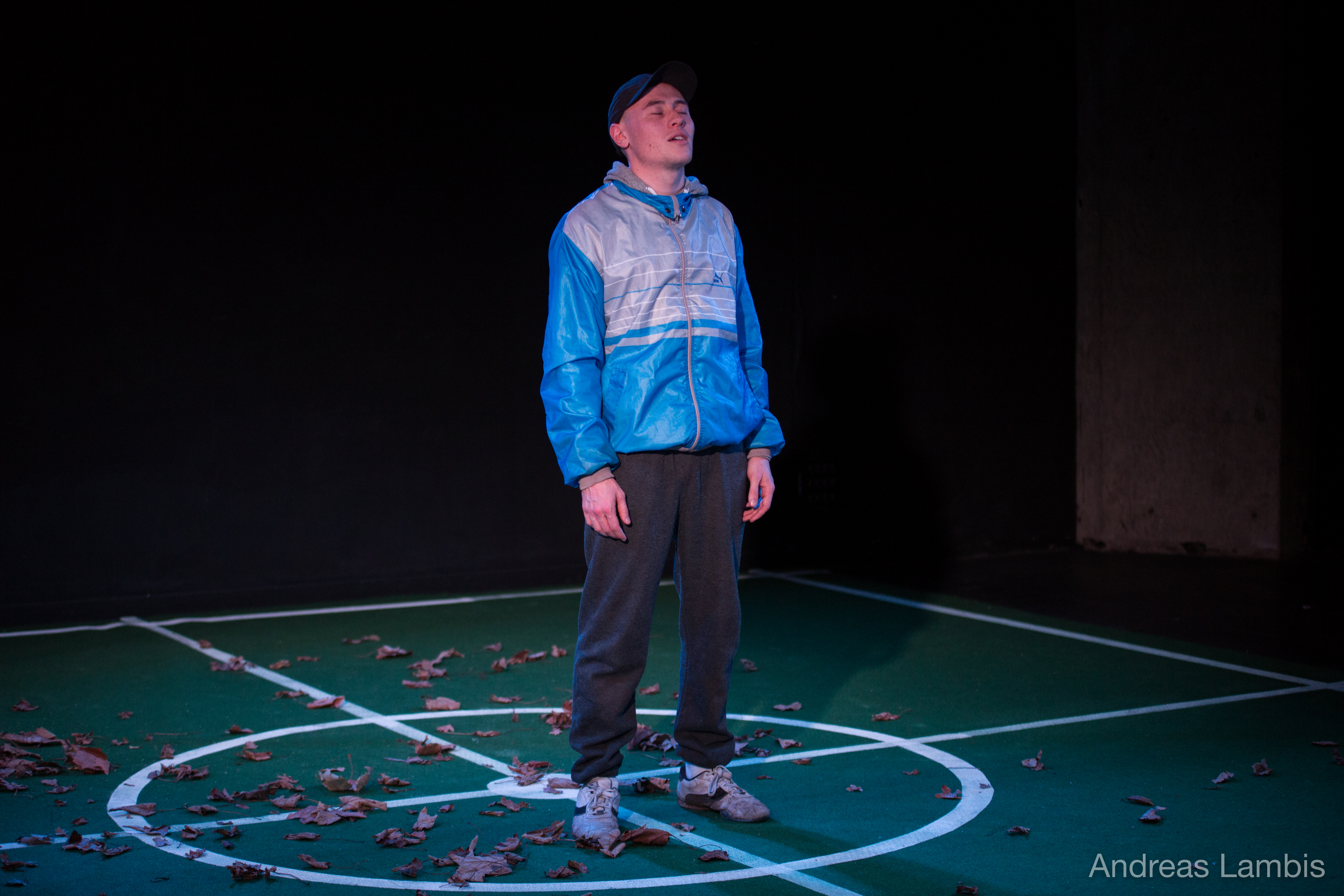
Photo credit: Andreas Lambis

The rest of the production, which is also directed by Niall Ransome, is similarly understated, with effects that – unlike in many festive shows – support the central performance without trying to be the main focus. Peter Wilson’s ominous score helps to build the tension, while the set by Grace Venning captures the harsh urban environment of Boy and Matty’s world. And Jess Bernberg’s brilliantly effective lighting combines with Ransome’s words to show us things we can’t see, like the flickering orange of a flame, or the blue lights of an approaching police car.

FCUK’D is not your typical Christmas show, but that’s not a bad thing; pantos are always good festive fun, but they’re also about as far from the real world as it’s possible to get. At this time of year perhaps more than any other, when we can get so absorbed by shopping, wrapping, cooking and partying, a shot of reality – however sobering – might be just what’s needed.


Can’t see the map on iPhone? Try turning your phone to landscape and that should sort it. I don’t know why but I’m working on it… 😉
Review: Guys and Dolls at Royal Exchange Theatre

Guest review by Aleks Anders

The Royal Exchange Company develops its ongoing collaboration with all-black theatre company Talawa for this, their latest offering, the Broadway musical Guys and Dolls.

With a book by Jo Swerling and Abe Burrows, and music and lyrics by Frank Loesser, we are well and truly in the golden age of Broadway musicals. In other words, an age when musicals were perhaps a little more fanciful and comedic than some of today’s through-sung rock opera musicals are. This one is no exception, and traditionally set in Times Square, it is a mickey take of persons perhaps real or imagined that peopled that neighbourhood at that time, based on the Damon Runyon stories of 1930s New York.

Photo credit: Manuel Harlan

If you have never seen Guys and Dolls before, then the story follows two would-be couples. Two of the area’s most notorious gamblers, Nathan Detroit and Sky Masterson, finally get hitched (to Adelaide and Sarah respectively). It is a comedy love story set in this Noir-esque underbelly of NYC.

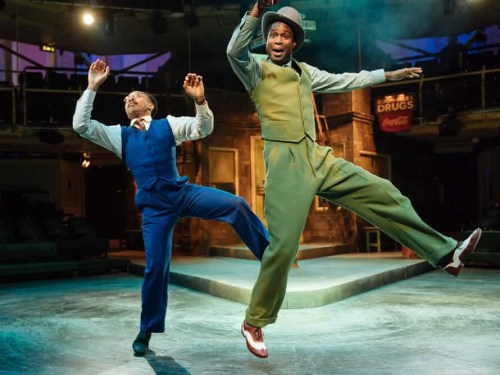
This version saw the action shift to Harlem, New York’s black neighbourhood, and the directing (Michael Buffong) and feel of the show was much more real and much darker than I have ever seen it before. It suited the cast, as they played their characters with much more truth and realism than the normal mono-dimensional musical theatre caricatures, and the interpretations of some of the leads was totally different from any other time I have seen this show.

Musically too, the orchestra (led by Mark Aspinall) was given leeway to jazz-up many of the songs, giving them much more authenticity in the new setting of the show.

Overall this idea worked and worked well, but it was flawed. I didn’t like the new song that Adelaide sung in the night club in act one – I had never heard that in a theatre performance before, and only realised later that it came from the film; and her very serious and heart-wrenching rendition of her lament was pitched wrongly, finding no comedy in there at all, and with absolutely no hint of her actually having a cold either before it or during it.

There were several other things too which didn’t quite sit right with me, but I’ll just put those down to personal choice, and leave it at that.

Photo credit: Manuel Harlan

If you have never seen the show before, then you will absolutely love this re-working, and not have anything with which to compare it. Myself, I had mixed reactions to it, but overall did enjoy it immensely, especially Kenrick Sandy’s choreography to Luck Be A Lady and the showstopper Sit Down You’re Rocking The Boat.

Ray Fearon is a very likeable Nathan Detroit, and he plays his role with charm and ease, whilst the object of his desires, Adelaide, played here by Lucy Vandi, to whom he has been engaged for 12 years, is given a completely new make-over and the strong, sassy side of this new characterisation really did not work at all. Couple number two came in the form of a more nervous and less confident Sky Masterson than I have previously seen, but this suited actor Ashley Zhangazha well, and was the perfect foil for the more tight-lipped and upright Sarah Brown, played wonderfully by Abiona Omonua.

It is clear that this is a musical however, and so vocally one would expect it to be superb. Sadly it wasn’t. Undeniably all the cast could sing but it felt weak in places and the voices seemed much more at home with the bluesy, jazzy, crooning style, instead of Broadway musical numbers. They were also drowned out too a couple of times by the orchestrations.

Happily, my favourite song in the show was sung superbly and so a special mention should be given to Trevor Toussaint, who plays the often understated part of Abernathy excellently.

Guys and Dolls is not perhaps the sure-fire hit that the Royal Exchange were hoping for, but an all black version, as far as I can tell, is a UK first, and it certainly makes it a most interesting and unusual show. There is certainly much to like and enjoy within it, and the cast play it for all its worth with truth and sincerity, which reaps dividends, but running at 2 hours 50 minutes (with interval) it is a little too long.

Guys and Dolls is at the Royal Exchange Theatre until 27th January.

Review: Actor Awareness Best of Scratch 2017

The Actor Awareness campaign, founded by Tom Stocks two years ago to fight for more equality, diversity and working class talent in the arts, has continued to go from strength to strength this year. Alongside regular scratch nights and the return of their annual new writing festival, the team have also found time to make an award-winning documentary, The Acting Class, which features the likes of Maxine Peake, Christopher Eccleston and Julie Hesmondhalgh. Needless to say, they have a lot to look back on as the year comes to an end, and they chose to mark the occasion by revisiting four of the best new plays performed at Actor Awareness scratch nights during 2017, in a best of evening hosted by actor and singer Stephanie Houtman.

The first of the four plays, selected from the Women’s Night back in March, was Come Die With Me by Vicki Connerty, directed by Shaadi Rad. Newly widowed Helen (Stella Ross) has decided to get her husband embalmed and keep him in her living room until the funeral, much to the dismay of daughter Rachel (Charlotte East) and morbid fascination of son David (Jack Spencer). This thoroughly enjoyable extract from the now 60-minute play is laugh-out-loud funny but somehow still feels very grounded in reality, touching on the fears and worries that all of us face when we lose a loved one.

Next was the altogether more sinister 2022, a dystopian drama written and directed by Colleen Prendergast, about a post-Brexit British Muslim ban.  Selected from the Race, Religion and Culture night, the play sees young mother Selwa (Lauren Santana) trying to convince border guards Colquhoun (Deborah Wastell) and Gower (Richard Innocent) to let her and her baby cross – before events take an unforeseen turn. It’s a very timely piece that, given recent events here and in the States, feels frighteningly probable and challenges us to question our own assumptions. That said, the play is also very funny – Richard Innocent and his ever more depressed facial expressions are particularly fun to watch.

Assumptions are also challenged in the pick from Political Night, Stephanie Silver’s Our Big Love Story, a tale of four teenagers (Holly Ashman, Maria Kolandawel, Alex Britt and Emelia Marshall Lovsey) and a teacher (Arjun Bhullar) affected by the 2005 London bombings. Directed by Calum Robshaw, the play explores various themes including faith, prejudice, love and the radicalisation of young people – which is a lot to try and squeeze into a fifteen-minute extract. The full-length piece is set for a run at The Hope Theatre next March, and it will be interesting to see how all the different stories and ideas come together given more time.

Last but by no means least Michelle Payne’s Full Circle, which was first performed at the Mental Health Night, presents a movingly honest account of living with depression. Nicole (Elicia Moon Murphy) starts a peer support group in the hope of making some friends, but gets a little more – or should that be less – than she bargained for when just two people show up: Amy (Kate Kelly), who’s always angry, and Skye (Lucy Gape), who treats everything as a big joke. The play combines humour and tragedy as the three very different women begin to build a tentative friendship, with each sharing her own unique experience with depression – a useful reminder that mental illness can affect everyone differently, and that it isn’t always obvious to the outside world.

The four plays were sandwiched between two new comedy sketches from Brittle Britain by Tom Stocks, which takes a sharply satirical swipe at the sorry state of our nation. From a general election campaign featuring the WGAF party (I’ll let you figure that one out) to playing the Immigration Game to avoid deportation, it’s all quite surreal but – depressingly – very much inspired by actual events.

The fact that most, if not all, of the plays showcased during the evening have gone on to be developed into full-length work and performed elsewhere is a good indication of the quality on display. This evening of strong performances and thought-provoking writing is a fitting round-up of a successful year for Actor Awareness; I look forward to seeing what 2018 has in store.

To find out more, visit the Actor Awareness website or follow @actorawareness.

Review: Once Upon a Snowflake at Chelsea Theatre

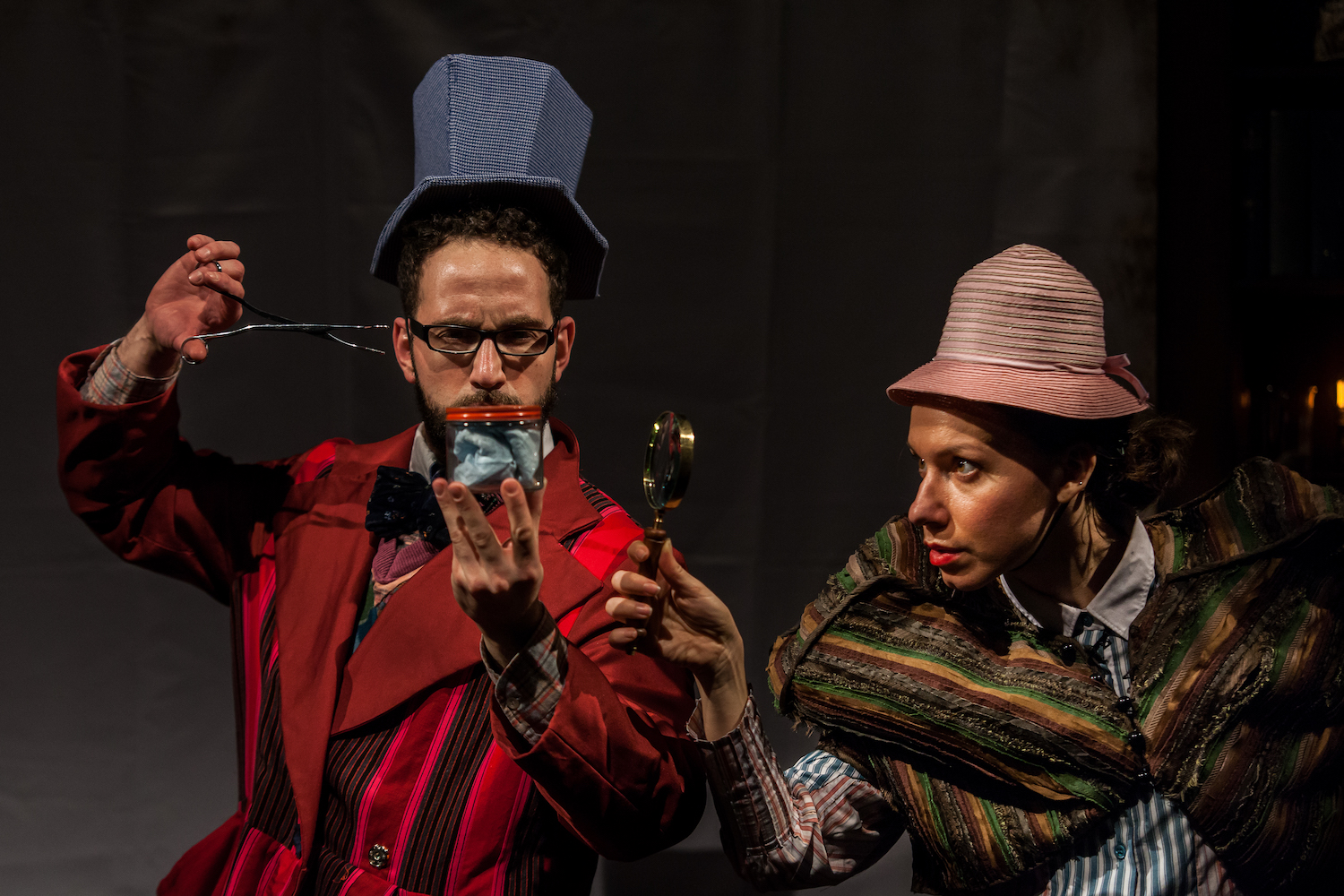
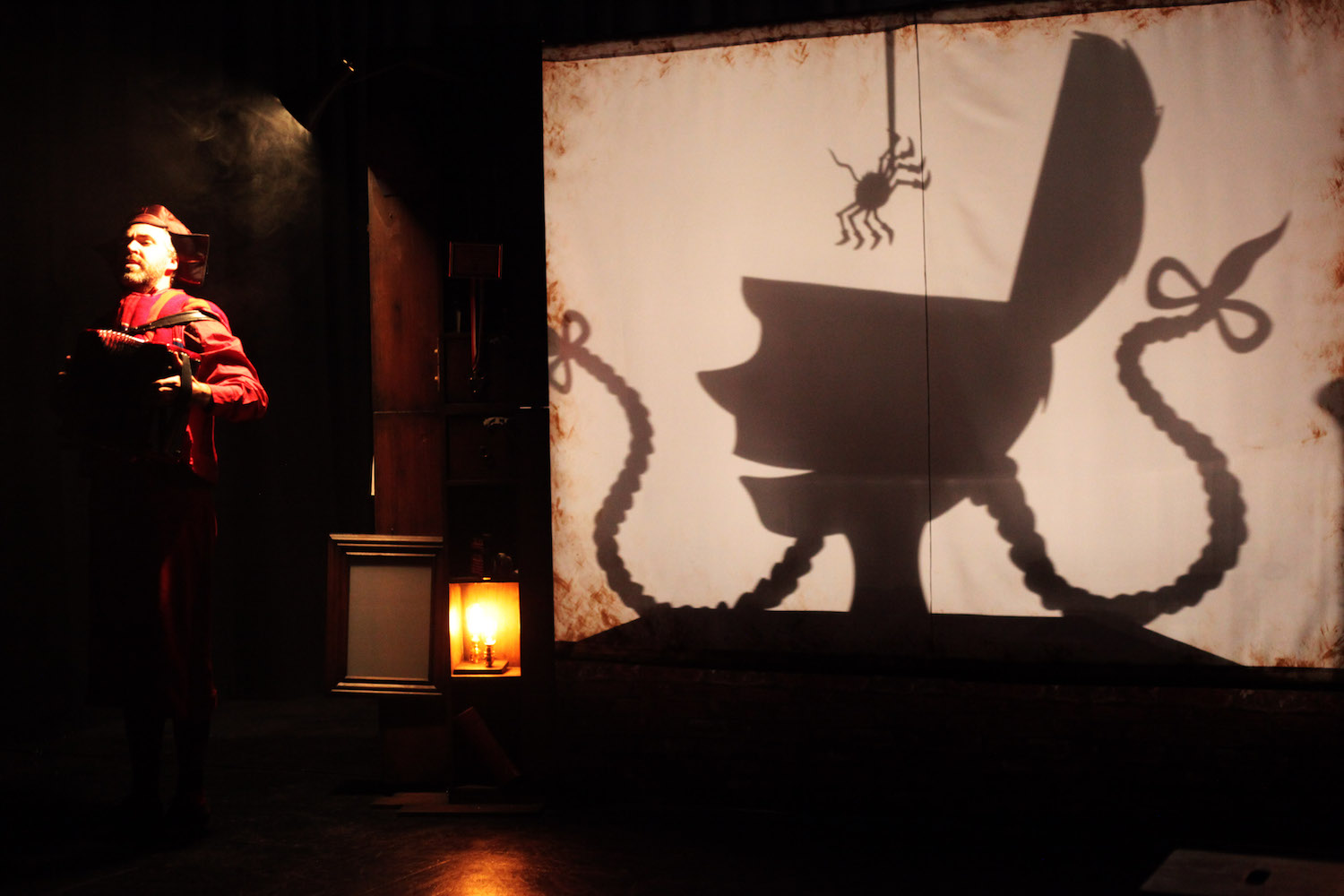
Given that we had our first (very brief) snow of winter last week, the timing of Paper Balloon’s alternative Christmas show Once Upon a Snowflake seems particularly appropriate. Combining live music, shadow puppetry and storytelling, Once Upon a Snowflake introduces us to three spriteologists, who begin by smugly informing us (in song, no less) that there’s nothing they don’t know about sprites. But when a young girl disappears after an encounter with a mischievous winter sprite, they’re forced to enlist the audience’s help in solving the mystery.

Photo credit: Paper Balloons

The show has plenty to delight audiences of all ages: catchy songs, colourful costumes, plenty of witty references to popular stories, and – naturally – a bit of audience participation (the section in which the cast improvise a story and song with suggestions and props supplied by their young audience is a highlight, if only to see how they manage to turn a shoe and an umbrella into a footballing dinosaur). As in all the best family shows, the humour is carefully pitched so it can be enjoyed by adults and kids alike, and there’s even an educational element: while we may not all believe in winter sprites, there’s still a lot to learn for all ages, whether it’s that polar bears don’t live in Antarctica, or that sometimes even so-called experts get things wrong.

But what makes this production really stand out from your typical seasonal family show is the skilful use of light and shadow puppetry, which are put to magical effect throughout the show, particularly when telling us about the missing Liza; it proves as fascinating for the grown-ups as it is for the children to watch her dream-like world come alive. The shadow work is incorporated seamlessly into spirited performances from Alex Kanefsky and Dorie Kinnear who, as well as spriteologists, also play at various points Liza, her parents, her neighbour and even the chatty sprite she discovers in her pocket one day, all while interacting with their (at times unpredictable) audience.

The two also have excellent support from Joseph Hardy, who not only plays an impressive number of musical instruments (frequently all at once, with the aid of a loop pedal) but also sings and provides wonderfully creative and entertaining sound effects for the story. Darren Clark’s music – like the rest of the production, which was originally directed by Maria Litvinova – has a very Russian folk feel to it, all of which adds to the show’s unique character and style.

Photo credit: Paper Balloons

Once Upon a Snowflake is charming, quirky and different, sidestepping the usual panto conventions but still delivering a heartwarming Christmassy message about acceptance and friendship. Perhaps the story might go a little over the heads of some younger children – but it’s beautifully presented, and the show has more than enough joyous energy to keep most little ones spellbound regardless.


Can’t see the map on iPhone? Try turning your phone to landscape and that should sort it. I don’t know why but I’m working on it… 😉

Review: The Tricycle at the Blue Elephant Theatre

In 1962, Fernando Arrabal co-founded the Panic Movement, a collective of artists whose aim was to create theatre that was surreal and shocking. Although it was written a decade earlier, these are two adjectives that very accurately sum up Arrabal’s The Tricycle, which has been revived in a new production translated and directed by Jesús Chavero of Bright South Theatre. In the play, teenagers Apal, Climando and Mita resort to murder to get their hands on some money so they can pay for a tricycle they’ve hired. Though we don’t see any actual violence (there’s plenty of blood and gore, but poetically, this is portrayed by red petals scattered across the stage), the play’s powerful shock value lies in the casual attitude of the characters towards their intended crime, and the ease with which they later justify their actions.

However, it’s not quite as black and white as it sounds. The characters’ genuine amazement when they realise they’re in trouble confirms our belief that they’re not bad people, they just don’t understand that they’ve done anything wrong. Prior to their fateful encounter with the Man With The Banknotes, Climando (Andrew Gichigi) is a cheeky chappy who spends most of his time clowning around, flirting with Mita (Lakshmi Khabrani), having nonsensical arguments with The Old Man (Simon Lammers), and trying to get Apal (Arif Alfaraz) to stay awake more than a couple of minutes at a time. It’s all very childlike and innocent, albeit with a slightly sinister twist (at one point, Climando and Mita cheerfully encourage each other to commit suicide), and in a strange way it’s easy to brush off the bit where the friends murder someone as an unfortunate blip – not forgivable by any means, but perhaps almost understandable.

This is probably because in the killers’ eyes their crime was simply something that needed to be done, and not an act of malice. They’re poor and nobody wants to help them, so the only logical response for them is to help themselves. The decision to relocate the play to London gives its themes of poverty and social rejection more immediacy, and asks the audience to consider how much we really blame these outcasts for what they’ve done, and how much responsibility should fall on a society that put them in such a desperate position in the first place.

An example of Spanish Absurdist theatre, The Tricycle is undoubtedly an odd little play, but it’s also strangely endearing, thanks to the obvious passion of the company, and the cast’s infectious and energetic performances (except Apal, obviously, who spends most of his time asleep on a bench). The production features a surprising amount of laughter, a lot of fast-moving word play – so much so that it becomes hard to keep up with the increasingly heated arguments – and some impressive, and unexpected, acrobatics. This light-hearted treatment of the play’s dark, challenging themes makes for an intriguing blend; an acquired taste, perhaps, but one I wouldn’t mind getting used to.


Can’t see the map on iPhone? Try turning your phone to landscape and that should sort it. I don’t know why but I’m working on it… 😉