Review: Mr Stink at Chickenshed

Chickenshed is an inclusive theatre company that celebrates diversity in all its forms. Mr Stink is a story about a homeless man who’s befriended by a 12-year-old girl – the only person who ever bothers to stop and talk to him. Put the two together, and it’s pretty much a perfect fit.

The second novel from best-selling children’s author David Walliams is a heartwarming tale of friendship, loneliness and the social responsibility we all have to look out for our fellow human beings… even if they really, really stink. Adapted as a musical by director Lou Stein, it’s a colourful, funny and thought-provoking show for all ages, with songs that are so catchy you may well find yourself still singing them the next day, whether you want to or not (trust me on this, I speak from experience). And really, how can you not fall in love with a show that opens Act 2 with a musical number about sausages?
Mr Stink at Chickenshed
Photo credit: Caz Dyer for Chickenshed

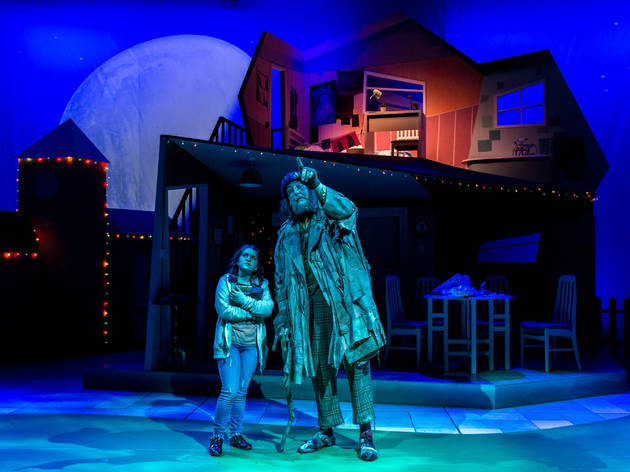
Mr Stink (Bradley Davis) is an old “vagabond”, to use his word, who arrives in town one day and takes up residence on a bench. He and his dog are ostracised by the local community because they smell so bad, until one day Chloe Crumb (Lydia Stables) stops to say hello. Chloe has a nice house and a family; she goes to a posh school and always has enough to eat. But she’s also lonely and feels unloved by her exhaustingly perfect sister Annabelle (Maddie Kavanagh) and above all by her mother (Belinda McGuirk), a determined social climber running for election as a local MP. One of her campaign promises is to get “soap-dodgers” off the streets, and so to protect her new friend, Chloe moves him into the garden shed – but he doesn’t stay hidden for long…

Chickenshed never fail to impress with the quality of their productions, and Mr Stink is no exception, showcasing some excellent performances from the whole cast, and in particular Bradley Davis and Lydia Stables (sharing the role with Lucy-Mae Beacock) as Mr Stink and Chloe. Their blossoming friendship is a joy to watch, with each of them helping the other in ways they could never have predicted. Alongside them, Belinda McGuirk and Maddie Kavanagh (sharing her role with Courtney Dayes) are enjoyably loathsome as Mrs Crumb and Annabelle, while Ashley Driver plays the hapless Mr Crumb – who spends most of his time hiding from his wife – to great comic effect.

There’s also a delightful appearance by Goutham Rohan as Raj, the local shopkeeper, who’s always on hand with some helpful advice or a Teenage Mutant Ninja Turtles stationery set. Oh, and did I mention Mr Stink marks the professional acting debut of a certain Jeremy Vine, who appears in a pre-recorded video segment as Sir Dave, the host of TV show Politics Today.

Mr Stink at Chickenshed
Photo credit: Caz Dyer for Chickenshed

The show looks amazing, too, with colourful and exceptionally detailed set and costumes designed by Keith Dunne, all of which are beautifully lit by Andrew Caddies. The musical numbers, written by Lou Stein and Dave Carey, may not add much to the story but they do provide a visual treat, and allow for the inclusion in the show of a small chorus ensemble, who execute Dina Williams’ choreography in the group numbers with flair and the boundless enthusiasm that’s such an irresistible feature of Chickenshed performances.

Like all good family shows, there’s something for everyone in Mr Stink; it’s a lot of fun and occasionally very silly, with humour that will tickle kids and adults alike. But it also makes a powerful point; while I don’t for a minute believe David Walliams wants us all to go out and find a homeless man to hide in the garden shed, what his story does show us is the importance of reaching out to help others, without making judgments about who they are or what they do. And that, I think, is a lesson we can all benefit from – whether we’re 8 or 80.


Can’t see the map on iPhone? Try turning your phone to landscape and that should sort it. I don’t know why but I’m working on it… 😉

Review: Bluebird at The Space

It might be 20 years old, but Simon Stephens’ early play Bluebird could have been written yesterday – and not only because of the many very apt references to the stiflingly hot weather.

A play of two halves, the first act consists of a series of short encounters between taxi driver Jimmy and the various fares he picks up in his cab one summer night in London. As he drives them to their destination, each shares a bit of themselves with him – whether it’s bad jokes, philosophical musings or reliving a personal tragedy – and he in return reveals a little of his own story.

These short sketches are performed by a talented ensemble cast and are by turns funny, moving and intriguing; they feed, ultimately, into Jimmy’s tale, but they also stand alone as a snapshot of London in all its glorious randomness. And with more than one passenger expressing concerns about where we’re all headed, you could easily be forgiven for thinking this is a play for 2018, not 1998.

With the majority of the action taking place in one location – Jimmy’s car – director Adam Hemming keeps things visually interesting with a stage consisting of two intersecting runways, and the audience arranged at the four corners. With each new fare, the actors move to a new location on the stage, giving us a different perspective in more ways than one, and between scenes the characters we’ve met – or are about to meet – continue on with their night.

The only other set consists of a couple of chairs and various car parts which are arranged on stage one by one; during one scene Jimmy holds a steering wheel, for another he and his passenger sit behind the car headlights or between two wing mirrors. This, it turns out, is a neat visual metaphor for the play itself; just as each new encounter provides a little more of the puzzle that is Jimmy, so all the car parts are eventually reunited for the final emotionally charged scene with Claire, his estranged wife.

As the other actors rotate around him, Jonathan Keane maintains a steady, quiet presence throughout as Jimmy. He spends most of Act 1 listening to other people’s problems, taking care of them, and establishing himself firmly in our minds as a good guy – a guy who gets people home safe and lends an ear to those who need it. But there’s just enough of an edge to the character, and Jimmy’s conversations reveal sufficient snippets of information, to allow us to hazard a guess at what’s coming – even before he meets Claire, played by Anna Doolan with a poignant mix of anger, hurt and lingering affection. Their encounter sizzles with a gripping emotional intensity, before coming to a rather abrupt end that leaves us with many unanswered questions about the story we’ve just heard.

Despite this minor frustration, however, Bluebird successfully hits the emotional mark with its portrayal of a couple taking their first tentative steps towards some kind of reconciliation, and a man navigating his own unique and bumpy road to redemption. A moving study of grief and guilt, imaginatively staged and set in a London we can all recognise, this revival is well worth a visit.


Can’t see the map on iPhone? Try turning your phone to landscape and that should sort it. I don’t know why but I’m working on it… 😉

Review: The White Rose at the Brockley Jack Studio Theatre

Best known for their adaptations of literary classics, Arrows & Traps have taken a different approach in their latest production, The White Rose. An original piece written and directed by Ross McGregor, based on Richard Hanser’s A Noble Treason, the play tells the powerful true story of Sophie Scholl who, along with her brother Hans, was the leader of a resistance group – known as the White Rose – and was arrested and executed in 1943 for distributing leaflets denouncing Hitler’s regime. The structure of the play interposes scenes of Sophie’s interrogation with the story of the White Rose, telling an extraordinary tale of courage in the face of tyranny, and posing some important questions that resonate now more than ever with a modern day audience.

First of all, to anyone who fears that the company moving away from its roots was a bad idea, let me put your mind at rest: I think it’s very possible that The White Rose is the Arrows’ best show yet. It’s certainly the one that’s had the biggest impact on me personally – although leaving the theatre I couldn’t quite decide if I was sad, inspired, furious or terrified at the state of the world (both past and present).

The White Rose at Brockley Jack Studio Theatre
Photo credit: Davor Tovarlaza @ The Ocular Creative

The outstanding ensemble cast don’t put a foot wrong – both metaphorically and literally; like all Arrows productions, this is a play where every movement has meaning – and make us feel every emotion: there’s desperation and anger in abundance, but in lighter moments we’re also given the chance to appreciate the optimism and camaraderie of young people who want to make the world a better place. And through it all runs fear: the fear of being caught, of speaking out, of losing friends – but on the other side of the scales sits the fear of keeping quiet and what that could potentially lead to.

From Christopher Tester’s conflicted Gestapo officer Robert Mohr to Pearce Sampson’s quietly courageous Christoph Probst; Conor Moss’ witty Alexander Schmorell to Will Pinchin’s intense, furious Hans Scholl, every character has their own voice, and their own reason for behaving as they do. But above all, this is Sophie’s story, and just as she’s welcomed into her brother’s group of friends, Lucy Ioannou proves to be a fantastic new recruit to the Arrows family, balancing perfectly Sophie’s youth, wit and innocence with the courage and moral strength that will lead her to risk everything for what’s right.

With resident Movement Director Will Pinchin taking to the stage as Hans, Roman Berry seamlessly takes up the mantle, producing thrilling, immaculately choreographed dreamlike sequences reminiscent of the company’s earlier work. The cinematic quality of the play is further enhanced by the inclusion of video footage at the beginning of each act, which shows chilling scenes of Hitler addressing adoring crowds, and drives home more powerfully than any words the impossibility of what the White Rose is trying to do.

The White Rose at Brockley Jack Studio Theatre
Photo credit: Davor Tovarlaza @ The Ocular Creative

The script teases out parallels between 1943 and 2018, without beating us around the head with them, and also makes a point of reminding us that Nazism wasn’t always death camps and terror in the streets; Hitler came to power on the promise of rebuilding Germany, and everyone – including Sophie and Hans – believed him. The play celebrates and acknowledges the White Rose’s sacrifice, but at the same time attempts to understand why everyone else stayed silent even when things went bad. Some, like Sophie’s fiance Fritz (Freddie Cambanakis), feared the repercussions of resistance; some, like her cellmate Else (Cornelia Baumann) optimistically believed it would all soon be over; others, like Gestapo officer Mohr, genuinely thought Hitler had made things better. In allowing these characters to have their say, the play becomes something far more complex than simply good versus evil, and is all the richer for it.

Despite being very well known in Germany, very few of us here in Britain know the story of Sophie Scholl. The White Rose aims to set that right with this powerful, emotional tribute, but also seizes the opportunity to explore the many unnerving similarities between then and now. It’s uncomfortable, and devastating, and you should definitely go and see it.


Can’t see the map on iPhone? Try turning your phone to landscape and that should sort it. I don’t know why but I’m working on it… 😉

Review: Locked Up at Tristan Bates Theatre

Possibly the only thing worse than being locked up and kept in isolation for an indeterminate amount of time is not knowing who’s responsible or why. This is the plight of the characters in Locked Up, a tense two-hander that’s both the professional London debut of writer Heather Simpkin and the first full-length play from emerging theatre company Bear in the Air Productions.

Locked Up at Tristan Bates Theatre
Photo credit: Rosalind White Photography

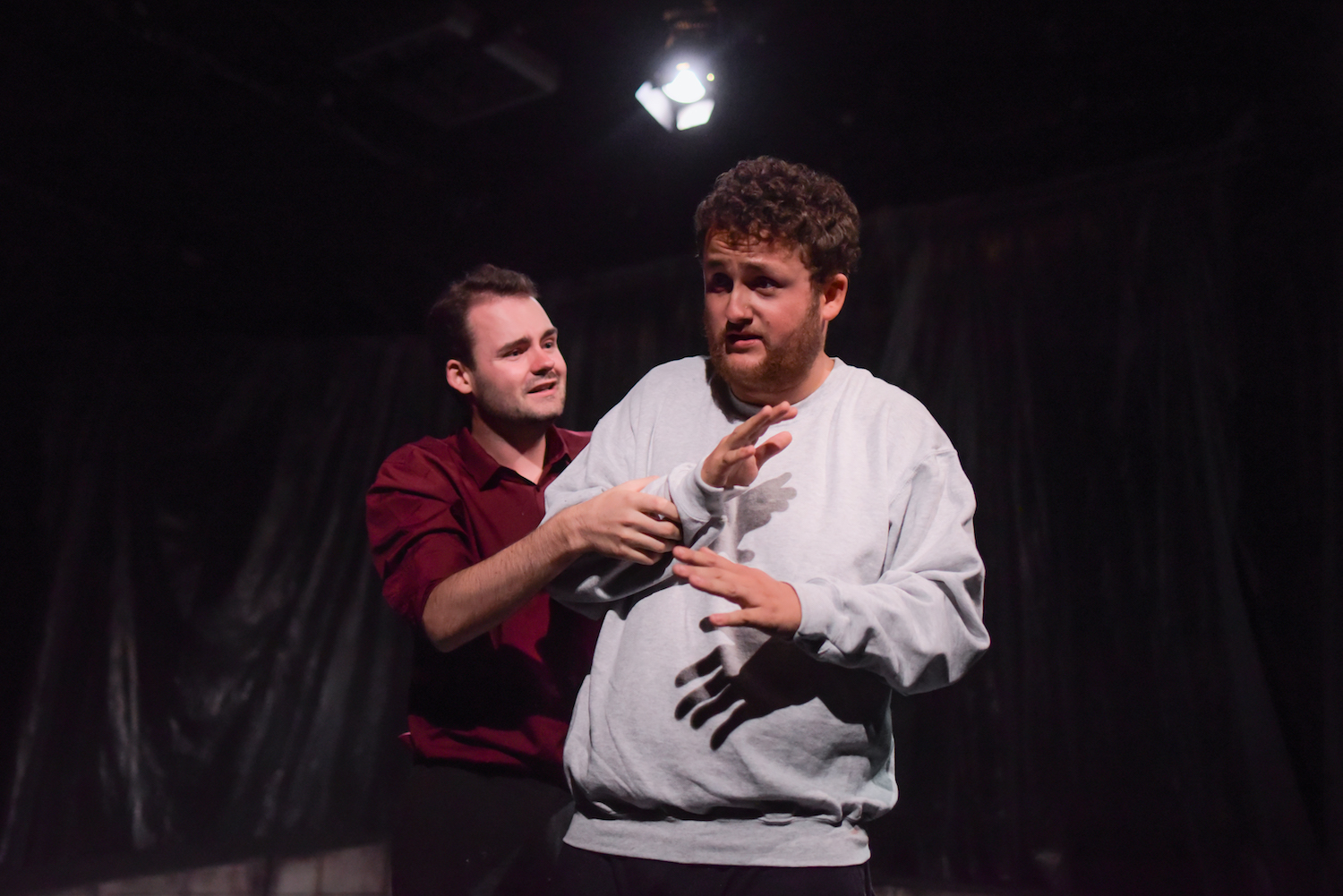
We first meet Declan (Samuel Ranger), who passes his time pacing the floor of the cell, attempting to do push-ups, and singing “99 bottles of beer on the wall” in an endless, mind-numbing loop. The opening minutes of James McAndrew’s production convey very effectively the monotony of Declan’s day-to-day existence, and after a series of short, sharp scenes it’s not long before we too have lost track of time. It’s as much of a shock for us as it is for Declan, then, when one day he suddenly finds he’s no longer alone. His new cellmate is Topher (Conor Cook), who’s equally clueless as to their captors’ intentions – or is he?

Time passes, and the two slowly grow more relaxed around each other, allowing us to get to know them better and fill in a bit of their backstories. We soon learn that they’re very different personalities: Samuel Ranger’s Declan is sensitive and risk-averse, while Conor Cook’s Topher takes a “no guts, no glory” approach to life – so it’s no surprise that he’s the one who ends up taking charge of their escape plan. The uneasy friendship and shifting dynamic between the two is interesting to watch as it develops, particularly as we’re also not sure who – if anyone – we can trust.

Locked Up is a story about human relationships, first and foremost, and asks some searching questions about trust, betrayal and the ways in which a crisis can bring together even the unlikeliest collaborators. But it also touches on current political and social issues that we can all relate to, like the threat of terrorism and government surveillance, and the fear of failure that so often holds us back from pursuing what we really want in life.

If Simpkin’s writing isn’t enough to keep us on the edge of our seats then the light and sound effects employed at each scene change will finish the job; lighting designer Euan Davies has a row of bright spotlights shine directly on to the audience, accompanied by loud and unsettling noises. This has the practical purpose of allowing the actors to invisibly reset the stage – occasionally disappearing from it altogether when one of the characters is taken away for interrogation in the mysterious White Room – but it also keeps the audience on our toes; there’s little chance of us getting too comfortable at any point during the hour-long play.

Locked Up at Tristan Bates Theatre
Photo credit: Rosalind White Photography

Similarly, Justin Williams and Jonny Rust’s set design is logistically clever, allowing the actors to leave and return seemingly out of thin air, but it also helps reinforce the play’s claustrophobic atmosphere. The characters aren’t the only ones who have no idea what’s going on outside these four walls; for the duration of the play, we’re as trapped and in the dark (both literally and figuratively) as they are.

The end, when it comes, is abrupt and catches us completely off guard, and though it’s frustrating that the story cuts off where it does, in a way it’s the perfect moment to stop and leave it to the audience to ponder answers to our many remaining questions. An intriguing and unnerving hour of theatre, Locked Up will keep you guessing to the end – and beyond.

Can’t see the map on iPhone? Try turning your phone to landscape and that should sort it. I don’t know why but I’m working on it… 😉
Review: Fat Jewels at The Hope Theatre

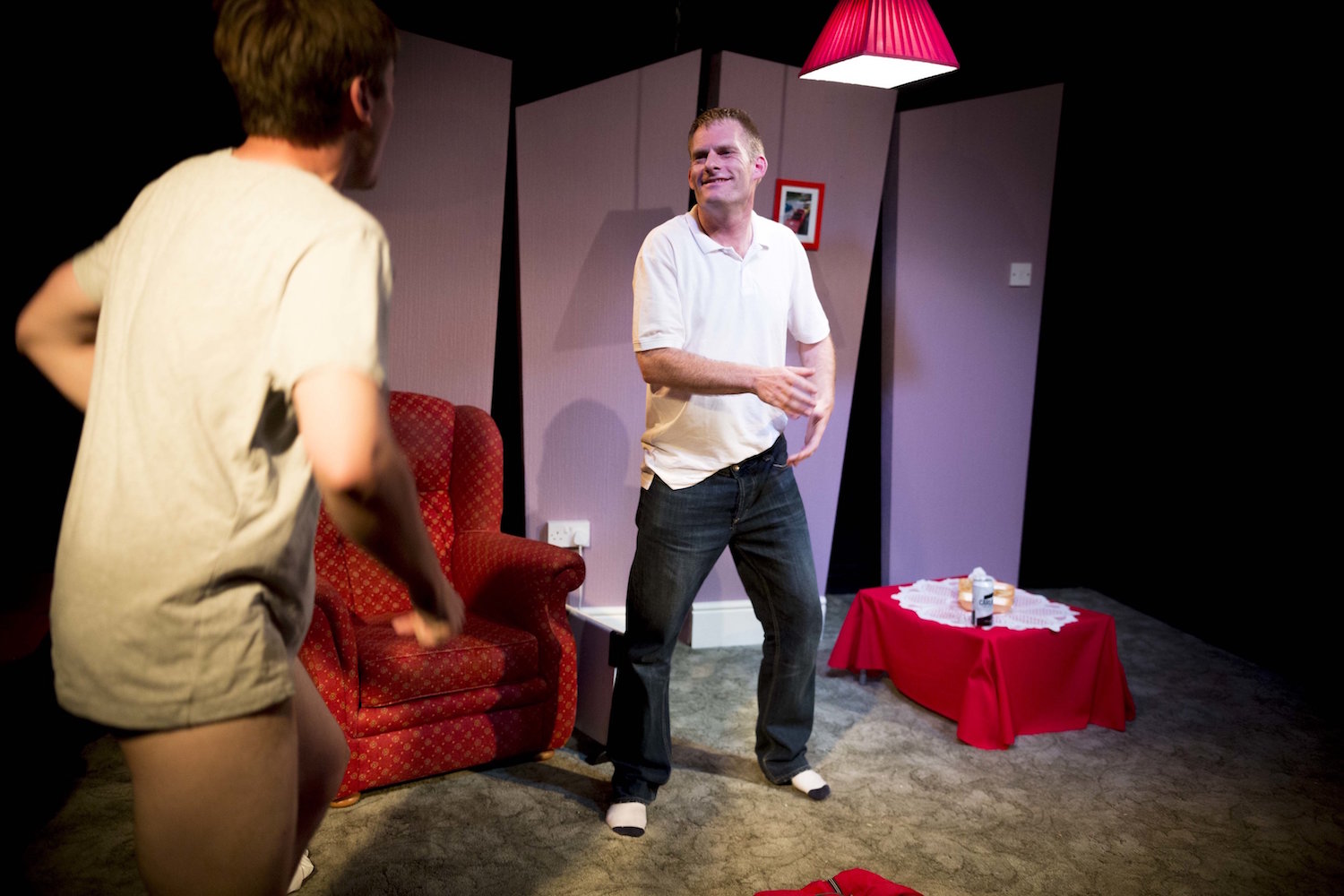
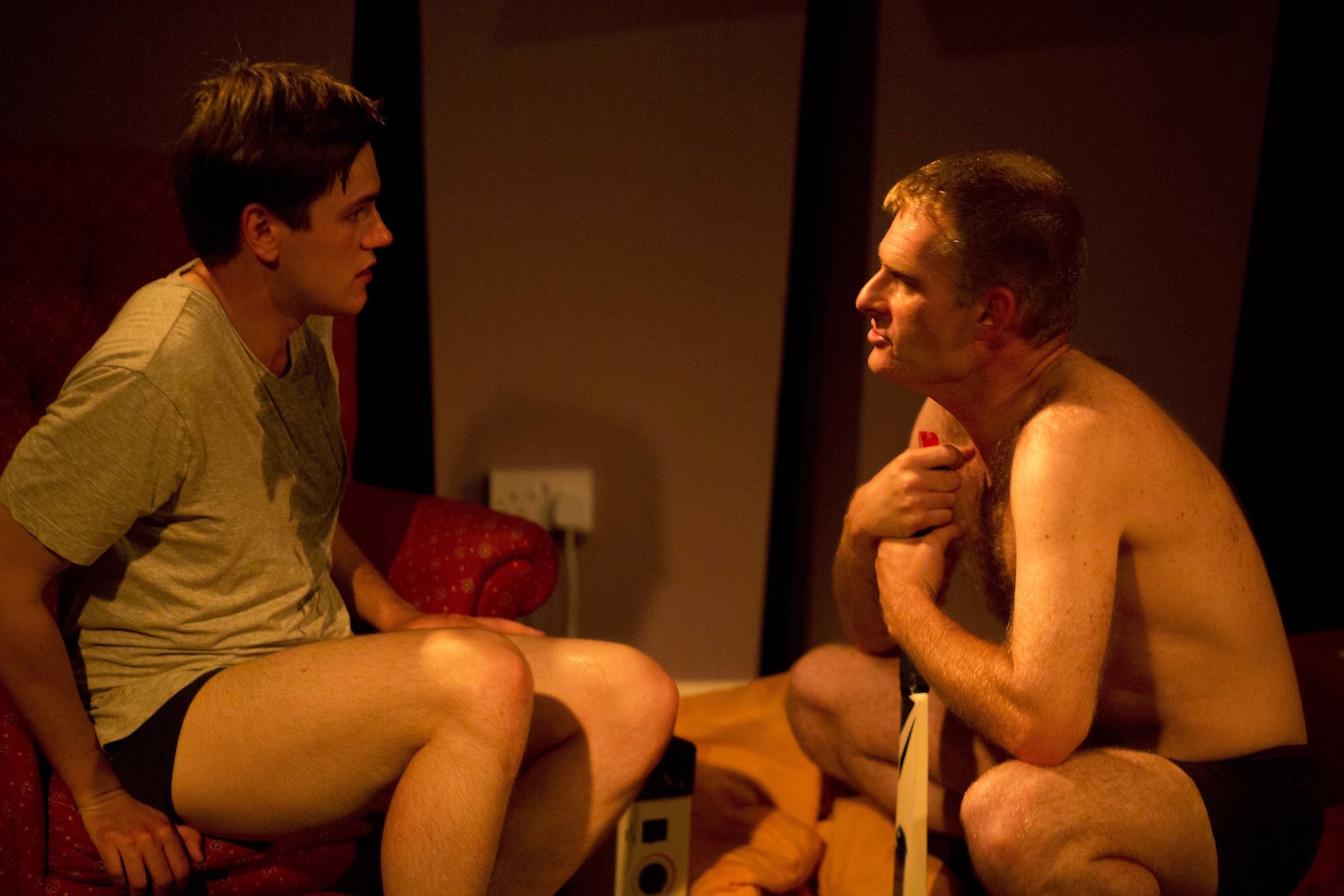
Temperatures soar in more ways than one in Joseph Skelton’s Fat Jewels, a dark and deeply unsettling tale of abuse, manipulation and mental fragility. An already warm theatre becomes increasingly stifling as tensions between the two characters rise, and all the audience can do is sit and wait for the inevitable explosion.

Fat Jewels at The Hope Theatre
Photo credit: Laura Harling

21-year-old Pat (Hugh Train) is a loner who lives with his mum, has no friends and is troubled by violent fantasies. Convinced there’s something wrong with him, he seizes on family friend Danny’s (Robert Walters) vague offer of “therapy”, which seems to mostly involve encouraging him to let out his pent-up aggression by killing animals. But Danny has his own agenda, and takes advantage of Pat’s vulnerability to embark on a programme of emotional and sexual manipulation, all the while convincing him it’s for his own good – and in doing so, like most bullies, reveals his own deep insecurities.

We’re thrown straight into the midst of their bizarre encounter in Danny’s living room on a South Yorkshire council estate, where the heater is turned up to the max and several discarded beer cans hint at a long evening already behind us. Any hopes that this might be a normal friendship go quickly out the window as the older man suggests a trip to the zoo with a cricket bat; while Pat seems clueless as to his true meaning, Danny is visibly excited by the idea of beating a sea lion to death. And it only gets more disturbing from there, as we get into sleeping bag “worm fights”, chicken phobias and a nail-biting final confrontation during which the balance of power shifts dizzyingly back and forth.

As surreal as the plot occasionally gets, it’s sold with absolute conviction by the performances of actors Hugh Train and Robert Walters. As the naive, affable Pat, Train appears every inch the victim; it’s hard to imagine him having violent dreams, let alone acting on them – unless someone insults his mum, that is. Walters’ Danny seems by far the more volatile and dangerous of the two as he uses every unsavoury (and at times downright creepy) method at his disposal to get under Pat’s skin. But as director Luke Davies slowly ramps up the tension, cracks begin to show for both men, and while we can’t feel sympathy for Danny in the same way we do for Pat, by the time he finally crumbles we have some understanding of the insecurity and past trauma that drives him to abuse what little power he has.

Fat Jewels at The Hope Theatre
Photo credit: Laura Harling

Despite some darkly humorous moments, Fat Jewels is not always an easy play to watch; in fact there are points where it’s tempting (and on one occasion necessary, for those sitting front and centre) to physically recoil. The Hope’s tight quarters and rising temperatures work with Skelton’s narrative to create a sense of claustrophobia, so that instead of being a distracting inconvenience, the discomfort becomes a vital part of the audience experience – and when combined with an intriguing plot and two utterly absorbing performances on stage, there’s more than enough in this disturbing production to keep us gripped throughout.


Can’t see the map on iPhone? Try turning your phone to landscape and that should sort it. I don’t know why but I’m working on it… 😉