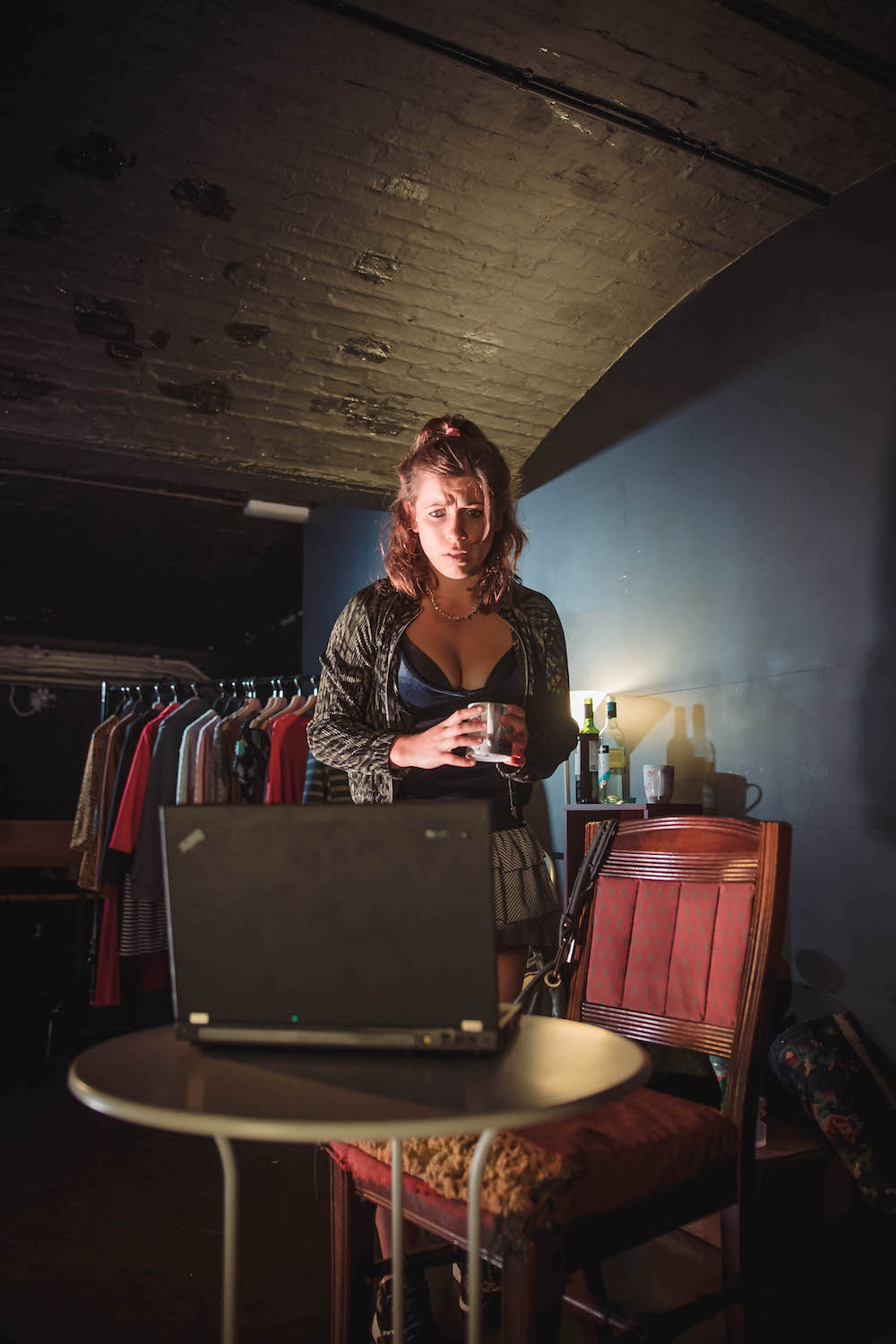
Review: The Government Inspector at Brockley Jack Studio Theatre

Paula Chitty’s new adaptation of Nikolai Gogol’s The Government Inspector is an entertaining comedy of errors, which relocates the action from 19th century Russia to northern England in 1979. With public workers on strike in response to cuts and corruption within the council, the town of Worsborough Dale has fallen into unsanitary disrepair – so it’s with some horror that the local officials learn there’s a government inspector on the way.

When they hear there’s a well-dressed young man staying at the local B&B, they jump to the obvious conclusion, and deal with the problem the only way they know how: by throwing money at it. There’s just one problem – said well-dressed young man isn’t the inspector at all, but Norman, a minor civil servant who’s gambled away all his funds, and is consequently only too happy to accept every penny of the council’s generosity.

Nobody comes out of this story very well: as loathsome as Norman (Jack Blue) and his travelling companion Osip (John Stivey) are, we can’t help but enjoy seeing them take advantage of the equally vile council officials, who’ve been cheerfully lying, cheating and lining their own pockets at the expense of the local residents. Property dealers Black and Jack (Elizabeth George and Richard Houghton-Evans) are dreadful gossips, Tommy the postman (Robert Mclachlan) routinely opens everyone’s mail, the Deputy Leader (Richard Willmott) is a creep who’s already having at least one affair, and the Chairman (Bernard O’Sullivan) is a tyrant who’s only interested in his own career advancement. The one character for whom we have any sympathy is Anna (Fiona Vivian), the Chairman’s daughter, who ends up an innocent pawn in the schemes of her father and Norman.

The real victims, however, are the people of Worsborough Dale, who’ve seen their wages cut, jobs lost and public services slashed; the town’s overrun with rats and the lights keep going out, so it’s hardly surprising that they’ve taken to the streets in protest. Though the play’s set in the 70s, it’s not hard to draw parallels with the current political situation, and the lack of public faith in those elected to lead our country.

The production is at times a little unpolished, but the enthusiasm of the cast can’t be faulted as they throw themselves gleefully into their various unsavoury roles. There’s also some excellent physical humour, particularly in Act 2 when events really begin to spiral out of control. Jack Blue and John Stivey make an enjoyably unscrupulous comedy double act as Norman and his long-suffering companion Osip, and Bernard O’Sullivan also stands out as the increasingly frustrated Chairman; when he finally explodes, it’s quite a sight to behold.

At a time when it feels harder than ever to trust those in power, it feels both appropriate and depressing to see Gogol’s play revived, almost 200 years after it was written. Perhaps one day we’ll no longer need cautionary tales like these – but based on humanity’s track record to date, it seems sadly unlikely.

Review: Much Ado About Nothing at Gray’s Inn Hall

Well, it’s official. I was already a fan of Antic Disposition’s work after enjoying their productions of Henry V and Richard III – but their latest offering, a joyous and hilarious take on Much Ado About Nothing, has well and truly sealed the deal. The play itself I have all kinds of issues with, but I’m not going to get into those, because I had such a great time watching this production that I’m seriously considering a return visit before the run ends on 1st September.

Photo credit: Scott Rylander

Transplanted from Italy to a small French village at the end of World War II, Much Ado sees Don Pedro (Theo Landey) and his triumphant soldiers call in to visit the town’s Governor, Leonato (Chris Hespel) on their way home. One of the officers, Claudio (Alexander Varey), falls in love with Leonato’s daughter Hero (Floriane Andersen), and Don Pedro steps in to arrange their marriage. He then turns his attention to convincing Hero’s cousin Béatrice (Chiraz Aïch) and another of his men, Benedick (Nicholas Osmond), that their constant bickering actually masks much deeper feelings. It’s all going swimmingly, until Pedro’s bastard brother Don John (Alfie Webster) teams up with soldier Borachio (Tommy Burgess) and Hero’s unwitting maid Margaret (Molly Miles) to convince Claudio that Hero’s been unfaithful to him, leading him to publicly shame her and leave her for dead on her wedding day. But this is a Shakespearean comedy, so we can all guess what happens next: Don John’s plot is uncovered, all is forgiven, and everyone has a song and dance to end the evening.

The Anglo-French cast are superb. Chiraz Aïch and Nicholas Osmond give brilliant verbal and physical comedy performances as Béatrice and Benedick, while Alexander Varey is a perfectly petulant Claudio to Floriane Andersen’s tender-hearted (and, in my opinion, far too forgiving) Hero. But the stars of the show, for me, are the two relatively minor characters of Dogberry and Verges, played by the wonderful Louis Bernard and Scott Brooks. Presumably there’s not a lot of policing to be done in this small rural village, because Constable Dogberry and his long-suffering deputy also appear to run – somewhat ineptly – a cafe on the side. This not only means we get to see much more of their characters in Act 1 than we usually would; it also allows directors Ben Horslen and John Risebero to explore the predominantly silent comedic style of French film director Jacques Tati. Bernard is particularly delightful to watch; we may not understand everything he says but such is his charisma it really doesn’t matter – and because English isn’t Dogberry’s native language, we’re much more sympathetically inclined than usual towards him and his bizarre vocabulary. (Also, “I am an ass!” sounds much funnier in a French accent.)

Photo credit: Scott Rylander

In addition to the bilingual cast, there are other elements of the production that will be familiar to fans of Antic Disposition’s previous shows. Music plays an important part in the play; Nick Barstow’s compositions, performed by the cast, contribute to the evening’s celebratory mood. The venue too is unique: having visited some of the nation’s most stunning cathedrals during July, followed by performances in France earlier this month, the tour concludes at London’s historic Gray’s Inn Hall, which is transformed for the occasion into Dogberry’s very traditional French cafe.

In summary, this production is so much fun that you’re pretty much guaranteed to leave with a smile on your face (and possibly with a hankering to run away to the French countryside). Don’t miss the final few opportunities to be charmed by this riotously entertaining clash of cultures.

Can’t see the map on iPhone? Try turning your phone to landscape and that should sort it. I don’t know why but I’m working on it…

Review: Serve Cold at Katzpace

The programme notes describe Mark MacNicol’s Serve Cold as a “cracking wee script” – and I think I’d have to agree. When two women – one a prostitute, the other a doctor – meet one night on a bridge in Glasgow, a chain of events is set in motion that only one of them could have foreseen… and it’s not necessarily the one we might expect. Darkly humorous and unapologetically twisted, Serve Cold makes us question our assumptions and reflect on the lengths some people, even those we think of as “respectable”, will go to in the name of revenge.

Concerned that Joy (Paula Gilmour) is about to throw herself in the river, Grace (Anna Marie Burslem) stops to try and talk her out of it. The two end up back in the attic that Joy calls home, where events take an unexpected turn as she reveals calmly that she’s been stalking her ex-boyfriend in a variety of unpleasant and twisted ways. Tonight is the grand finale – if Grace is willing to do her part, that is.

Photo credit: Liz Isles Photography

MacNicol’s storyline at times strains credulity a bit, but PJ Stanley’s production is consistently excellent. Serve Cold is driven by its characters, and the performances from Anna Marie Burslem and Paula Gilmour are right on the money. Grace has every reason to be mad at the world, but her innocent, almost childlike determination to see the positives in everything and everyone around her means she’s the one we instantly warm to and root for throughout the play. She has no filter; she says what she thinks and doesn’t try to hide her growing discomfort (which matches our own) as the evening progresses and humour turns to horror.

In contrast, Joy is the picture of calm professionalism – alarmingly, even when discussing in detail all the shocking things she’s done to her ex – and displays a truly psychopathic lack of remorse. It’s chilling to reflect that this is a woman countless people entrust their lives to every day – people who would probably turn their backs on someone like Grace if they saw her in the street. It’s testament to Paula Gilmour’s performance, however, that we find ourselves unable to hate Joy completely; every now and then we catch a small glimmer of humanity behind the mask, and the play’s conclusion is actually oddly heartwarming – albeit in an extremely dark and messed up way.

Photo credit: Liz Isles Photography

It’s not only in personality that the two women are worlds apart; a recurring theme of religion (their names are, I suspect, no accident) looks at two very different ideologies when it comes to retribution. While Grace lives in constant fear of going to “the bad fire”, a hangover from her evangelical Christian upbringing, Joy is a great believer in doling out more earthly punishments – ironically, by subscribing to the biblical principle of an eye for an eye.

Though its short two-day run at the appropriately atmospheric Katzpace is already at an end, Serve Cold is the kind of play that’s not that easy to forget. Gripping and disturbing, it boasts two fantastic performances and provides a good amount of food for thought – but more importantly, it makes you think long and hard about going anywhere near the attic any time soon.

Review: The Three Musketeers at St Paul’s Church

For swashbuckling family fun this summer, look no further than Iris Theatre’s The Three Musketeers. Set at the beautiful St Paul’s Church in Covent Garden, the largely open-air production takes Alexandre Dumas’ 1844 novel and condenses it into a thrilling adventure that sees Athos, Porthos, Aramis and new recruit d’Artagnan battle the mysterious and cunning Milady de Winter.

Even if – like me – you haven’t read the novel, there have been enough TV and film adaptations over the years of the Three Musketeers story that most people will probably have some idea what it’s all about (“all for one, and one for all” etc). What makes Daniel Winder’s adaptation particularly unique and refreshing, however, is that both its hero and its villain are women.

Photo credit: Nick Rutter

Faced with a future of limited opportunities following the death of her father, the young d’Artagnan (Jenny Horsthuis) has realised the only way she can hope to achieve her dream and gain a position with the Musketeers is to disguise herself as a man. Meanwhile Milady (Ailsa Joy), having suffered years of brutality at the hands of men, has decided to give them a taste of their own medicine; though she’s every inch the baddie, when we learn her story we can’t help but feel some sympathy for her motives. As Milady eventually observes, she and d’Artagnan are more alike than they realise – they’ve just chosen to tackle their situation in very different ways.

Despite having two strong female leads, it’s very telling that it’s still the male characters who make it into the show’s title, despite being rather less heroic than we might expect. The three Musketeers – Aramis (Albert de Jongh), Porthos (Elliot Liburd) and Athos (Matt Stubbs) – are certainly brave, but as individuals, and particularly in their attitude towards women, they leave quite a bit to be desired. (In a funny but significant sequence at the start of Act 2, d’Artagnan – having single-handedly saved Bethan Rose Young’s Queen of France from a plot hatched by Milady and Cardinal Richelieu – is then forced to extricate her colleagues, at great personal cost, from a variety of scandals in a series of country pubs.)

While it does give us plenty to think about, Paul-Ryan Carberry’s promenade production is also a lot of fun, with an immersive atmosphere and plenty of opportunities for audience members of all ages to get involved in the action as we make our way around the gardens and into the church itself. A hard-working cast play multiple roles, with special credit going to Stephan Boyce, who has to change costume and personality every five minutes as he plays four very different characters during the course of the show. The sword fights, choreographed by Roger Bartlett, are also particularly impressive – even more so given that cast member Albert de Jongh’s “wounded warrior” Aramis broke his ankle three days before the show opened.

A rip-roaring adventure full of humour, intrigue and drama, The Three Musketeers offers a fresh perspective on a well-known classic that can be enjoyed by the whole family – and in particular by young girls who want to see female characters do more than fall in love and get rescued. And with tickets starting from just £14, and special family offers available, it’s one of the best value theatrical experiences you’ll find in central London this summer.

Can’t see the map on iPhone? Try turning your phone to landscape and that should sort it. I don’t know why but I’m working on it…

Review: On Mother’s Day at the Cockpit Theatre

“I could tell you I’m a good man… but you wouldn’t believe me.” Inspired by writer Saaramaria Kuittinen’s seven-year correspondence with prisoners on death row, On Mother’s Day from Ekata Theatre tells a heartbreaking tale that’s all too familiar. It’s the story of a crime – a violent, horrific murder that should never have happened. But it’s also the story of the man who committed it, his shame and guilt over what he’s done, and his desperate need to cling on to who he is in a world that’s specifically designed to dehumanise him.

Ramón (Christian Scicluna) is a murderer – but he’s also thoughtful, creative, funny and extremely likeable. He doesn’t try and make excuses, nor does he ask us to condone what he’s done. Instead, he shares with us his memories, which are all that he has left of his former life, and in doing so tells us all we need to know about the path that brought him here.

Those memories are recreated not only through Ramón’s words but by the mesmerising movement and physicality of ensemble members Lukas Bozik and Silvia Manazzone. The violent abuse suffered by his mother at the hands of his father; the party at which he met Maria, the love of his life; the precious childhood holidays at his grandma’s in the countryside – all are brought vividly to life and allow Ramón to step outside the confines of his tiny cell and experience in his mind a world he no longer gets to see, hear or touch.

Although, on the surface, the story told by On Mother’s Day is personal, not political, it’s difficult to watch it without feeling a growing sense of anger at a system that places retribution above rehabilitation, and utterly disregards the circumstances that may have led someone to commit a terrible crime. Ramón’s has been a life of violence, but at the hands of others, not his own. The crime for which he was condemned was, he tells us, the one time in his life that he acted without thinking – and yet it’s enough, in the eyes of the law, to wipe out any good he may have done or may go on to do in the future.

The set is simple – just Ramón’s cell, a metal bedframe and a small box of possessions, right in the centre of the stage. Director Erika Eva makes creative use of The Cockpit’s in-the-round stage area, however, extending it to include the high walkways that overlook the stage, and where the actors pace up and down like prison guards. The show also makes particularly effective use of light, which is used both as an interrogation tool and to create the play’s striking and desperately poignant final image.

I had a personal interest in seeing this show because I also have some experience of writing to prisoners on death row, and have been struck repeatedly by the wit, wisdom, compassion and astonishing creativity of men and women who’ve been written off by society. This is exactly what On Mother’s Day captures so well. However incongruous it may seem, Ramón is both a murderer and a good man; he deserves to be punished for his crime, but there’s so much more to him than the single worst thing he’s ever done. Although the current run is at an end, let’s hope it isn’t the last we see of this beautiful and heartbreaking story of life on death row, which succeeds not only as a piece of theatre but also as a powerful argument against the senseless violence of the death penalty.

On Mother’s Day ran at the Cockpit Theatre from 13th to 16th August. For more details about Ekata Theatre and future productions, visit www.ekatatheatre.com or follow @EkataTheatre.