Review: Jekyll and Hyde at Chickenshed

Like the gothic novella on which it’s based, Chickenshed’s new musical adaptation of Jekyll and Hyde is short and to the point. Storming through Robert Louis Stevenson’s story in around 70 minutes (plus interval), Jonny Morton’s highly physical piece takes the original plot and adds a modern twist to the performance, along with a strong theme of social responsibility that feels particularly resonant today.

The studio space at Chickenshed has been transformed by set designer Constance Villemot into a smoky, dimly lit Victorian London street, where the poor huddle in corners while the more well-to-do go about their business, blind to the suffering around them. The story’s opening incident, which sees Hyde trampling a young girl in the street, has been upgraded in this version from a moment of carelessness to a deliberate and prolonged attack, which is observed but not interrupted by passing lawyer Utterson (Demar Lambert) and his companion Dr Lanyon (Finn Kebbe). Their chief concern in that moment is not for the nameless girl who’s beaten and left for dead in the street, but for their friend Dr Jekyll (Nathaniel Leigertwood), who they fear is being blackmailed by the perpetrator of the attack, Hyde.

Utterson’s anxiety grows when he’s informed by Jekyll’s household staff, led by butler Poole (Will Laurence), that their master seems changed – but it’s only much later that he learns the truth: Hyde is Jekyll, transformed by a potion of the doctor’s own invention into a villain. Over time, this side of Jekyll has seized control and gone on the rampage, climaxing at the end of Act 1 with the brutal, unprovoked murder of philanthropist Sir Danvers Carew (Ecevit Kulucan) as he tends to the poor.

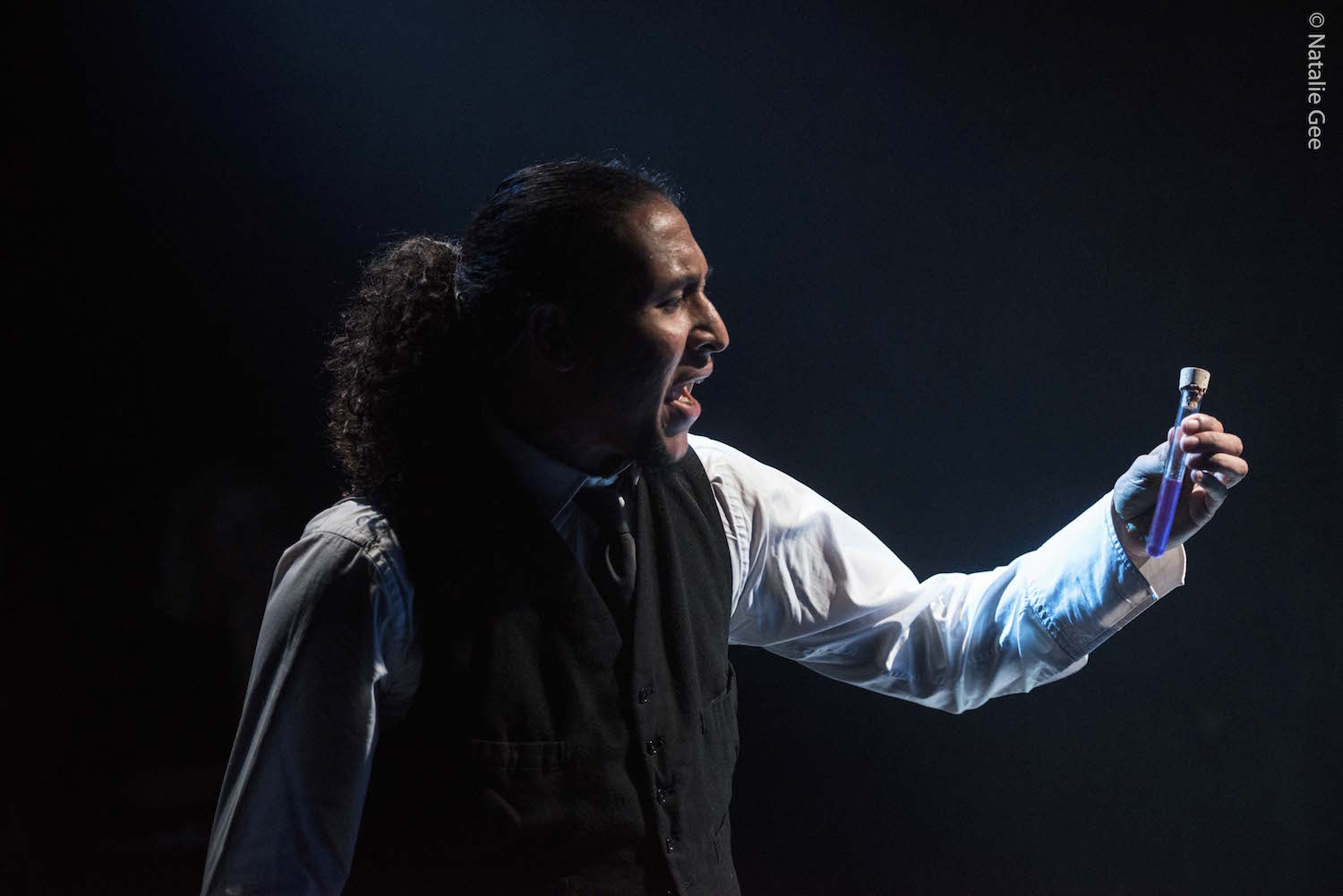
Both Jekyll and Hyde are played by Nathaniel Leigertwood, and while he gives a good performance as both, it’s as the more interesting of the two – Hyde – that he really comes into his own. His transformation from the elegant and mild-mannered Jekyll into Hyde (further enhanced by Andrew Caddies’ particularly atmospheric lighting) is frighteningly convincing: appearance, voice and personality all change beyond recognition as he’s wracked by spasms and emerges a hunched, animalistic figure with an evil cackle and an absolute lack of remorse.

Strong individual support comes in the form of Demar Lambert and Finn Kebbe as Utterson and Lanyon – the former a commanding presence, the latter ultimately a broken man destroyed by the knowledge of his complicity in Hyde’s crimes. In reality, however (and in keeping with Chickenshed’s inclusive philosophy), this is an ensemble piece; a diverse, hard-working and vocally impressive chorus perform the majority of the physically demanding musical numbers and provide commentary on events as they unfold.
Like the rest of the production, Dave Carey and Hanna Bohlin’s up-tempo rock musical score has a distinctly modern flavour. With no spoken dialogue, the show moves swiftly from one number to the next, managing to pack an impressive 21 songs (albeit with several reprises) into its 70-minute duration. There are occasions when the vocals struggle to compete with the volume of the pre-recorded soundtrack, and combined with the pace of some of the songs, this can make it difficult to catch every word. Perhaps in recognition of this, the “penny dreadfuls” that are distributed as we arrive contain a handy synopsis of the plot, while the title of each new chapter is projected on the wall to help us orientate ourselves and fill in any plot gaps.

With this production, Chickenshed proves once again that it knows how to entertain audiences with a good story. But the show also asks us to consider some pertinent and rather topical questions about the importance of the choices we make – for ourselves, for others and for society as a whole.


Can’t see the map on iPhone? Try turning your phone to landscape and that should sort it. I don’t know why but I’m working on it… 😉
Review: Side Show at the CLF Art Cafe

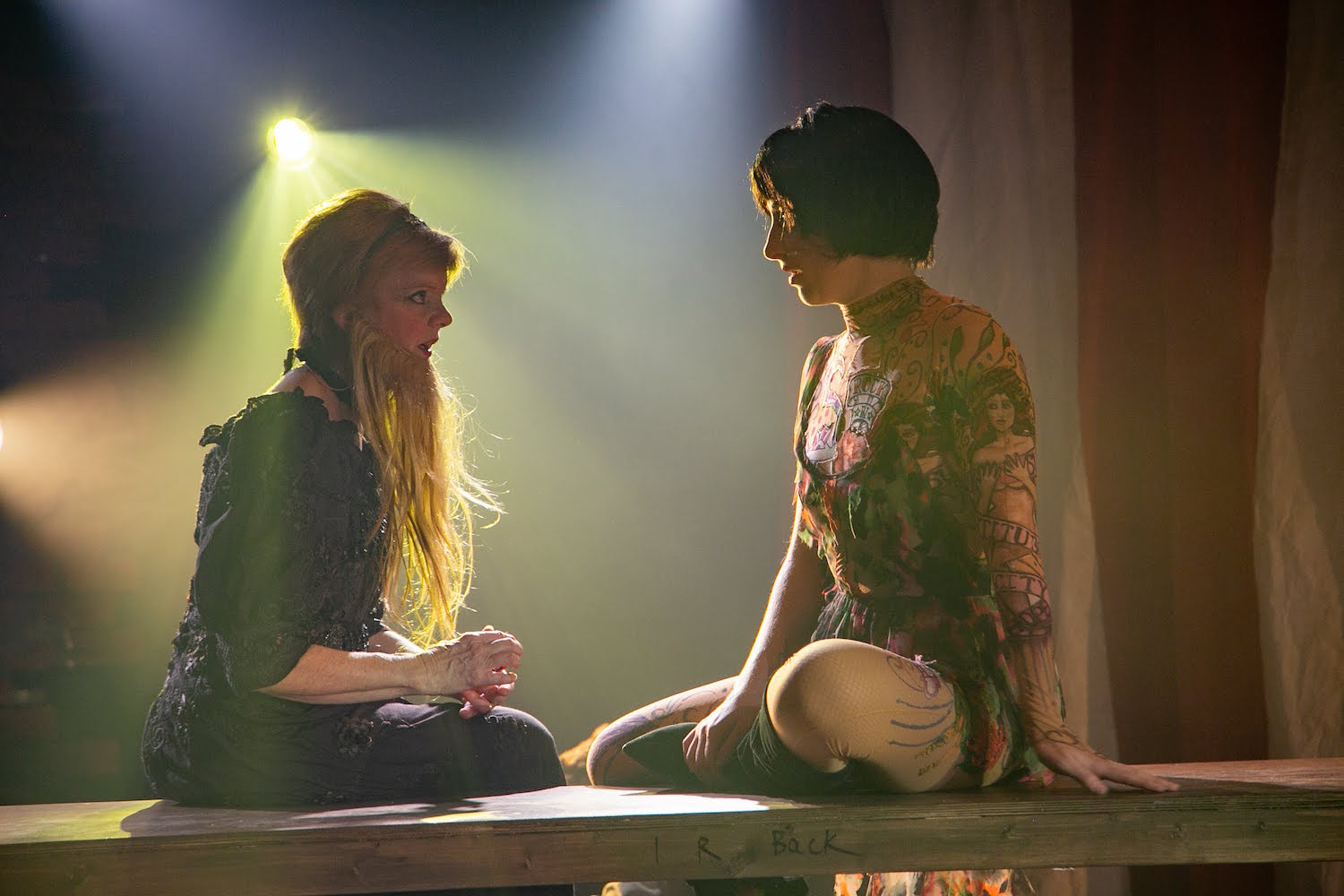
First performed in 1997 – a couple of decades before The Greatest Showman earwormed its way into our lives – Side Show is based on the true story of conjoined twins Daisy and Violet Hilton. Like the recent monster hit movie about the life of PT Barnum, Bill Russell and Henry Krieger’s musical is a story about being different, but takes a rather darker and more grimly realistic approach than Jackman and co.

As the star attractions of a travelling show, the two sisters – conjoined at the hip – dream of stardom (Daisy) and romance (Violet). But while they experience brief glimpses of both, the two never get to live the one dream they share: that of a normal life. Instead they find themselves ruthlessly exploited by everyone around them, while they’re constantly torn between their desire to be alone and their fear of being apart.

Photo credit: Michael Smith

Pint of Wine’s revival, at the suitably unconventional Bussey Building in Peckham, immerses us instantly in the sights, sounds and atmosphere of the side show. A lot of attention has clearly gone into the production’s design, with Lemington Ridley’s increasingly glamorous array of costumes plotting the sisters’ rise to fame, while a simple but effective set from Roberta Volpe proves you can do a lot with some wooden bleachers and a couple of screens.

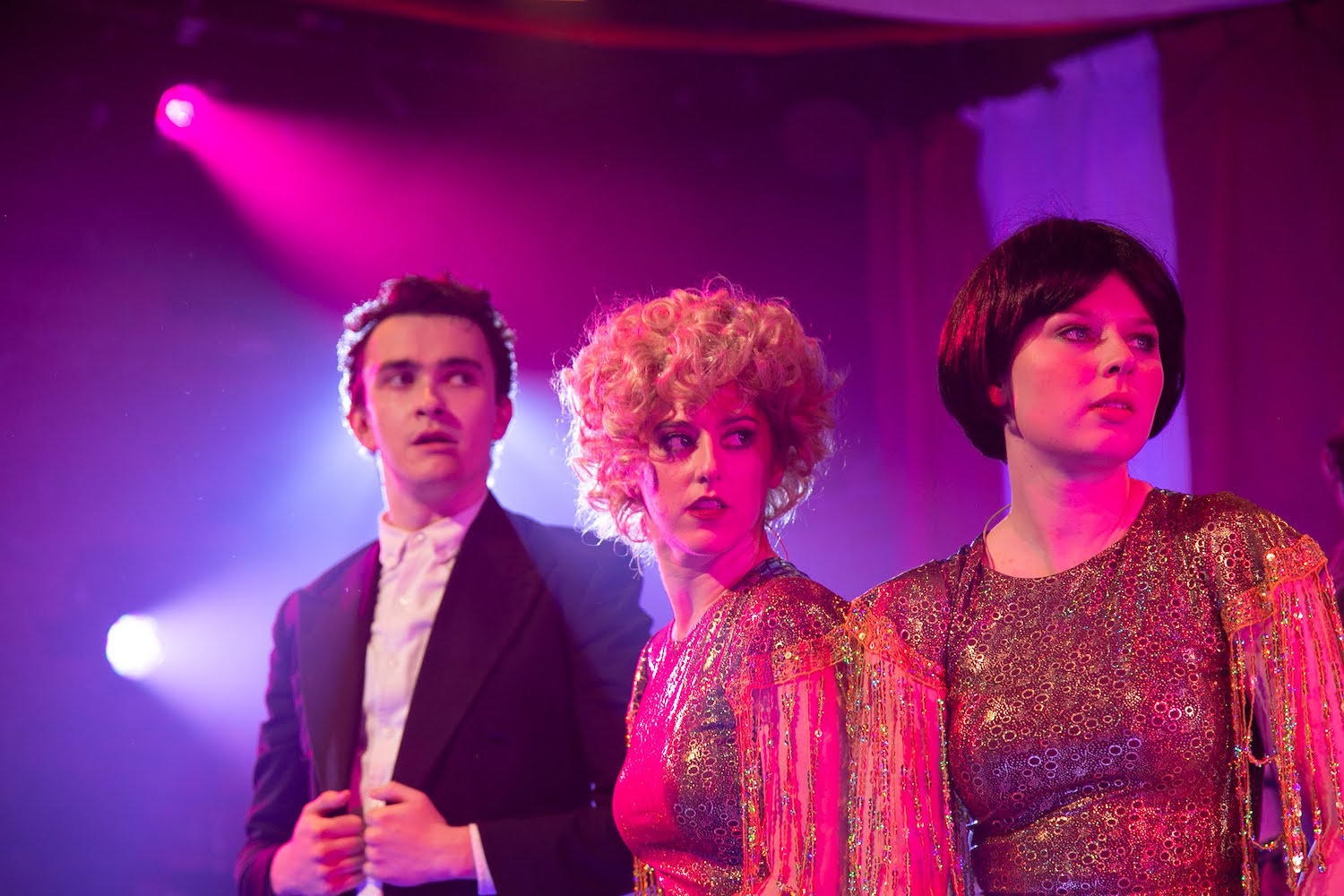
The cast for Dom O’Hanlon’s production are generally strong, with stand-out vocal performances from Matthew James Nicholas as Terry, the twins’ manager, and Lauren Edwards as the sweet-natured Violet. She and Katie Beudert work well together, capturing in both performance and appearance the differences between Violet and Daisy’s personalities, and managing with ease the physical demands that come with being attached to another performer.

As Violet’s love interest Buddy, Barry O’Reilly excels in the dance numbers – including an impressive solo tap routine – and Alexander Bellinfantie is vocally strong as the sisters’ friend and protector Jake. Both seem less confident with their spoken dialogue, however, and we never quite get to the bottom of their character’s complex emotional struggles around their feelings for Violet.

Meanwhile the ensemble give an accomplished performance, particularly as the other side show acts, who step up to support their friends against their bullying adoptive father, Sir (Stephen Russell). In doing so each gives us a glimpse of their distinct personality, and a reminder that they’re not just attractions to be stared at, but real people who live, love and dream like everyone else. In fact, they’re considerably more human than the journalists, doctors and audiences – the other parts played by the ensemble – who view Daisy and Violet as little more than objects to be exploited.

Photo credit: Michael Smith

The musical numbers are performed well, led by musical director John Reddel’s excellent band, with the opening number Come Look at the Freaks and Terry and Daisy’s Act 2 duet Private Conversation among several highlights. The vaudeville routines are great entertainment, and Act 1 comes to a poignant close with the cast’s heartfelt rendition of Who Will Love Me As I Am? This song in particular taps into an emotion we can all identify with – the need to be loved and accepted just as we are – but it also represents something Daisy and Violet seem destined never to have. The show’s sombre conclusion might be more realistic than most, but that doesn’t stop us from feeling a bit unsatisfied by the resignation with which the twins accept what lies ahead.

Pint of Wine’s debut musical theatre production, while not perfect, is a welcome opportunity for London audiences to discover a little-known show – as well as the true story of two fascinating women who, while certainly unique, in a lot of ways really were “just like everyone else”.


Can’t see the map on iPhone? Try turning your phone to landscape and that should sort it. I don’t know why but I’m working on it… 😉

Review: La Tragédie de Carmen at Asylum Chapel

As operas go, Bizet’s Carmen is a good choice for anyone in search of an entry-level option, because chances are most of us know more of the music than we think. In La Tragédie de Carmen, Peter Brook, in collaboration with composer Marius Constant and writer Jean-Claude Carrière, takes this a step further, condensing Bizet’s four-act original – and all its greatest hits – into just 80 minutes. This means we lose all but four of the characters, and instead focus solely on the tragic “love rectangle” between the protagonists.

Photo credit: Ugo Soffientini

Micäela (Alice Privett) arrives from the country looking for her childhood friend Don José (Satriya Krisna), a corporal in the Nationalist army, with whom she’s in love. He, however, has fallen for the seductive Carmen (Chloe Latchmore), who leaves him after a brief romance for Escamillo (James Corrigan), an officer. After trying and failing to win her back, Don José murders his former lover in a fit of passion.

Directed by John Wilkie, Pop-Up Opera’s production of La Tragédie de Carmen is exquisitely performed by the four singers and musical director Berrak Dyer; watching and listening to her perform the opera’s entire score on piano is worth the ticket price all by itself. Though it may be much smaller in scale than a traditional performance of Carmen, there’s nothing half-hearted about this production, which brims over throughout with passion, intensity and obvious talent. As the tragic love story unfolds, a video screen shows images from the Spanish Civil War – which, in this updated version of the story, has just ended – as well as Pop-Up Opera’s trademark minimalist surtitles, which provide us with just enough of a translation to understand the context of each scene, but don’t distract from the action.

Cutting back the story so dramatically has both advantages and drawbacks. On the plus side, it’s much shorter and more accessible than the original, with a more straightforward storyline, which makes this an ideal ticket for an opera first-timer. On the other hand, it’s all over so quickly that there’s a risk of the audience not becoming fully invested in Don José’s relationship with Carmen, or appreciating why he reacts so violently to her rejection. This is dealt with, to some extent, by setting the action at the end of the Civil War, and portraying both Don José and his love rival Escamillo as having suffered some trauma as a result of what they’ve seen and experienced during the conflict. In light of his obvious fragility, perfectly captured in Satriya Krisna’s performance, the apparent ease with which Don José is driven to madness doesn’t seem quite so hard to accept.

Peter Brook’s aim in writing La Tragédie de Carmen was “to focus on the intense interaction, the tragedy of four people” that lies at the heart of the story. Pop-Up Opera have stayed true to that purpose, and while some may take issue with Brook’s extreme edits, it’s hard to find fault with this particular production of his work. (That said, I do recommend sitting at the front if you can – depending on the venue, some audience members further back may struggle to see what’s happening during the final climactic scene.) Whether you think you like opera or not, this one is certainly worth a visit.

La Tragédie de Carmen continues on tour – for full details visit www.popupopera.co.uk.

Review: Lifeboat at the Brockley Jack Studio Theatre

In September 1940, a ship carrying evacuee children from Britain to Canada was sunk by a torpedo attack, with the loss of an estimated 258 lives. For nineteen hours, two schoolgirls, Bess Walder and Beth Cummings, clung to an overturned lifeboat in the middle of the Atlantic, dressed only in their pyjamas and dressing gowns. As the hours passed, they willed each other to hang on, until they were finally rescued and brought home to Britain. Their terrifying ordeal and the friendship and courage that helped them both survive it, are the subject of Nicola McCartney’s two-hander Lifeboat, and under the direction of the consistently brilliant Kate Bannister, they make for an enthralling 70 minutes.

Photo credit: Tim Stubbs Hughes

The play covers the hours following the attack, when we find Beth (Lindsey Scott) and Bess (Claire Bowman) floating, alone and terrified, in the freezing Atlantic. But it also flashes back to the months leading up to their departure, and the impact of the war on their lives in Liverpool and London respectively, as well as their four days travelling on The City of Benares, where they’re brought together by a shared love of The Wizard of Oz. There’s a playfulness and humour to these flashbacks – in which Claire Bowman and Lindsey Scott also play all the other characters, from annoying little brothers to the ship’s Indian crew members – that draws us in, and which contrasts sharply with the intensity of the lifeboat scenes placed intermittently throughout the play. The more we know about the two friends’ lives and their dreams for the future, the more we want them to survive.

The Brockley Jack has a well-deserved reputation for its excellent in-house productions. Lifeboat is no exception, rising magnificently to the challenges presented by the play’s structure and themes, and ticking every box in terms of design, direction and performance. Karl Swinyard’s set transforms the small studio space into the deck of the doomed ship, while the sound and lighting design from Jack Elliot Barton and Tom Kitney recreates with stunning accuracy not only the sights and sounds of the 1940s but also the horror of the attack and its aftermath.

Throughout the play, Claire Bowman and Lindsey Scott show their versatility as they slip seamlessly from one character to another. But it’s as the central characters that they’re most compelling – whether they’re cheerfully singing rude songs about Hitler, gazing in awestruck wonder at the cinema screen, giggling over a handsome sailor, or fighting for survival in icy waters. In just 70 minutes we come to know and care about both girls, and as their ordeal continues, we can feel their fear and growing exhaustion.

Photo credit: Tim Stubbs Hughes

Although Lifeboat focuses on one specific incident of World War II, it’s difficult to watch it and not think more broadly about the horrors of war, and the millions of innocent lives lost around the world to conflicts past and present. Bess and Beth’s story ends well – the two women would go on to be lifelong friends – and Lifeboat pays tribute to their incredible courage and resilience. But the play’s sombre conclusion also ensures we don’t forget the 258 people, among them 77 children, who weren’t so lucky.

It’s tragic that stories like this one still need to be told, but if they must then it’s at least some comfort to see them told as well as this. A sensitive portrayal of devastating real events, Lifeboat is undoubtedly another triumph for the Brockley Jack team. Go and see it while you can.


Can’t see the map on iPhone? Try turning your phone to landscape and that should sort it. I don’t know why but I’m working on it… 😉

Review: Hear Me Howl at the Old Red Lion Theatre

If you ask most children what being a grown-up looks like, chances are most would say at least some of the following: job, marriage, family, house, car, dog/cat/goldfish… That’s what society trains us to believe from a young age, so it’s no surprise that if we don’t fit into that box, we’re deemed – by both others and ourselves – to have somehow failed.

This seems particularly true in relation to the marriage and babies part, and because of the idea of a “biological clock”, it’s almost always women who take the brunt of the judgment. At my friend’s wedding a couple of years ago, as the only single member of the wedding party, I fielded questions from no less than three people (all of whom I’d only just met) as to why I was there alone – and as a bonus, a helpful reminder from the bride’s mum that I should probably get a move on.

Photo credit: Will Lepper

I feel like Jess, the character in Lydia Rynne’s Hear Me Howl, would sympathise with that experience. She’s about to turn 30, and has been in a relationship for years with a very lovable guy. So naturally she faces frequent pressure from family and friends to take the next step, whether that’s marriage or babies, because after all, she’s “not getting any younger”. The only problem is that Jess doesn’t really want to take that step, so it’s no surprise that when she discovers she’s pregnant, she freaks out quite dramatically. A week later, she’s joined a post-punk band, thrown out most of her clothes, attended her first protest and even appeared on the news – and all the while, she knows she has a huge, life-changing decision to make.

There’s plenty of humour in the one-woman show, which is beautifully performed with energy and unflinching conviction by Alice Pitt-Carter, but we’re also very aware that what we’re watching is much more than simply a woman having a meltdown. What we’re seeing is the dawning, liberating realisation not only that Jess doesn’t want to be a mother, but that she doesn’t need to be. She’s spent the last twelve years conforming to what society expects – boring job, nice boyfriend, rented flat, hair-free armpits – and is only now beginning to understand those are just a few of the options open to her.

This produces a conflicting set of emotions for the audience; it’s exhilarating to see Jess take her first steps towards figuring out who she really wants to be, but also depressing because it took a crisis – not to mention twelve years – for her to realise she even had that option. We see her grappling with the idea that not wanting a baby makes her selfish, or that she’s somehow failing in her womanly duty to continue the human race, even though she knows it wouldn’t make her happy – and to see another woman go through that turmoil is infuriating.

Photo credit: Will Lepper

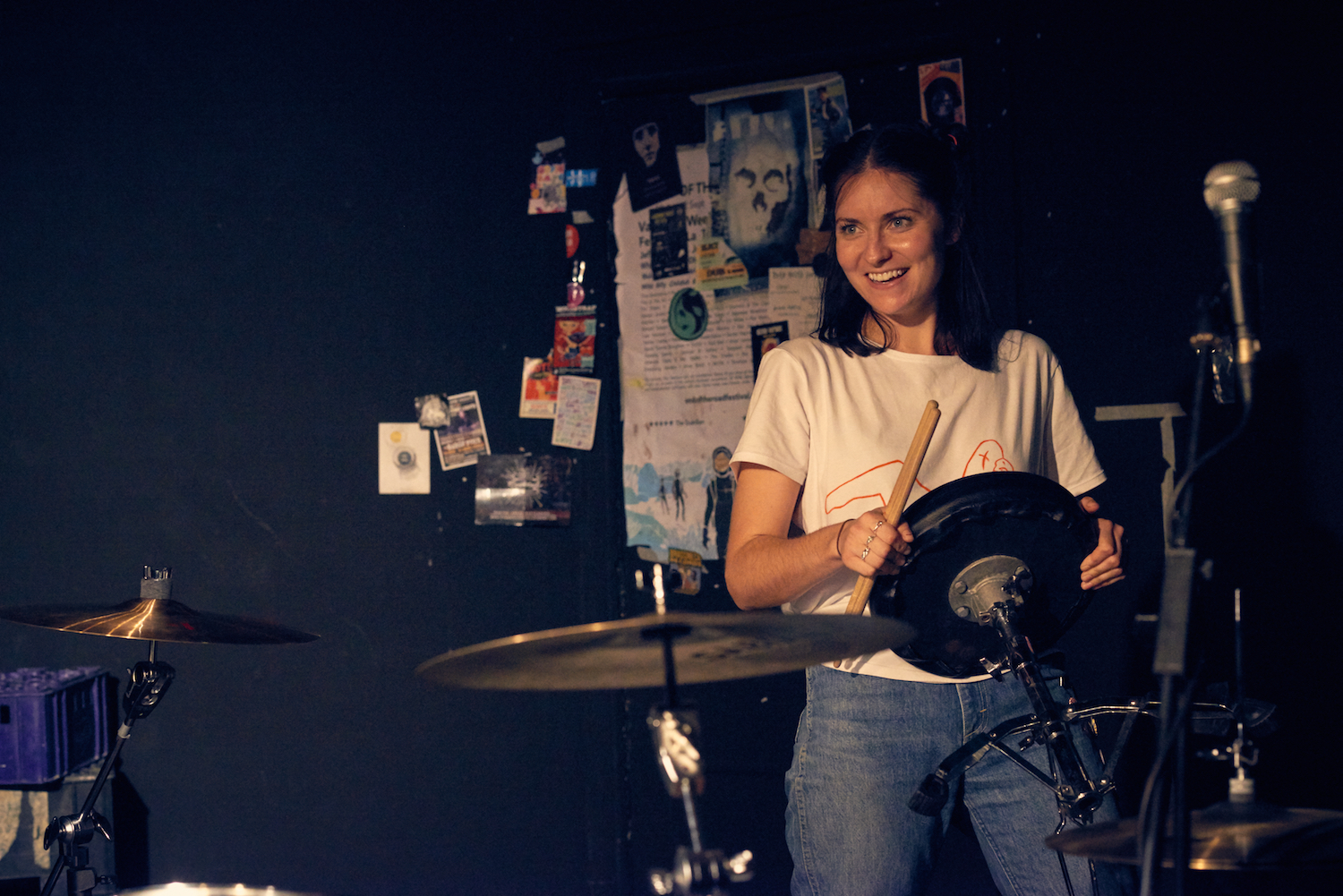
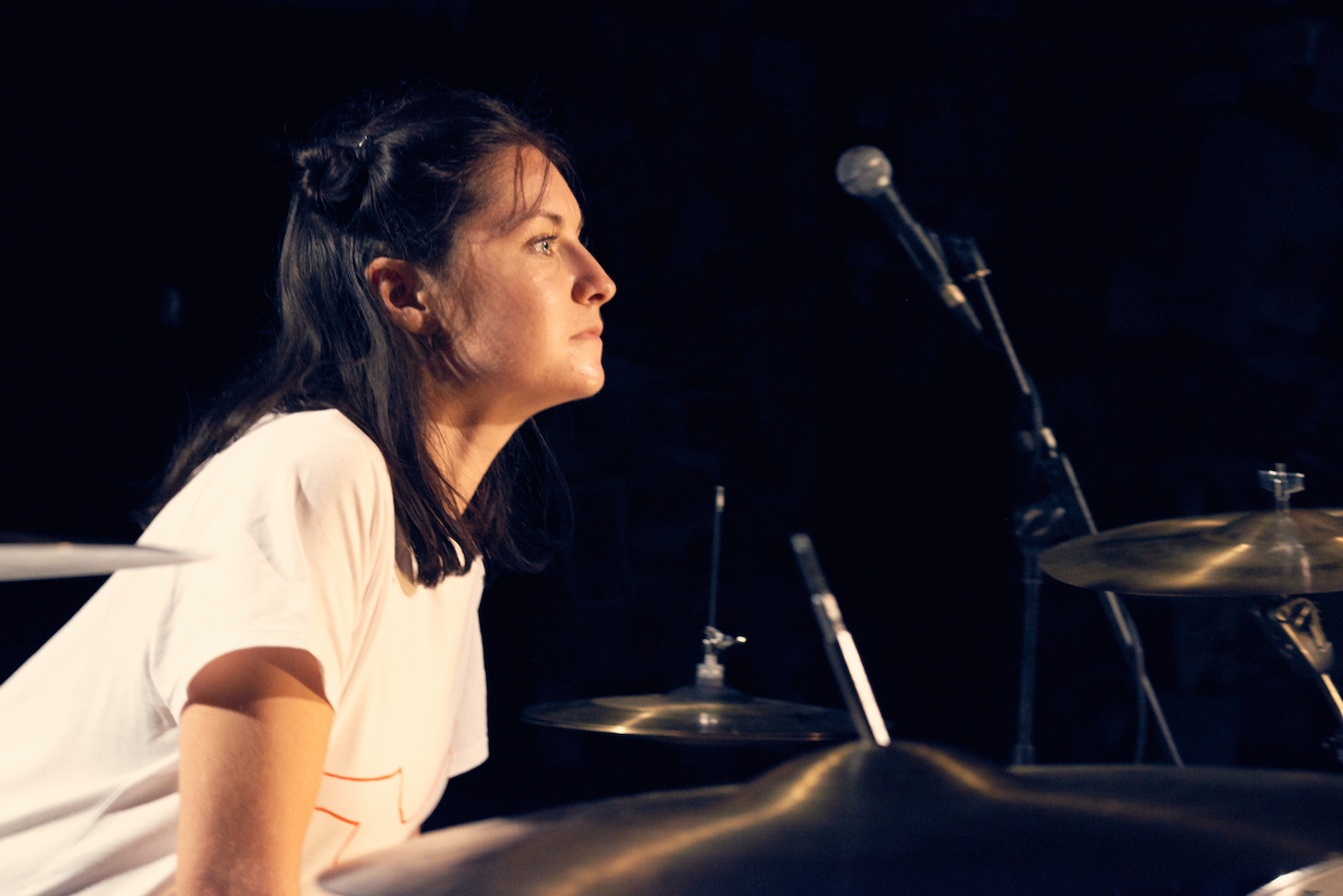
Throughout the 70-minute show, director Kay Michael ensures we’re always aware of the drum kit that sits centre stage, as Jess hovers around it, her hands never far from the drumsticks she’s clearly itching to use. And when she finally takes her place behind the kit at the end of the show, she’s drumming not only for herself, but for every woman who’s ever felt unable to live the life she wants for fear of judgment. You may at this point want to use the earplugs provided at the box office; personally I wanted to experience every beat of her performance.

Can’t see the map on iPhone? Try turning your phone to landscape and that should sort it. I don’t know why but I’m working on it… 😉