Review: Twelfth Night at the Rose Playhouse

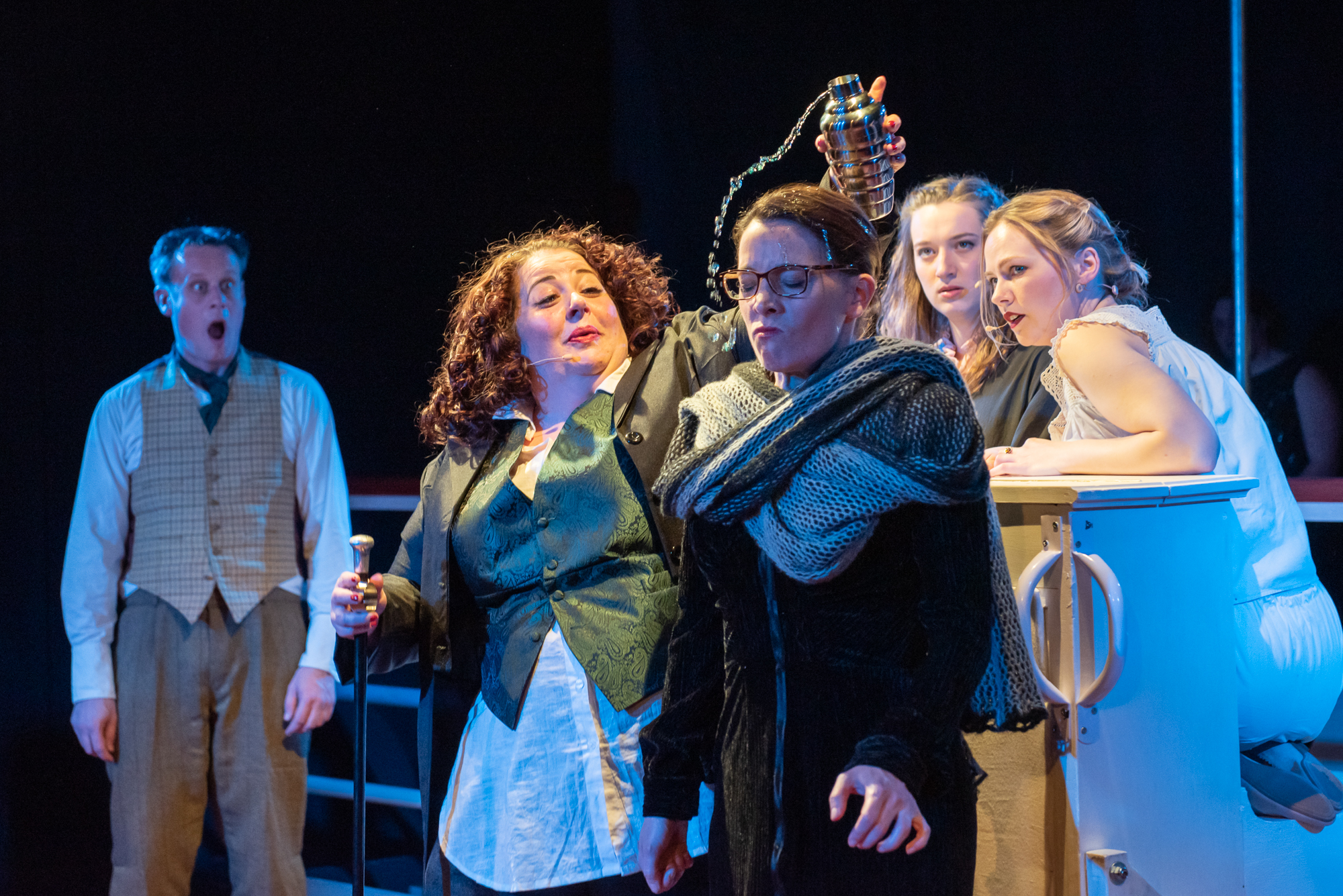
OVO’s reimagining of Twelfth Night begins like any other: at sea, with the devastating shipwreck that separates twins Viola (Lucy Crick) and Sebastian (Joshua Newman). But unlike most, this version never reaches land, as vaudeville performer Viola is saved from the waves and brought on board the cruise ship SS Illyria at the height of the roaring 20s. In this adaptation, Orsino (Will Forester) is the captain, Olivia (Emma Watson) is a fabulously famous actress, and Lady Toby Belch (Anna Franklin) is a washed up music hall star (I’m not being mean; that’s what it says in the programme).
Twelfth Night at the Rose Playhouse
Photo credit: Lou Morris Photography

It’s a clever premise, and one that works particularly well at the Rose Playhouse, where it takes very little imagination to transform the small wooden stage area into a ship’s deck. By setting the action at sea, director Adam Nichols brings to the production an atmosphere of stifling luxury; at the end of the day, this is basically a story of bored rich people amusing themselves with drink, song and fairly meaningless romantic dalliances. It’s still a comedy with plenty of laugh out loud moments, but this version places more emphasis on the spiteful bullying of Olivia’s uptight PA Malvolia (Faith Turner) and nice but dim “upper class twit” Sir Andrew Aguecheek (James Douglas). It feels appropriate, then, that these two characters should get to have the final word – though it’s equally disheartening that most of the others, having had a good laugh about it all, don’t bother to stick around to hear it.

Equally interesting is the gender switching, inspired by the changes that took place around gender and sexuality in the 1920s. Two pivotal characters – Malvolia and Lady Toby – are now women, which mixes things up not only in terms of the potential romantic pairings but also the gender politics. Orsino might be the ship’s captain in name, but in reality the male characters are reduced to little more than onlookers who things happen to; it’s the women who drive the action forward, and though some of their actions are despicable, that new perspective feels refreshing and rather enjoyable.

The 20s setting is punctuated by jazz versions of more recent hits from the likes of Britney, Rihanna and Katy Perry, which should probably feel jarring but actually works surprisingly well. That said, there are a lot of songs squeezed into quite a short play (90 minutes), not all of which contribute much to the plot – although there are undeniably some great performances, particularly from Hannah Francis-Baker’s Feste, who in this version is not a Fool but the ship’s Master of Ceremonies. In addition to singing, the cast also provide their own music, with the piano in particular a vital and extremely adaptable part of the set that’s played (and/or climbed on) by most members of the cast at some point.

Twelfth Night at the Rose Playhouse
Photo credit: Lou Morris Photography

One small but bothersome plot niggle aside – where was Sebastian for the last three months, and how come nobody ever ran into him? – this is an inventive and well-executed reimagining of a well-known comedy. There are laughs aplenty, but where the play really shows its strength is in its drawing out of the nastier aspects of human nature, which are so often brushed aside or treated as just a bit of fun. This brings a fresh perspective to a story many of us will have seen several times before, and that in itself is quite an achievement.

Review: The Wasp at The Space

There’s a fascinating but rather horrible nature fact at the heart of Morgan Lloyd Malcolm’s 2015 play The Wasp. It concerns the tarantula hawk wasp, which is by all accounts exactly as unpleasant as it sounds. I won’t go into the full gory details – if you want to know more, go and see the play – but essentially the baby tarantula hawk wasp grows up inside the abdomen of a tarantula, eating it from the inside out and only emerging when fully grown. Oh, and apparently it’s got one of the most painful stings on the planet – because it didn’t sound bad enough already.

The Wasp at The Space
Photo credit: Robert Bettelheim

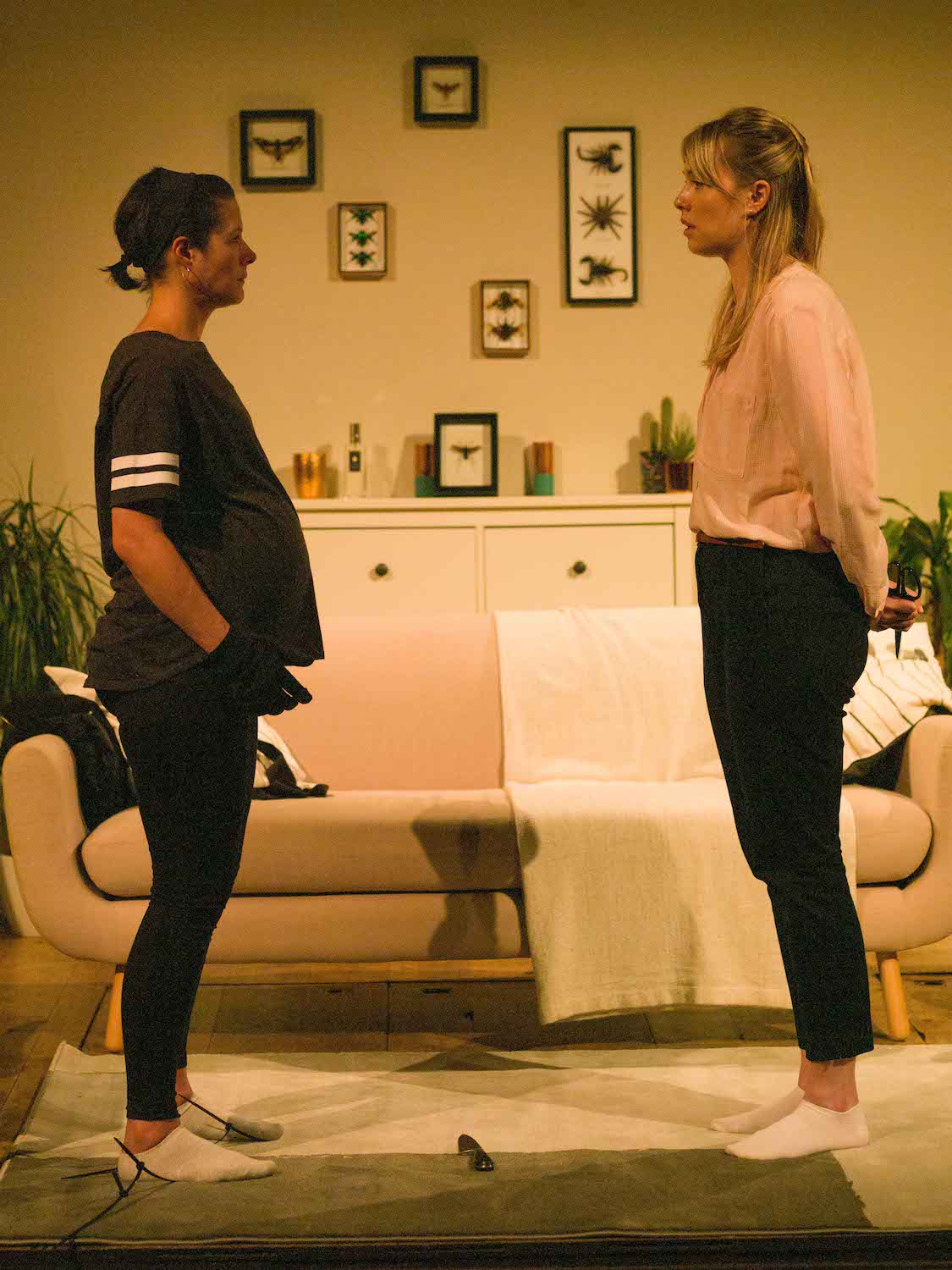
Thankfully there are no actual wasps or tarantulas in the play (though it seems only fair to those who hate both even more than I do to mention the ones on the wall – which, depending where you sit, are clearly visible throughout). It does, however, feature an equally gripping power struggle between its two characters. The question is: which of them is the wasp, and which the spider?

Heather (Lucy Pickles) and Carla (Rea Mole) haven’t seen each other since school – and there’s a very good reason for that. But then Heather gets in touch out of the blue with a proposition that unhappily married mum of many Carla can’t refuse. She thinks she knows what she’s getting herself into, but with twenty years of bitterness and disappointment between the two women, their reunion is about to take a very dark turn.

The plot feels at times a bit farfetched, but The Wasp’s sting lies not so much in what happens as why. Morgan Lloyd Malcolm, the writer of current West End hit Emilia, obviously knows how to write good female characters – and these two are no exception. We get enough information up front to assume we understand Heather and Carla’s current situations and their history, but as the story gets filled in a little at a time, we realise we’ve barely scratched the surface of what happened between them all those years ago, or the lasting impact it’s had. And while we may not all have gone through the kind of trauma that’s described in vivid, shocking detail in this play, anyone who went to school with other teenage girls can identify on some level with the characters’ experience and emotions, both then and now. (Personally I found that Carla reminded me so much of a girl in my class at school that it was actually a bit disconcerting.)

Presented by The Undisposables and directed by Sarah Fox, the play is set predominantly in Heather’s tastefully middle-class living room; the only hint of the nastiness to come can be found in the aforementioned framed bugs on the wall. As the balance of power shifts back and forth, the twists start to come so thick and fast that eventually we don’t even know who to believe, let alone whose side we should be on. This allows Lucy Pickles and Rea Mole to successfully explore different aspects of their characters; while each starts out as little more than a stereotype based on her social status, by the end of the play the two women have proven themselves to be not only much more complex but also far closer – in every sense – than anyone could have anticipated.

The Wasp at The Space
Photo credit: Robert Bettelheim

Much like the creature for which it’s named, The Wasp is not a nice play. The story delves into themes of mental illness, domestic abuse and sexual assault, and explores the ways in which human beings perpetuate cycles of violence by passing our own hurt on to others. But it’s also not without an element of hope; for all their differences, the two women do at certain moments reach a kind of understanding, and the whole play hinges on the fact that it is possible to choose kindness over violence. Above all, though, The Wasp is a gripping and suspenseful psychological thriller – so if you enjoy a good twist and a surprise ending, this is definitely the play for you.


Can’t see the map on iPhone? Try turning your phone to landscape and that should sort it. I don’t know why but I’m working on it… 😉

Review: Queen of the Mist at Brockley Jack Studio Theatre

I felt a bit bad going into Queen of the Mist last night, because I’d never heard of its subject: Anna Edson Taylor, who in 1901 on her 63rd birthday, became the first person to survive going over the Niagara Falls in a barrel (as one does). But as it turns out I needn’t have worried, because very few people have heard of her; despite her achievement, which was motivated by dreams of fame and fortune, Taylor quickly lost the public’s interest and died a pauper 20 years later.

Queen of the Mist at Brockley Jack Studio Theatre
Photo credit: Stephen James Russell @SpeedyJR

Annie (Trudi Camilleri) tells her extraordinary story in Michael John LaChiusa’s 2011 musical, which receives a resounding European premiere at the Brockley Jack courtesy of the excellently named Pint of Wine. As a production, it’s hard to fault; it’s polished, looks great, and is exquisitely sung by a cast of seven, who share the stage with Jordan Li-Smith’s equally impressive band.

Where there are flaws, they belong to the show itself, which doesn’t have a great deal of plot to speak of; it reaches its dramatic climax by the end of Act 1 – when Annie and her custom-made barrel go over the Falls – but even then, it doesn’t devote more than a few minutes to this pivotal event. By the time we return from the interval, the adventure’s all over and things are already going wrong for Annie. She’s struggling to keep people interested in her “deed” (largely due to her refusal to answer the recurring question of Act 2: what did it feel like going over the Falls?), she’s fired her manager Frank Russell (Will Arundel), her relationship with her sister Jane (Emily Juler) is at breaking point; even her barrel’s been stolen. A few grimly humorous moments aside, there’s not a glimmer of the excitement or ambition of Act 1, and as such the show’s second act feels much longer than the first.

Even so, the score does include some enjoyable – and rather catchy – musical numbers, and the cast really are excellent. Trudi Camilleri is a formidable lead with incredibly powerful vocals; her Anna isn’t particularly likeable, but while we may have little sympathy for her, it’s hard not to respect her intelligence, determination and courage. The complex relationships she has with her conservative sister and charismatic manager are well played by Emily Juler and Will Arundel respectively, and Emma Ralston, Tom Blackmore, Conor McFarlane and Andrew Carter provide versatility and strong vocals as a host of other characters – among them temperance campaigner Carrie Nation, a young soldier on his way to fight in World War 1, a mysterious man with his hand wrapped in a handkerchief (it makes sense at the time), and Annie’s exasperated new manager(s) following Frank’s departure.

Queen of the Mist at Brockley Jack Studio Theatre
Stephen James Russell @SpeedyJR

Considering the intimacy of the performance space (a decent proportion of which is taken up by the band) and the number of times the cast have to enter and exit the stage in different guises, Dom O’Hanlon’s tightly choreographed production feels surprisingly uncluttered; nor is there ever any danger of the singers being drowned out by the orchestra. Having said that, the production could certainly benefit from a larger stage, if only to accommodate the sheer vocal power of the cast, which at times does threaten to become overwhelming in such a small venue.

Queen of the Mist is, first and foremost, Anna Edson Taylor’s little-known story, but it also has things to say about the lengths to which people will go for fame, and the fickle nature of both public and press – both of which are issues we still grapple with today. The show is not without flaws and does feel longer than it needs to be, but even taking into account these shortcomings, the quality of this excellent production cannot be denied.


Can’t see the map on iPhone? Try turning your phone to landscape and that should sort it. I don’t know why but I’m working on it… 😉

Review: Tony’s Last Tape at Omnibus Theatre

Tony Benn is well known for being one of Britain’s most divisive politicians – and yet when he died in 2014, tributes poured in from colleagues across the political spectrum, who spoke of their great respect for his enduring commitment to the values and causes in which he believed. In his tribute, then Labour leader Ed Miliband said, “He believed in movements and mobilised people behind him for the causes he cared about, often unfashionable ones. In a world of politics that is often too small, he thought big about our country and our world.”

Photo credit: Robert Day

That commitment comes across powerfully in Andy Barrett’s play Tony’s Last Tape, in which a frail 87-year-old Benn (or rather “a character called Tony Benn, based on the real life Tony Benn”) decides it’s time to finally quit politics… well, maybe. For 50 years he’s recorded the events of his life in his diaries, and on this rainy morning he’s recording his final tape. What emerges from the meandering monologue that follows is a picture of a principled and still fiercely dedicated politician, but also a devoted family man with a mischievous sense of humour… and an enduring love of bananas.

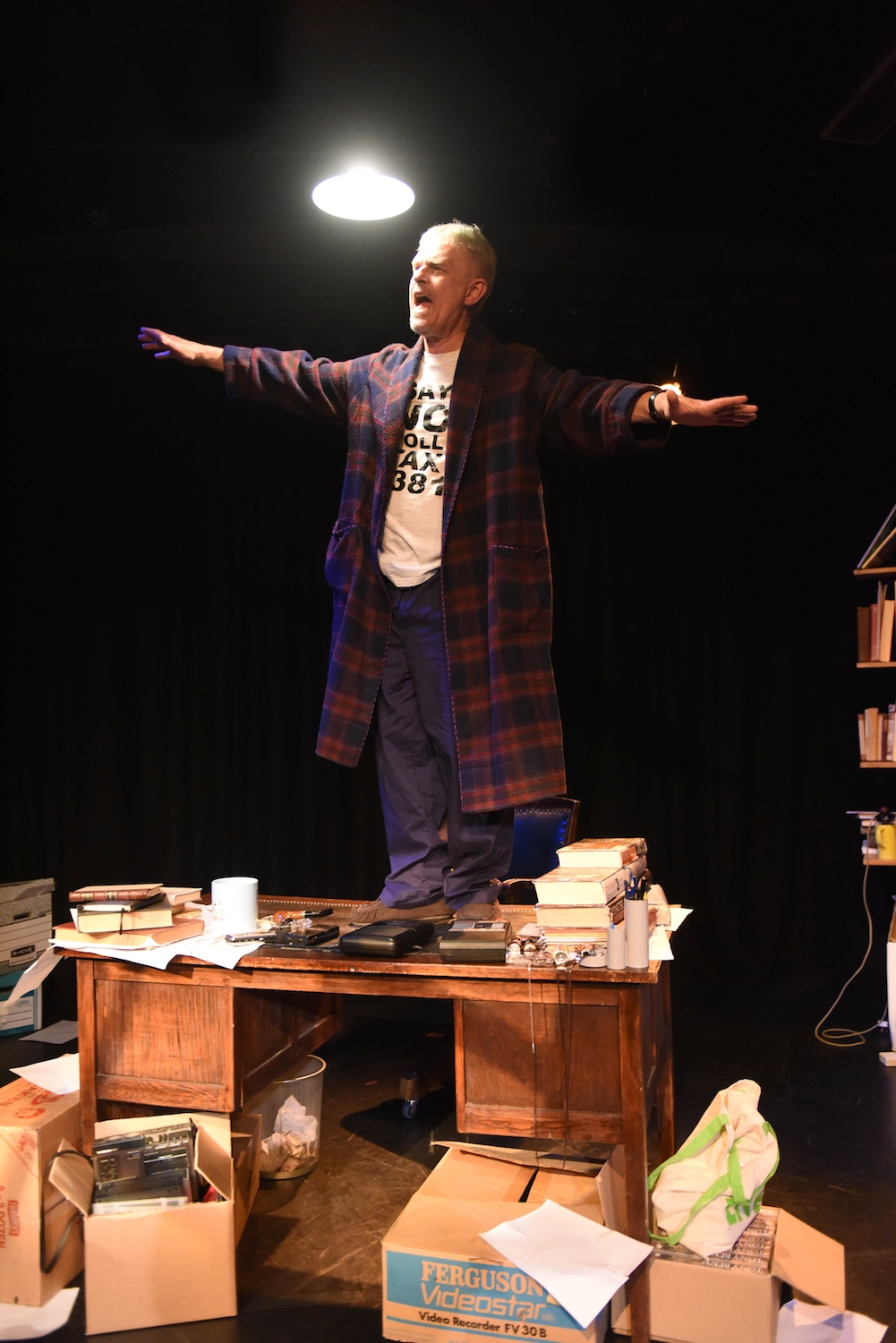
Most importantly – and refreshingly, particularly at the moment – Tony Benn comes across as a human being fighting for other human beings. And whether we agree with or even understand everything he says (I suspect you’d need to know quite a bit about British political history to pick up every reference and name-drop in the play), it’s impossible not to like and respect him for his passion and determination. It’s also very obvious that a man like that, despite his best intentions, won’t be able to stop; he can’t even resist risking life and limb to change a lightbulb, even though common sense dictates he should definitely not be climbing on the desk in his condition.

Photo credit: Robert Day

Philip Bretherton gives a strong solo performance, recognisably portraying the real Tony Benn in voice, appearance and mannerisms. He’s equally convincing, however, in his depiction of an elderly man looking back over an eventful life and reflecting thoughtfully on the decisions – both right and wrong – that he’s taken, and emotionally on the loved ones he’s lost along the way. Director Giles Croft manages the pace and energy of the production well; rather than just sit at his desk and talk, Benn potters around his cluttered study and rummages in desk drawers and bookcases, frequently stumbling on long-forgotten objects that spark new memories and anecdotes. As a result, there’s little in the way of linear narrative – instead the play is a 75-minute stream of consciousness that hops from one topic to another.

In light of this, Tony’s Last Tape shouldn’t be seen as anything approaching a Tony Benn biopic (with over 50 years of material to work from, Barrett could hardly be expected to cover everything anyway), and it’s probably a good idea to read at least a brief summary of Benn’s career before going in to give the play some context. What the play is, however, is a sympathetic and respectful portrayal of a man who went into politics for the right reasons, and who never wavered from his convictions. Particularly in the current political climate, that feels like something which deserves to be celebrated.

Review: The Trials of Oscar Wilde at Greenwich Theatre

Exactly 124 years ago, on 3rd April 1895, the hearing of a libel case opened at the Old Bailey. The prosecutor was the renowned playwright Oscar Wilde; the defendant was the Marquess of Queensberry who, concerned by his son’s close relationship with the writer, had accused him in a note of “posing as a somdomite”. Outraged, Wilde sued for defamation, but the move backfired spectacularly; faced with overwhelming evidence that he was, in fact, homosexual – at that time an illegal act – he was forced to drop the case, only to be arrested immediately and sentenced just a few weeks later to two years hard labour.

Photo credit: David Bartholemew

The Trials of Oscar Wilde, co-written by John O’Connor and Oscar Wilde’s grandson Merlin Holland, is based on court transcripts from the two trials, and charts Wilde’s rapid downfall. Just days before the libel case began, The Importance of Being Earnest had opened at St James’s Theatre, and Wilde was complacent enough to believe that his success as a writer would make for an easy win. The production – also directed by John O’Connor, with Eva Savage – sets the drama not in a courtroom but on a stage, and in Act 1 Wilde takes to it like a true showman. But over the next hour, his relaxed confidence is chipped away piece by piece, and the man who appears at his own criminal trial in Act 2, though still possessing the same sharp wit, appears shaken and humbled by his sudden fall from grace.

This dramatic transformation is captured to perfection in a brilliant central performance from John Gorick, who leads the four-man cast with effortless style. Around him, his fellow cast members slip in and out of a variety of costumes to play multiple different characters, with impressive versatility and more than a little humour; Benjamin Darlington and Patrick Knox have particular fun as a short-sighted hotel chambermaid and an Italian masseuse respectively. The real highlight of the play, however, is the clashes between Gorick and Rupert Mason, who plays both the defence lawyer who meticulously unravels Wilde’s libel case and the prosecutor who sees him condemned to prison. Though of very different temperaments, the men are equally matched in their skill as orators, and in their hands an encounter that could on paper have become rather dry crackles with tension.

Though it references it several times, The Trials of Oscar Wilde is not The Importance of Being Earnest. For one thing, there are considerably fewer laughs to be found in this tragic true story of a great literary talent brought down by society’s intolerance and prejudice. It’s also considerably more demanding for the audience; the play puts us in the position of the jury in both trials (though unfortunately we get no say over the final decision), and as such it demands our constant attention – just as would be the case in a real court, we have to stay focused throughout so as not to miss any name, date or other important detail. None of which is to say that the play isn’t entertaining – there are certainly moments of light relief, and the staging of the courtroom scenes is very well done.

Most of us know something of how Oscar Wilde’s story ended, but perhaps not so many are aware that in effect he set in motion his own downfall. This play fills in the gaps in a way that’s both educational and dramatically satisfying. A fascinating true story, very skilfully told.