Fun fact to remember for future pub quizzes: George Orwell’s real name was Eric Blair. This is just one of the things to be learnt about the author of Animal Farm and 1984 in Tony Cox’s Mrs Orwell at the Old Red Lion. The play, directed by Jimmy Walters, charts the final months of Orwell’s life following the publication of 1984. Admitted to University College Hospital suffering from tuberculosis, a fragile George proposes to young, glamorous magazine editor Sonia Brownell, who goes on to become the second Mrs Orwell. Cox examines their relationship and the motivations of each party in this fascinating and moving new play, which also touches on Orwell’s politics, his guilt over the death of his first wife Eileen, and the universal need to be remembered after we’re gone.
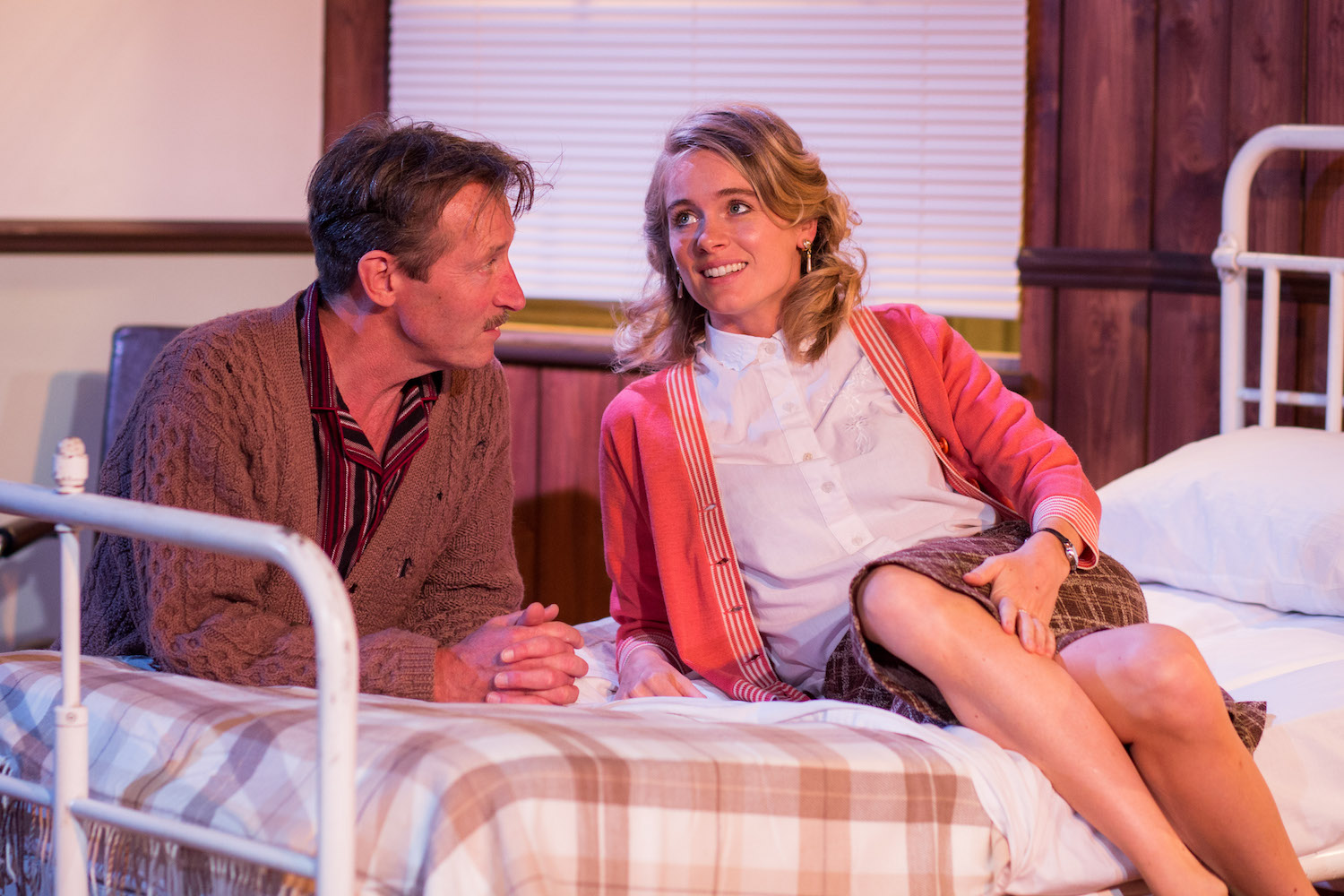
Photo credit: Samuel TaylorDespite its title, the play is just as much the story of Mr Orwell as that of his wife, and Peter Hamilton Dyer absolutely commands the stage for almost the entirety of the evening. A hunched, pathetic figure in clothes that are far too big for him, racked by ill health and desperately lonely and afraid, it’s tragically clear that his wits are still as sharp as ever, and he longs to believe he has at least three more novels in him. George loves Sonia without hope or agenda, knowing full well her heart belongs to the French philosopher Maurice Merleau-Ponty, and his simple joy in just being around her is devastatingly well played by Hamilton Dyer.
As his new wife, Cressida Bonas is equally compelling. Clipped, efficient and often impatient, she also demonstrates an obvious affection for George that makes it difficult to work out Sonia’s true motivation. While she certainly seems swayed by the suggestion that she could benefit financially from the marriage, her grief when she learns of his death and her desire to honour his final wishes appear genuine and heartfelt. She’s not a particularly likeable character in the story – all our sympathy is spent on the vulnerable figure of Orwell himself – but at the same time, she’s not a villain of the piece either, and we find ourselves admiring her sacrifice whilst still questioning her motives.
A brilliant cast is completed by Rosie Ede as Orwell’s no-nonsense nurse, Robert Stocks as his fiercely loyal publisher Fred Warburg, and Edmund Digby Jones in a particularly intriguing performance as Lucian Freud. His scenes with Bonas are marked by a simmering sexual tension, while with her husband he’s relaxed and humorously frank about his own and others’ shortcomings. (In fact the play in general is surprisingly funny, considering it’s a story about a dying man.)
Photo credit: Samuel TaylorThe majority of the action takes place in George’s hospital room, though some conversations are held in the corridor behind, amplified for our benefit and with the actors visible through the bedroom windows. This presents a slight confusion, because it isn’t made clear if these discussions can also be heard inside the room – perhaps this isn’t hugely significant given that George is always fully aware of Sonia’s romantic indifference to him, but it’s a minor frustration in an otherwise excellent production.
Cox delights in name-dropping famous writers and artists throughout as a way of reminding us that the play’s based on true events: Picasso, Dalí, Thomas Mann, Norman Mailer all get a mention. Even so, you don’t need to know much – or anything at all, really – about Orwell or his work to enjoy this very human story of love, fear and hope. Beautifully performed with warmth and humour, Mrs Orwell is a fascinating and entertaining insight into the life and death of a legend.
Can’t see the map on iPhone? Try turning your phone to landscape and that should sort it. I don’t know why but I’m working on it… 😉
First, a word of warning: don’t go and see Mumburger on an empty stomach. It’s all kinds of confusing.
Now that we’ve got that out the way, let’s discuss Sarah Kosar’s play. Andrea just died in a horrific car accident on the M25, leaving behind her devastated daughter Tiffany (Rosie Wyatt, reprising her Offie-nominated role) and husband Hugh (Andrew Frame). What begins as a seemingly straightforward story of two people struggling to process their grief in very different ways (she’s made a Google spreadsheet and is looking at urns on Amazon; he just wants to read the messages of condolence on Facebook and watch his wife’s favourite movie) takes a surreal and grisly turn when a mysterious delivery arrives. Inside the greasy bag are burgers – an odd enough sight in a house of committed vegans, even before we learn that they’re in fact a “Digestive Memorial” arranged by Andrea as a way to sustain her family after she’s gone.
Photo credit: Lidia Crisafulli
If it’s visceral theatre you’re after, you’ve come to the right place; it’s impossible to watch Mumburger – which follows Tiffany and Hugh’s horrified attempts to abide by Andrea’s final wish – without feeling some kind of physical reaction. Director Tommo Fowler has obeyed to the letter the writer’s instruction that “the actors should consume food when it says they eat”, so there’s no getting away from either the consumption or the various bodily functions that accompany it. (Or indeed the smell of cooking burgers, which explains the confusion I mentioned earlier.) It’s disgusting and messy and uncomfortable to watch, particularly when you add into the mix a series of video projections against the curtain at the back of the set, which verge at times on motion sickness inducing.
But let’s put the meat to one side for a second. At its heart, Mumburger is a story about a family coping with the loss of the person that held them together. Though we never meet Andrea, Kosar’s script paints a detailed picture of her; it’s clear from listening to Tiffany and Hugh argue and reminisce that she was the common link between them, and that without her they’re almost strangers who have no idea how to communicate. Both are also pretty annoying in their own ways; Tiffany, played by Rosie Wyatt, is shrill, domineering and self-involved, while Andrew Frame’s Hugh would rather play Candy Crush on his iPad than deal with anything even remotely difficult. Each believes that they knew Andrea better and therefore has more right to grieve, and the mumburgers become a physical manifestation of that competition. All of which begs the question: was Andrea’s intention really a noble wish to help her bereaved daughter and husband go on, or was it prompted by her own selfish need to maintain her position at the centre of the family for as long as possible?
Photo credit: Lidia Crisafulli
Many plays about bereavement go for the emotional jugular, encouraging us to feel sympathy for the characters and move us to tears as we watch them bond over memories of their loved one. Mumburger is not one of these plays. You’re more likely to come out feeling slightly sick than overwhelmed with emotion (though the play certainly has its moments) but that doesn’t make it any less real, and in this regard it’s actually oddly refreshing. Death – particularly of the sudden, violent kind – is not romantic or glamorous, but messy and painful. Not everyone who dies is perfect; nor are the people they leave behind. Grief can drive us apart just as much as it brings us together. These may not be truths we want to hear – or see, or smell – but they’re truths all the same. Not one for the faint-hearted (or vegetarians), maybe, but Mumburger certainly makes a lasting and powerful impression.
Can’t see the map on iPhone? Try turning your phone to landscape and that should sort it. I don’t know why but I’m working on it… 😉
In one of the stories that make up Althea Theatre’s One Last Thing (For Now), a British soldier serving in Afghanistan asks his friend: if he didn’t come back, what would be the last words his fiancée at home had heard from him? And would they be enough?
Photo credit: Headshot Toby
The power of words – both shared and withheld – is a theme running through the show, which was devised with the company by director Lilac Yosiphon, and brings together stories of lives and loves touched by conflict across the world and across history. An American husband can’t tell his wife the truth about the war and its effect on him. A woman from Colombia struggles to master the English language so she can plead for help for her husband, who’s been kidnapped by FARC guerrillas. A French wife and mother can’t escape the words written to her by a German soldier years before, and a teacher from Israel sets one of her students an assignment that proves to have a surprising significance for them both.
These are just a few of the many plotlines skilfully interwoven throughout the show, each introduced by a different company member and returned to later as each story unfolds and develops. The international nature of the stories requires a range of accents and even languages from the cast of eight (Josephine Arden, Sam Elwin, Carolina Herran, Cole Michaels, Katerina Ntroudi, Tom Shah, Elizabeth Stretton and Thomas Wingfield), and both they and dialect coach Laura Keele deserve a lot of credit for their almost flawless delivery, and easy transitions from one to the next.
And it’s not just accents that change; each cast member takes on more than one significant role in the show, juggling comedy and tragedy with equal skill, but even with no introduction there’d be no problem telling the very different characters apart. It’s hard to choose favourites amongst such a universally talented cast, so I won’t try… and to be honest, several of my personal highlights were the moments the actors formed an ensemble – moving, listening, reacting, even breathing as one. Each of these moments is carefully choreographed and staged for maximum visual impact, with the images that conclude both Acts 1 and 2 most striking.
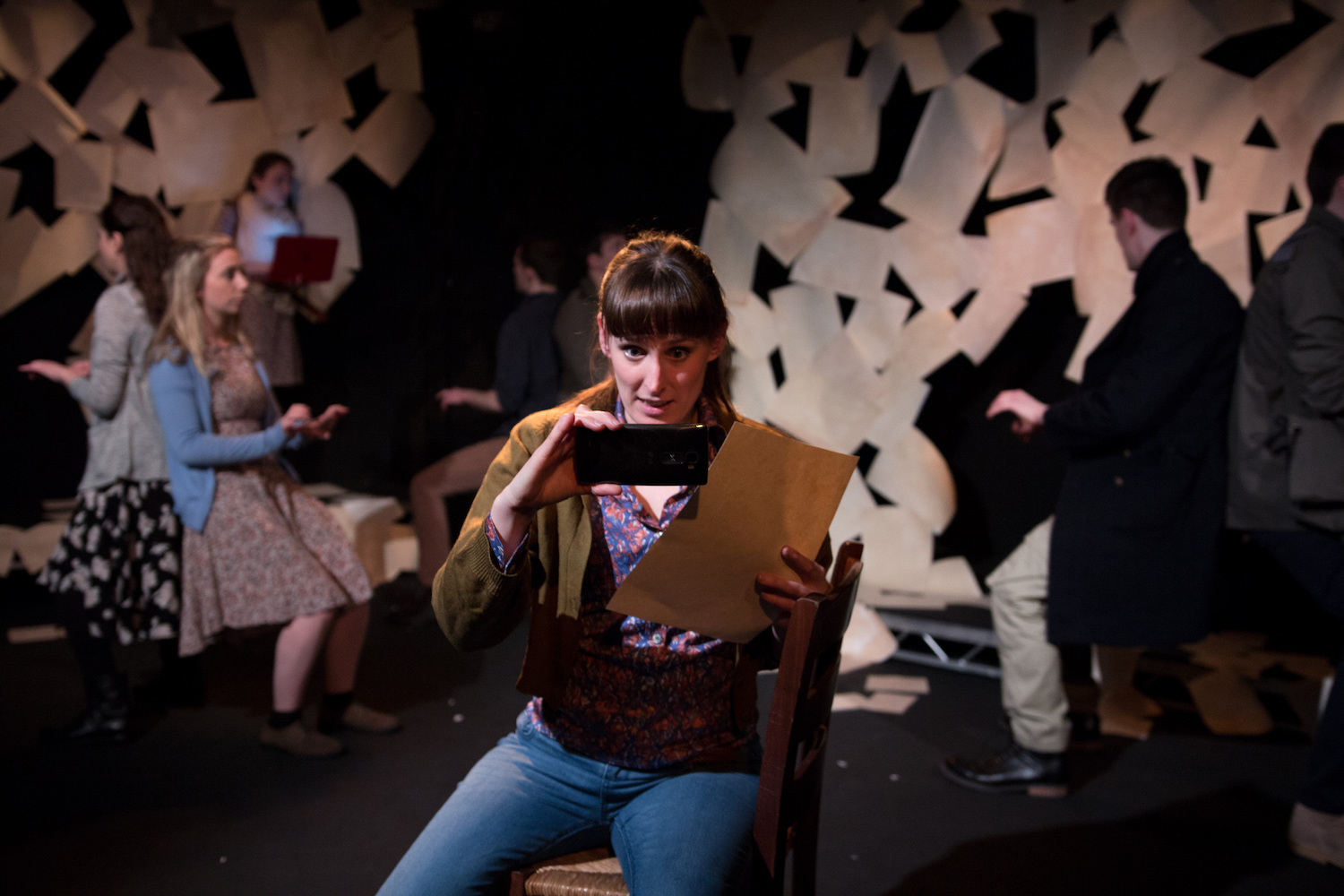
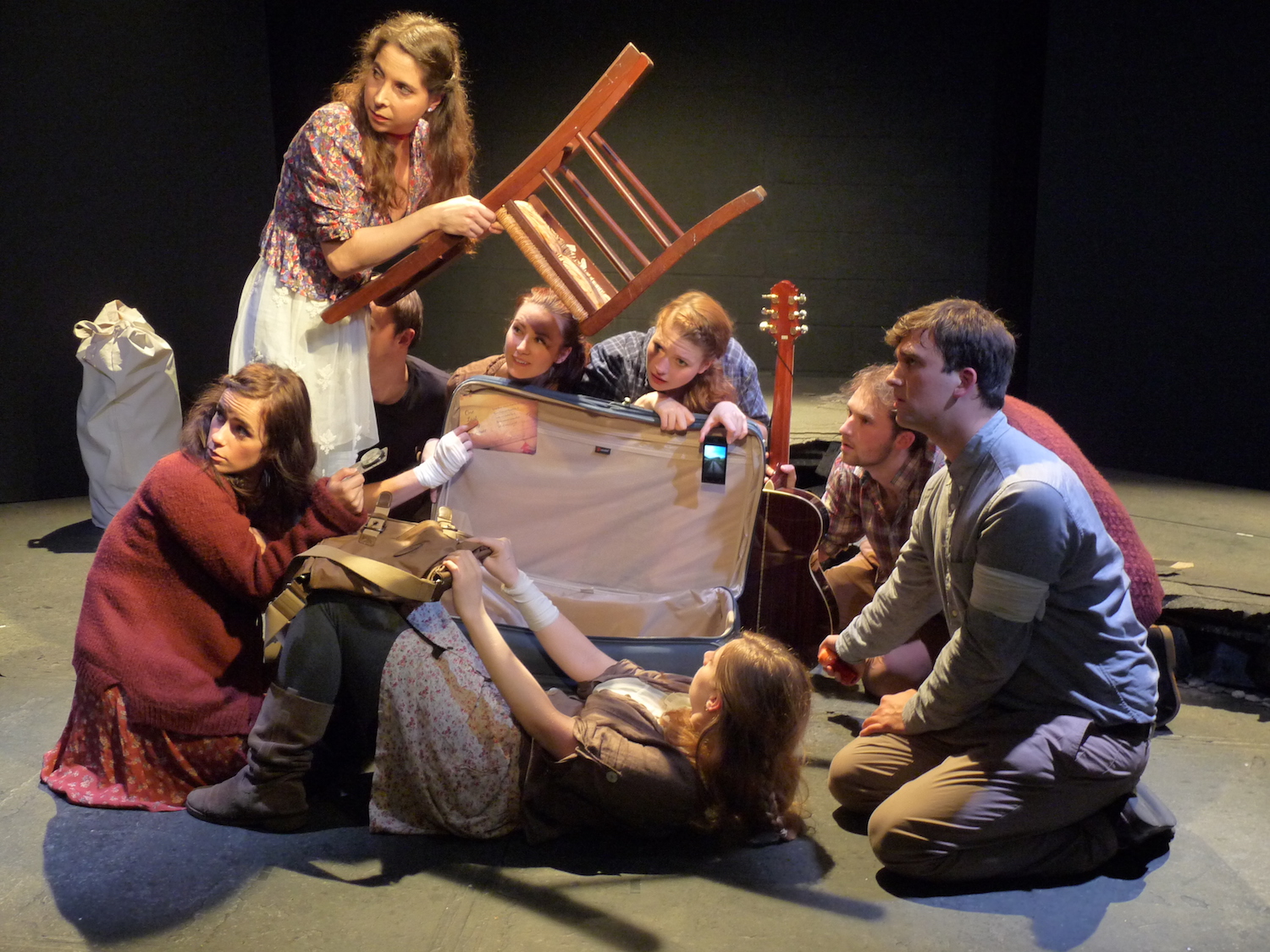
There’s no set to speak of, though designer Elliott Squire has created a simple yet very effective backdrop made up of blank pages cascading to the floor, and the actors make creative use of a selection of items (a chair, a wooden chest, a trombone…) not to mention their own bodies, to fill in the gaps in each picture to the point where you don’t even notice what’s missing.
Photo credit: Headshot Toby
Though the play isn’t overtly political, it does have a few pointed comments to make about the impact of war on the individuals involved (both directly and indirectly), and on whether war is ever the answer. But there are moments that hit a little closer to home, too, like the seemingly lighthearted story of a carefree woman whose life has never been touched by conflict, or the harsh, insensitive treatment of an asylum seeker by a British journalist, who hears only what makes a good story and is deaf to her desperate pleas for help.
As in life, some of the stories in One Last Thing (For Now) end happily, others in tragedy. One has a shocking twist; some never conclude at all. There are a lot of distinct threads to this show, but combined they create a memorable and undeniably powerful portrayal of the universal human emotions that hold us all together, even in the worst of times and circumstances. Though not always an easy watch, it’s certainly an important – and recommended – one.
Can’t see the map on iPhone? Try turning your phone to landscape and that should sort it. I don’t know why but I’m working on it… 😉
After more than two years in the making, Althea Theatre’s One Last Thing (For Now) has its world premiere at Islington’s Old Red Lion Theatre next month. Conceived by director Lilac Yosiphon, this ambitious project has been developed by the internationally diverse company, including cast members Tom Shah and Sam Elwin, and offers “a universal look at the language of love, the wounds of war and everything in between”.
The play’s creation was inspired by love letters from times of conflict in different cultures and languages. “The concept came from our director, Lilac, whose first instruction was to start reading,” says Tom. “Often they were the letters that were only intended to be read ‘should the worst happen’, and what is important to people in those situations – the words that they can’t leave unsaid – is more than enough inspiration.”
Photo credit: Laurie Field
“Alongside discussing the letters’ common themes, we began to develop a physical language for the show,” continues Sam. “We then attempted writing our own letters and began writing scenes inspired by the stories that had stood out to us. We selected and adapted from this pool of scenes to create a number of more cohesive storylines, which we then overlapped with each other, using the physical language to bind them together and enhance the storytelling.”
The development process began in September 2014, when the basis for most of the storylines was formed. Sam explains: “The process is still ongoing; since the initial development process we’ve had a rehearsed reading of a full length version of the script and we have two more days of R&D (research and development) before rehearsals start, during which we’ll finalise the script. Moreover, rehearsals themselves are a process of devising and discovery, so the show will continue to develop and change during the rehearsal weeks.”
“Initially, it was about using the fact that we were a group of people of different ages, genders, and nationalities with different experiences to draw us to as wide and varied subjects as possible,” says Tom. “Since then we have periodically come back to One Last Thing (For Now) to get it to the point it’s at now. That said, we still have one more story to write; Islington will be our home for the duration of the show’s run, and we’ll be creating an entirely new scene based on letters sourced from the Islington borough.
“One of the themes of the show is that for all our differences, we have the fundamentals in common. We’re asking for letters from Islington that we will workshop with people from the borough to help create this brand new scene for the show. We want to make our show part of the local community, because with such a global spread of stories, we don’t want it to feel like it’s about other people.”
This additional scene is a crucial part of the audience experience, wherever the show is being performed. “We believe that everyone has a story that needs to be heard,” explains Sam. “The intention is to use the letters to inspire a new storyline or scene which is specific to the Islington area and will only be performed while the show is at the Old Red Lion – a new venue would result in a new scene being devised; again inspired by letters, emails, texts etc from the local area. We also wanted to create a direct link with the local community in the performance they would see. To give the audience a sense of ownership and participation – these stories belong to all of us in that they have shaped and continue to shape the world we live in.”
Dealing with such universal issues as love and war, the company hope that the show has something for everyone. “We can certainly all learn something from it, and indeed, since one if its primary themes is cross-cultural understanding, we hope everyone would,” says Sam. “That said, the people most likely to want to see it are those who are interested in stories from around the world; those who have experienced war, either through family and friends or directly; people with an interest in the history; and people who enjoy visually arresting theatre.”
Tom agrees, and adds, “I do think anyone would take something away from seeing the show, but it will probably resonate most with people who at one time or another have felt cut-off from the people they love. I hope audiences will leave with a better idea of what it is that’s important to them.”
The show brings together stories from several different conflicts across the world – stories that the cast have come to know well during the development process. “One of my favourites follows a Colombian woman as she travels the world in search of someone she loves,” says Tom. “Even though she’s from a country most of us have never been to (and probably couldn’t name the capital of), speaks another language, and the ‘foreign’ environment she finds herself in is London, our connection to her is almost instantaneous.”
Sam has a few favourites: “That’s a really tough question to answer, all of the stories are so special. I think three in particular stand out. One is a letter conversation between an American soldier in Vietnam and his wife at home in the US, because it highlights the gap between what is written home and what is experienced and the couple’s struggle to deal with that.
The second is a storyline concerning a French resistance fighter, because it asks how much can love forgive and can we escape the roles we have chosen for ourselves? Thirdly, the story about a woman who sends her touch, because it’s in the tradition of the Brothers Grimm and Struwwelpeter – full of the fantastical and the macabre.”
Photo credit: Laurie Field
The fact that the different stories cross so many historical and geographical borders inevitably presents some challenges: “First, with so many of the storylines featuring non-British characters we had to devise ways of translating or having enough English to be understood by English speakers without repeating ourselves,” explains Tom. “Second, was to have some form of connection between what could otherwise be unconnected stories from different times and places.”
“As part of this some of us have to learn new languages and accents,” adds Sam. “Russian and Hebrew were a particular challenge…”
He concludes: “I hope our audiences will go away with an empathy for people from countries other than their own, an insight into the effects of war after the shooting stops, a remembrance of those who have died on all sides, and a hope that these three things can reduce conflict.”
This year sees the 50th anniversary of Heathcote Williams’ The Local Stigmatic, which follows two sociopaths obsessed with celebrity culture. First performed in Edinburgh in 1966, the play was later made into a film starring Al Pacino. Michael Toumey’s new production remains faithful to the 1960s setting in which the play was written, and yet the story still feels chillingly relevant in our modern world of social media and reality TV.
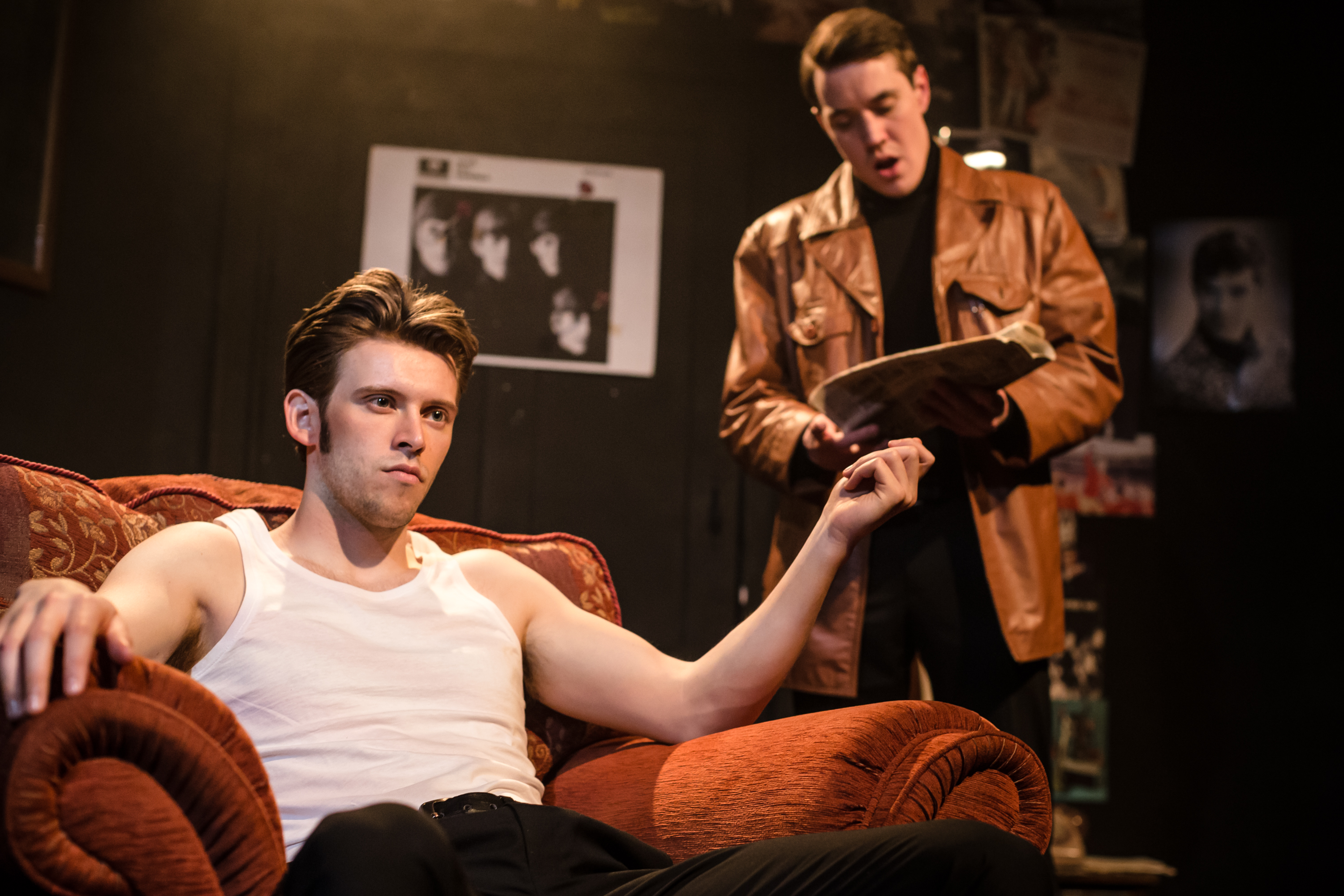
Graham (Wilson James) and Ray (William Frazer) are two friends who spend their time gambling, getting thrown out of pubs and reading newspaper gossip columns. When they bump into David (Tom Sawyer), a slightly famous actor, the two befriend him – but their twisted game takes a sudden, shocking turn, revealing their deep resentment of the celebrities they follow so religiously, and the depths to which they’re willing to go to prove their own superiority.
Photo credit: Scott Rylander
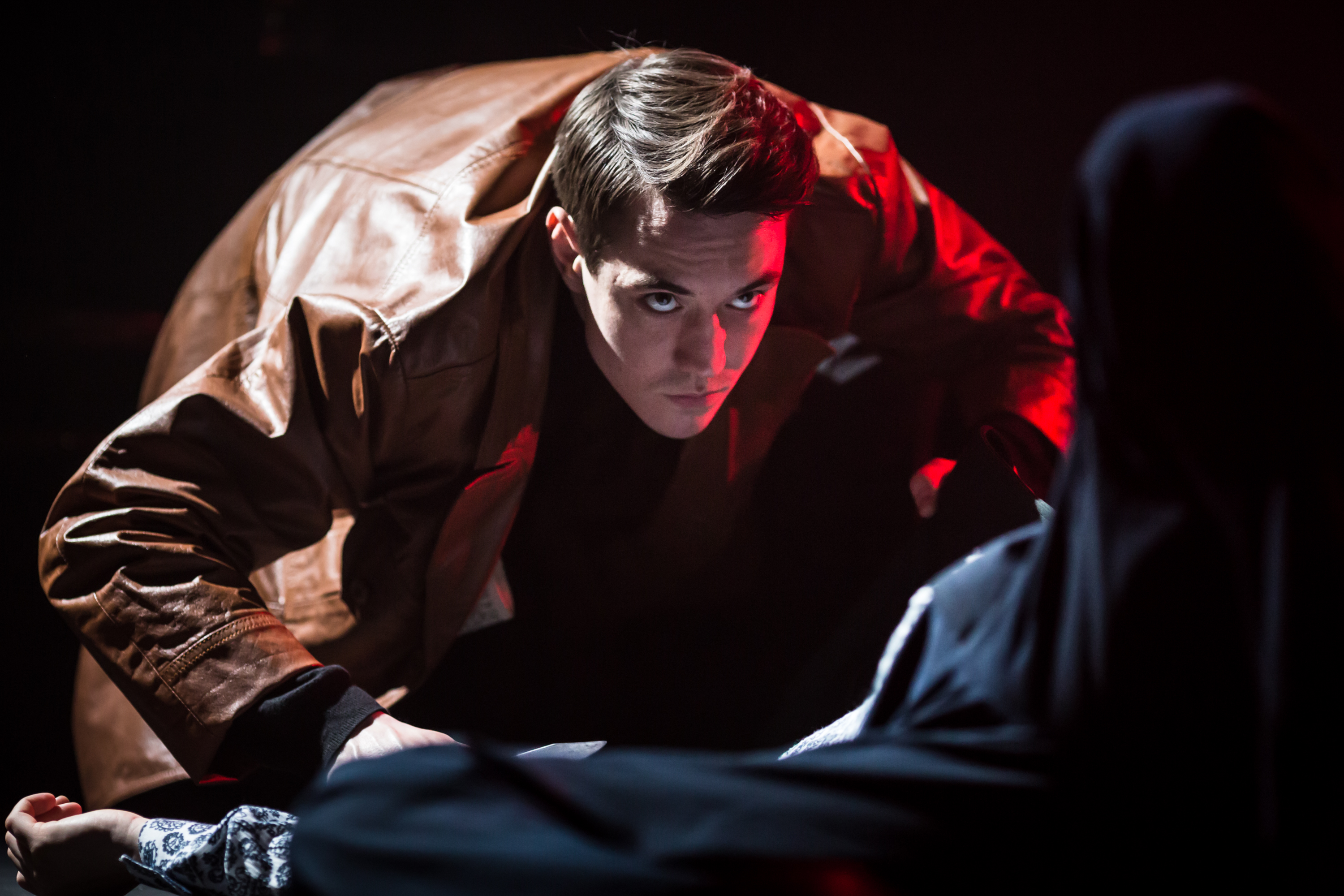
Wilson James and William Frazer give two unforgettable performances as Graham and Ray, subtly highlighting the differences in their personalities. Graham is the undoubted leader; his wide-eyed, unblinking stare (which he occasionally fixes on terrified audience members) gives the impression of a man on the brink of madness, and yet we soon discover beneath it all he’s always in control, choosing and pronouncing his words carefully to manipulate those around him.
Ray, on the other hand, is arguably the scarier of the two – though physically much more relaxed, and even occasionally quite funny, he too carries a pent-up rage that occasionally explodes in violence, and his blank-faced subservience to Graham, particularly in the closing minutes of the play, is truly chilling. Tom Sawyer’s David never stands a chance against this pair as, clearly flattered by their attention, he’s led neatly into the trap.
The dialogue is fast-moving and laden with meaning; it’s the sort of script that needs to be heard more than once to catch all the references (it also helps, I think, if you have a little knowledge of dog racing). What is clear is the way phrases are repeated throughout but with shifting significance, as the piece builds towards its shocking conclusion. And it is truly shocking, though not in the way I expected. When you’re braced for blood and gore, the violence initially seems a bit tame… but its power lies in the ability to send our imaginations into overdrive to fill in the gaps.
Photo credit: Scott Rylander
A simple set allows the actors to move easily between home, where celebrity posters adorn the walls, and the outside world, whilst keeping the two distinct. Tom Kitney’s lighting helps create an increasingly tense atmosphere, and sound designer Neil McKeown uses 60s hits to great effect both between and during scenes, to ensure some of the most powerful moments are those where no words are spoken.
The Local Stigmatic is an extreme example, but we only have to look at the increasingly common occurrences of internet trolling, or read the comments on any article in the Daily Mail sidebar, to realise the resentment felt by Graham and Ray towards the rich and famous is still shared by many. And now that we live in a world where we don’t even need to be stalkers to know all about the lives of celebrities we follow – a word used with startling prescience in Williams’ script, written long before Facebook or Twitter had even been dreamed of – this 50-year-old play feels more relevant than ever.
Can’t see the map on iPhone? Try turning your phone to landscape and that should sort it. I don’t know why but I’m working on it… 😉





 Theatre Things