Review: The Sound of Music at the Orchard Theatre

If the measure of a good show is how many people burst into song as they leave the theatre, The Sound of Music is surely well up there. Based on the true story of the Von Trapp family, Rodgers and Hammerstein’s musical is undoubtedly a classic, featuring a host of much-loved songs, a heartwarming love story, some unexpected Nazis and the world’s nicest children. What’s not to love?

Photo credit: Mark Yeoman

Set in 1930s Austria, The Sound of Music tells the story of Maria, a young woman struggling to adapt to the restrictive life of a nun, who’s sent away to live with the Von Trapp family as a governess. Charmed by the seven musically talented Von Trapp children, it’s not long before she starts to fall for their father too. All seems to be turning out well, until the Nazis turn up and try to ruin everything (as Nazis do).

Bill Kenwright’s revival stars Lucy O’Byrne, who gives a pitch perfect performance in just about every way. Maria is a role that requires a lot more vocally than just do-re-mi, and O’Byrne wastes no time in showing off the incredible range that took her all the way to the final of TV’s The Voice, along with the irresistible joie de vivre that instantly wins over both Von Trapps and audience alike.

But it’s not just the star of the show who hits the mark vocally. Rebecca Caine comes close to outshining the rest of the cast, as she brings down the curtain on both acts with her stunning rendition of Climb Every Mountain. Former Corrie star Andrew Lancel produces a charming Edelweiss, and the Von Trapp children repeatedly melt our hearts with their polished performance and beautiful harmonies.
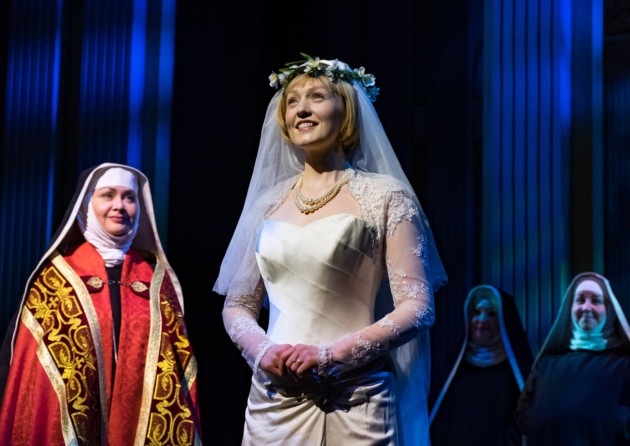
Photo credit: Mark Yeoman

Gary McCann’s set is one of the most impressive I’ve seen at the Orchard. The story takes us back and forth more than once between Nonnberg Abbey and the Von Trapp house, with occasional trips to other locations – and the set follows suit, without ever missing a beat or compromising on either scale or detail. And these frequent set changes happen so smoothly that the audience, absorbed in the story and music, barely notices them.

Nazis aside, The Sound of Music is very much a feel-good show; it’s difficult not to walk out feeling a little bit better about life (and, let’s be honest, even the Nazis aren’t that scary, really). It’s a love story first and foremost, but there are some other themes in there too, like growing up, finding your passion in life and standing up for what you believe in, no matter what anyone else says. Also, singing is good. As are hills.

For lifelong fans of The Sound of Music, this revival is a fitting tribute. For first timers or – dare I say it – sceptics, it may just win you over. Either way, it’s a production not to be missed.

The Sound of Music is at the Orchard Theatre until 1st October.

Review: Vanities: the Musical at Trafalgar Studios

We’ve waited ten years, but it’s finally here. ‎The London debut of Vanities: the Musical has been hotly anticipated, and it’s easy to see why. David Kirshenbaum’s show, which in turn is based on a 1976 play by Jack Heifner, has all the ingredients of a smash hit: an uplifting story, a catchy, toe-tapping score, a stellar cast of West End stars, and direction and choreography from American Idiot’s Racky Plews.

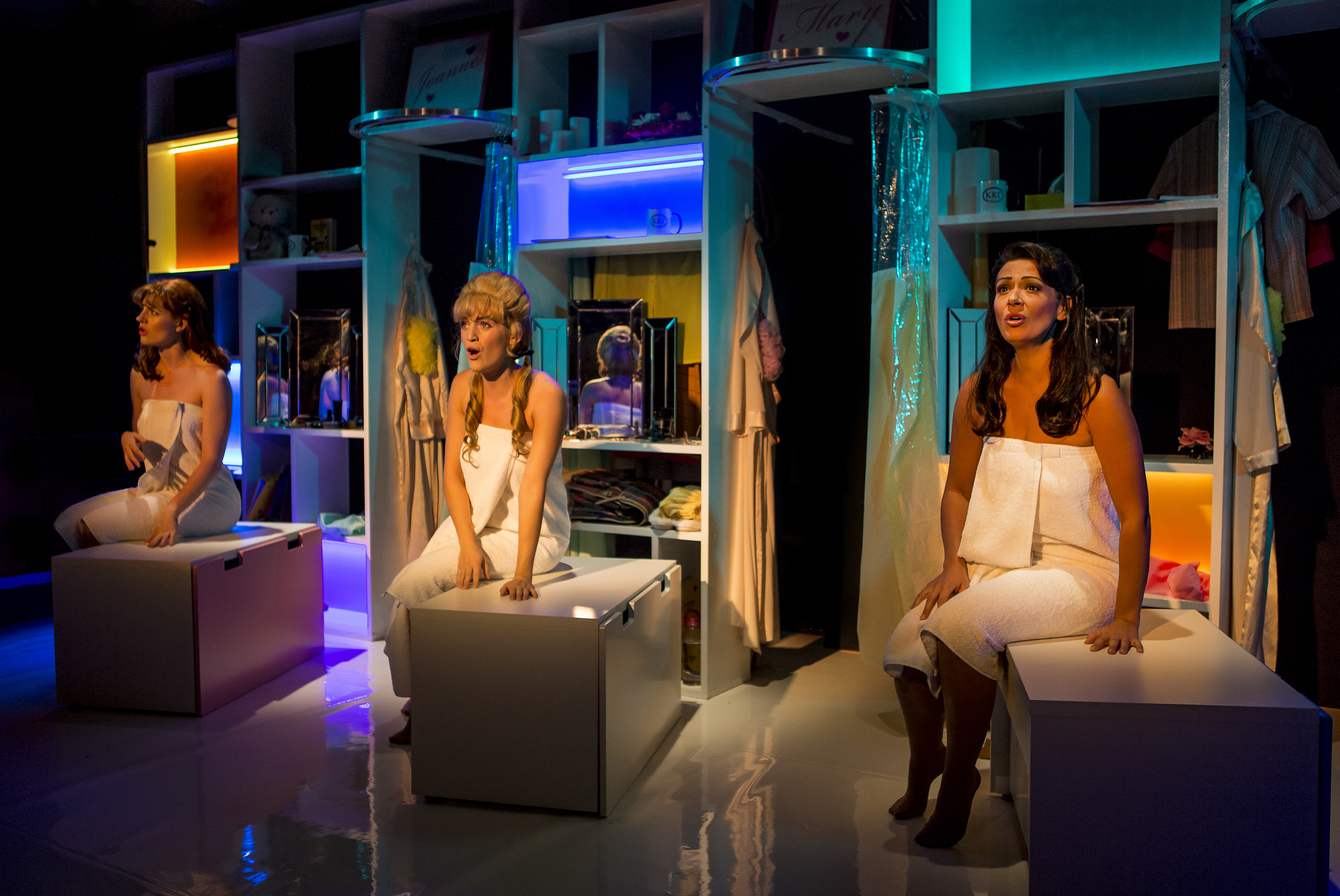
Kathy (Ashleigh Gray), Mary (Lauren Samuels) and Joanne (Lizzy Connolly) are cheerleaders from Dallas, Texas, preparing to graduate high school in 1964. Life’s been kind to the three best friends, who are used to being pretty and popular, and generally getting what they want. They have their whole lives planned out – but as the years pass, reality intrudes on their insular, superficial world, and the young women begin to realise things don’t always turn out quite like you thought they would. Can their friendship survive?

Photo credit: Pamela Raith

It’s essentially the plot of every classic American chick flick we’ve ever seen, and certainly doesn’t stand up to scrutiny in terms of realism. But those movies are wildly popular for a reason, and as cheesy and predictable as Vanities is, it’s also very easy to relate to. We might not all have been cheerleaders or sorority girls (and we definitely don’t all own erotic art galleries), but we were all teenagers once, and it’s easy to recognise ourselves – albeit sometimes a bit reluctantly – in the characters at each stage of their lives.

Because of limited space at the tiny Trafalgar Studios, where the audience sit so close to the stage that there’s a very good chance of getting hit in the face by a flying pom-pom, Vanities needs to have more up its sleeve than dazzling song and dance numbers. Racky Plews’ necessarily restrained production means the cast have nowhere to hide (unless you count the curtained changing rooms into which they disappear occasionally to age a few years), and Lauren Samuels, Lizzy Connolly and Ashleigh Gray rise to the occasion magnificently.

Photo credit: Pamela Raith

Alongside strong vocal performances, the three manage to bring a depth to their characters, even in the fluffy opening scenes when all the girls care about is make-up, hair, and if the president getting shot will interfere with their football game. Lizzy Connolly is hilarious as the naive and often gloriously tactless Joanne; her champagne-fuelled antics bring some much-needed light relief to Act 2. Ashleigh Gray’s Kathy is wound so tight you feel she might snap at any moment, and her stunning performance of Cute Boys with Short Haircuts, a significant turning point for the character, is an emotional highlight. Finally, Lauren Samuels plays Mary, on paper the least sympathetic of the three, with a haunted vulnerability that constantly contradicts the abrasiveness of her words and actions.

Andrew Riley’s pastel-coloured set is another star attraction, allowing the action to continue flowing seamlessly despite the need for multiple costume changes. Unusually, these changes actually become quite enjoyable, and even exciting, because each time the girls emerge from their changing room, their choice of outfit and hairstyle gives us an initial glimpse into the direction their life’s taken in the intervening years.

Vanities is a fun and ultimately uplifting show, with an irresistible score that will get stuck in your head for days afterwards. And whatever your views on chick flicks, there’s no doubt that this production is a triumph – so while it might not change your life, it’ll certainly brighten it for a couple of hours.


Can’t see the map on iPhone? Try turning your phone to landscape and that should sort it. I don’t know why but I’m working on it… 😉

Review: Bugsy Malone at the Orchard Theatre

The Summer Youth Project at Dartford’s Orchard Theatre brings together a 100-strong community cast of young people aged between 9 and 19, who’ve had just two weeks to rehearse a show before taking to the stage and performing for friends, family and the general public.

Now in its seventh year, previous SYP productions have included Fame, Annie and Footloose, with last year’s Oliver! described by reviewers as “West End standard”. Does this year’s choice, Bugsy Malone, live up to its predecessor? You’d better believe it.

Bugsy Malone

Bugsy is a great pick for a project of this kind, because besides being a family-friendly show with some irresistible tunes, it also has a huge amount of speaking parts; the list of characters in the programme is a page long. As a result, the Dartford audience gets to enjoy a true showcase of the vast amount of talent to be found on our doorstep. Many of the characters only have a few lines, but that doesn’t stop the actors making the most of their moment – like Thomas Gill, who has us eating out of his hand as Babyface (a.k.a. “the star of Dartford”), or Charlotte Whyte, who sparkles in her brief appearance as the spoilt diva Lena Marrelli.

Bugsy himself is played by Reece Eastgate, who owns the stage with cool confidence and charm; I’ve no doubt he’s got a great future ahead. Joseph Warrilow is great fun as Fat Sam, the incompetent gang boss and nightclub owner, while Calum Page’s slick, ruthless Dandy Dan wouldn’t look out of place in a remake of The Godfather.

There are some fantastic vocal performances too, most notably from Hollister Jacob as wannabe singer Blousey Brown, and Olivia Clark, who not only has a beautiful voice, but on Saturday afternoon also proved her professionalism as she powered through Fizzy’s solo number, Tomorrow, despite some distracting sound interference.

I could name everyone… but we’d be here all week. Suffice to say, every single member of the cast gives it their absolute all, and knowing the short time they’ve had to prepare only makes the achievement all the more impressive.

Directed and choreographed by Richard Peakman, who’s worked on the last five SYP productions, with musical direction from Melanie Crouch, the show dazzles most in its big musical numbers, during which the entire cast fill the stage and auditorium with an irresistible energy and enthusiasm. The finale is particularly infectious, with neither cast nor audience wanting the show to end.

Unfortunately this review is coming towards the end of the three-day run (I was meant to be there for opening night but had a train disaster), but if you have time to grab a ticket for the final show tonight, I really recommend it. Colourful, energetic, funny and joyful (not to mention the most child-friendly gangster story ever written – imagine how much better the world would be if all guns just squirted cream instead of bullets), the production is a wonderful testament to the power of theatre to bring people together – and for those of us who are regulars, it’s a refreshing reminder of the pleasure it can bring to so many.

Bugsy Malone has its final performance tonight, 13th August, at the Orchard Theatre, Dartford.

Review: How To Win Against History at Ovalhouse

I watched How To Win Against History after a very long day at work, hardly any sleep and okay, maybe a couple of glasses of wine. Perhaps that’s why looking back at this fast, frenetic and frankly quite bonkers little musical brings with it a slightly surreal, dream-like feeling – although I suspect had I been wide awake and stone cold sober it wouldn’t be much different.

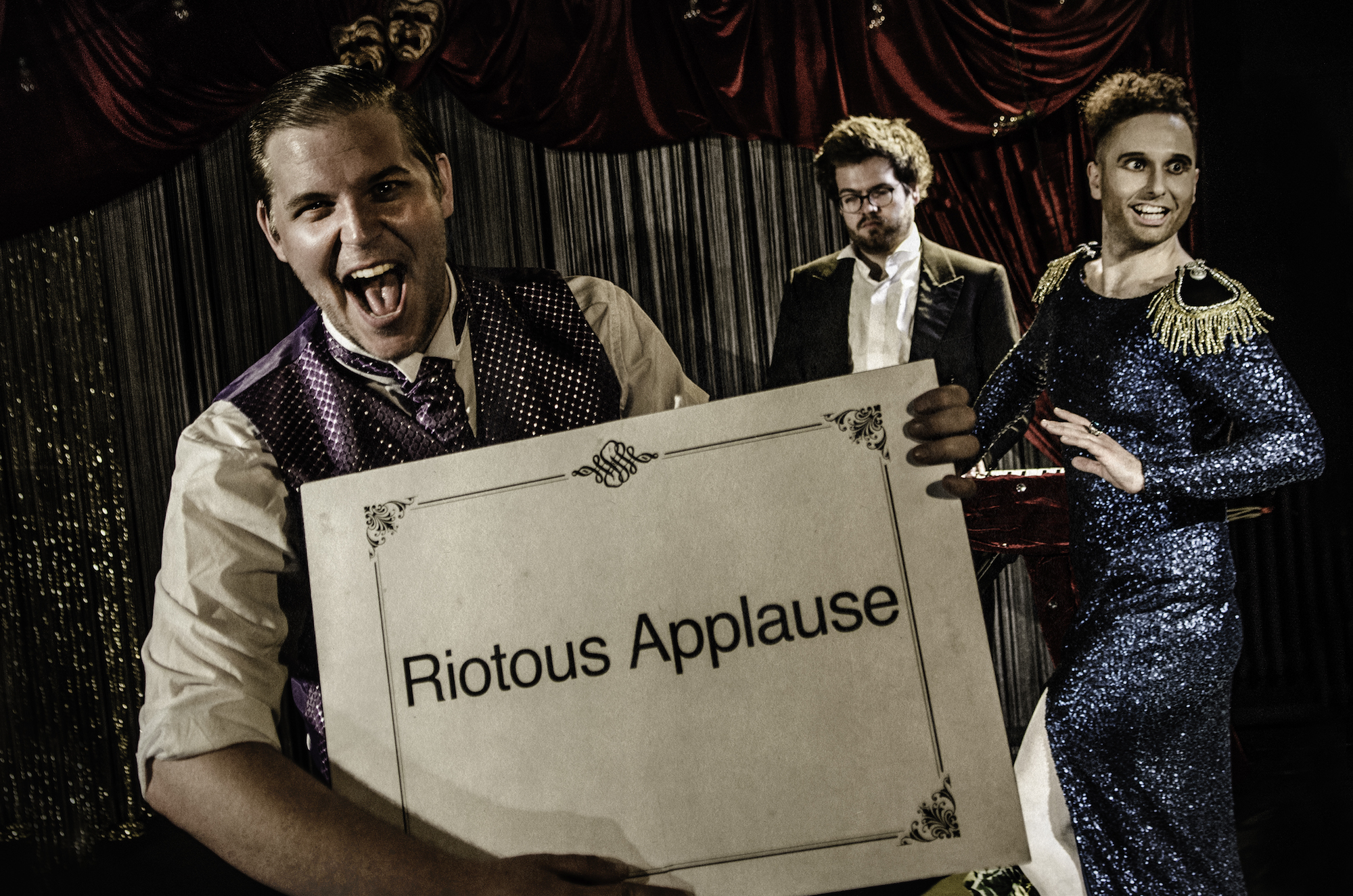
Seiriol Davies’ show tells the little-known story of Henry Cyril Paget, the 5th Marquis of Anglesey, a cross-dressing aristocrat from the 1800s who blew his family’s fortune on an unsuccessful theatrical career, and died at the young age of 29 in Monte Carlo of an unspecified “lung thing”. His outraged family then erased all trace of him from history.

Photo credit: Rah Petherbridge

This tragic story makes for a surprisingly hilarious musical, directed by Alex Swift and performed by a cast of three: writer and composer Seiriol Davies as Henry, musical director Dylan Townley as The Band, and Matthew Blake as Mr Alexander Keith (and everyone else). These three are a dream team, bouncing off each other brilliantly and working in perfect harmony throughout to bring this bizarre story to life.

In the hottest week of the year so far, all three performers nonetheless give it their absolute all. The tiny stage brims with energy and an infectious enthusiasm that never lets up; this show is full on fabulous from start to finish. And though it’s only an hour long, it packs in a lot – so much so, in fact, that it becomes hard to keep up. Fortunately, as instructed by the actors themselves, we have the option to go away and Google anything we might have missed, and I’m willing to bet a significant proportion of the audience did just that.

Davies’ Henry is an ethereal being, so delicate that at times his voice barely rises above a whisper. He’s instantly appealing despite his many flaws, full of wide-eyed innocence and seemingly blissfully unaware that he might not be winning at life (“apparently,” he explains at one point, appearing genuinely surprised, “I treated Lilian [his wife] rather badly”). He’s joined by loyal friend and supporter Mr Alexander Keith – just one of many roles played by the multitalented Matthew Blake (another is Lilian, in case you were wondering) – and his band, played by the eccentrically wonderful Dylan Townley on piano.

Photo credit: Rah Petherbridge

The show acknowledges and addresses its audience, encouraging participation (at one point we found ourselves singing in German) with a witty script that includes several current political and cultural references; the Daily Mail joke went down particularly well. In keeping with its central character, the humour occasionally steers very close to the line – a couple of jokes drew audible groans from the audience – but never slips across it completely, and remains good, (almost) clean fun. The final message seems a bit muddled: on the one hand, Henry feels that he’s “sort of won” by being himself and living life his way, despite opposition and indifference from those around him; on the other, he also counts it as a win to convince the Daily Mail that he’s “normal” and enjoys wearing tweed.

How To Win Against History is undoubtedly an odd show (even without a glass of wine in your hand) – but like its hero, it’s also fabulous and fierce. And it does things its own way, no matter what anyone thinks, with a cast of three who seem to be having easily as much fun as the audience. Riotous applause is a fitting end to such an entertaining and brilliantly performed show.


Can’t see the map on iPhone? Try turning your phone to landscape and that should sort it. I don’t know why but I’m working on it… 😉

Review: The Return of the Marionettes at Bridewell Theatre

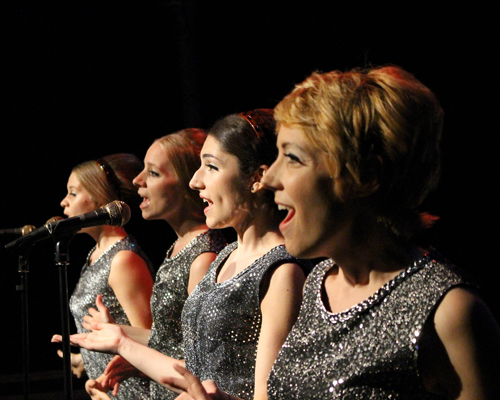
Welcome to the 1960s, where girl group The Marionettes are taking to the stage at the height of their fame. But as they come to the end of their final number, one of the girls runs from the stage in tears. And that, we learn from their manager George Ellis, is the end of the Marionettes.

Until now (well – 1984, anyway): 20 years later, the girls are back together for a one-off reunion show that could see their career picking up where they left off. But with so much history to work through – personal and professional – can they put the past behind them and deliver the show their adoring fans have been waiting for?

13412175_10154979027938289_5124830498646302303_o

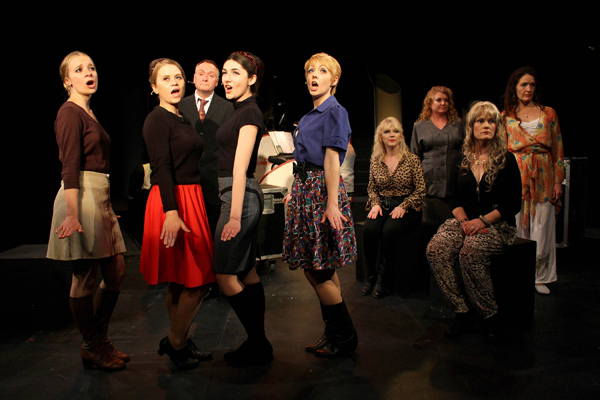
Writers Peter and Phillip Ley of Tower Theatre Company take us back to the start of the story, introducing us to four giggling schoolgirls who call themselves the Moonbeams, and charting their progress to the top. Along the way, we’re treated to 18 original songs that capture the spirit of the 60s and – like all the best songs from that period – are easy to pick up and totally infectious. (Two days later, I’m still singing the Marionettes’ first big hit, Dynamite.) Polished performances from the cast, along with Ruth Sullivan’s choreography and costumes from Lynda Twidale, mean the musical numbers do a great job of transporting us back in time.

Photo credit: Robert Piwko

A dual cast of actresses play the Marionettes then and now, which enables the two groups to share the stage, with the older women often observing their younger selves and providing commentary on events as they unfold. Angharad Ormond and Stella Henney earn their place as lead vocalist Cathy with some impressive performances, but both also reveal a touching vulnerability hidden beneath a veneer of false confidence. Meanwhile Fiorella Osborne and Annette Ross show the fiery passion and determination that have always made Mary the true leader of the Marionettes.

What works really well is the way the dynamic of the group picks up where it left off 20 years ago – the professional tension between Mary and Cathy continues, there’s tension of a whole other kind between Mary and George, and the Meltzer sisters (Olivia Barton-Fisher and Jessica O’Toole as the younger, Deborah Ley and Annemarie Fearnley as the older) are enjoying the moment and providing light relief with their banter. The transition is aided by the constant, reassuring presence of Brad Johnson as both the older and younger George, along with Julian Farrance as heartless record boss Allan Tyrell.

Photo credit: Robert Piwko

Despite a few small stumbles in the spoken scenes, and some sound issues – the live band, led by musical director Colin Guthrie, are fabulous but occasionally drown out the actors – there are a lot of great things about this show, and opening with the break-up of the band creates an enjoyable suspense as we wait to see not only what eventually proved to be the last straw, but whether the women can now overcome their differences. It would have been nice to see more of the simmering romance between Mary and George; considering their feelings for each other are still present and obvious to everyone 20 years later, there are very few references to it in the flashbacks. And while it’s a challenge to recreate the sensation of a huge sell-out gig in an intimate fringe setting, there’s a lovely moment with some crazy fans, which helps demonstrate just how big the group were at the height of their fame.

The Return of the Marionettes is a thoroughly enjoyable take on the familiar ‘rags to riches to ruin to redemption’ story we’ve come to know and love from shows like Jersey Boys and Dreamgirls. With a soundtrack of irresistible songs, some strong vocal performances and a rousing finale, this is a show with great potential, which is pretty much guaranteed to send audiences out with a smile on their face and a skip in their step.


Can’t see the map on iPhone? Try turning your phone to landscape and that should sort it. I don’t know why but I’m working on it… 😉