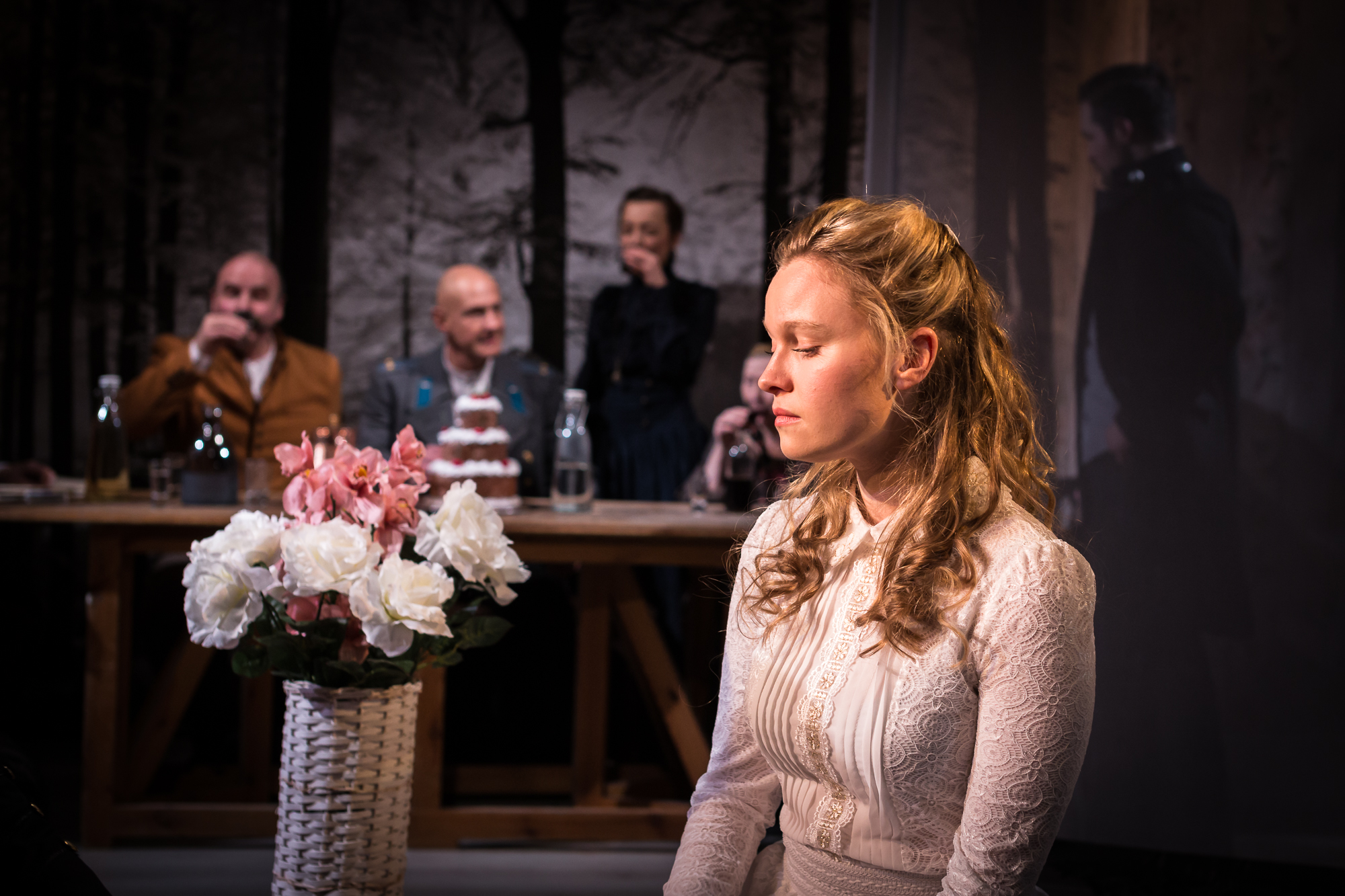
Review: Devil With The Blue Dress at The Bunker Theatre

In Kevin Armento’s Devil With The Blue Dress, Hillary Clinton refers to her husband’s affair with Monica Lewinsky as the second worst thing ever to happen to her. It’s a great line, which unsurprisingly earns a big laugh, but it’s also a very telling comment. Hillary Rodham Clinton – lawyer, author, politician, mother, grandmother, the first woman to be nominated for president by a major political party in U.S. history – is still known above all by people across the world, and within her own nation, for two main events: that time her husband cheated on her with a 22-year-old intern, and that time she was beaten in the presidential election by a man with zero political experience, qualifications or intelligence.
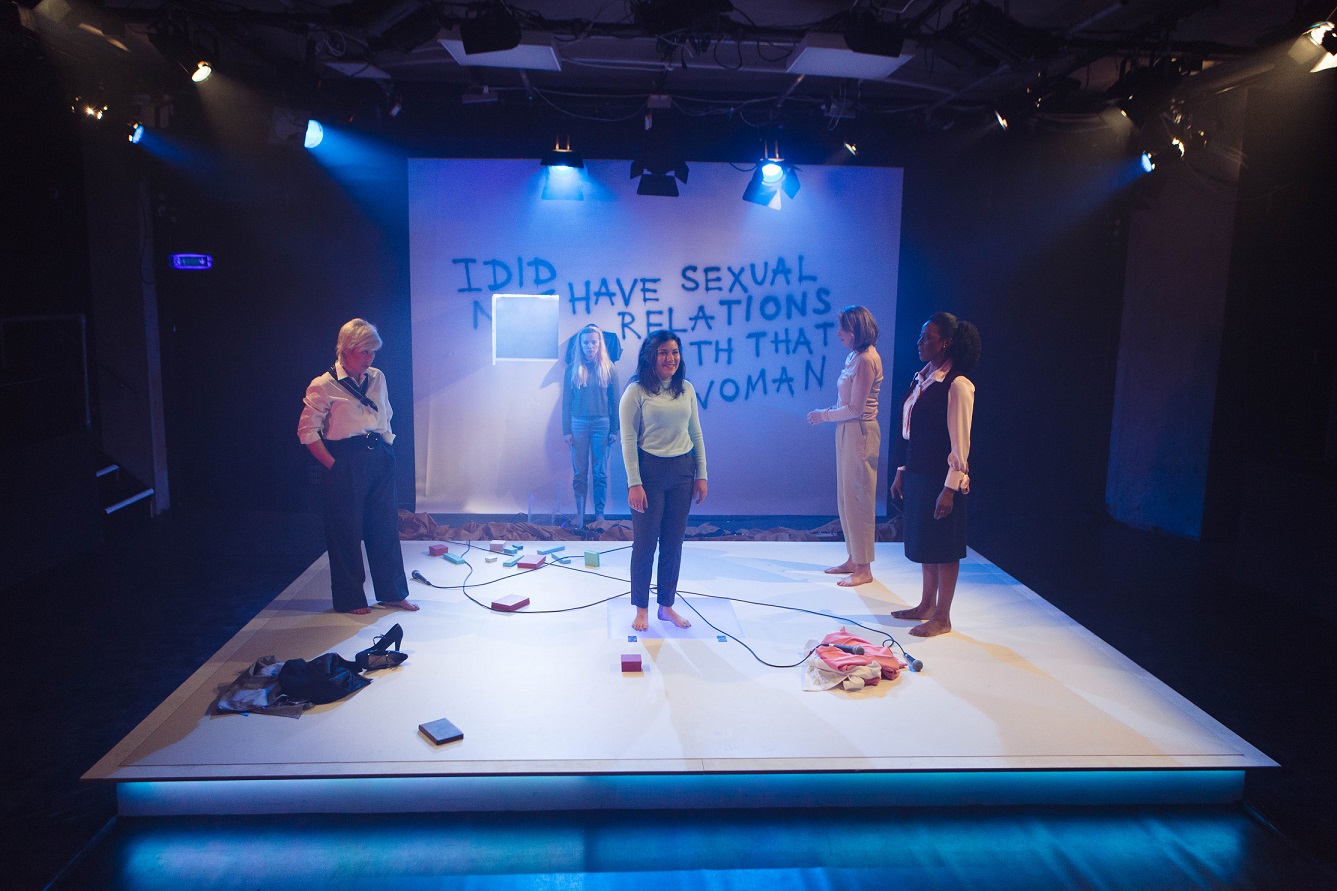
Photo credit: Helen Murray

Devil With The Blue Dress examines the circumstances of the former, while reflecting on the impact it may or may not have had on the latter. Most of us above a certain age will remember, however vaguely, what’s become known as “the Monica Lewinsky scandal”; Armento’s script fills in the political and personal details, from the perspective of both Hillary (Flora Montgomery) and Monica (Daniella Isaacs), as well as the Clintons’ daughter Chelsea (Kristy Philipps), Bill’s devoted secretary Betty (Dawn Hope) and Monica’s friend and confidante, Linda (Emma Handy).

Joshua McTaggart’s production begins in an orderly fashion, with Flora Montgomery’s meticulously controlled Hillary presenting each of the characters in “her play” as they emerge from behind a curtain at the back of the stage. Then Monica, played by Daniella Isaacs, crashes the party, at which point the narrative takes a very different direction. She wants to tell her side of the story, and does so with colour and emotion; in fact she’s the total opposite of Hillary, and if we met her out of context, we’d probably quite like her. It’s a sympathetic view of a woman who’s rarely seen in such a positive light: young and in love, she’s manipulated by those around her and pays for it by becoming the face and name of a global scandal.

By Act 2, the curtain’s down, the truth is out and the gloves – or rather heels – are well and truly off, as little by little the five women turn on each other. And if there’s one key player noticeably missing from the all-female line-up, Bill Clinton still makes his voice heard, both through the sterling work of saxophonist Tashomi Balfour and through the women themselves, with the “supporting cast” of Chelsea, Linda and Betty each taking turns to speak his words. Meanwhile Hillary and Monica face off in a battle over who’s been most wronged by the other, neither apparently giving a moment’s thought to the idea that the President might bear some responsibility for their misery. And it’s that very point that makes this play about a 20-year-old scandal so relevant right now in 2018, with the #metoo movement continuing to gain momentum, even as Donald Trump – a man who literally believes he can do anything he wants to women because he’s famous – sits smugly in the White House.

Photo credit: Helen Murray

Though a little knowledge of U.S. political history might help, particularly at the start of the play, Armento’s writing is clear enough that anyone with the sketchiest knowledge of what happened in 1998 – and 2016 – can easily keep up with the chain of events. The conflict between the women makes for compelling viewing, but what really sets the stage for an interesting debate is the underlying question of why that conflict is even happening, and what damage it’s inflicting on both the individuals involved and the perceptions of those watching. I’ve never questioned why it’s known as the Monica Lewinsky scandal and not the Bill Clinton scandal – but I am now, and I don’t think I’m the only one.

Can’t see the map on iPhone? Try turning your phone to landscape and that should sort it. I don’t know why but I’m working on it… 😉

Review: Mirrors at Leicester Square Theatre

In a world of fashion magazines, social media, online dating and reality TV, who needs a magic mirror to remind you every day that you’re not the fairest – or funniest, or coolest, or most talented – of them all? In darkly humorous modern fairytale Mirrors, Siobhan McMillan draws on her own experiences to examine our obsession with measuring our own self-worth based on the perception of others, and the desperate places that obsession can take us to.

Photo credit: Thomas Aston

Vlogger ShyGirl is excited – not only does she now have eight YouTube subscribers, she also has a new boyfriend, Mikey, who’ll be here any minute. Mikey, however, doesn’t sound to us like much of a catch, and when he inevitably doesn’t show up, ShyGirl’s fragile self-esteem is crushed. In a fit of rage, she conjures up a gorgeous, confident alter ego, Shivvers, who’s a distant relative of Snow White’s evil stepmother. Shivvers has her own magic mirror, which dutifully tells her every day that she’s the most beautiful in the land… until one day it doesn’t. Horrified and furious, she sets out to find and destroy her competition, but ultimately discovers only other women who are secretly as messed up and neurotic as she is.

Directed by Gabi Maddocks, Mirrors is a short, punchy and action-packed solo show, which takes us on an epic journey through a brand new fairytale land. Writer and performer Siobhan McMillan is a gifted storyteller, bringing her characters and surroundings to life with the aid of a few props, some impressive physical characterisation, and a lot of imagination. She’s also very funny, frequently diverting from the traditional fairytale script and in doing so making her character much more relatable than your standard Disney villain; Shivvers might be a terrifying ice queen on a murderous quest, but she also drinks, swears, and gets bored, hungry and grumpy just like the rest of us.

Photo credit: Thomas Aston

As laugh out loud funny as the show frequently is, however, anyone hoping for a fairytale ending for Shivvers (or ShyGirl) will be disappointed. This surreal adventure ends as it began: having failed to find her rival, she returns home alone, still begging her broken mirror/laptop for reassurance. It’s a gloomy note to end on, but feels appropriate given that the universal quest for perfection – whether you’re a Shivvers or a ShyGirl – is one that seems unlikely ever to be over.

Frequently bizarre, and occasionally downright baffling, Mirrors is a unique experience. The show tackles some serious questions in an entertaining and humorous way, and while it doesn’t offer any constructive solutions, in reflecting back to us our own anxieties and fears, it does make us feel a little bit less alone.


Can’t see the map on iPhone? Try turning your phone to landscape and that should sort it. I don’t know why but I’m working on it… 😉

Review: Love Me Now at Tristan Bates Theatre

Love Me Now might be Michelle Barnette’s debut play, but there’s nothing tentative about this funny and infuriatingly on-the-money portrayal of dating and sex in 2018. B is an independent, modern woman, who for the last few months has been enjoying a casual sexual relationship with A. He said it could be whatever she wanted it to be – except she doesn’t really know what that is any more, and it turns out he didn’t really mean it anyway.

The fact that B (Helena Wilson) is not called A in her own story is our first clue that all is not well, even though initially the arrangement seems to be working out for both of them. It soon becomes clear that A (Alistair Toovey) repeatedly puts his own needs and desires – sexual and otherwise – before B’s, and on the one occasion she doesn’t let him get away with it, he labels her a psychopath, tries to physically and sexually assault her, and then tells her not to play the victim. Later, she starts dating C (Gianbruno Spena), who appears to be A’s opposite but turns out to be just as obnoxious and casually sexist – the only difference being he’s less upfront about it. And somehow in both cases, B ends up getting the blame when the relationship crashes and burns.

Photo credit: Helen Murray

And it’s with this important point that the play really makes an impact. We live in supposedly enlightened times, where anyone – male or female – can have any kind of relationship they want free of judgment, but the truth is attitudes haven’t really changed that much. So it’s fine for A to have six sexual partners at once, but if B does the same, she’s easy – and when it turns out she doesn’t, she’s a tease. On their third date, C presents B with a bracelet that his niece made for her, but when she speaks jokingly about reclaiming her virginity, he dumps her (over voicemail) because she’s “obviously looking for something serious”. She literally can’t win – and it’s maddening to watch, mostly because it’s so depressingly relatable.

In fact, the play thrives on its audience’s rage, with several deliberately provocative lines from both men that can’t fail to get a reaction. It’s quite something to not only see and hear but actually feel a theatre full of people respond, spontaneously and in perfect unison, to the actions of a character on stage – whether that reaction is hearty laughter (of which there is a lot) or shocked disgust (of which there is also quite a bit).

All three actors get their performances spot-on. Helena Wilson demonstrates an incredible emotional range, from confident and flirtatious in those fleeting moments where B has the upper hand, to shocked, angry and confused by the way both men have treated her. As A, Alistair Toovey has an irresistible boyish charm that leaves us in no doubt why B is attracted to him, but is just as convincing in his character’s darker moments; the climactic scene between them is genuinely frightening in its intensity. Despite having considerably less stage time, Gianbruno Spena is great as the dull and patronising C – and gets arguably one of the best audience reactions with his stunningly ill-judged attempt to stop B talking.

Photo credit: Helen Murray

The play makes use of multiple timelines, so that as well as B’s short-lived relationship with C, we also drop in on her time with A at various points. Jamie Armitage’s production neatly separates these moments in time with the help of Ben Jacobs’ excellent lighting design – but does little else to distinguish between them, which leaves the audience a little confused, particularly towards the end of the play, as to whether we’re in the past or present.

This small complaint aside, Love Me Now is a brilliant debut from Michelle Barnette. Her writing is witty and insightful, not afraid to go to some pretty bleak places, and I guarantee there will be something in it that everyone can relate to. Will it make you laugh? Definitely. Will it make you angry? Absolutely. Will it make you consider giving up dating altogether and getting a cat instead? Quite possibly. But should you go and see it? 100% yes.

Can’t see the map on iPhone? Try turning your phone to landscape and that should sort it. I don’t know why but I’m working on it… 😉

Review: Our Big Love Story at The Hope Theatre

In June 2017, Theresa May concluded her response to the UK’s third terrorist attack in as many months with these defiant words: “We must come together, we must pull together, and united we will take on and defeat our enemies.”

The call for unity and defiance is a common refrain at times like these, and rightly so; faced with such mindless horror and violence, it’s important that we look out for each other, and of course we should present a united front against those who want to harm us. But what happens when that determination to protect our way of life at all costs goes a step too far?

In Our Big Love Story, Stephanie Silver explores the idea of radicalisation of teenagers – only not, as one might expect, that of young Muslims. Instead it’s a young white girl, Destiny (Holly Ashman), who’s drawn in by the racist rhetoric of her dad’s EDL group following the July 7 bombings in 2005. Her anger at the devastation and loss of life is both understandable and relatable, but it’s also wildly misplaced – having finally convinced herself that her classmate and secret crush Anjum (Naina Kohli) isn’t a terrorist because she’s not a Muslim, she moves on to a new and equally innocent target, with horrifying consequences.

Though the story takes place on and immediately after the 2005 attack, it could just as easily be happening today, at a time when the threat of terror attacks remains high, and far right groups in the UK and overseas gain ever more ground, both socially and politically. That said, July 7 feels like a particularly significant landmark to choose: the first example of radical Islamist terror most of us – and certainly the four teenage characters in the play – can remember on home soil, and the moment at which attitudes towards Muslims began to shift rapidly in an uncomfortable direction.

The play begins as two separate love stories, neither of which has any obvious connection to terrorism; it’s not until it’s almost over that all the threads finally link together. While Destiny and Anjum discuss their mutual attraction and Destiny worries what her dad will think, Katie (Emelia Marshall Lovsey) and Jack (Alex Britt) are more coy about their own budding romance, recalling with some embarrassment their parents’ attempts to educate them on the birds and bees. It’s instantly clear that although they’re on the brink of adulthood, these young people are still of an age where their parents have an influence on them – a fact that will take on darker significance as the play goes on.

Into the midst of all this youthful exuberance steps The Teacher (Osman Baig), a religious Muslim man injured in the attack, with an account that’s harrowing in its graphic detail. He’s traumatised by what he saw that day, but even more so by not knowing the fate of a fellow passenger and his little girl, and over the course of the play describes how this trauma affected his life in the days and weeks afterwards. At the same time, he gives us an insight into the judgment and suspicion faced by Muslims in the wake of this and other attacks – a judgment he eventually begins to turn on himself as his precious faith slips away.

The Teacher’s appearances slow the tempo of Calum Robshaw’s otherwise fast-paced production, with Osman Baig’s direct and personal delivery ensuring that we hang on his every word. The play’s conclusion brings all five characters together and is performed with genuine and heartfelt emotion by the young cast, but it’s reassuring to see that while in some ways their lives have been irrevocably changed, we can still catch glimpses of those giddy teenagers we met earlier, still falling in love and convinced they can conquer the world.

I saw an extract from the opening of Our Big Love Story at an Actor Awareness scratch night last year, and was intrigued by the multiple different themes that the play seemed to be dealing with: love, sex, religion, racism, porn… It’s satisfying therefore to see how the full-length play successfully weaves these themes together, forming a coherent narrative that’s thought-provoking, moving and, at times, quite unsettling. There’s still a lot going on, and the play could be longer to allow it to delve into each issue in more depth – but as it stands, the story already provides more than enough food for thought to keep us going for quite some time.

Can’t see the map on iPhone? Try turning your phone to landscape and that should sort it. I don’t know why but I’m working on it… 😉
Review: Three Sisters at the Brockley Jack Studio Theatre

It only takes one look at Odin Corie’s set – a light, sophisticated and immaculately decorated family room, which makes the intimate Brockley Jack Studio look far bigger than it is – to understand that with their third foray into the Russian classics, Arrows and Traps mean business. Following the success of their Anna Karenina and Crime and Punishment in 2016 and ’17 respectively, the multi-Offie nominated company has now turned its attention to Chekhov, with a new adaptation of Three Sisters written and directed by Ross McGregor.

Photo credit: Davor Tovarlaza

Set in a Russian garrison town, the play immediately introduces the eponymous three sisters: Olga (the responsible one), Masha (the passionate one) and Irina (the romantic one). One year on from the death of their father, all three yearn to find some joy and purpose in a life that’s become relentlessly dull and ordinary. They believe the answer lies in their long-held dream of returning to Moscow – and yet, four years later, we find them exactly where they began, having moved precisely nowhere. This inertia means that not only have they not found happiness; they’re also significantly worse off, thanks to their brother Andrei (Spencer Lee Osborne). He’s led them into ruin with his gambling habit and disastrous marriage to Natasha (Hannah Victory) – a local girl they all once looked down on, but who now rules the roost with an iron fist and has, little by little, driven them out of their own home.

The substantial cast of fourteen is uniformly excellent. Cornelia Baumann never disappoints, and she hits the target again with her fragile and lonely Olga, trapped in a public service job she never wanted because she’s too nice to say no. At the other end of the scale, Claire Bowman is full of uncompromising fire as the sharp-tongued Masha; her disdain for her comically ridiculous husband Fyodor (Stephen MacNeice, whose plaintive insistence that he’s a happy man becomes harder and harder to believe) is matched only by her passion for the equally unhappily married Colonel Vershinin (Toby Wynn-Davies). Somewhere in the middle, Victoria Llewellyn balances the two out as the youngest sister Irina, soaring from ecstatic highs to desperate lows in her search for an idealistic true love that seems doomed to end in tragedy.

Photo credit: Davor Tovarlaza

The production also makes interesting use of music, with musical director Elliot Clay combining sweeping orchestral tracks with a more modern twist provided by guitar-toting soldiers Vladimir and Alexei (Freddie Cambanakis and Ashley Cavender), and – in a rare moment of joyful abandon – a traditional Russian singalong that might just have you reaching for the vodka, and will almost certainly get stuck in your head, possibly forever. (Just to make sure, they sing it twice.)

At 2 hours and 45 minutes it’s not a short play, but we easily become invested enough in the characters that the story remains compelling, and under Ross McGregor’s direction it never feels like the pace is too slow – all the more impressive when you consider this is, by its very nature, a play where the characters talk a lot but don’t do much. Five years of consistent excellence from Arrows and Traps have set the bar incredibly high – but while Three Sisters perhaps lacks a little of the cinematic grandeur we’ve seen in the company’s earlier work, this is still without doubt a stylish and beautifully acted piece of storytelling.


Can’t see the map on iPhone? Try turning your phone to landscape and that should sort it. I don’t know why but I’m working on it… 😉