Review: The 25th Annual Putnam County Spelling Bee at the Drayton Arms Theatre

Fun fact: yesterday was the final of the US National Spelling Bee in Maryland. The 14-year-old winner, Karthik Nemmani, triumphed by correctly spelling “koinonia” – which means Christian fellowship or communion – after his opponent, aged 12, stumbled on her own word, “Bewusstseinslage” (a state of consciousness or a feeling devoid of sensory components). Afterwards, reports the Guardian, the generous champion took no pleasure in beating his rival, saying, “We weren’t against each other. We were against the dictionary.”

There’s little sign of such magnanimity at the start of MKEC Productions’ The 25th Annual Putnam County Spelling Bee. We arrive to find the contestants and organisers milling about the theatre, chatting to the audience and bickering amongst themselves, before the show begins and battle commences. Somehow I’d never seen William Finn and Rachel Sheinkin’s Tony award-winning musical before – which is ironic considering I seem to be the only person in the world who thinks a show about spelling actually does sound like fun – but I’m now officially a convert. What starts as a hilariously silly comedy about six misfits who love to spell unexpectedly turns into an emotional rollercoaster, as we get to know the contestants and understand the backstories that have brought them to the bee. Unlike most rollercoasters, however, this is one I’d happily get back on and do it all over again. And then again after that.

Photo credit: Alex Harvey-Brown at Savannah Photographic

This is partly because bits of the show have an improvised feel – specifically those involving members of the audience (nothing too scary and all voluntary, although I’m still glad it wasn’t me up there) and a few pointed one-liners referencing current events – and it would be fascinating to see what goes differently on a second viewing. But it’s mostly because the story, characters and music are all genuinely delightful, despite also being “the slightest bit bizarre” in their own special ways.

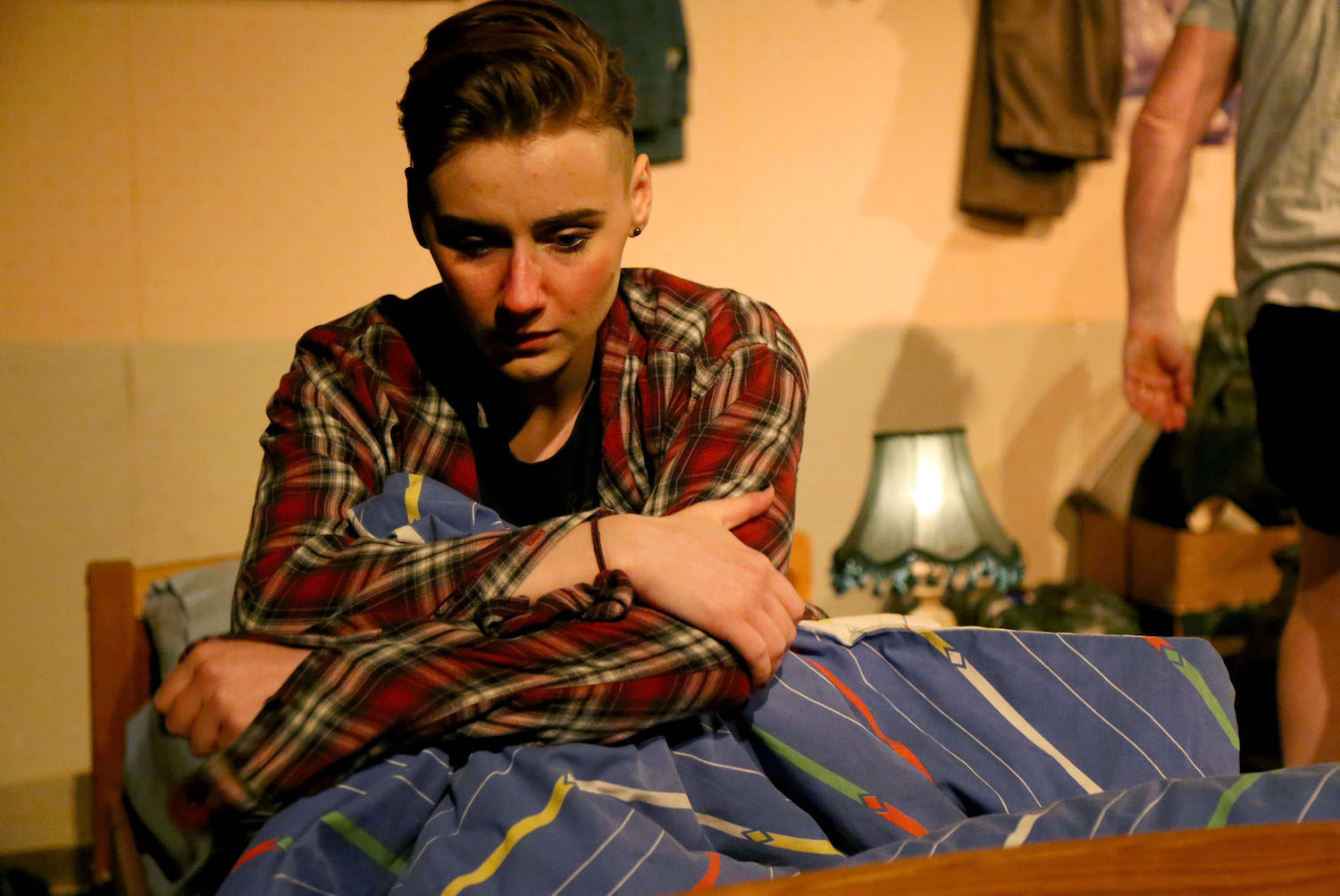
There’s last year’s winner Chip Tolentino (Aaron Jenson), who’s doing fine until he spots a pretty girl in the front row and all the blood rushes from his brain to – well, somewhere else. Logainne Schwartzandgrubenniere (Lottie Johnson) is desperate to make her two dads proud, while Marcy Park (Jeannie May) knows that whatever she achieves it’ll never be enough for her parents. William Barfee – excuse me, Barfée (TJ Lloyd) – has a magic foot that helps him spell (yes, really), and Leaf Coneybear (Danny Whelan) is beginning to realise that he might actually be quite smart after all, despite what his family keep telling him. And finally there’s Olive Ostrovsky (Thea Jo Wolfe), who before the show even started, slipped a piece of paper on to the empty seat beside me and whispered, “It’s for my dad.” The obvious and tragic fact that the seat was guaranteed to remain empty made Olive my immediate and enduring favourite.

Trying to keep some kind of order amidst all this pandemonium are former champion Rona Lisa Peretti (Elizabeth Chadwick), vice principal Douglas Panch (Michael Watson-Gray), and bizarrely, Mitch Mahoney (Inti Conde), who’s doing his community service consoling defeated spellers. As you do.

Photo credit: Alex Harvey-Brown at Savannah Photographic

Because there can be only one winner at the spelling bee. As we get to know more about the contestants and what drives them, it becomes obvious this is much more than just a game to our six young spellers, and the final round is surprisingly tense as we wait to see who’ll crack first under the pressure. But although each elimination is a sad moment, the show ends on an upbeat note with the realisation that winning isn’t necessarily everything. Sure it’s a cliché, but when you’re having this much fun, who cares?

A seemingly casual joke about the show’s brief rehearsal time highlights what a polished production this is in spite of that. A brilliant cast excel both individually and as an ensemble, hitting all the right comic notes but also giving emotional depth to characters who at first glance appear to be no more than stereotypes. Director and choreographer Adam Haigh makes full and effective use of the intimate space, setting the tone of the production with the pre-show activities to ensure the audience – who are cast early on as proud parents watching the bee – always feel involved and connected to what’s going on.

The 25th Annual Putnam County Spelling Bee is brilliantly bonkers, and proves what I knew all along – that spelling really is fun. But the show also champions those who dare to be different, and reminds us that sometimes it really is the taking part that counts. This little gem of a production is a feel-good treat and guaranteed to put a smile on your face; don’t miss it.


Can’t see the map on iPhone? Try turning your phone to landscape and that should sort it. I don’t know why but I’m working on it… 😉

Review: Into The Woods at the Cockpit Theatre

Once upon a time… Stephen Sondheim and James Lapine got together to write a musical based on classic fairy tales, including Cinderella, Rapunzel, Jack and the Beanstalk and Little Red Riding Hood. But there’s a twist to this tale: the happy ending comes halfway through, and on reflection in Act 2 turns out to be not quite so happy after all – mostly because none of the characters is satisfied even after they get their wish. A lot of the show’s appeal lies in that simple fact: after listening to their stories all our lives, it’s oddly comforting to discover our favourite fairy tale characters are just as flawed as the rest of us.

In this revival of his 2014 adaptation, Tim McArthur takes that idea one step further, bringing the characters out of their fairy tales altogether and into a world inspired by 21st century reality TV. TOWIE, Jeremy Kyle and Made in Chelsea are all recognisable influences – although interestingly, the Baker and his Wife seem to hail more from Greggs than from Bake Off.

Photo credit: David Ovenden

It’s a clever concept, and works reasonably well in terms of entertainment value as the various characters are introduced, although it doesn’t really go anywhere after that. The story – and some of the characters – remain very much rooted in a world of myth and magic, where it jars slightly that even these very modern characters can’t just whip out their phones and Google how to get what they want.

For lovers of fairy tales, the musical itself is an enchanting blend of familiar and original. The story centres around a childless Baker (Tim McArthur) and his Wife (Jo Wickham), who have to collect four obscure items to break the curse put on them by the Witch (Michele Moran) so they can have a baby. Into the woods they go, where they stumble into the paths of Jack (Jamie O’Donnell), Cinderella (Abigail Carter-Simpson), Rapunzel (Louise Olley) and Red Riding Hood (Florence Odumosu) – who just happen to have all the things they need. All seems well, until in a considerably darker Act 2, a giant starts terrorising their village and the characters are forced back into the woods to fight for survival.

This production is staged in the round, which both works and at the same time, really doesn’t. On the plus side, it does mean that the audience feels surrounded by the action; you never quite know where an actor is going to pop out of next. On the other, even from my relatively high vantage point, I couldn’t see or hear much of what was happening on the other side of Joana Dias’ impressive but complicated set of many ladders, and consequently felt like I was missing out on half the action. This wasn’t helped by the score, which frequently has actors speaking or singing over each other, and to make matters worse, there were also a few technical problems with the sound system at this particular performance.

Photo credit: David Ovenden

In spite of these issues, the cast are generally very good, with standout vocal performances from Michele Moran and Abigail Carter-Simpson as the Witch and Cinderella respectively. Meanwhile Ashley Daniels and Michael Duke bring the house down with their hilariously posh rendition of Agony (yah), and Jamie O’Donnell and Madeleine MacMahon are good fun as Glaswegian Jack and his chain-smoking, beer-swigging Mother – although their accents are at times so thick, particularly in the musical numbers, that it can become tricky to make out what they’re saying.

Though not without some problems, Into The Woods is nonetheless an ambitious and entertaining show, which puts an interesting new spin on a classic whilst retaining the wit and charm of the original. Worth a visit for fairy tale family fun.

Interview: Helena Jackson, Nine Foot Nine

What would happen if almost every self-identifying woman in the world grew to nine foot tall? Sleepless Theatre Company explore this intriguing concept in Alex Wood’s Nine Foot Nine, which opens at The Bunker Theatre in June as part of the Breaking Out season.

Nine Foot Nine follows a family over 16 years in a dystopic world where suddenly, painfully, self-identifying women start to grow and grow and grow and grow until the gender politics of the world start to break down,” explains director Helena Jackson. “We’re very interested in the concept of atypical bodies, and how bodies can shape and skew society’s view of an individual. We thought Nine Foot Nine would be a hugely interesting concept with which to interrogate the ‘monstrous’ – the atypical – and how it can affect gendered power dynamics. If self-identifying women had the ability to overpower every single cis male they came across without too much effort, how would the power structures of the world change?

“The concept is so broad there is no way that we’re ever going to be able to explore every single angle. We want the audience to walk out entertained, intrigued and for them to sit down for a pint afterwards saying ‘Gosh, yeh, what would happen if men were physically weaker than women?’ This is a show to hopefully make people talk and think way after they’ve left the venue, both in terms of gendered interaction and preconceptions attached to performers that identify as D/deaf, disabled or neurodiverse.”

In line with that commitment, Nine Foot Nine will be fully captioned and will involve performers and creatives who identify as D/deaf, disabled or neurodiverse. “We’ll be working as hard as we possibly can to make sure that the play is accessible to all audiences,” says Helena, “and we’re looking to create a culture where we interact with D/deaf, disabled or neurodiverse audiences and creatives no matter what the themes of the particular play we’re creating.”

Nine Foot Nine is the result of almost two years’ work – or, as Helena puts it, “The show has been in development forever, it seems. At first we had included way too many storylines – six characters instead of three – and it was more of a snapshot of society rather than something with a narrative focus. We completely redrafted around ten months ago, whittled our characters down to form this core family unit, and did a couple of other projects which boosted our confidence in terms of creating a piece of work that thinks about accessibility while not necessarily being about disability, as such.

“We showcased a section of it at the Royal Court in March and were part of the LET Award finalists in March as well, but this is the first time it’s been shown in its entirety. We’ve had tantrums, makeups, sleepless nights – it’s been a rock-and-roll ride but it’s now actually about to become a real physical thing, and we are so excited and terrified for it to actually become a proper play instead of this world existing on the computer screen. Sharing it with an audience will be one of the scariest and most thrilling moments – it’ll be so interesting to hear what people make of it, whether the way we portray the growth works and if it starts the kind of conversations we want it to. The Bunker is such a wonderful space for this kind of show, we have a huge amount of stage space and tech possibilities, so it should be pretty damn thrilling.”

It’s not just the venue that has Sleepless excited; they’re also looking forward to joining the other five theatre companies selected to be part of The Bunker’s Breaking Out season. “Breaking Out is fantastic because it allows us as an emerging company time to create, re-create and re-draft without the sort of financial pressure that is present in so many other spaces. It just means we can have fun with the piece and play around, developing our accessibility measures and audience pool in a way that wouldn’t be possible with a full run. It’s also so lovely to meet other companies that are in the same position we are – it creates a proper community of theatremakers that all critique and inspire each other – and then go to the pub together after. Of course.”

London-based Sleepless began around seven years ago at sixth form college. “We got fed up of the lack of opportunities there were in the performing arts and so decided to start making our own,” says Helena, who’s the company’s artistic director. “Over the years it’s massively developed, but there’s something wonderful about the naive, fearless attitude we had when it started, the sort of jump-first-and-figure-out-how-you’re-going-to-land-later type vibe that only 16-year-olds can really possess. We love that sense of community, of people getting their hands dirty, of sort of stumbling along and mucking up along the way but then knowing you’re going to do it better next time. Our aims are very much to keep accessibility at the core of what we do and to prove that emerging companies can engage in the access debate – and then just to produce exciting, magical, and anarchic theatre.”

Nine Foot Nine certainly sounds like it lives up to that ethos: “It’s going to be a thumping, ferocious, dystopic rollercoaster. If you’re into sci-fi, feminism or visually beautiful work you should definitely check us out – we’re going to have vast amounts of LEDs, some ridiculous soundscapes and will basically be portraying a world in uproar. It’s going to be chaotic, it’s going to be anarchic, it’s going to be banging, so check us out.”

Interview: Amy Bethan Evans, Libby’s Eyes

Created by a visually impaired writer, and starring two visually impaired actors, Libby’s Eyes is a play about disability, the benefits system and sight loss. It’s also one of the shows selected for next month’s Breaking Out season at The Bunker Theatre, alongside five other projects from emerging theatre companies. The play tells the story of Libby, a young visually impaired woman who’s given a government-issued assistance robot to describe her surroundings to her. The only problem is, the robot has opinions of its own – opinions that are very telling of the government’s attitude towards disabled people.

“As a visually impaired writer, I wanted to write the kind of visually impaired character I want to see – if you’ll excuse the pun,” explains writer Amy Bethan Evans. “Blindness is often used as a metaphor with a character who doesn’t see but knows ‘inner truth’, or visual impairment can be used as a slapstick comedy device. Failing that, along with other impairments, it’s seen as something to be ‘overcome’. I wanted to create a character who was visually impaired for no reason. Her impairment is a big part of her life, but her obstacles come from society.

“Also, while her impairment isn’t the butt of any jokes, there is comedy in the play as it is possible to be funny without that. The story has been through several development stages and the one I seemed keenest to tell was my PIP experience. I find it fascinating how governments and other organisations can tell disabled people what they do and don’t need, and that that can change and we’re all just expected to go along with it. I want to fly the flag for stories about being disabled in 2018, as told by disabled people. This is still quite rare and I hope others will be encouraged to do it by this piece.”


The show is narrated by an acting audio describer: “This is a sent-up version of the actor playing the part,” says Amy. “The character is very pretentious and wants to prove their acting ability but at the same time, needs to provide a reliable AD. There have been other shows working with creative audio description in the past, but I wanted to do it in a way that is reflective of the non-disabled gaze while making people laugh.

“I want sighted and visually impaired people to be inspired by the possibilities of audio description, of access for everyone and of the power of disabled protagonists played by disabled actors. I’d like people to feel for the injustices being heaped on the disabled community and even if they’re not spurred into action, appreciate the human stories behind all the numbers. I also want them to feel they’ve enjoyed a good piece of theatre!”

Amy was one of the top 100 entries for the Verity Bargate Award, and was shortlisted for Bristol Old Vic Open Sessions, Pint-Sized and 503 Five at Theatre503. She was also part of the Soho Theatre Writer Group, which is where Libby’s Eyes first came to life. “I’ve had an idea to explore the theme of defectiveness through disabled people and robots for some time, but Soho Writers’ Lab gave me the excuse to write it,” she says. “It was written for the programme, which involved writing three drafts with a dramaturg. The one in production will be the fourth. I had so many ideas in my first draft and didn’t want to leave any out because I could always cut them later, but as time went on I was still none the wiser about what to focus on, because I had so much to say and I’ve not really read anything like this before for a framework. I knew that it was lacking plot even by the third draft and that’s what a lot of the feedback said, so I’ve tried to make this the focus of my fourth draft. It’s difficult because there is no solution to the reality of what I present, so I want to respect the people currently going through it.”

As a writer at the start of her career, Amy’s thrilled to be part of the Bunker’s Breaking Out season. “It’s amazing. I had my first professionally commissioned short at Theatre 503 earlier this year and this is my first professional longer play. The other companies in Breaking Out are really exciting. I only moved to London last year and it’s great to see such talented people all around me and think I could be part of them. I’m also excited by the possibilities of the Bunker as a wheelchair-accessible fringe venue as it can be really difficult for disabled artists to access the fringe scene.”

The play’s being produced by Poke in the Eye Productions, a company founded by visually impaired actor Georgie Morrell, who also appears in the show. “The company aims to platform disabled-led work by up-and-coming artists,” says Amy. “Georgie and I met on a Soho Young Company Social; she was on Comedy Lab and I was on Writers’ Lab. I bumped into her, apologised, explained I was visually impaired and she said, ‘Me too!’ From that, a beautiful friendship was born. I sent her the play and she really liked it and wanted to bring Libby to the stage. I got in touch with my friend Adam, a brilliant visually impaired actor, and we took the first ten minutes to Yolanda Mercy’s Anything Goes scratch at Vaults, with two other actors. The event was a lovely atmosphere of exciting and diverse new work and was lovely to be part of.

“I’m now looking forward to seeing what the creative team do with the play and getting visually impaired people who don’t normally go to the theatre to come. The play is really important to me in subject matter and in what it could contribute to theatre and I think it will be important to other disabled people, artists or not. It has a witty and dynamic creative team behind it and I hope it will entertain and raise awareness. I’m equally excited and scared about watching it myself. I’ll be nervously hanging around the bar listening to what people say about it and gauging in what tone I should say ‘I’m the writer!’”

Review: The Night Alive at the Brockley Jack Studio Theatre

Despite its ominous title, and playwright Conor McPherson’s reputation for producing work populated by ghosts and devils, his 2013 play The Night Alive seems – at least at first – to be firmly rooted in reality. 50-something Tommy (David Cox) rescues Aimee (Bethan Boxall) from a violent attack by her ex-boyfriend, and brings her home to the room he rents from his widowed Uncle Maurice (Dan Armour). With nowhere else to go, Aimee agrees to stay for a few days, but while her presence proves a comfort to the lonely Tommy, it also brings trouble – not least for Doc (Eoin Lynch), Tommy’s friend and business partner (of sorts) – when her ex Kenneth (Howie Ripley) tracks her down.

Photo credit: Robert Piwko

I say it seems rooted in reality because there are definitely a couple of moments that are open to interpretation in First Knight Theatre’s new production, bringing both Acts 1 and 2 to an ambiguous close and leaving it to the audience to decide for ourselves what exactly we’ve just seen. In fact, both script and direction are clever enough that it’s possible to go back over the whole play afterwards, remembering little details and wondering if they meant more than they appeared to on first sight.

One element that is very real, however, is the isolation and desperate need for human connection displayed by the characters, each of whom is damaged in their own way. Tommy’s estranged from his family and getting by doing odd jobs with Doc, who has a mild learning disability and keeps getting kicked out by his sister and her boyfriend. The unconventional but clearly genuine friendship between the two men lies at the very heart of the play, and is movingly portrayed by David Cox and Eoin Lynch, with a generous and welcome sprinkling of humour to lighten the mood.

Bethan Boxall’s Aimee adapts quickly to her new surroundings, and offers a different kind of companionship, allowing Tommy a brief escape from the monotony of his unsatisfying daily life – and it seems he’s willing to pay almost any price to keep hold of that opportunity. Finally, there’s Uncle Maurice, played by director Dan Armour, whose gruff exterior and authoritarian manner can’t quite hide the fact that he’s still mourning and blaming himself for the death of his wife, or that he desperately wants Tommy to stop wasting his life and appreciate what he’s got while he still can.

Into all this quiet drama steps Howie Ripley’s Kenneth, in the first of two brief but memorable appearances, and instantly the play takes on a different energy as he prowls restlessly around Tommy’s room, taking in every detail and rambling about the darkness outside. We know something bad’s going to happen, but when it does it’s still unexpected enough to leave the audience sitting in shocked – and, if I’m honest, slightly perplexed – silence as we head into the interval. Both this moment of drama and the one that follows in Act 2 are well acted and directed, but don’t seem to fit within the rest of the play, particularly as neither event is really discussed again by the characters once the immediate aftermath is over. This is so odd, in fact, that it feels like it must be deliberate – so perhaps this is one of those details that will take on new meaning after a few days’ reflection.

Photo credit: Robert Piwko

Putting it all together, The Night Alive is a poignant, humorous and intriguing portrayal of five unhappy people whose lives are changed in one fateful moment. Whether that change ends up being for better or worse is left as something of an open question, along with much else that happens during the play. If you’re in the mood for a high quality production that doesn’t give you all the answers, The Night Alive is well worth a visit.


Can’t see the map on iPhone? Try turning your phone to landscape and that should sort it. I don’t know why but I’m working on it… 😉